

Pressure Relief Mattress for Side Sleepers: A Buyer’s Guide

At 3 a.m., a side sleeper may wake with a dead arm, a tender shoulder, or a hip that feels bruised. The mattress may look perfectly fine, yet the body keeps shifting to escape pressure. For residents in Ruidoso, Alto, and across Lincoln County, finding a pressure relief mattress for side sleepers starts with understanding why those aches happen, then matching the mattress to the sleeper rather than trusting a generic firmness label.
A suitable bed should cushion the shoulder and hip while keeping the waist and pelvis supported. The right combination depends on body weight, shoulder width, hip depth, preferred materials, sleeping temperature, and whether a partner shares the bed. The guidance below explains those decisions in plain language, with the kind of hands-on support available from a local Sleep Pro rather than a faceless bed-in-a-box website.
Why Side Sleepers Wake Up Sore in the First Place
A side sleeper often notices the problem before fully waking. The lower shoulder feels compressed, fingers tingle, and the upper hip aches after holding the body's weight for hours. Turning over may help briefly, but the discomfort returns because the mattress still pushes against the same bony areas.
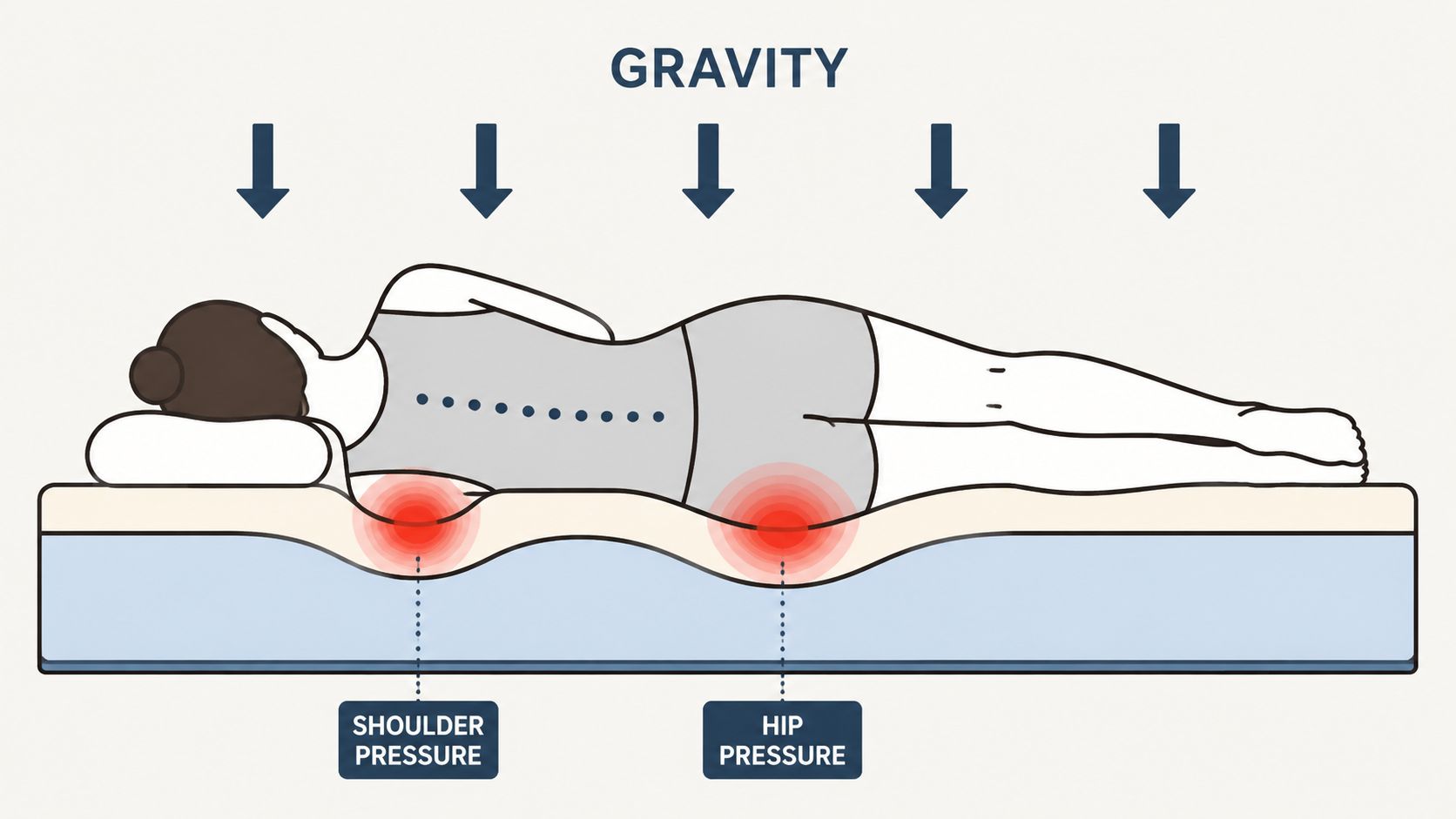
Pressure relief describes how well a mattress spreads the force created where the body meets the bed. In side sleeping, the shoulder and hip carry much of that load. A surface that's too firm can press into those areas, while a surface that's too soft may let the pelvis drop too far and disturb spinal alignment.

The shoulder and hip carry the conversation
Side sleepers need enough surface give for the shoulder to settle into the comfort layers. The hip also needs room to sink, but the mattress must stop the pelvis before it rotates the spine sideways. That balance explains why the softest bed isn't automatically the best bed.
The body's warning signals can include:
- Morning numbness: A shoulder or arm may be receiving too much concentrated pressure.
- Hip soreness: The comfort layer may not be contouring around the pelvis.
- Repeated repositioning: Tossing can be the body's attempt to find a lower-pressure angle.
- Lower-back discomfort: Excessive hip sinkage may leave the waist and lumbar area unsupported.
A detailed guide to pressure point relief for better mattress comfort can help shoppers connect those symptoms with the way a mattress supports the body. Persistent numbness or pain deserves medical attention, but a mattress mismatch can still be an important part of the nightly pattern.
Practical rule: A side sleeper should feel cradled at the shoulder and hip, not trapped, pinched, or folded at the waist.
The Science of Pressure Relief Explained Simply
The mechanics are easier to understand with a simple comparison. Standing on a small pebble concentrates force in one tiny area, so the foot feels sharp pressure. Stepping onto soft sand allows the foot to settle and spreads contact over more surface area, reducing the intensity at any single point.
A mattress works in a similar way:
- The body settles onto the surface. The shoulder and hip extend farther from the waist, so they meet the mattress first.
- The comfort layer gives beneath those areas. Foam or latex can contour around the body instead of pushing straight back.
- Contact area increases. More of the shoulder, hip, and surrounding tissue shares the load.
- The support core limits excessive sinkage. Coils or firmer foam help keep the pelvis from dropping below the rest of the spine.
What interface pressure means
Researchers can measure the force between the body and mattress as interface pressure, commonly expressed in mmHg. The important idea isn't memorizing a target reading. It's recognizing that lower peak pressure at a bony point generally means the mattress is distributing load more effectively.
A 2016 peer-reviewed study measured side-sleeping pressure distribution and found that latex reduced mean peak body contact pressure by 35.1% at the side torso and 28.2% at the side buttocks compared with polyurethane foam. The same study reported 96.1% low-pressure regions for latex versus 91.8% for polyurethane foam, demonstrating that load distribution can be measured rather than described only with comfort language. Read the peer-reviewed pressure-distribution findings.
Sink is useful, but only within limits
A pressure-relieving mattress needs enough contouring to reduce concentrated force. It also needs enough underlying resistance to preserve a neutral line from the neck through the pelvis. A helpful explanation of how memory foam contours around the body can clarify why the top layer and support core must work together.
A 2014 clinical study found that sleep efficiency was higher when subjects experienced an appropriately distributed pressure profile. The findings also indicated that pressure that was either too concentrated or too evenly distributed wasn't beneficial, reinforcing the importance of balanced support for lateral sleepers. Review the clinical discussion of mattress pressure and sleep quality.
Materials That Actually Cushion Your Shoulders and Hips
Mattress materials create different kinds of pressure relief. Memory foam usually offers the closest body contour and strong motion isolation, which can suit a sleeper who feels every movement from a partner. Its slower response can also make rolling over feel more deliberate, and some sleepers may find a dense foam surface warmer.
Latex provides cushioning with a more buoyant, responsive feel. It tends to make movement easier and can feel more temperature-neutral than dense foam, though it may not create the same deep shoulder cradle for every petite or sharply contoured body.
Pocketed-coil hybrids combine individually responsive coils with foam or latex comfort layers. The coils can improve airflow, reinforce the perimeter, and add lift beneath the lumbar area, while the upper layers cushion the shoulder and hip. Traditional innersprings generally feel more springy and breathable, but a thin comfort layer may leave side-sleeper pressure points feeling exposed.
| Mattress Materials Compared for Side Sleeper Pressure Relief | Pressure Relief | Cooling | Motion Isolation | Edge Support | Best For |
|---|---|---|---|---|---|
| Memory foam | Deep contouring and close pressure distribution | Can feel warmer | Strong | Moderate | Sleepers wanting a close cradle and minimal partner movement |
| Latex | Buoyant cushioning with responsive pressure relief | Often more temperature-neutral | Moderate | Moderate to strong | Sleepers wanting easier movement and a lifted feel |
| Pocketed-coil hybrid | Foam comfort plus coil-supported contouring | Good airflow potential | Moderate to strong | Stronger when reinforced | Couples, heavier side sleepers, and warm sleepers |
| Traditional innerspring | Limited unless paired with substantial comfort padding | Generally breathable | Lower | Often strong | Sleepers who prefer bounce and a firmer surface |
Material choice matters in pressure mapping. Comparative research summarized in a peer-reviewed source reports that memory foam provided more uniform pressure distribution than latex in testing, while another review found memory foam had lower average interface pressure and higher comfort scores than latex multi-hard polyurethane mattresses. Explore the comparative pressure-relief research.
For a closer look at the differences between latex and memory foam mattresses, shoppers can focus on feel rather than labels. Memory foam often suits a sleeper who wants deep contouring, latex can suit someone who dislikes sinking, and a hybrid may provide the most balanced starting point for a couple.
Matching Firmness and Zoning to Your Body Type
If your shoulder aches on a softer bed but your hip feels pinched on a firmer one, the problem may be a mismatch between the mattress and your body shape. Firmness is a starting point, not a universal prescription. Many side sleepers do well with medium-soft to medium, commonly 4–6 on a 10-point scale, because that range can cushion the shoulder and hip while keeping the spine supported. Review the commonly recommended firmness range for side sleepers.
Your weight changes how far you compress the same comfort layer. Shoulder width and hip prominence change the result as well. A broad shoulder may need more surface give, while a shallow hip may need less sink so the pelvis does not drift downward.
| Firmness and Zoning Recommendations by Body Type | Recommended Firmness | Shoulder Sink Depth | Zoning Need |
|---|---|---|---|
| Under 130 lb | Softer, around 3–4 on a 10-point scale | About 1–2 inches, with enough give for the shoulder | Helpful when the waist needs added support |
| 130–230 lb | Medium, around 5–6 on a 10-point scale | About 1–2 inches, adjusted for shoulder width | Useful for balancing cradle and lumbar support |
| Over 230 lb | Medium-firm, around 6–7, with softer comfort foam above | Controlled sink, generally within about 1–2 inches | Strongly useful for limiting pelvic sinkage |
These ranges guide a showroom test rather than guarantee a result. Pressure-relief research notes that lighter sleepers often need a softer surface, while average-weight side sleepers commonly need medium or medium-firm support with enough contouring. See the research methodology discussion of pressure relief and body-weight differences.
Zoning protects the waist
A zoned mattress places softer sections beneath areas such as the shoulder and hip, then uses firmer foam or coils beneath the lumbar and midsection. Your joints can settle into the surface while the pelvis receives resistance instead of dropping too far.
Aim for roughly 1–2 inches of sink at the shoulder and hip during an in-person test. Too little cushioning can concentrate force, while too much allows the spine to curve out of line. Review practical guidance on sink depth and side-sleeper alignment. Use this mattress firmness guide to prepare, then test whether the bed supports your weight, shoulder width, and preferred sleep climate in person.
Telltale Signs Your Current Mattress Is Failing You
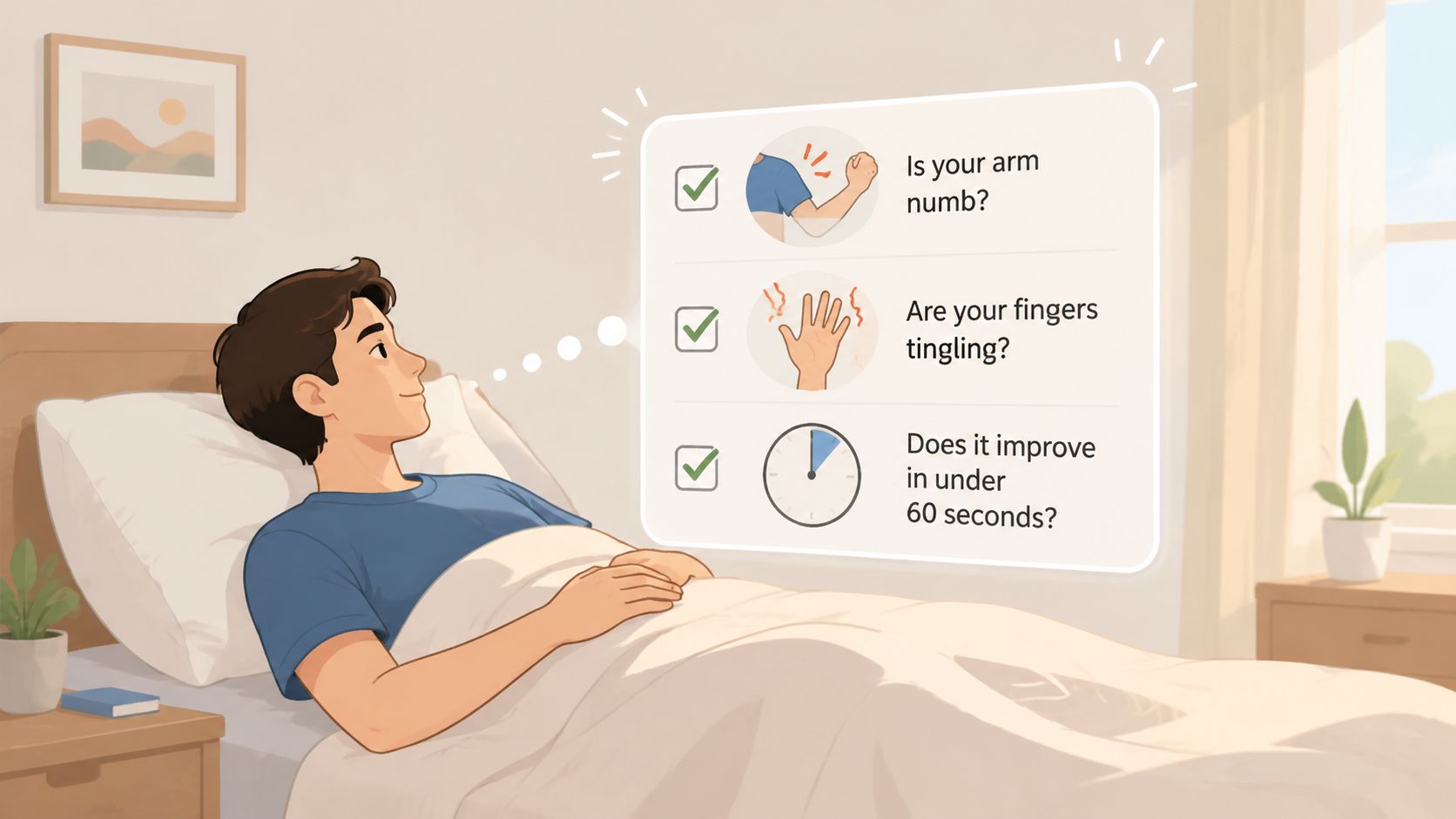
A quick morning check can reveal whether the current bed is helping or fighting the body. The answer doesn't need to be dramatic. Repeated, specific symptoms are more useful than a mattress that feels old.
Five quick yes-or-no checks
- Does an arm feel numb or tingly? Yes may indicate that the shoulder is absorbing too much pressure. A controlled pressure-mapping study found that 90-degree side lying produced the highest interface pressures, while a 30-degree laterally inclined posture reduced pressure. The same study found a viscoelastic mattress lowered interface pressures by 20–30% compared with standard hospital foam. Review the pressure-mapping study.
- Do shoulder or hip impressions remain visible? If an impression doesn't rebound within about a minute, the comfort material may have lost resilience. That can leave the body resting against a less forgiving surface.
- Do pillows keep migrating? A pillow between the knees can be useful, but constantly stacking pillows under the waist or around the hips may signal that the mattress isn't filling the body's natural gaps.
- Does lower-back soreness fade after getting up? If the ache eases within the morning, the pelvis may have spent the night in an unsupported position.
- Do sheet lines feel like ridges? Strong ridges along the hip can suggest that the comfort layer has compressed or bottomed out beneath that pressure point.
Persistent tingling, numbness, or pain should be discussed with a qualified healthcare professional. A mattress can affect comfort and alignment, but it shouldn't be treated as a substitute for medical care.
The Pressure Relief, Cooling, and Edge Support Tradeoff
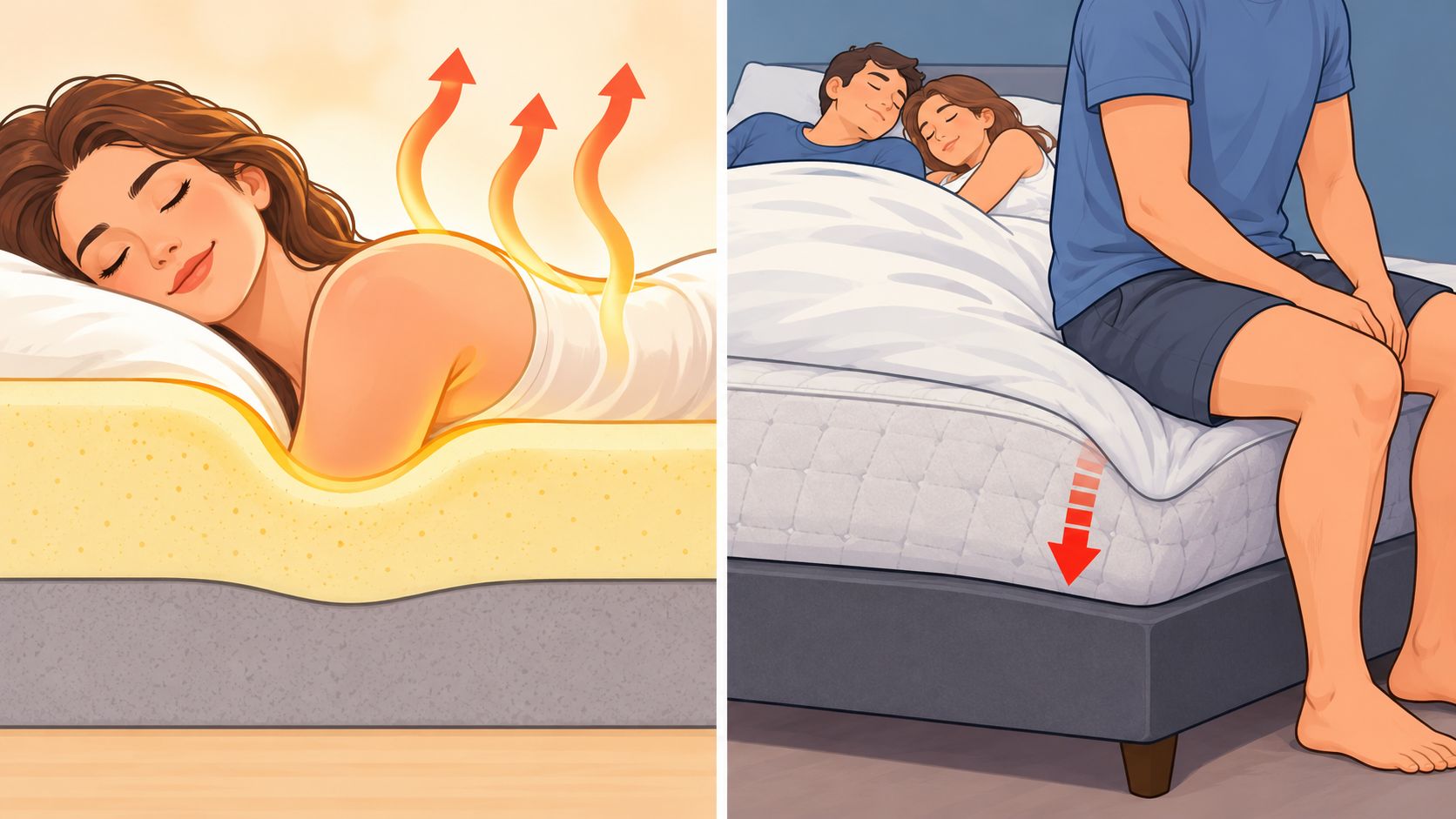
The deepest contouring doesn't always deliver the coolest or most stable sleep surface. Dense memory foam can create a generous shoulder cradle and dampen partner movement, but some sleepers may notice more heat and less perimeter pushback. That matters when a couple shares a smaller bedroom or when a heavier side sleeper sits at the edge to put on shoes.
Latex often feels cooler and more responsive because the sleeper rests more on top of the material. That buoyancy can be welcome for easy movement, although a petite side sleeper with pronounced shoulder or hip pressure may prefer more surface contouring. Innersprings breathe well and can provide sturdy edges, yet their pressure relief depends heavily on the thickness and quality of the comfort layer above the coils.
Why hybrids often balance competing needs
A well-designed hybrid can separate the jobs:
- Zoned pocketed coils lift the lumbar area and help control hip sinkage.
- Open-cell or gel-infused foam cushions the shoulder and hip while supporting airflow.
- Reinforced edges provide a steadier perimeter for sitting and sleeping.
- Independent coil movement can limit the spread of motion across the bed.
This doesn't mean every hybrid will suit every side sleeper. The comfort layer still determines whether the shoulder feels protected, and the coil configuration affects how stable the bed feels. The useful question is whether the mattress solves the sleeper's specific compromise.
Ruidoso's dry mountain air can feel cool at night, but a bedroom can still become uncomfortable when a mattress holds body heat. Sleepers who run warm, share a bed, or need dependable edge support may want to compare foam and hybrid constructions in person. A guide to cooling approaches for memory foam mattresses can help clarify which features deserve attention.
Your Side Sleeper Buying Checklist for the Showroom
Online specifications can't reveal how a mattress feels beneath a particular shoulder or hip. A structured showroom test gives the body time to respond before a purchase decision is made.
Test the surface in the position that matters
Wear comfortable clothing and lie on the side used most often at home. Stay long enough for the shoulder and hip to settle instead of judging the mattress after a quick sit.
Check these points:
- Shoulder comfort: There should be no sharp pinch at the shoulder tip or pressure that makes the arm feel trapped.
- Waist contact: The mattress should support the waist without forcing the spine sideways.
- Hip control: The pelvis should sink enough for comfort but shouldn't feel as though it's dropping through the bed.
- Movement: Rolling to another position should feel manageable, not like the hips are stuck in a deep pocket.
- Edge stability: Sit on the side and notice whether the perimeter compresses excessively.
Ask questions about construction
A shopper should ask to see the comfort-layer materials, learn whether a hybrid uses zoning, and check whether the cover is designed to support cooling. The answers can help distinguish a pressure-relieving build from a mattress that only feels soft for a few minutes.
The local buying process also matters. Mattress Pro by Miller Waldrop provides a Low Price Promise, a Comfort Promise designed to reduce the fear of choosing the wrong bed, and Full-Service Delivery with Professional Setup. Those policies give the showroom test a practical follow-through that a box left at the door can't provide.
Before signing, review:
- Exchange terms: Understand how the Comfort Promise works before delivery.
- Warranty coverage: Ask which material changes qualify for service.
- Delivery timing: Confirm when professional setup is available.
- Old-mattress handling: Verify whether removal is included in the delivery arrangement.
Finding the Right Fit Here in Ruidoso
A side sleeper's best match is easier to identify when the mattress can be tested directly. At a Ruidoso showroom, the shopper can compare a close memory-foam cradle, a buoyant latex feel, and a supportive hybrid without guessing from product descriptions.
Mattress Pro by Miller Waldrop is a family-owned Lincoln County mattress business with a 70-year Miller Waldrop legacy. Its Sleep Pros use a one-on-one consultation to narrow the choices according to body type, sleeping position, budget, and the pressure points that cause trouble. That local conversation can be especially useful for couples who need different comfort preferences on the same surface.
Bring useful information to the appointment
A shopper can make the visit more productive by bringing:
- Body-weight range: This helps establish a realistic firmness starting point.
- Shoulder and hip profile: Broad shoulders or prominent hips may need more contouring.
- Current symptoms: Notes about numbness, hip pressure, or morning back discomfort can guide testing.
- Temperature preference: Warm sleepers may want to compare foam and coil airflow.
- Partner needs: Motion isolation, edge support, and shared comfort should all be considered.
The Comfort Promise helps reduce the fear of picking the wrong mattress online because the decision isn't based only on a brief showroom impression. The Low Price Promise addresses local price comparison, while Full-Service Delivery with Professional Setup brings the new mattress into the room and handles the practical work. Residents near Sudderth Drive, Alto, and throughout Lincoln County can stop by, test the shortlist, and choose based on how their own shoulder, hip, and spine respond.
Mattress Pro by Miller Waldrop offers Sleep Pros, pressure-relieving mattresses from Tempur-Pedic, Sealy, Stearns & Foster, and Sherwood, plus the Comfort Promise and professional setup for a more confident purchase. Visit Mattress Pro by Miller Waldrop at 2801 Sudderth Drive, Suite F, in Ruidoso, and test a mattress that supports side sleeping before bringing it home.