


How to Stop Waking Up with Back Pain: 2026 Guide

You swing your legs out of bed, grip the edge of the mattress, and wait for your lower back to release. Coffee has to wait. So does dressing, driving down Sudderth Drive, or anything that asks you to bend. Learning how to stop waking up with back pain starts with treating that pattern as useful information, not as proof that a new bed will fix everything overnight.
Match Your Morning Pain to Its Likely Cause
You aren't unusual, and the pain isn't automatically a sign that you're getting older. The World Health Organization fact sheet on low back pain estimated that 619 million people worldwide experienced low back pain in 2020. A problem at that scale deserves a calm check, not guesswork or a rushed purchase.
Severity alone only tells part of the story. The timing, location, and response to movement point more clearly toward the first step. Stiffness that fades behaves differently from pain that follows you all day, and both differ from symptoms involving a leg.
Read the pattern before changing equipment
| Morning pain pattern | Likely cause | First step |
|---|---|---|
| Stiff for under 30 minutes, eases after moving | Joint stiffness or long overnight stillness | Use the morning routine and track for 14 days |
| Worst on sitting up, fades by midday | Strain from sleep posture or pillow height | Run the position and pillow test |
| Lower back sinks, hips or shoulders ache | Mattress too soft, or too firm to contour | Start a medium-firm trial |
| Pain with leg tingling, numbness or weakness | Possible nerve involvement | See a clinician before changing bedding |
| Night pain, fever, weight loss or pain that never eases | Possible serious cause | Seek urgent medical evaluation |
A sagging surface can hold your pelvis lower than your shoulders for hours. A surface with too little give can push back at the shoulders and hips, encouraging you to twist into a position that feels easier but loads the lower back. The guide on whether a bad mattress can cause back pain helps separate those surface clues from posture clues.
Pattern first: note when pain peaks, how long loosening takes, and whether the same spot hurts each morning.
Most readers in the first three rows can test position, pillows, and support for two weeks before buying anything. Readers in the last two rows shouldn't wait for a bedding experiment to work. That distinction keeps a practical home test from delaying care that matters.
Morning Routine to Loosen Up Before You Stand
Before your feet hit the floor, give your back a moment to adjust. Moving in a controlled way can make the first few minutes less abrupt and give you a steadier start to the day.

Get up in five controlled steps
- Pause and breathe: Take a moment while lying down before you move. This gives you time to wake fully and avoid a rushed twist.
- Roll onto your side: Move your shoulders and hips together rather than rotating through your lower back.
- Lower your legs and push up: Bring both legs over the edge of the bed as your arms lift your trunk.
- Sit for 30 seconds: Put your feet flat and let stiffness or dizziness settle before standing.
- Walk before loading your back: Stand slowly and walk gently for several minutes. Wait until movement feels easier before bending, lifting, or sitting for a prolonged period.
Add movement during the day
Once you are standing comfortably, try a gentle knee-to-chest stretch or slow pelvic tilts to bring back small, controlled movement. Stop if either causes leg symptoms or sharply increases your pain.
The American College of Physicians guideline on low back pain recommends non-drug approaches, including exercise, tai chi, yoga, and cognitive behavioral therapy, as initial treatment for chronic low back pain. Regular movement can complement changes to your sleep setup, though improvement may be modest.
Track three things each day for at least 14 days: your pain on waking from 0 to 10, how many minutes it takes to loosen up, and how much activity feels comfortable. Use the pattern, not one unusually good or bad morning, to judge whether your routine is helping.
Test Your Sleep Position and Pillow Setup
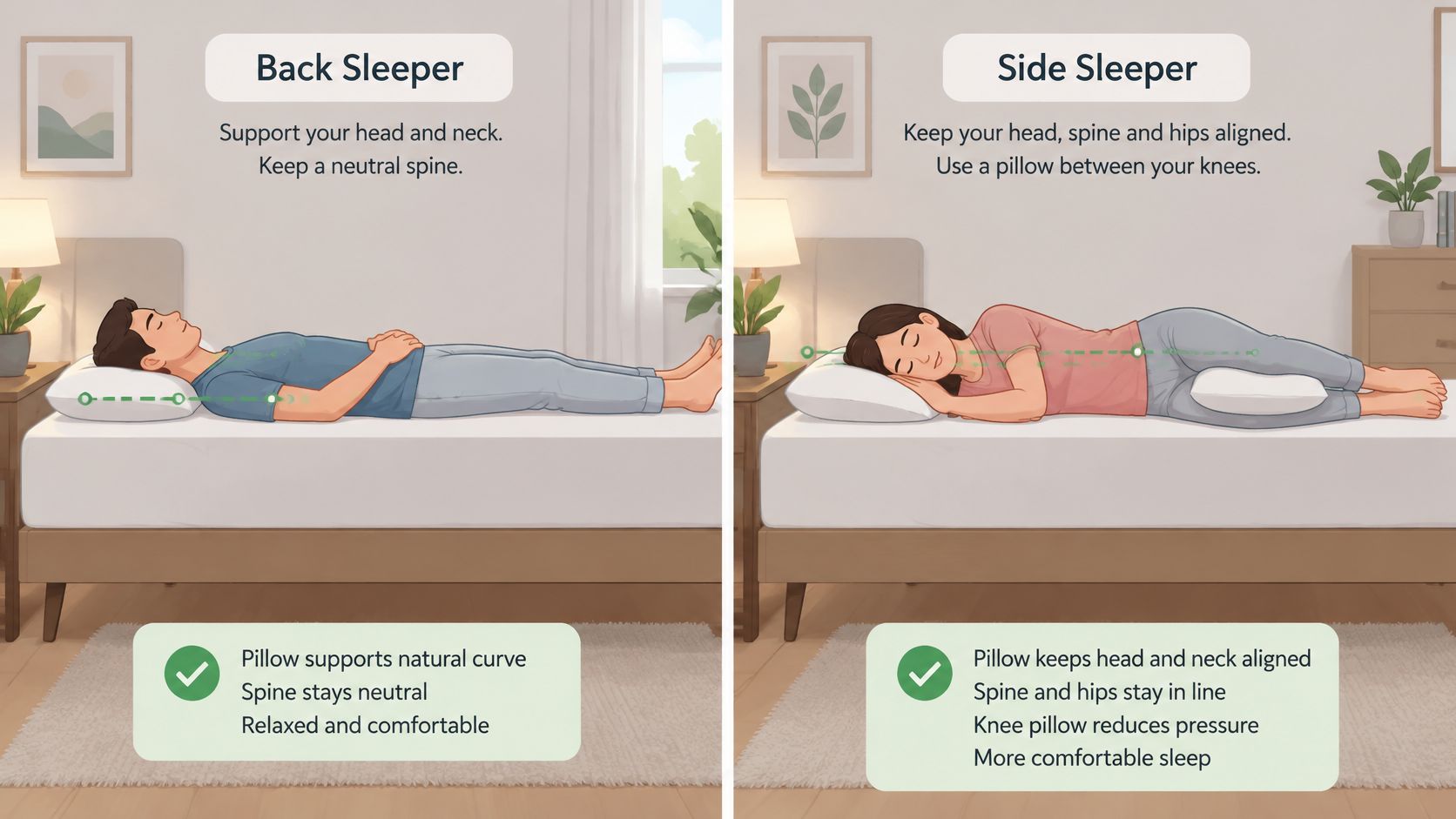
Your position decides how your spine carries load for hours at a time. A 2025 systematic review of six studies on sleep posture and low back pain reported that sleeping on the back was associated with better spinal alignment and lower low-back-pain prevalence, while stomach sleeping was associated with greater lumbar strain and increased risk. Side sleeping was most common, and supportive alignment was associated with less pain.
That doesn't make one position mandatory for everybody. Lying flat may feel poor if you have spinal narrowing, while bent knees or a slight incline may feel easier. Your repeated morning score is the deciding measure.
| Sleep position | Pillow setup | Watch for |
|---|---|---|
| Side sleeping | Pillow between the knees; pillow height fills the gap from ear to shoulder | Hips rotating forward or a sagging waist |
| Back sleeping | Modest pillow under the knees; thin pillow for the neck | Neck angled up or lower back arching |
| Stomach sleeping (if you cannot change it) | Thin pillow under the hips | Lower back extended and neck turned for long periods |
Change one variable at a time
Keep the same mattress while you test a position or pillow change. Score morning pain from 0 to 10 for 14 days, and keep wake time, exercise, and pillow arrangement reasonably consistent. Changing everything in week one leaves no way to know which adjustment helped.
For side sleeping, the knee pillow should fill the space without forcing your legs wide apart. Your head pillow should keep your neck level rather than tilted toward the mattress or propped upward. The guide on how to align your spine while sleeping gives a useful visual check for the ear, shoulder, and hip line.
If a position looks neat but your pain score rises for several mornings, it isn't the right position for you.
Forced posture isn't the goal. A supported position you can maintain and sleep through is more useful than a theoretically perfect position that keeps waking you.
Choose a Medium-Firm Mattress You Can Test Safely
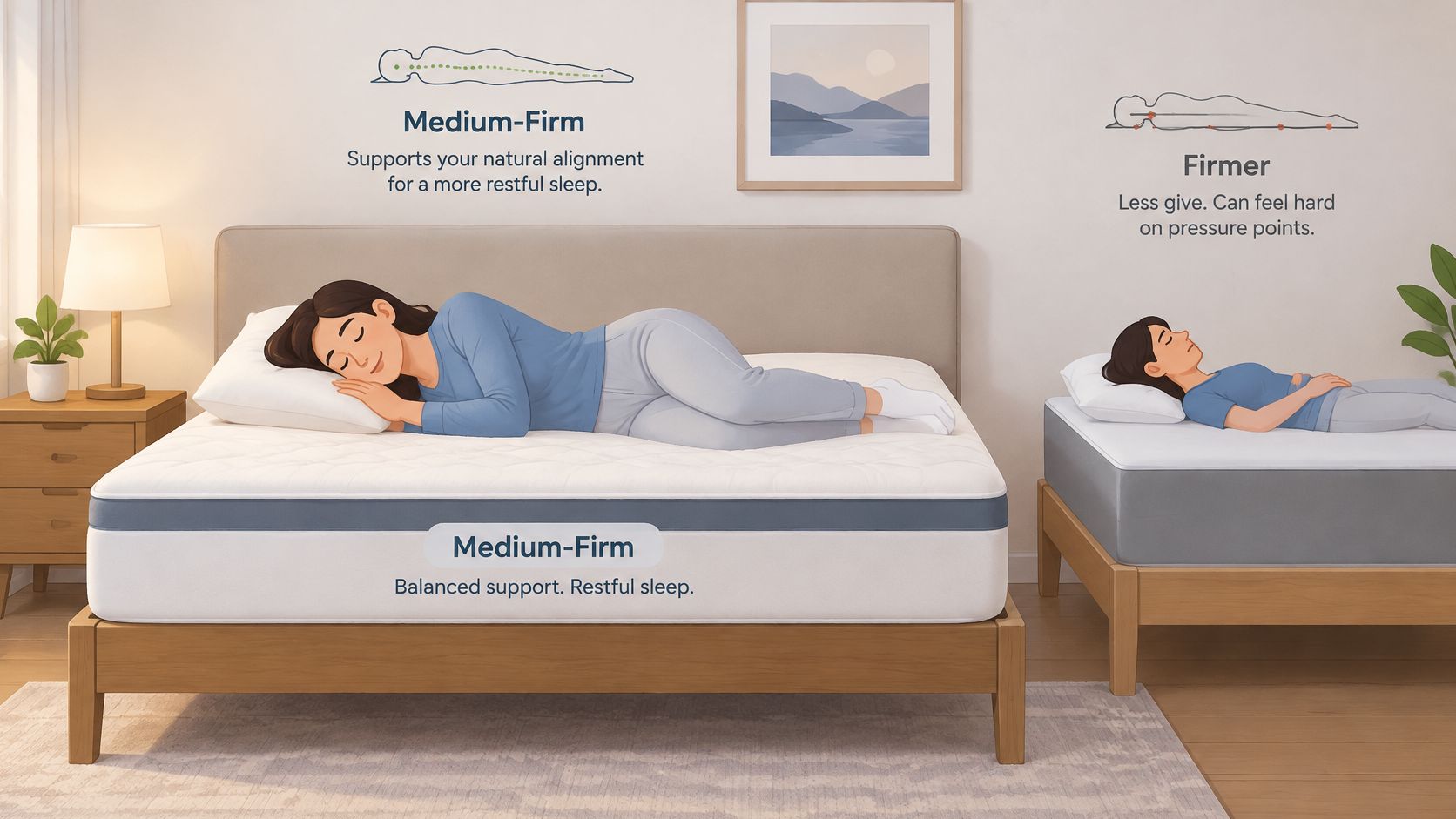
Medium-firm mattresses performed better than firm mattresses for chronic nonspecific low-back pain in a randomized trial of 313 adults. The 90-day trial published in The Lancet found odds of better pain-in-bed outcomes were 2.36 times higher, better pain-on-rising outcomes 1.93 times higher, and better disability outcomes 2.10 times higher with a medium-firm mattress.
A 2021 systematic review of 39 qualifying studies also concluded that medium-firm mattresses generally support comfort, sleep quality, and spinal alignment better than very firm or very soft surfaces. Use medium-firm as a starting point, not a prescription: body mass, shape, sleep position, and mattress construction all affect how a bed feels.
| Firmness level | Typical feel | Evidence for back pain | Best fit |
|---|---|---|---|
| Soft | Sinks deeply at hips and shoulders | Deep sinking can strain the lower back | Sleepers who need more contour, after testing |
| Medium-firm | Balanced contour with even support | Better pain and disability outcomes than firm in the 313-person trial | A practical starting point for side, back, and combination sleepers |
| Firm | Little give, with more pressure at shoulders and hips | Less improvement than medium-firm in the trial | Sleepers who find this level comfortable and supportive |
| Extra-firm | Almost no contour | Not supported as a default for back pain | Use only if a clinician recommends it |
Tell a poor match from settling in
One unusual night is not enough to judge a mattress. Look for a pattern across several mornings: hips sinking, pressure at the shoulder, or the same lower-back area aching after sleep. Record seven days on your current bed, then compare repeated nights on a medium-firm option. Check whether your spine stays relatively neutral and whether your morning pain score improves.
Use this guide to choose a mattress firmness by comparing support and pressure relief rather than relying on the firmness label alone. Ask about breathability, too, especially if you sleep warm. Before buying, confirm the trial or exchange terms so you have time to assess the mattress at home.
Sleep Habits That Support a Pain-Free Morning
Daily habits can affect how comfortable you feel at bedtime and how clearly you can judge a mattress change. Focus on routines that support sleep and reduce stiffness:
- Keep a regular wake time: Use roughly the same time on weekends so your morning notes are easier to compare.
- Limit late alcohol: Alcohol can fragment sleep, making it harder to settle into and maintain a comfortable position.
- Break up sitting: Stand and walk during the day to avoid carrying hours of stiffness into bed.
- Keep bedding breathable: A cool, dry sleep surface can be more comfortable during Ruidoso's cool nights and dry mountain air.
- Wind down away from work: Use a short routine to mark the end of the day and keep the bed for sleep.
- Replace flattened pillows: A worn pillow can change your neck angle and affect spinal alignment.
The sleep hygiene guide for adults covers these routines in more detail. Choose one habit to work on at a time, such as taking walking breaks after long periods of sitting or setting a regular wake time. Keep the rest of your routine manageable; a bedtime that shifts by a few minutes is less likely to confuse your morning notes than frequent changes in sleep location or pillow height.
When Morning Back Pain Needs a Doctor
See a doctor promptly if pain spreads below the knee, causes weakness or numbness, follows a fall or significant injury, or comes with fever, unexplained weight loss, night pain that doesn't ease, or bladder or bowel changes. Those symptoms need medical evaluation rather than mattress experimentation. A different pillow can't rule out nerve involvement or another serious cause.
Red flags that end the home trial
- Leg symptoms: pain below the knee, tingling, numbness, or weakness
- Trauma: pain after a fall, collision, or lifting injury
- Whole-body signs: fever or unexplained weight loss
- Unrelenting night pain: pain that doesn't ease with position changes
- Bladder or bowel changes: new loss of control or difficulty passing urine
- Steady worsening: pain that persists or progresses despite a consistent home trial
Bring the facts that make the visit productive. Take your 14-day log, note the positions and mattress setup you tested, and list medicines you use. Mention whether pain improves with walking, sitting, bending, or lying down.
A clinician may combine an examination with exercise, physical therapy, or other non-drug care. That plan can sit alongside sensible sleep changes rather than replacing them. Stiffness that eases with gentle movement is common and often improves, but red flags deserve quick action.
Don't let embarrassment about a simple log stop you from bringing it. Dates, scores, and loosening times give a clinician a clearer picture than a general statement that mornings feel rough.
Start Your Two-Week Sleep Trial This Week
Set a clear order for your trial so you can tell which change helps. Keep your current mattress for the first week, then adjust one position or pillow variable for the second.
- Days 1 to 7: Keep your current sleep setup.
- Days 8 to 14: Test one position or pillow change.
- After day 14: If mornings remain painful and your hips or shoulders feel pressured or sink too far, try a medium-firm surface.
- Review your results: Keep the change that helped, test a different single adjustment, or arrange medical advice if pain persists.
Sleep Pros can help narrow medium-firm options from Tempur-Pedic, Sealy, Stearns & Foster, and Sherwood based on your body type, sleep position, and pressure sensitivity. Read the guide to in-store mattress testing before visiting. Mattress Pro by Miller Waldrop offers a Comfort Promise, a Low Price Promise, and full-service delivery with professional setup.
Bring your two-week log to the showroom at 2801 Sudderth Drive, Suite F, in Ruidoso. The Sleep Pros can help you compare firmness options against your morning scores and sleep setup. The showroom is open Monday through Saturday.