

Charcoal Mattress Guide: Benefits, Limits and Buying Tips

Does the charcoal inside a mattress do anything, or does the word on the label just make the foam sound cleaner?
Most shoppers compare charcoal beds against each other, reading one claim sheet beside another, and never ask the question that settles it. What exactly was tested, and was the finished mattress part of that test? That gap is where the confusion lives. Activated charcoal is a real material with real laboratory behavior. A finished bed is a different object, built from foam, adhesive, ticking and coil units that all change how the carbon behaves.
The useful split is simple. Understand what carbon does at the fiber level, understand what a bed is tested for, and then ask for the second before you trust the first.
What a Charcoal Mattress Is and How It Traps Odor
A charcoal mattress is a bed with activated carbon worked into part of its construction. The carbon usually sits in one of four places: blended into the comfort foam, bonded into the cover fabric, spun into a yarn that contains carbon fiber, or laid as a separate thin layer under the sleep surface. Where it sits determines almost everything about what it can and cannot do. Carbon woven into a cover rests close to the sleeper and the room's air. Carbon blended deep into foam rests under quilting, where far less air ever reaches it.
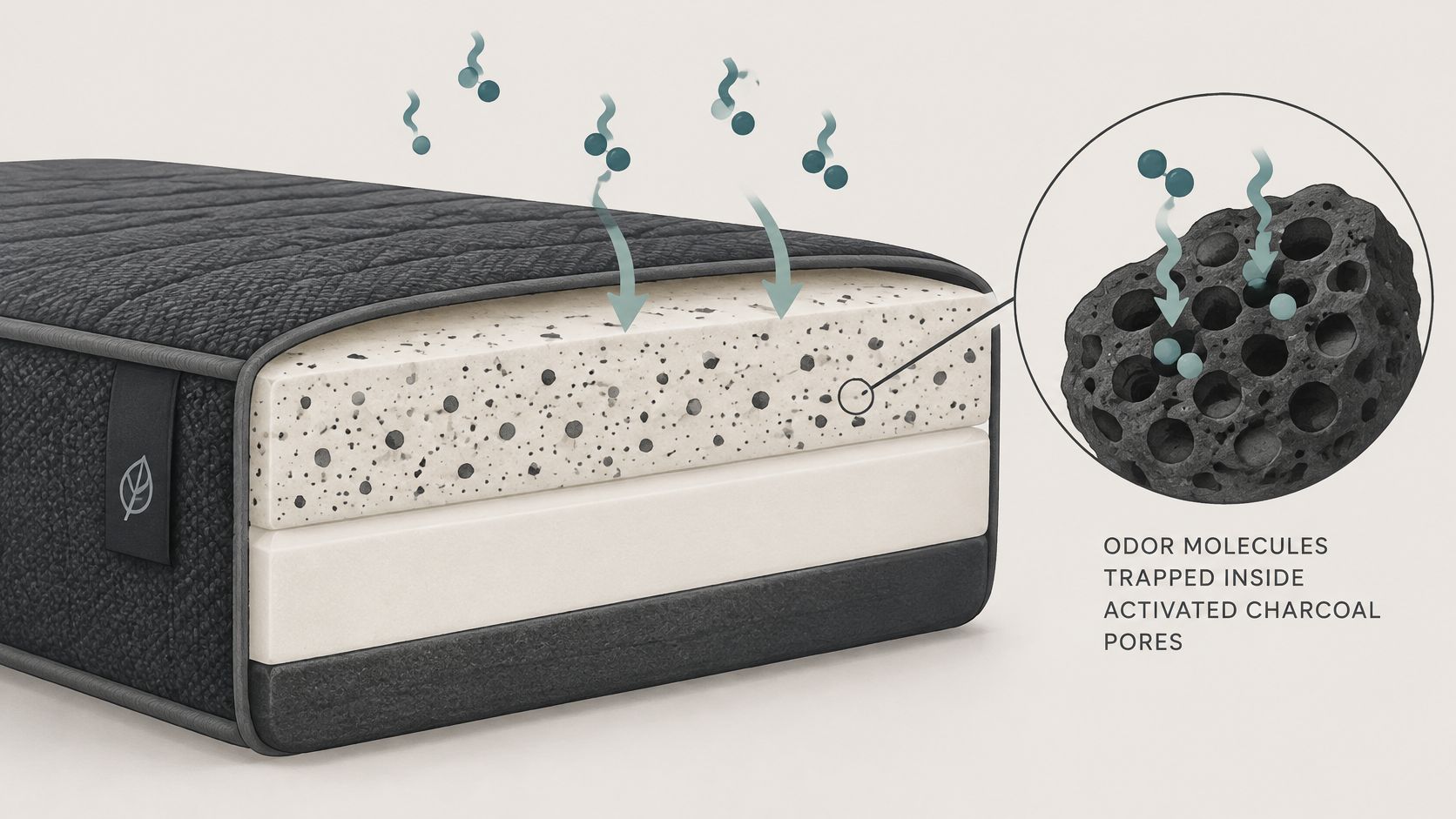
Activated carbon differs from the charcoal in a grill bag. Manufacturers heat and treat carbon-rich material until it develops a network of internal pores, and that pore structure is the whole point. The material works like a sponge built from millions of microscopic pockets. Odor molecules drift into the pockets, touch the pore walls, and stick there instead of floating around the room.
The scale is what makes it interesting. In fixed-bed experiments published in Water, Air, & Soil Pollution, commercial activated carbon reached a specific surface area approaching 1,099.74 m²/g and adsorbed VOCs at 289.8 to 474.3 mg/g across five tested compounds. One gram of carbon carries more than 1,000 square meters of internal surface, so even a thin charcoal layer holds plenty of wall space for odor to land on. Those experiments also showed capacity shifting with the compound, concentration, airflow, humidity, bed depth and contact time, which means the numbers move with the room around the bed. In a dry mountain climate like Ruidoso's, where indoor humidity stays low for much of the year, that humidity variable carries real weight.
The layer build looks like this in cross section, with the carbon working as an adsorptive middle ground rather than an air purifier.
Read the claim sheet on a typical listing and the same six promises show up, each attached to a different part of the bed.
- Odor control: the headline promise, tied directly to the carbon's adsorption.
- Moisture wicking: usually a property claimed for the cover fabric.
- Temperature regulation: a whole-build claim, since surface temperature depends on foam chemistry, layer design and coil airflow.
- Antibacterial protection: a promise that would have to live in the fabric.
- Dust-mite resistance: traced to work on carbon fibers, which is a different object from a finished mattress.
- Detox: the broadest word on the sheet and the hardest to pin to anything.
Every line belongs to a different layer, so every line needs its own test. One promise passing says nothing about the next.
Does Charcoal Keep Working Forever?
No. Adsorption is finite. Once the pores approach saturation, capture efficiency falls, and a passive layer buried under quilting and foam gets limited airflow to begin with. That is why carbon works best as a supporting feature instead of the headline of a bed.
Practical rule: if a listing cannot tell you the carbon type and how much is in the build, treat the charcoal as decoration and judge the mattress on its foam, springs and cover.
Two points worth keeping straight. A charcoal layer is not a replacement for ventilation or a certified air-cleaning device, and it is not sized to clean a whole bedroom. A new bed's first smells usually come from foam and adhesive rather than anything the carbon created, which is why what causes new mattress smell matters more than carbon content during the first week.
Which Charcoal Benefits Hold Up Under Testing
Two kinds of evidence get tangled together in charcoal mattress marketing: what activated carbon does to a fiber in a laboratory, and what a finished mattress has been tested for. The first has real findings behind it. The second is largely unmeasured, and that gap is where most overpromising happens.
| Level of testing | What researchers found | What it can tell a shopper |
|---|---|---|
| Activated carbon fibers | House dust mites attached to the fibers, shrank and died in test dishes | Charcoal fiber can be hostile to mites, though no mattress build was part of the work |
| Charcoal-engineered fabric | A charcoal-polyester knit beat standard polyester on antibacterial rate | Engineered fabric can outperform plain fabric in a lab, while the cover on a specific model still needs its own result |
| Bamboo-charcoal textiles | Moisture-regulating and deodorizing applications described at the textile level | Sweat handling across months of real sleep is unestablished |
| A finished mattress | No published trials on sleep quality, health or bedroom air | Comfort, cooling and odor performance rest on construction, certifications and ventilation |
Start with dust mites, the claim with the most interesting evidence behind it. Researchers in a 2012 pilot study exposed house dust mites to activated charcoal fibers, and the mites attached and began shrinking almost immediately. In some experimental dishes no live mites remained after 40 minutes, and all were dead after 190 minutes, the pilot study archived by the National Institutes of Health reports.
That result is striking, and it arrives with limits. The team used one charcoal-fiber concentration and never built a mattress. They flagged open questions about performance inside bulkier products, the effect of sleep-generated moisture on long-term adsorption, and whether saturated fibers can regenerate. The study's practical value for a shopper is the sharper set of questions it raises about the finished bed.
Fabric testing lands one step closer to a real product. A 2018 fabric engineering study examined weft-knitted polyester mattress fabric made with activated carbon from coffee residue and reported a 93.1% antibacterial rate, against 59.2% for standard textured polyester and 63.1% for spun polyester. The gap is meaningful for an engineered textile, though it still describes a laboratory formulation rather than the cover on a specific floor model.
Here's where shoppers get tripped up: a strong result for charcoal fabric says nothing about charcoal-infused foam, and a foam claim cannot borrow a fabric's test report. Charcoal in the cover and charcoal in the foam are different materials in different positions, and each needs its own evidence. Bamboo-charcoal textile work describes moisture-regulating applications, yet mattress-level proof of sweat handling over months of use doesn't exist. Detox and whole-room purification have no finished-product support behind them.
Ask three questions of any claim: What was tested? On which product? Under what conditions?
If antimicrobial fabric language is part of what's pulling you in, read what antimicrobial mattress treatments actually cover before comparing price tags.
Charcoal Mattress Compared With Foam, Latex and Innerspring
Charcoal works like a tinted finish on furniture: it changes how the surface behaves, while the frame underneath still carries the load. The core construction decides how the bed supports you, how warm it sleeps, and how much of your partner's tossing reaches your side of the mattress.
| Mattress type | Support and pressure relief | Heat and motion | Where charcoal fits |
|---|---|---|---|
| Memory foam | Contours closely and relieves pressure at hips and shoulders | Can trap heat unless gel or open-cell foam is used, and motion isolation is strong | Infused in comfort foam or added in the cover |
| Latex | Responsive support with a bouncier feel | More breathable than memory foam, with moderate motion isolation | Limited, so check whether a charcoal cover or layer is offered |
| Innerspring | Firm support from coils and less contouring | Airflow through coils, with more motion transfer | Usually in the cover or quilting only |
| Hybrid | Coils for support plus comfort foam for contouring | Balanced airflow and heat, with motion isolation set by the foam layer | Charcoal foam or cover, depending on the model |
| Charcoal-enhanced foam or hybrid | Same support as the base construction | Charcoal adds odor and moisture features, while cooling depends on the base layers | Foam infusion, cover or separate layer, verified per model |
Memory foam's advantage is pressure relief. It softens under body heat and molds to the hips and shoulders, which is why side sleepers with sore pressure points often gravitate to it. The tradeoff is heat retention, because dense foam blocks the airflow that carries warmth away. Gel infusions and open-cell formulations exist to blunt that, and they change the feel more than a charcoal additive does.
Latex behaves differently. It pushes back quickly, so you sleep more on top of it than in it, and its open structure moves air more readily. Innerspring construction takes that airflow furthest, because a coil unit is mostly empty space. The cost is motion transfer and less body contouring than foam.
Hybrids split the difference on purpose, pairing a cushioning foam comfort layer with a coil support layer so the foam contours the body while the coils supply deeper support and airflow through the core. In pressure-relief and temperature testing summarized by the National Council on Aging, one hybrid's surface warmed by 6.3 degrees after use, compared with at least 8 degrees for many tested mattresses. Surface temperature gets measured on the finished bed, and layer design is what produces that gap.
A showroom visit makes the comparison concrete. Mattress Pro carries Sealy, Tempur-Pedic, Stearns & Foster and Sherwood, with Tempur-Pedic built on TEMPUR material and the Sherwood brand filter alone returning 12 mattress results on the shop page. None of that tells you whether a given bed contains charcoal, so ask a sleep pro about each specific model, then compare candidates on support, heat and motion before the additive enters the conversation. For a closer look at the two most common cores, innerspring versus memory foam breaks down the tradeoffs.
Which Sleepers Gain the Most From Charcoal
| Sleeper type | What matters first | Where charcoal helps |
|---|---|---|
| Back and side sleepers with pressure points | Contouring comfort layers and correct firmness | Very little directly, since pressure relief comes from foam |
| Active mountain sleepers who hike, ski or sweat | Breathable cover and airflow | A washable charcoal cover helps with sweat and gear odors |
| Couples | A firmness that suits both partners plus motion isolation | Secondary, at best |
| Allergy-prone sleepers | Dust-mite control and washable bedding | Promising laboratory data, unproven in finished beds |
| Hot sleepers | Breathable layers and coil airflow | Minimal, because carbon doesn't move heat |
For back and side sleepers, the charcoal is close to irrelevant next to the comfort layer. Pressure relief at the shoulders and hips comes from how the foam or latex conforms, and a too-firm surface will hurt regardless of what's woven into the ticking. Get the firmness match right first.
Active sleepers get the most practical value. Someone who hikes in the Sacramento Mountains or skis through a wet spring brings sweat and gear smell into bed, and a breathable, washable cover that contains carbon does useful work there. Couples usually judge a bed by whether both partners can sleep through each other's movement, which charcoal doesn't touch.
Allergy-prone sleepers deserve candor. The dust-mite work is encouraging and incomplete, so treat it as a tiebreaker rather than the reason to buy. Hot sleepers should spend their attention on layer breathability and coil airflow.
One local detail matters. Ruidoso sits close to 7,000 feet in dry mountain air, which gives dust mites a harder time than a humid coastal bedroom does. That doesn't make cleaning optional, but it does mean mite pressure is a smaller factor here than the internet suggests. Customers who need help choosing a mattress can connect with a sleep pro who can match body type, sleep position and budget to the right construction.
Buying Checklist to Run in a Ruidoso Showroom
Bring this list to a showroom on Sudderth Drive and work through it in order. It's the same sequence a neighbor would use, and it takes about an hour.
- Ask what kind of carbon it is and how much is in the bed. Request the carbon type, the loading percentage and the exact location, whether that's foam, cover or a separate layer. A brand that can't answer hasn't earned the premium.
- Confirm the carbon is enclosed. Carbon particles that can migrate into bedding or air are a handling problem you don't need. Sealed construction is the baseline.
- Request finished-product emissions results and the test standard. Chamber results from engineered samples don't transfer to a finished mattress, as the indoor air research on carbon-impregnated media makes clear. The benchmark that matters is testing on the complete bed.
- Lie down for 15 to 20 minutes in your usual position. Bring your own pillow and lie the way you sleep. Ten minutes on your back tells you almost nothing if you're a side sleeper.
- Check the edges and how the surface responds when you shift. Push up from the edge, roll toward the middle, and notice whether you feel the transition between layers. Edge support is what keeps a bed usable for years.
- Read the warranty and return path before you pay. Mattress Pro by Miller Waldrop covers manufacturing defects under warranty, with details listed on each product, and returns run through the customer service team, which walks you through the process.
- Ask what happens after delivery. Confirm whether full-service delivery with professional setup is included, and ask about the Comfort Promise and the Low Price Promise.
The fear many shoppers bring into a mattress store is simple. What if I pick wrong and I'm stuck with it for a decade? That fear is reasonable, and it's answered by two things, an unhurried in-store test and a clear path if the choice doesn't work out. Testing a mattress in person at the showroom removes more doubt than any spec sheet, which is why testing a mattress in store is worth the drive from Alto or anywhere in Lincoln County.
Caring for a Charcoal Mattress in Its First Year
A new mattress smell in week one is normal, and it fades faster than most shoppers expect. Research published in the journal Chemosphere in 2022 tracked new memory-foam mattresses in a simulated home setting, sampling the air over the course of a month. VOC concentrations peaked on the first day, declined steadily from there, and stayed well below available health-based benchmarks.
Ventilation does most of the work during that stretch.
First-week routine: unbox in the bedroom, open the windows, and let the room air out for a day or two before you sleep on it.
Here is the part that surprises people. Whether the charcoal sits in the cover fabric or inside a foam layer changes what care reaches it. Carbon woven into a cover works at the surface, so it benefits from open airflow and shows up in the maintenance steps below. Carbon sealed inside the foam asks nothing of you, and nothing you do at the surface, washing, airing, spraying, reaches it or refreshes it.
After the first week, a simple rhythm keeps the bed in shape.
- Vacuum the surface monthly with an upholstery brush to lift dust and skin cells before they work into the quilting.
- Rotate or flip as the design allows, roughly twice a year, so body weight doesn't concentrate in one spot.
- Spot-clean the cover with a mild cleaner and read the care tag before any machine washing, because charcoal fabrics vary.
- Use a breathable protector that lets air move, since a fully waterproof sheet blocks the airflow a charcoal cover depends on.
- Keep the bedroom dry and ventilated, especially in a closed cabin that sits empty for weeks between visits. Dry mountain air helps, but a room sealed shut with no air exchange lets moisture settle where the mattress meets the base.
Watch the bed itself rather than the calendar. Persistent aches, visible sagging, deep body impressions and noisy springs all mean the support system has stopped doing its job, and no charcoal layer compensates for a worn core. The Sleep Foundation's replacement guidance suggests a general window of six to eight years while noting that performance matters more than age. For cleaning schedules, stain timing and protector choices, mattress maintenance and cleaning tips walks through the day-to-day details.
Frequently Asked Questions About Charcoal Mattresses
What Form Does the Charcoal Actually Take Inside the Mattress?
Two forms show up most often: fine powder blended into the foam, or carbon bonded into the cover fibers. The distinction matters because carbon in the cover sits closer to the air you breathe and the odors from sweat, while carbon dispersed through foam works on smells held inside the mattress itself. Ask where the charcoal sits before you compare models, since the location changes what it can realistically do.
Is a Charcoal Mattress Safe for Children and Chemically Sensitive Sleepers?
Activated charcoal itself is chemically inert, but neutral medical evidence on its benefits in bedding remains limited, as Integris Health's review of activated charcoal claims notes. The key question is what surrounds the carbon: foams, adhesives, flame-retardant systems and fabric finishes can each emit compounds over time, so sensitive sleepers should judge the whole bed rather than one ingredient.
Does Charcoal Change How the Mattress Feels?
Charcoal is an additive, not a comfort layer. Firmness, pressure relief and support come from the foams, coils and quilting around it, so two charcoal mattresses can feel completely different on the showroom floor.
Does the Charcoal Wear Out?
Carbon traps odor molecules passively and gradually, with nothing to refill or recharge at home.
Make Your Charcoal Mattress Choice in Ruidoso
The charcoal decision ends the same way every mattress decision ends, with your body on the bed. Choose it when odor, sweat or a verified dust-mite claim matters to you, and only after construction, firmness and heat behavior pass your in-store test. If a bed fails any of those, the carbon layer doesn't rescue it.
- Name your main problem. Pressure points, night sweats, stale cabin odor or a partner who wakes you: one of these leads the list.
- Shortlist two or three constructions. A memory foam, a hybrid and a latex model give you a genuine comparison rather than three versions of the same feel.
- Book a one-on-one consultation with a Sleep Pro. Arrive with your sleep position, your budget and any pain you wake up with.
- Lie down and run the buying checklist. Stay in your normal position, on your own pillow, long enough for the surface to settle under you.
- Confirm delivery and setup. Ask whether full-service delivery with professional assembly is included so the bed lands where it belongs.
The Comfort Promise exists to remove the fear of picking the wrong bed, and the Low Price Promise means a local purchase doesn't cost more than a distant one. Mattress Pro is a family-owned business with a 70-year Miller Waldrop legacy, serving sleepers across Ruidoso and Lincoln County. Book a consultation with a Sleep Pro, then visit the showroom at 2801 Sudderth Drive in Ruidoso. From luxury brands to budget-friendly solutions, the goal stays the same: helping you wake up loving your mornings.
The charcoal question comes down to evidence you can inspect, and that's a conversation worth having face to face rather than through a listing photo. Mattress Pro by Miller Waldrop stocks Tempur-Pedic, Sealy, Stearns & Foster and Sherwood builds across foam, hybrid and innerspring cores, so you can compare a charcoal option against the beds it's competing with on the same floor. Bring your pillow, plan on a slow hour on Sudderth Drive, and let a Sleep Pro walk you through the layers before you decide.