

Best Mattress with Springs: Spring Types Compared for 2026

Morning arrives with a stiff lower back, a sore shoulder, and the memory of a partner rolling over again. The mattress still looks respectable, but neither sleeper feels rested. Shopping for the best mattress with springs starts with identifying which problem matters most: pressure, partner movement, heat, or support that no longer holds up.
For Ruidoso households, that decision also includes dry mountain nights, changing bedding needs, and the reassurance of trying a mattress locally. Mattress Pro by Miller Waldrop brings a 70-year family legacy to that conversation, with a sleep-focused approach that puts individual fit ahead of a firmness label.
Which Spring Mattress Type Fits Your Nights
Spring mattress types compared on the criteria that matter
| Type | Support feel | Motion isolation | Cooling |
|---|---|---|---|
| Innerspring | Bouncy and responsive, with firmness influenced by coil gauge and upholstery | Low with interconnected coils, movement travels across the bed | Good airflow through open coils |
| Pocketed coil | Contouring with targeted support | High potential, because each coil moves independently | Moderate when substantial comfort layers cover the coils |
| Hybrid with coils | Layered pressure relief over a coil core | Moderate to high, according to the complete construction | Moderate to good with breathable layers |
These are useful shopping families, not perfectly separate categories. A hybrid can contain pocketed coils, and an innerspring label doesn't always mean interconnected springs. The actual construction matters more than the category name.
What each construction changes
Traditional interconnected innersprings use linked coils beneath comparatively thin cushioning. They offer an easy-to-move-on surface, but someone turning on one side can disturb a sleeper on the other.
Pocketed coils sit inside individual fabric sleeves. That arrangement allows more localized compression, although the layers above the springs still influence how much movement reaches a partner.
Hybrids add substantial foam or latex cushioning over a spring core. The practical trade-off is more shoulder and hip cushioning against a potentially deeper, less immediately responsive surface.
Mattress Pro carries Tempur-Pedic, Sealy, Stearns & Foster, and Sherwood, including spring-based options across these brands. A Sleep Pro should identify each candidate's exact coil and comfort-layer construction before comparing prices.
Where the search should start
- Pressure discomfort: Start with a cushioned hybrid, then check whether the pelvis remains supported.
- Partner disturbance: Start with pocketed-coil candidates and compare the complete mattress, not merely the spring label.
- Heat discomfort: Start with open spring construction and breathable upholstery rather than a cooling name alone.
Lifespan deserves a separate construction check. A spring-family label can't establish how long the cushioning, perimeter, and coil unit will remain comfortable.
How Coils and Support Cores Build Feel
A high coil count isn't a complete explanation of support. Spring wire thickness, coil shape, connections, zoning, and perimeter reinforcement all affect how a mattress responds under a sleeper.
A cutaway helps separate the cushioning that creates the first impression from the structure carrying the load.
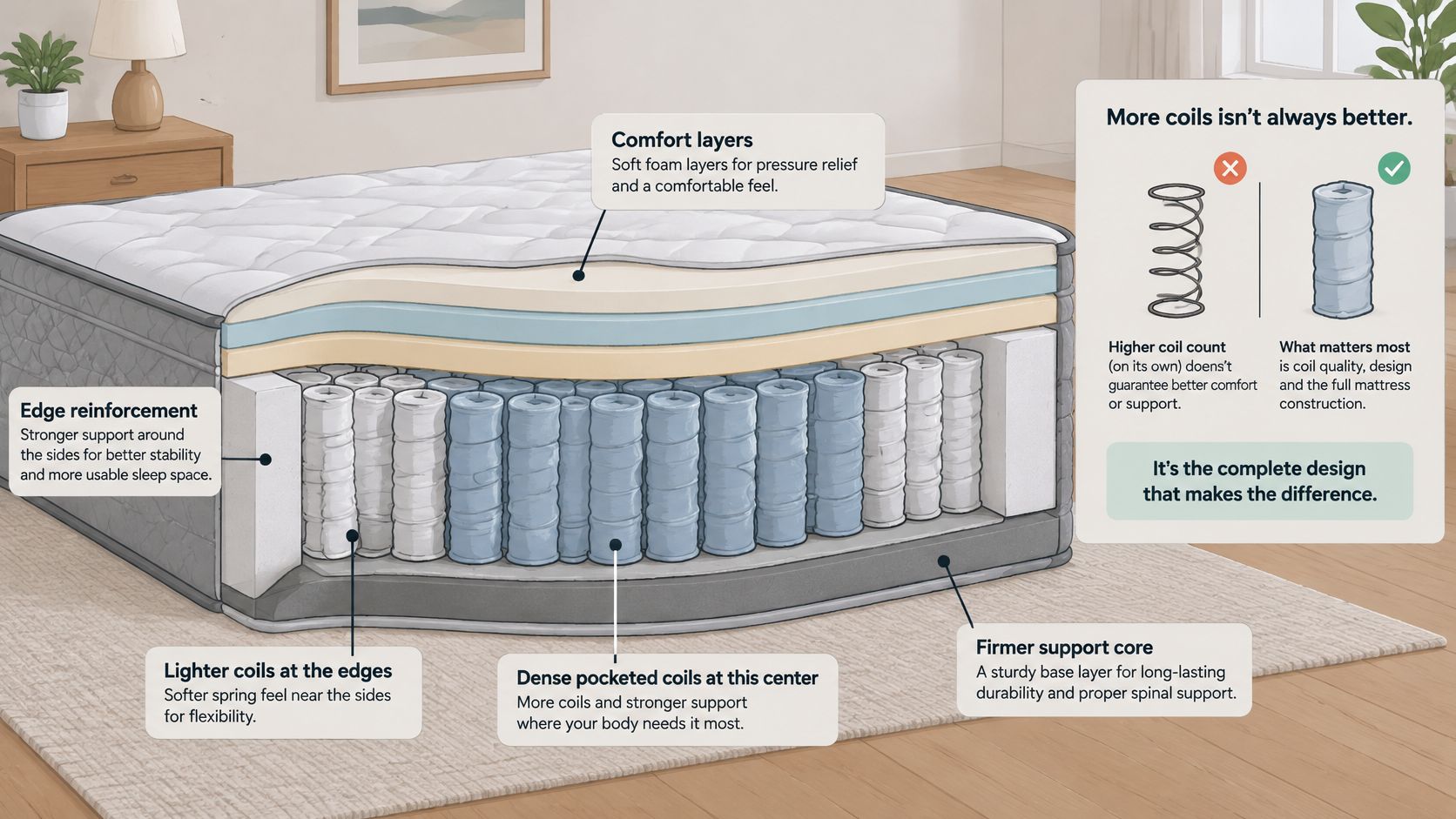
Read the structure beneath the upholstery
Coil gauge describes wire thickness, not the comfort of the entire mattress. Thicker wire can create stronger resistance, but coil geometry and the upholstery above it can change the resulting feel substantially.
Interconnected units tend to respond across a broader area. Pocketed units allow more localized movement and are often combined with stabilizing base materials. The pocket-coil mattress guide offers a useful starting point for understanding that construction.
Edges deserve their own inspection. A supportive sleeping surface can still have a perimeter that folds excessively when someone sits down, making nighttime entry and exit less secure.
Put density claims in context
For polyfoam support cores, Sleep Foundation's support-core guide gives a minimum density of 1.5 pounds per cubic foot, with 1.8 pounds per cubic foot or higher preferred, and defines high-resiliency polyfoam as requiring at least 2.5 pounds per cubic foot plus a compression modulus of at least 2.4.
Those are specifications for particular foam categories, not universal requirements for every layer inside a hybrid. A spring mattress may use foam beneath the coils, around the perimeter, or above the spring unit, and those components serve different purposes.
Density also isn't another word for firmness. A dense material can feel cushioning, while a firm-feeling surface can contain materials that don't retain their initial feel particularly well.
Practical rule: A strong spring unit can't compensate indefinitely for cushioning that loses its shape.
Take a specification checklist
A Sleep Pro can write down the following for each serious contender:
- Coil unit: Interconnected or individually pocketed, including any support zones.
- Wire gauge: The specification and whether it changes across the mattress.
- Edge design: Reinforced springs, foam encasement, or another perimeter system.
- Foam specifications: Material type, density, and location within the construction.
- Comfort-layer thickness: How much cushioning separates the sleeper from the support unit.
Missing specifications shouldn't be replaced with assumptions. A clear description of the materials is more useful than an unexplained premium label.
Matching Firmness to Your Sleep Position
No single firmness is best for everyone, and the firmest mattress isn't automatically the healthiest choice. The useful target is enough cushioning for pressure-sensitive areas without allowing the body to settle into an unsupported position.
In a 2011 RTI International study, 128 healthy adults in the Raleigh–Durham area tested seven innerspring mattresses, rated from firmness 1 to 7, for approximately four weeks each, producing 16,366 compliant nights of observations. Firmness significantly affected 9 of 11 key measures, but both the least-firm and firmest mattresses were associated with more pain and worse self-reported sleep than most alternatives.
A separate randomized trial involving 313 adults with chronic nonspecific low-back pain, discussed in this clinical review, found greater improvement in pain and disability with medium-firm mattresses than firm mattresses. That supports testing a balanced surface rather than automatically moving to an ultra-firm model.
Use firmness labels as starting points
Starting firmness and spring feel by sleeper type
| Sleeper | Firmness to try | Spring feel to check | Watch for |
|---|---|---|---|
| Back sleeper | Medium to medium-firm | Even lumbar support with no hammock dip | Surface too firm for the shoulders |
| Side sleeper | Medium-soft to medium | Shoulders and hips settle while the spine stays level | Too soft lets the hips drop |
| Stomach sleeper | Medium-firm to firm | Hips held up without sagging | Too soft increases lower-back arching |
| Combination sleeper | Medium | Responsive surface and stable edges that help turning | Movement transfer during position changes |
| Heavier body weight | Medium-firm to firm | Coil construction and edges suited to the load | Excessive sinking under the pelvis |
| Lighter body weight | Medium-soft | Enough give at shoulders and hips | Firm surface feels unyielding |
These are fitting recommendations, not prescriptions. Someone with a heavier build who sleeps on the side may need firmer underlying support and more surface cushioning at the same time.
Account for body shape
A spring-unit alignment study published through BMJ Open Respiratory Research found no significant overall alignment difference across 60 participants, but subgroup results favored firmer springs for higher-body-weight participants and softer springs for lower-body-weight and shorter participants. Medium firmness better supported taller participants in that study.
That distinction matters for couples whose bodies load the same mattress differently. A surface that feels comfortably yielding to one person may barely compress beneath the other.
The mattress firmness selection guide can help narrow the initial choices. During fitting, a Sleep Pro should assess the shoulder, waist, and pelvis relationship in side-lying and the support beneath the lower back in a supine position.
Comfort isn't treatment. Persistent pain, worsening symptoms, or unexplained morning stiffness deserves clinical advice rather than another firmness experiment.
Motion Isolation, Responsiveness and Cooling for Couples
For a couple with a light sleeper or a restless partner, motion isolation should usually lead the decision. Cooling becomes equally important when heat is an actual source of waking, not just an appealing feature on the label.
The choice is cool versus calm, with enough responsiveness left for comfortable movement. A mattress can feel airy and easy to turn on while still transmitting every change of position.
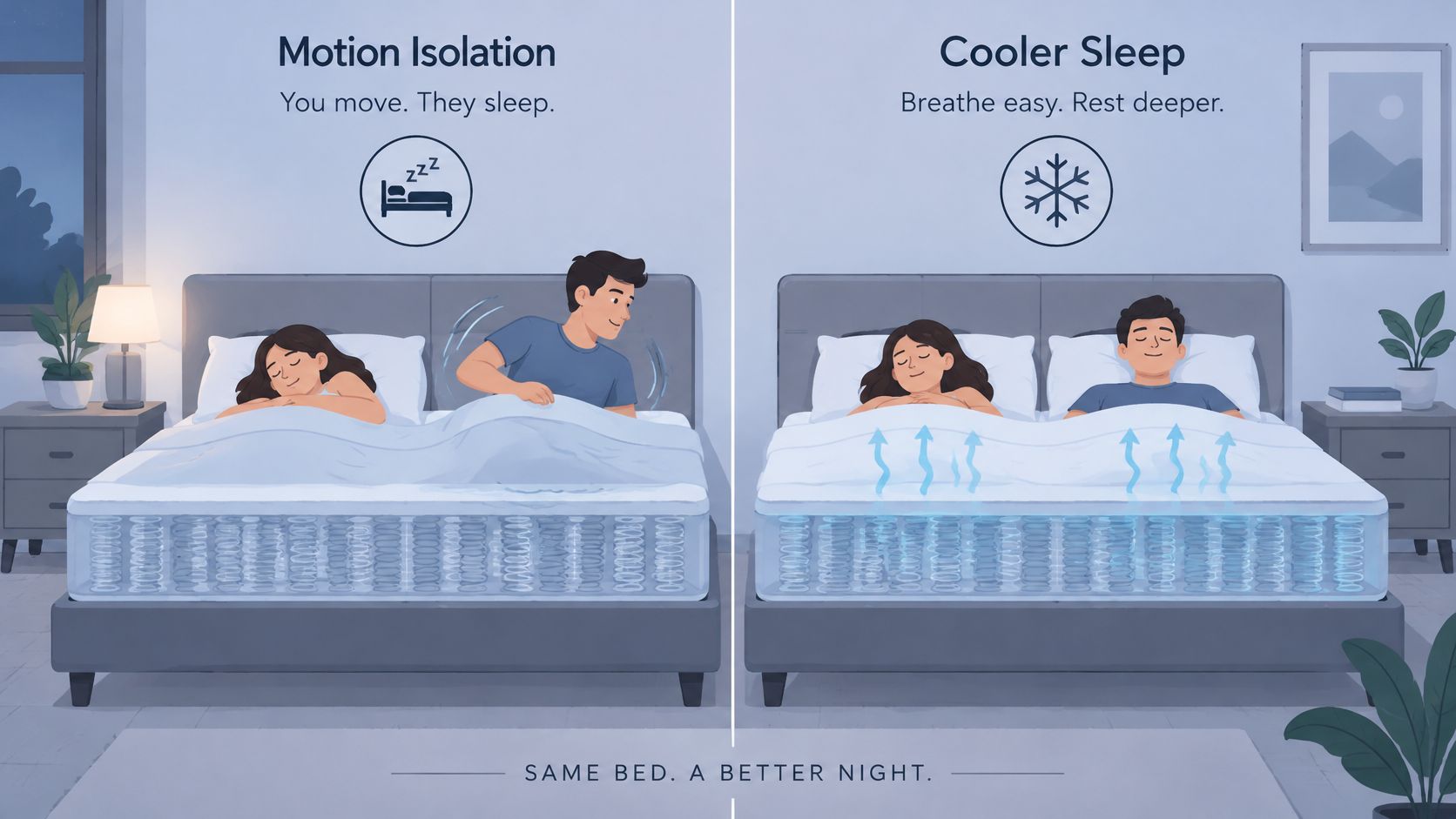
Cooling and undisturbed sleep aren't interchangeable
Consumer Reports' mattress testing coverage treats heat retention and motion isolation as separate performance dimensions and indicates that innerspring and hybrid designs can trap less heat than many other mattresses. A favorable result in one category doesn't establish a favorable result in the other.
The relevant distinction is thermal comfort versus sleep improvement. A cool-touch cover or cooling gel can change surface sensation, but it doesn't prove that someone will sleep better or wake less often.
Memory foam conforms under pressure and can soften the impact of movement. Latex usually rebounds more promptly, while thicker cushioning can change how easily someone turns. No material name resolves the whole couple's decision.
Read cooling claims against mountain nights
Ruidoso's dry mountain air and cool nights make household conditions important. A cabin with heavy bedding and an overheated bedroom presents a different problem from a cool bedroom where one sleeper dislikes a warm surface.
- Light sleeper with a mobile partner: Favor the calmer tested surface, provided turning remains comfortable.
- Hot sleeper without partner disturbance: Give more weight to breathable upholstery and the complete bedding system.
- Different comfort preferences: Ask whether separate firmness arrangements are available for the intended setup.
- Different body weights: Test together, since loading the mattress can change the shared experience.
The guide to reducing motion transfer in bed helps distinguish mattress movement from other sources of disturbance.
The showroom split-position routine should be the deciding check. Each partner should record disturbance awareness, edge stability, and ease of movement rather than agreeing that the mattress feels nice.
How Long a Spring Mattress Really Lasts
A spring mattress may remain usable for approximately five to eight years, a common industry replacement range. Construction quality, foundation support, use, and care can shorten or extend its service life. Repeated loading stresses the springs and compresses the upholstery, so wear may show first as uneven cushioning even when the spring unit still feels resilient.
What durability testing establishes
Consumer Reports' mattress buying guide describes a test that rolls a wood roller weighing more than 300 pounds across each mattress 30,000 times, simulating approximately eight to 10 years of use. That procedure measures resistance to repeated loading; it does not promise that every mattress will remain comfortable for that long.
In a spring mattress, both the coil unit and the foam or fiber layers must withstand repeated compression. Initial softness alone reveals little about how those materials will hold up.
Signs that deserve attention
- Visible or felt depressions: A dip near the middle or edge reduces the usable sleeping surface.
- A consistent location problem: Sleeping more comfortably elsewhere is a reason to inspect the mattress.
- New nighttime disruption: More waking alongside a loss of support warrants a closer look.
- An unstable perimeter: Difficulty sitting or getting out of bed can make replacement more urgent.
These signs don't prove the mattress caused a health problem. Check the surface, foundation, and overall condition before deciding what to do.
The mattress lifespan guide can help organize that assessment. Rotate or flip the mattress only as the manufacturer directs, since many models aren't designed for use on both sides.
Mattress Pro mattresses have warranties covering manufacturing defects, with specific details listed for each product. Check the warranty terms alongside your own comfort needs before choosing a mattress.
How to Test a Spring Mattress Before You Buy
A useful showroom test recreates actual sleeping positions and partner movement. Pressing a hand into the surface or sitting briefly on the edge won't reveal whether the mattress fits a full night's needs.
Mattress Pro by Miller Waldrop allows customers to test mattresses before buying, with a Sleep Pro available to interpret the differences. The in-store mattress testing guide helps turn that visit into a practical comparison.
Follow a repeatable fitting routine
Bring the usual pillow. Wear comfortable clothing that permits normal sleeping positions. Pillow height and restrictive clothing can alter the impression of shoulder and neck support.
Settle into the main sleeping position. Stay long enough for the initial softness to stop dominating the decision. Notice whether pressure builds or the pelvis continues sinking.
Check alignment with assistance. In side-lying, the shoulder, waist, and pelvis should form a balanced posture rather than a pronounced bend. On the back, the pelvis shouldn't settle into a hammock-like depression.
Run the split-position check. One partner stays still while the other rolls, changes position, and gets out of bed, then they swap. The still partner records whether the movement would interrupt drifting off or seems likely to wake them; an awake showroom test can't measure actual nighttime waking.
Test the perimeter and turning effort. Sit near the edge, stand up, and return to lying down. Each partner should note edge stability and whether changing position requires excessive effort.
Clarify the Comfort Promise. Ask the Sleep Pro to explain the exact trial or exchange arrangements and how the Comfort Promise applies to the purchase. Its role is to address the fear of choosing the wrong bed, not to replace a careful fitting.
Keep separate notes before comparing
Each partner should describe the mattress independently before discussing it. That prevents the more enthusiastic shopper from unintentionally choosing for both people.
A useful note describes a sensation: shoulder pressure, pelvis sinking, partner movement, or difficult turning. A general rating such as comfortable gives the Sleep Pro much less to work with.
The final shortlist should contain mattresses that pass both partners' essential checks. A pleasing first impression shouldn't override a repeatable problem.
Spring Mattress Price Tiers in Ruidoso
Mattress Pro's listed prices vary by model and configuration. Compare the same size and intended setup, and confirm how the displayed discount is applied before making a price comparison.
| Product | Listed price range | Listed discount |
|---|---|---|
| Resort XXV Ultra Firm TT | $549.99 to $1,149.99 | 15% |
| Resort XXV Soft Tight Top | $599.99 to $1,199.99 | 20% |
| Sunrise XXV Firm Tight Top | $349.99 to $699.99 | 22% |
| Sunrise XXV Medium Tight Top | $349.99 to $699.99 | 20% |
| Sunrise XXV Medium Pillow Top | $399.99 to $799.99 | 19% |
| Vista XXV Soft Tight Top | $469.99 to $899.99 | 18% |
| Selene Ocho (Mattress in a Box) | $349.99 to $499.99 | 22% |
| Villa XXV Firm Fx Euro Top | $269.99 to $529.99 | 27% |
| Villa XXV Medium Fx Euro Top | $379.99 to $649.99 | 21% |
The model name alone doesn't specify the full construction. Ask the Sleep Pro to confirm the spring unit and cushioning materials for the exact mattress you're considering.
Compare value by the problem being solved
For a budget-conscious household, lower-priced candidates still deserve a fitting. Check whether the mattress distributes pressure comfortably, supports the perimeter, and allows you to turn without undue effort.
For a higher-priced option, ask what changes in its construction and feel. More cushioning may relieve pressure, while a softer, deeper surface can make turning harder for some sleepers.
For a cabin or vacation-rental bedroom, consider the intended use alongside support and care needs. A plush first impression alone won't tell you whether the mattress suits the people who will sleep on it.
Put the promises beside the price
Mattress Pro's Low Price Promise matches local competitors' prices. Ask the Sleep Pro how it applies to the specific model. Financing is available to let customers pay over time; compare the payment arrangement with the total purchase cost.
Mattress Pro also offers full-service delivery with professional assembly. Experts position the mattress for comfort, adjusted to the customer's preferences. To compare delivery with pickup, ask which option fits your setup. For guidance on assessing fit, revisit How to Test a Spring Mattress Before You Buy.
A sound price comparison weighs the mattress's construction, fit, purchase terms, and the service your household needs.
Choose Your Spring Mattress with a Ruidoso Sleep Pro
A mattress can feel right in a quick trial and still prove uncomfortable for a regular sleeping position. Bring your current complaints and budget to the showroom at 2801 Sudderth Drive, then start the comparison with sleep position and the feel each sleeper prefers.
Local guidance for the final choice
Mattress Pro by Miller Waldrop offers one-on-one guidance based on body type, sleep position, and budget. Customers can also answer questions in the Mattress Guide for sleep recommendations before visiting.
For couples, ask to try the mattress in each person's usual position, then check whether a change in position disturbs the other sleeper. In Ruidoso's dry mountain climate, weigh coolness against comfort: bedding and the mattress surface both affect how warm or cool a bed feels, while a spring system's responsiveness may make movement more noticeable.
Customers can choose pickup or full-service delivery with professional assembly. Bring the questions that matter most, such as whether the surface feels supportive without too much pressure or whether movement carries across the bed. A Sleep Pro can use those preferences to guide the comparison.
Bring your current mattress complaints, preferred sleeping positions, and budget to Mattress Pro by Miller Waldrop at 2801 Sudderth Drive in Ruidoso. A Sleep Pro can help you compare spring and hybrid options in person.