

What Is a Medium Firm Mattress? Feel, Fit and Who It Suits

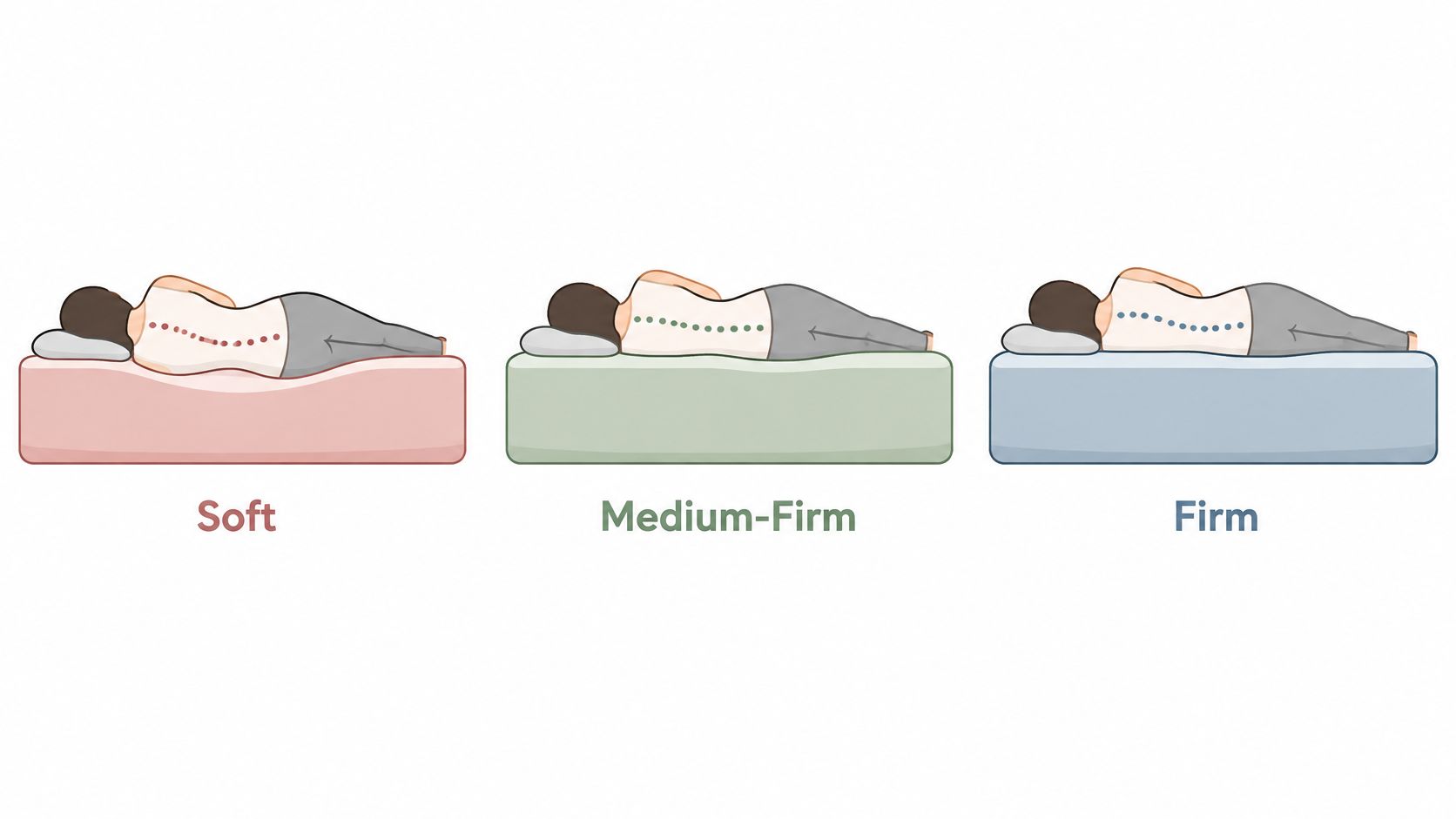
A medium-firm mattress sits near the middle of the firmness scale, giving noticeable support with gentle contouring, and it rates about 5.6 on the clinical scale where 10 is softest.
If a firmness label tells the whole story, why can the same mattress feel comfortable to one sleeper and wrong to another? The missing piece is the person lying on it. Body shape, sleeping position, and the way the mattress layers respond matter more than the name on the tag.
For shoppers asking what is a medium firm mattress, the useful answer goes beyond a rating. It's a category worth exploring, followed by a careful check of pressure relief, alignment, and ease of movement.
Medium-Firm Defined by the Numbers You Can Compare
A medium-firm mattress provides noticeable support with gentle contouring rather than the hard, rigid sensation associated with very firm bedding.
In the 2003 randomized, double-blind, multicenter trial published in The Lancet, medium-firm mattresses measured 5.6, while firm mattresses measured 2.3, on a European Committee for Standardisation scale running from 1.0, firmest, to 10.0, softest. Those measurements give the category a clinical reference, not a universal showroom specification.
Firmness ratings behind the medium-firm label
| Firmness label | Clinical scale value (10 = softest) | Stiffness (RTINGS method) | Typical feel |
|---|---|---|---|
| Firm | 2.3 in the clinical trial | Firm range not specified in the cited guide excerpt | Supportive with little sinking |
| Medium-firm | 5.6 in the clinical trial | 50–60 pascals per millimeter | Support with gentle contouring |
| Medium | No corresponding trial value specified | 43–49 pascals per millimeter | Softer, with more sinking than medium-firm |
The clinical figures describe the tested mattresses. The stiffness figures belong to a separate mechanical testing method, explained below, and aren't conversions of the clinical ratings.
Why the label isn't a fixed measurement
Manufacturers can use different internal rating systems. A mattress labeled Medium might feel close to another manufacturer's medium-firm model, especially when their cushioning materials differ.
Even the direction of a firmness scale needs checking. The clinical scale above moves toward softer surfaces as its numbers rise, so shoppers shouldn't assume that every larger number means a harder bed.
Think of firmness categories like shoe widths. The label helps narrow the selection, but the fit still needs checking on the person who'll use it.
How to use the category while shopping
A mattress comfort-level guide helps organize the choices before a showroom visit. The next step is describing the sleeper's usual position, body frame, and current discomfort to a Sleep Pro.
Mattress Pro by Miller Waldrop is a local, family-owned business. At its Sudderth Drive showroom in Ruidoso, shoppers can compare the label with the actual experience of lying down, rather than treating a printed rating as the final answer.
How Construction and Measured Stiffness Create the Feel
A medium-firm mattress is like a well-built chair cushion: the base resists collapse while the top allows some give. Pressing the surface with a hand reveals only part of that relationship.
Consider a side sleeper settling onto a mattress. The shoulder meets the cushioning first, then the deeper layers resist further compression as more body weight settles into place.
The layers perform different jobs
The support core may use innersprings, hybrid coils, or high-density foam. Its job is to resist excessive sinking and provide a stable foundation beneath the body.
The comfort layers shape the initial sensation. Memory foam conforms around shoulders and hips, spreading contact over a broader area instead of concentrating it at a small point; latex generally rebounds more quickly and feels springier.
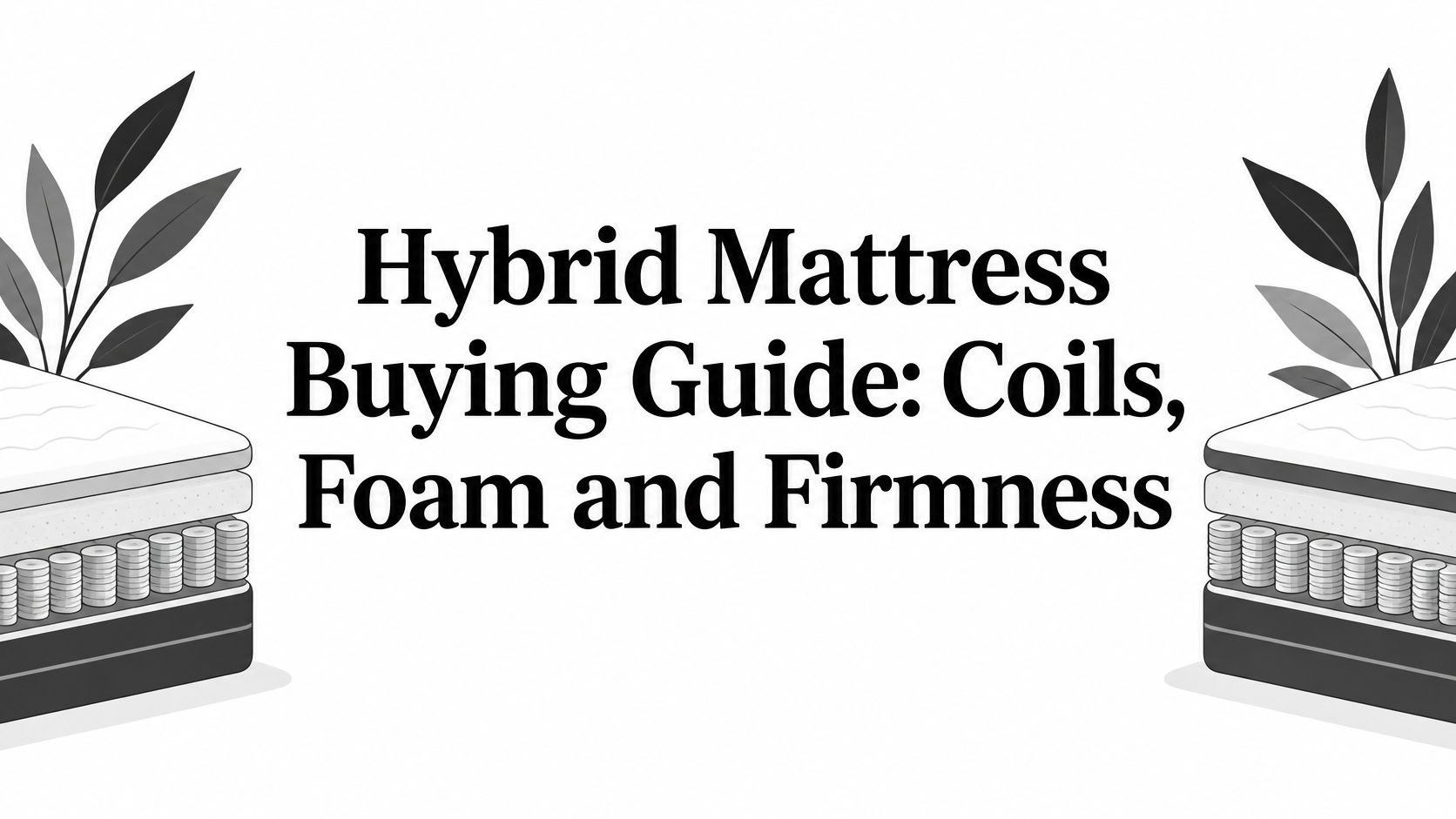
A hybrid combines a coil support system with cushioning above it. The hybrid mattress buying guide explains that construction choice in more detail, but the useful showroom question is whether the combination feels supportive without creating pressure.
The cover and quilting affect the surface too. A lofty pillow top can feel welcoming even when the structure beneath it offers substantial resistance.
What stiffness testing measures
The RTINGS firmness guide describes a 355-millimeter platen that compresses a mattress, measuring resistance at 1.5, 2.1, and 2.8 kilopascals at the lumbar and head-or-foot areas; its normalized stiffness categories place medium-firm at 50–60 pascals per millimeter and medium at 43–49 pascals per millimeter.
In plain language, a broad testing plate presses down and records how strongly the mattress pushes back. Testing different locations helps reveal differences that a quick press near the corner could miss.
Cooling gel technology in foam is intended to help manage heat, but a gel label alone doesn't establish how cool a whole mattress will sleep. In Ruidoso's dry mountain air and cool nights, bedding choices and personal heat sensitivity still deserve attention.
A useful construction checklist includes:
- Core support: Does the pelvis remain supported after settling?
- Comfort-layer depth: Is there cushioning without a trapped-in-the-bed sensation?
- Surface consistency: Does support change noticeably from the middle toward the edges?
- Temperature feel: Does the cover feel comfortable beneath ordinary sleepwear?
Which Sleepers and Body Types Medium-Firm Suits
Medium-firm is a strong starting point for many sleepers, not a universal prescription. The best fit balances the demands of the sleeping position with the person's shape and weight distribution.
A side sleeper needs room for the shoulder and hip to settle. A back sleeper needs comfortable contact beneath the lower back, while a stomach sleeper usually needs stronger resistance beneath the pelvis.
Fit by sleeping position and frame
Medium-firm fit by sleeper profile
| Sleeper profile | Medium-firm fit | Why it matters |
|---|---|---|
| Side sleeper | Often a good fit | Contouring eases pressure at shoulders and hips while the spine stays level |
| Back sleeper | Often a good fit | Gentle contour supports the lower back without excessive sinking |
| Stomach sleeper | Firmer end of the category | Helps keep hips from sinking below the rest of the body |
| Combination sleeper | Good starting point | Balances sinking and support as position changes |
| Lighter body frame | Test carefully | Can feel softer than the label suggests with forgiving top layers, though shallow compression can also make it feel firm |
| Heavier body frame | Test carefully | Sinks farther and may need a firmer core |
The table offers fitting guidance, not clinical ratings. A lighter side sleeper might enjoy a soft-feeling surface yet still notice shoulder pressure once lying still; a heavier sleeper might initially describe the same bed as firm but settle too far overnight.
For heavier frames, memory foam mattress selection guidance can help separate surface cushioning from the deeper support requirements.
Back comfort and shared-bed compromises
Support and firmness aren't interchangeable. A systematic review in the Journal of Orthopaedics and Traumatology summarized nine relevant studies and found that medium-firm mattresses may improve pain and sleep compared with firmer mattresses, while also identifying pressure-related problems associated with excessive firmness.
For couples, the practical issue is whether both bodies remain comfortable at the same time. One partner may need greater shoulder cushioning while the other needs stronger resistance beneath the hips, and both should test movement from the other side.
Customers who need help choosing can connect with a Sleep Pro at Mattress Pro by Miller Waldrop. Describing each partner separately is more useful than averaging their preferences into a single firmness word.
Medium-Firm Compared With Softer and Firmer Mattresses
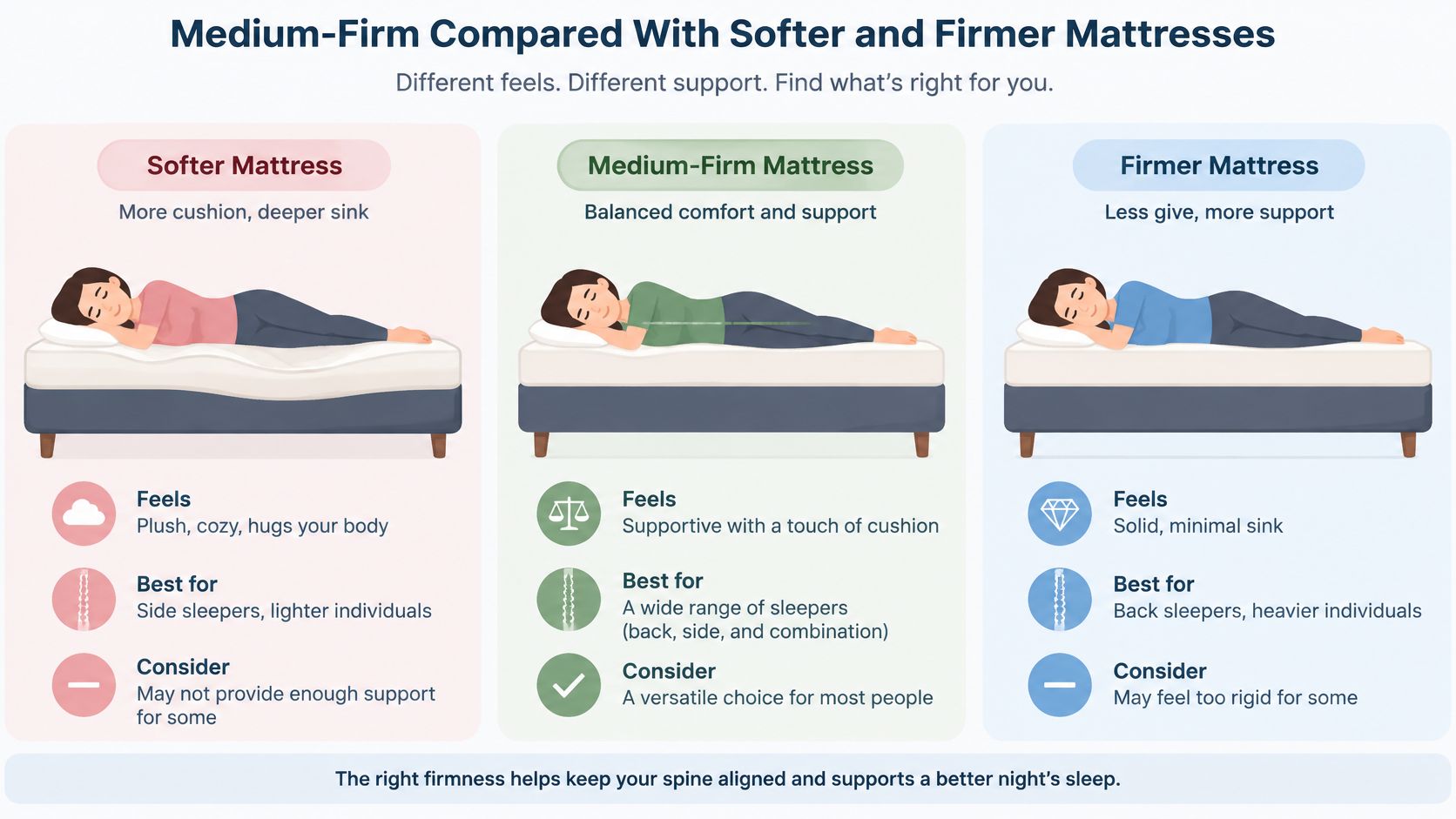
| Criterion | Softer (plush) | Medium-firm | Firmer |
|---|---|---|---|
| Sink depth | Deep | Moderate, with contouring | Shallow |
| Pressure relief at shoulders and hips | Strongest cushioning potential | Balanced cushioning and resistance | Lowest cushioning potential, can concentrate pressure |
| Spinal support | Can sag for heavier frames | Can preserve neutral alignment in many positions | Strong resistance, can feel rigid |
| Motion | Deep cushioning may make turning harder | Often balances contouring and movement | Shallow sinking can make turning easier |
| Best fit | Side sleepers wanting cushioning | Many sleepers and mixed-preference couples | Stomach sleepers and heavier frames wanting a solid surface |
Firmness selection resembles shoe shopping: the label matters less than comfortable support during use. These are typical tendencies, not promises about every mattress within a category.
Where the trade-offs appear
A softer mattress allows more of the body to settle into its upper layers. That can feel comfortable around prominent shoulders or hips, but excessive pelvic sinking can leave a back or stomach sleeper poorly positioned.
A firmer mattress offers less surface give. Someone who prefers lying on top of the bed may appreciate that sensation, while a side sleeper may feel concentrated pressure before the rest of the body feels settled.
A medium-firm mattress occupies the middle ground. It can offer enough contouring for comfort without the deep cradle that some sleepers find difficult to move through.
A practical verdict by situation
- Consider softer: A side sleeper wants generous cushioning and remains well aligned after settling.
- Consider medium-firm: A combination sleeper changes positions frequently, or partners need a workable compromise.
- Consider firmer: A stomach sleeper needs less pelvic sinking, or a sleeper has tested a solid surface and found it comfortable.
Motion transfer deserves a separate check. A firm surface can still transmit a partner's movement, and a plush surface can still isolate it well; construction matters alongside firmness.
Practical rule: Choose the surface that remains comfortable while holding the body well, not the hardest mattress that feels tolerable.
How to Test Medium-Firm and Answer Common Questions
A firmness rating describes what a mattress is intended to feel like. A body-position check shows whether that mattress is doing the right job for a particular sleeper.
The Canadian Agency for Drugs and Technologies in Health review hosted by the National Library of Medicine supports evaluating medium-firm mattresses through comfort, spinal alignment, sleep quality, and nonspecific low-back symptoms rather than relying on the category alone. Neutral alignment and comfortable pressure distribution are the useful targets, not a particular sensation of hardness.
A showroom routine that checks more than softness
Settle into the usual side-sleeping position. Stay still long enough for the cushioning to respond and for pressure to become noticeable. A companion or Sleep Pro can look from behind for a reasonably straight spinal line, without a dropped waist or sharply tilted pelvis.
Repeat the check on the back. The pelvis shouldn't feel buried while the upper body remains perched above it. The lower back should feel comfortably supported rather than suspended over an obvious hollow.
Use a hand check as a clue, not a verdict. Sliding a flat hand beneath the lower back can help reveal a conspicuous gap. A large gap may suggest inadequate contouring, but difficulty sliding a hand through doesn't, by itself, prove that the mattress is too soft.
Notice shoulders and hips. Localized soreness, tingling, or a persistent urge to escape the position deserves attention. A mattress doesn't need to feel painfully hard to create an uncomfortable pressure point.
Roll over and sit up. Turning should feel manageable without a struggle against deep cushioning. Couples should also take turns moving while the other partner remains still.
Record the home experience. Note morning stiffness, aches, night waking, and whether changing position feels easy. Consistent patterns are more informative than an isolated poor night.
A familiar pillow helps keep the comparison focused on the mattress. Shoes, a thick jacket, or an unusually high showroom pillow can change posture enough to distract from the fit.
The in-store mattress testing guide provides a useful starting point for shoppers who feel awkward lying down in a showroom. A proper test is part of choosing a mattress, not an inconvenience.
How long should a medium-firm mattress be tested?
Several weeks of ordinary sleep can provide a clearer picture than a brief showroom impression. The evaluation period must still fit the applicable Comfort Promise terms.
The log needn't be elaborate. Short notes about comfort on waking, pressure at the hips or shoulders, and ease of turning can help distinguish a repeatable problem from an unusual night.
Is medium-firm the right choice for back pain?
It's a reasonable starting point for many people, not a diagnosis or a treatment guarantee. Persistent, worsening, or unexplained pain needs a clinician's assessment.
The fitting conversation should describe where discomfort occurs and which positions aggravate it. A mattress purchase shouldn't replace medical evaluation or changes recommended by a treating professional.
What does the Comfort Promise do for someone afraid of picking the wrong bed?
The Comfort Promise addresses the fear of choosing the wrong mattress by providing a defined process if the fit isn't right. A Sleep Pro at Mattress Pro by Miller Waldrop will confirm current terms before purchase.
Shoppers should understand eligibility, required steps, and any applicable conditions before deciding. That clarity offers more useful reassurance than assuming every comfort concern automatically qualifies.
Ruidoso shoppers can work through these checks with local guidance. The goal is a decision grounded in the sleeper's actual comfort, with a clear next step if concerns appear at home.
Choose Your Medium-Firm Mattress in Ruidoso
Ruidoso's dry mountain air, altitude, and cool nights make bedroom comfort personal. Someone who piles on bedding during cold weather may still want a less heat-retentive sleep surface, while a sleeper returning from hiking, skiing, or outdoor work may be especially sensitive to pressure around tired shoulders and hips.
Mattress Pro by Miller Waldrop brings a 70-year family legacy to a business focused on sleep. The local, family-owned showroom serves Ruidoso, Alto, and Lincoln County from 2801 Sudderth Drive, Suite F.
Local guidance without guessing
The mattress selection includes Tempur-Pedic, Sealy, Stearns & Foster, and Sherwood. Shop comfort labels include Ultra Firm, Cloud 1, Cloud 2, Cloud 3, and Medium; shoppers exploring medium-firm should compare suitable options within the Medium selection rather than assuming the label guarantees a particular feel.
The local mattress-store guide offers context for shoppers deciding how to approach an in-person visit. Personal fitting allows questions about posture, body frame, and shared-bed preferences that a bed-in-a-box product page can't resolve by itself.
- Comfort Promise: Addresses concern about choosing the wrong feel, with current terms confirmed before purchase.
- Low Price Promise: Mattress Pro by Miller Waldrop matches prices from local competitors.
- Full-Service Delivery with Professional Setup: Standard and white glove delivery options allow shoppers to discuss the appropriate level of assistance.
A useful visit compares a small selection of medium-firm candidates using the same pillow, positions, and movement checks. The aim isn't to find the most impressive specification sheet, but a mattress that makes comfortable support feel ordinary.
Visit the Sleep Pros at the Mattress Pro showroom at 2801 Sudderth Drive, Suite F, in Ruidoso. Browse the collection online or stop by Monday through Saturday to compare comfort with personalized guidance.
Mattress Pro by Miller Waldrop offers personalized mattress fitting, the Comfort Promise, and delivery options to help turn a medium-firm label into a well-matched choice. Visit Mattress Pro by Miller Waldrop online or stop by the Ruidoso showroom Monday through Saturday to compare mattresses by comfort, support, and budget.