

Mattress Trial Period Guide: Terms, Testing and Returns

The new mattress felt comfortable in the showroom, but now a sleeper is waking with unfamiliar hip pressure. Their partner likes the support, yet neither knows whether the bed needs more time or whether the return deadline is getting close. That uncertainty is exactly why a mattress trial period needs more than a promising headline.
A useful trial combines clear terms with a practical way to evaluate sleep. For Ruidoso households, that means understanding the policy before buying, watching comfort trends at home, and getting help before a small concern becomes a missed exchange window.
Typical Trial Lengths and What They Mean
A mattress trial period is a set window, usually measured in nights, when a customer can sleep on a mattress at home and may return it for a refund if it does not suit them. The policy determines when that window starts and which conditions apply.
NapLab's review of mattress trial policies found that 94.1% of 290 mattresses offered at least 100 nights, and the average trial lasted 176 nights (NapLab's review of mattress trial policies).
Trial Lengths Across 290 Mattresses
The table below summarizes the trial-length distribution reported in NapLab's review of mattress trial policies.
| Trial Length | Share of 290 Mattresses | What It Means for You |
|---|---|---|
| 100 to 101 nights | 40.9% | The most common benchmark, often with a waiting period before returns |
| 120 nights | 22.3% | More time to adjust before deciding |
| 180 to 200 nights | 3.8% | A longer window, but uncommon |
| 365 days | 27.1% | A full-year test, a longer promise |
| Under 100 nights | 5.8% | Less time to adjust |
These figures describe the reviewed mattresses and are not a guarantee for every mattress sold. They offer a useful reference point: a home trial gives you time to observe how the mattress feels across ordinary nights, rather than relying on a quick first impression.
Headline Length Versus Usable Time
NapLab's review describes a typical trial of approximately 100 days, often with a minimum waiting period of about 30 days before a return can begin. That waiting period falls within the trial window; it does not automatically extend the deadline.
This timing matters if a mattress arrives at a cabin before anyone stays there regularly. The trial clock may be running even while the bed is unused, so check when the period begins and when a return becomes eligible.
Practical rule: Before buying, confirm when the trial starts, when returns become eligible, and what must happen before the deadline.
Pickup arrangements, refund deductions, exchanges, and mattress condition requirements also affect how useful a trial is. Read those terms alongside the headline length, then keep track of the end date so you can make a decision before the window closes.
Online Versus In-Store Trials Compared
| Factor | Online Trial | In-Store Trial |
|---|---|---|
| Where testing happens | The customer's bedroom, over normal nights | A showroom, providing a brief impression |
| Typical length | Often an extended, multiweek home test | No fixed showroom testing duration; confirm with the Sleep Pros |
| Payment | Often paid upfront, refunded after an approved return | Confirm payment arrangements with the Sleep Pros |
| Return process | Approved return, with conditions that may include pickup and fees | Confirm the applicable return or exchange policy |
| Best for | Shoppers needing real-world testing | Shoppers wanting to feel the mattress before buying |
Different Tests Answer Different Questions
A showroom visit helps a shopper notice whether a surface feels overly rigid, difficult to move on, or uncomfortable around the shoulders. It also creates an opportunity to compare nearby options without purchasing each mattress first.
Home testing answers different questions. It reveals how the mattress feels during ordinary routines, with familiar bedding, nighttime movement, and the bedroom's actual temperature.
The 2019 report on online mattress trials describes how direct-to-consumer sellers used home trials to address the inability to test before purchasing, commonly requiring upfront payment followed by a refund after an approved return. A trial therefore shouldn't be confused with borrowing a mattress without paying.
A Local Starting Point
Mattress Pro by Miller Waldrop allows customers to test mattresses before buying. Its Sleep Pros conduct consultations around sleep habits and preferences, helping shoppers consider body type, sleep position, and budget.
The in-store mattress testing guide can help shoppers prepare for that visit. Wearing comfortable clothing and lying in normal sleeping positions makes the appointment more useful than briefly sitting on each mattress.
A showroom impression and an eligible home trial can complement each other. The sensible choice is a purchase arrangement that permits meaningful testing under normal sleeping conditions and explains the return or exchange route before payment.
Ruidoso Shoppers and the Miller Waldrop Promises
A mattress can feel different at home than it does in a showroom. In Ruidoso, cooler nights, room heating, and heavy bedding all affect how warm a bed feels. Keep those conditions in mind as you assess comfort over time, rather than judging temperature from a short showroom test alone.
Mattress Pro by Miller Waldrop draws on a 70-year family legacy serving Ruidoso and Lincoln County. Its Sleep Pros offer personalized guidance, and customers can visit the showroom to test mattresses before buying.
Matching the Mattress to the Sleeper
The showroom carries Tempur-Pedic, Sealy, Stearns & Foster, and Sherwood. Comparing how different materials respond can be more useful than relying on labels such as plush or firm.
- Memory foam: Its contouring response spreads contact across the body. Notice whether it eases pressure around your shoulders and hips.
- Hybrid construction: Foam comfort layers sit above a spring support system. Check whether the mattress supports your alignment while still allowing comfortable movement.
- Cooling features: Cooling gel is a material feature, not a promise of a particular overnight temperature. Your bedding and bedroom conditions remain part of the test.
Promises That Address Specific Worries
The Comfort Promise addresses concerns about choosing a mattress that does not feel right. Read its terms to understand the eligible remedy, since a comfort promise does not necessarily mean an unrestricted cash refund.
The Low Price Promise addresses local price comparisons: Mattress Pro matches the prices of its local competitors. For the practical challenge of moving a heavy mattress, the store offers full-service white-glove delivery.
Local care starts with a conversation about the problem. Mattress Pro also offers a Rest Easy Guarantee. Review its terms separately from any trial policy, so you understand what each commitment covers.
Confirm Your Trial Terms Before You Buy
Before choosing a mattress, get the trial terms in writing. Clear details help you know when the trial begins, what makes a return eligible, and what to do if the fit still feels wrong after an adjustment period. A policy name alone does not explain the remedy, so get a clear answer on refunds versus exchanges before relying on it.
The Prepurchase Checklist
- Trial length and start date. Record whether the clock begins at purchase, shipment, or delivery.
- Mandatory break-in period. Ask when a comfort return or exchange first becomes eligible, and whether that period affects the trial deadline.
- Return deadline. Confirm the last day to request a return and whether there is a separate deadline to complete it.
- Pickup and transportation. Find out who moves the mattress and whether any charges apply.
- Protection and packaging. Ask what condition the mattress must be in and whether a protector, labels, or original packaging are required.
- Exchange rules. Confirm whether an exchange restarts the trial or uses the remaining time.
- Refund timing. Ask how approval works, how payment is returned, and whether deductions apply.
- Warranty separation. Keep comfort-policy terms separate from warranty coverage for manufacturing defects. Check the selected product for its specific warranty details.
Review the store policies page while preparing questions, then make sure the purchase paperwork identifies the policy for your mattress. Mattress Pro offers a Rest Easy Guarantee, so ask how its terms apply to your purchase.
Questions to Settle Before the Trial Ends
Ask what steps the customer service team requires to start a return, and which dates or documents you should have ready. If you are considering an exchange, clarify how the available options and remaining trial time will be handled. Keep the answers with your purchase paperwork.
Mattress Pro's Ruidoso showroom is open Monday through Saturday, 10 AM to 6 PM, and closed Sundays. Call (575) 630-1234 with policy questions before buying, or while there is still time to act under the trial terms.
Testing a Mattress and Spotting Real Mismatch
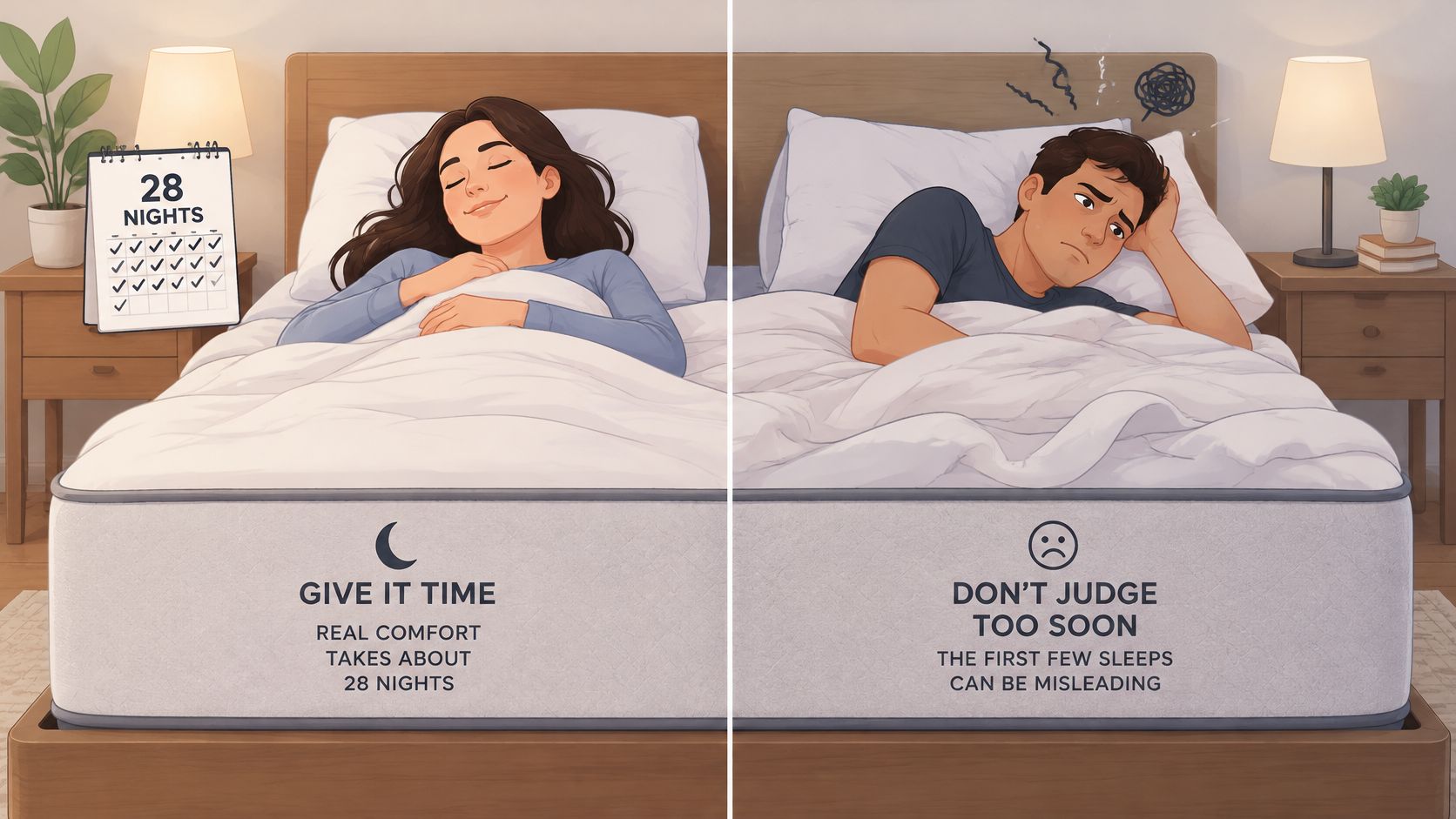
After a few nights on a new mattress, mild soreness can make it hard to tell whether your body is adjusting or the mattress is a poor fit. Track how you feel over about 28 nights when possible, while taking persistent or worsening pain seriously rather than pushing through it.
In a peer-reviewed bedding study, participants recorded their experience for 28 consecutive nights after switching to a new medium-firm mattress. Sleep quality in week four was 24.2% better than in week one. That result supports watching for gradual change, not expecting the same outcome for every sleeper.
A Simple Sleep Log
Use a brief daily record to spot patterns instead of relying on one uncomfortable morning.
- Record morning symptoms. Note back, neck, hip, or shoulder discomfort, along with how rested you feel. Use the same descriptions each day.
- Test normal positions. Pay attention to the positions you usually sleep in. If you share the bed, each partner should record their experience separately.
- Track interruptions. Write down overheating, movement from a partner, edge instability, or difficulty turning.
- Compare trends. Look across early, middle, and later entries. Keep your pillow and sleep schedule reasonably steady so changes are easier to interpret.
The mattress break-in guidance can help you understand what adjustment may involve. Treat a break-in period as a way to observe changes, not a guarantee that discomfort will disappear.
Read the Direction of Change
| Pattern | Practical Interpretation | Next Action |
|---|---|---|
| Mild soreness steadily easing | Possible adaptation | Continue testing while eligible |
| Repeated pressure without improvement | Possible fit problem | Discuss support and comfort adjustments |
| Persistent partner disturbance | Shared-bed mismatch may remain | Explore eligible alternatives early |
| Worsening pain or numbness | Not something to endure for policy compliance | Seek appropriate clinical advice |
A 2021 systematic review favored medium-firm mattresses for comfort, sleep quality, and spinal alignment. An included double-blind trial involving 313 adults with chronic nonspecific low-back pain found better outcomes with medium-firm than firm mattresses at 90 days. Firmness alone does not determine whether a surface supports you well.
For example, a side sleeper whose hip pressure eases over time may reasonably continue testing. If both partners keep waking when one turns, patience may not resolve the disturbance. Watch the trend, and act while the trial period still allows you to do so.
Decision point: Improving comfort supports patience. Flat or worsening symptoms support taking action.
The mattress break-in guide offers additional preparation. Depending on the pattern, you can continue testing, discuss a suitable feel adjustment, or begin an eligible return or exchange.
How to Start a Return or Exchange
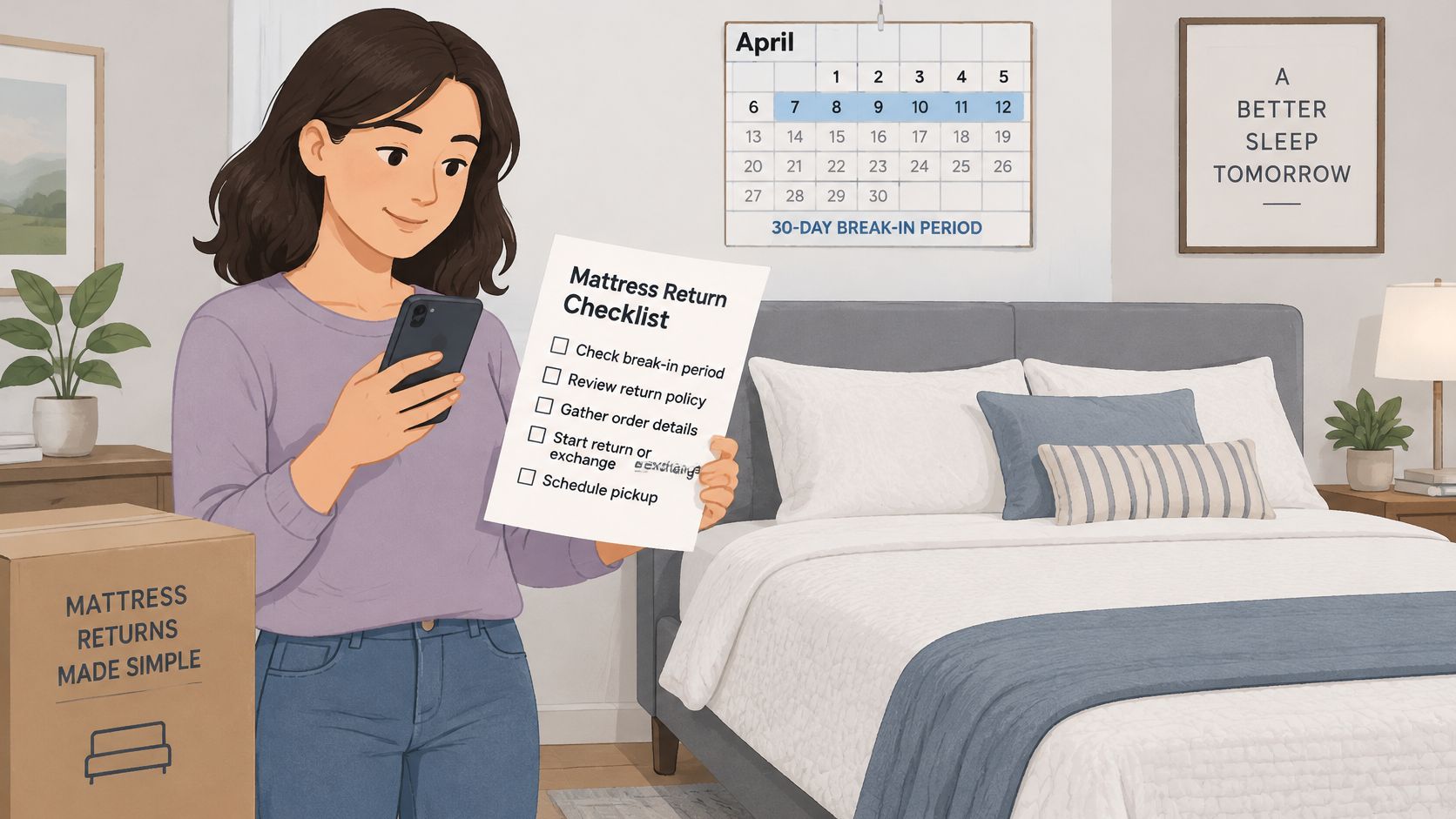
Before requesting a return, check whether the policy requires a break-in period. Sleep Foundation's mattress guide describes a 365-night trial with a 30-night break-in period, so a customer must keep the mattress for at least 30 nights before starting a return. This example shows one policy mechanism; your purchase documents set Mattress Pro by Miller Waldrop's actual terms.
Follow the Documented Process
- Verify eligibility. Check the purchase date, any waiting period, the mattress's required condition, and possible fees against your written policy.
- Preserve required materials. Keep the protector and original packaging if the policy requires them. If you are unsure, ask before discarding anything.
- Contact customer service early. Mattress Pro by Miller Waldrop's customer service team guides customers through the return process.
- Arrange transportation. Confirm who will handle pickup, the appointment date, and how to prepare the mattress.
- Get written confirmation. Save the approved refund or exchange terms, including whether a replacement has a new trial.
Describe the comfort concern clearly when you contact the team. For example, note whether shoulder pressure, warmth, or partner disturbance persists, and explain whether it has improved, remained unchanged, or worsened. A sleep log can help you describe that pattern.
Distinguish Comfort Requests From Defects
Mattress Pro by Miller Waldrop mattresses come with warranties covering manufacturing defects, and specific warranty details are listed with each product. A mattress that feels unsuitable without a manufacturing defect should be discussed as a comfort-policy matter. The warranty does not itself determine whether a comfort return or exchange is available.
Start the process while there is still time to resolve questions about paperwork or pickup scheduling. If a pickup date falls after the trial deadline, ask for written confirmation that your request remains valid. Keep the confirmed instructions with your purchase records so you can follow the agreed process.
Frequently Asked Questions
What Happens to a Returned Mattress?
Return handling depends on the retailer's policy. Before buying, ask whether the retailer arranges pickup, what preparation is required, and whether any fees apply. In Ruidoso, confirm those details directly with the retailer rather than assuming returned mattresses follow the same process everywhere.
How Long Should a Mattress Last?
Sleep Foundation's mattress-care guidance gives an average useful life of approximately 7–10 years, with material-specific averages of 5–6 years for innerspring, 6–7 for foam, 6.5–7.5 for hybrid, and 7.5–8.5 for latex.
Age is only one clue. Visible sagging, lasting indentations, new stiffness, or waking unrefreshed may signal that a mattress no longer suits you. Construction, body type, sleep position, and care all affect how it feels over time.
Does the Warranty Cover Comfort?
Check the product-specific warranty for manufacturing-defect coverage. For a closer explanation, read this mattress warranty guide.
What if Partners Want Different Feels?
Each partner can track their own comfort concerns, such as pressure or motion disturbance. Separate observations make it easier to explain what feels wrong and discuss whether an eligible exchange could help.
Before buying, confirm the comfort terms in writing. Keep checking them as the trial progresses, so you can act before the deadline if the mattress still feels like a mismatch.
For personal mattress guidance, visit the Sleep Pros at Mattress Pro by Miller Waldrop, located at 2801 Sudderth Drive in Ruidoso. Customers can compare mattresses in the showroom Monday through Saturday, from 10 AM to 6 PM, and ask about the Rest Easy Guarantee before deciding.