

Best Mattress for Combination Sleepers with Back Pain

At around two in the morning, a Ruidoso sleeper rolls from her back onto her side, tugs the blanket higher, and falls asleep again. By breakfast, her lower back feels stiff, even though the mattress seemed comfortable at bedtime. The problem may be what happens during the turn, not just where she lands.
Why Combination Sleepers Often Wake Up With Back Pain
Combination sleepers ask a mattress to handle changing loads. On the back, the midsection needs enough resistance to prevent excessive hip sink. On the side, body weight concentrates around the shoulder and hip, which need room to settle.
A surface that feels reassuringly sturdy on the back can feel unforgiving on the side. A plush surface that cushions the shoulder may let the pelvis descend too far after a roll onto the back. Neither extreme automatically provides good support.
The turn matters as much as the resting position
A sleeper who must brace, push with an elbow, or twist out of a deep impression may struggle even when the final position feels comfortable. The best mattress for combination sleepers with back pain should accommodate the resting positions and the movement between them.
Useful signs to watch include:
- Midsection sag: The pelvis settles noticeably deeper after rolling onto the back.
- Pressure buildup: The shoulder or hip feels compressed on the side.
- Difficult movement: Turning requires effort rather than an easy roll.
The guide to aligning the spine while sleeping offers a useful starting point for recognizing these differences.
A local approach to fit
Ruidoso's dry mountain air and cool nights make bedding choices part of mattress comfort. A cool bedroom doesn't necessarily prevent overheating beneath a heavy blanket.
Mattress Pro is a family-owned Ruidoso business backed by the 70-year Miller Waldrop legacy, with a focus entirely on sleep. Its Sleep Pros help neighbors evaluate fit in person, including the awkward turns that a bed-in-a-box description can't demonstrate.
Quick Picks for Combination Sleepers With Back Pain
A mattress that feels comfortable in one position can become a problem on the turn. Use the hardest position change you make at night to narrow your options, then compare how each type handles that transition.
| Mattress type and example lines | Firmness band | Pressure relief | Responsiveness | Best fit |
|---|---|---|---|---|
| Responsive hybrid, Sealy or Stearns & Foster coil-and-foam lines | Medium-firm | Midsection support with surface cushioning | Easy to turn | Sleepers who change position often |
| Memory foam, Tempur-Pedic conforming foam | Medium-firm to medium-soft | High shoulder and hip relief | Slower to turn | Side-dominant sleepers who need cushioning |
| Latex | Medium-firm | Firm, even support | Quick response | Hot sleepers seeking a responsive feel |
| Adjustable or custom-firmness hybrid, including Sherwood options | Varies by configuration | Adjustable to the selected setup | Depends on the comfort layer | Couples with different weights or changing comfort needs |
| Budget innerspring with comfort top | Medium-firm by feel | Moderate | Moderate | Occasional or guest-room use |
These categories are starting points, not guarantees for every model within a brand.
Rank the mattress by the hardest turn
Side to back with a strained lower back: Start with a responsive medium-firm hybrid from Sealy or Stearns & Foster. After rolling onto your back, check whether your pelvis stays supported.
Back to side with a sore shoulder: Compare a conforming foam option with a cushioned hybrid. Focus on shoulder pressure and how easily you can roll back out of the surface.
Stomach to side with a feeling of getting stuck: Give quicker-response latex or a less enveloping hybrid priority. Make sure the stomach position still feels supportive through the midsection.
Different needs across the bed: Ask about Sherwood configurations and separately adjustable systems. Clarify whether the setup changes the support, the comfort layer, or the mattress model.
The best pick is the one that makes your hardest turn feel manageable, not just the one that feels good during a single lie-down test.
Matching Medium-Firm Support to Your Body and Sleep Pattern
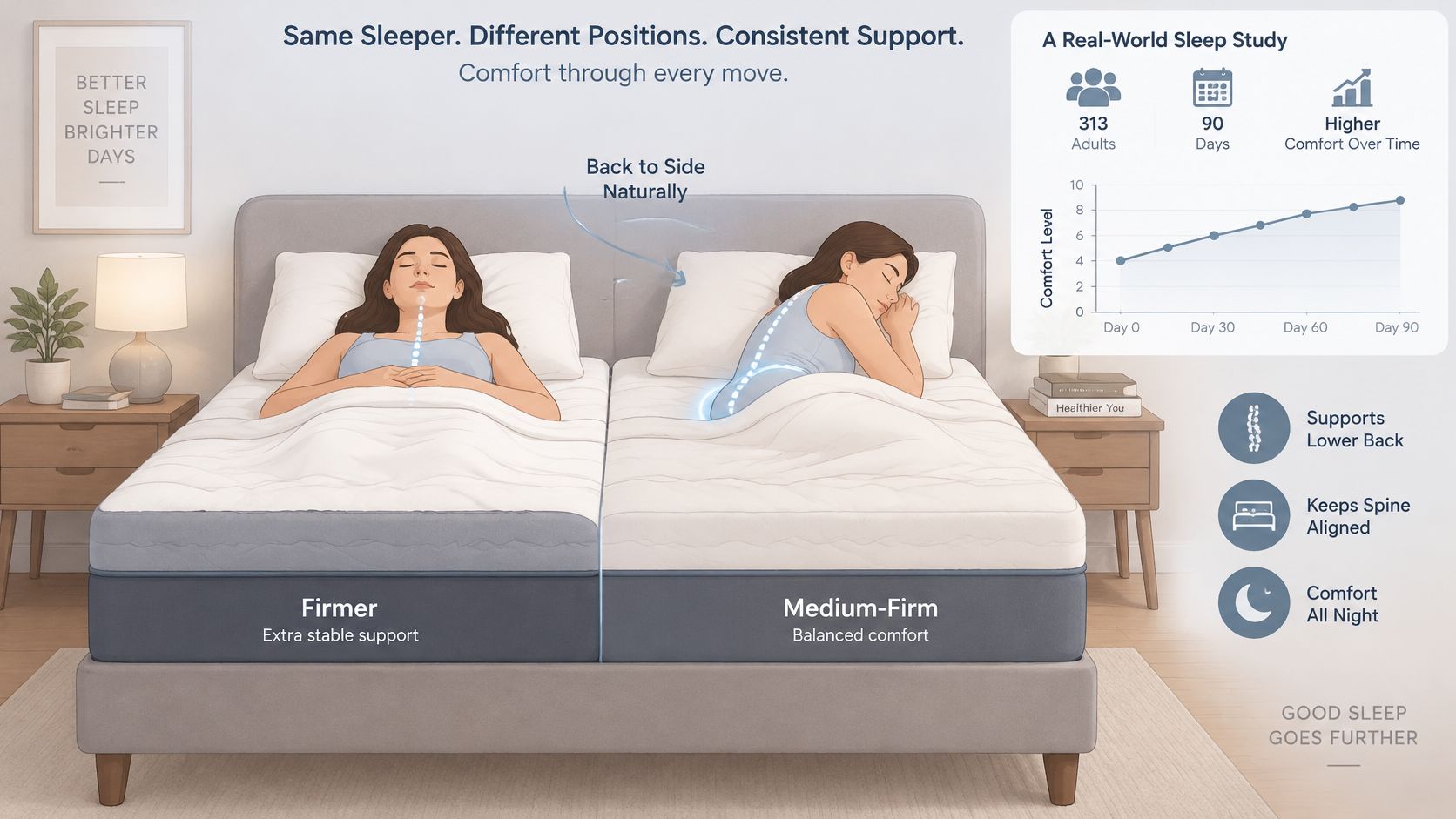
A double-blind, multicenter trial summarized by Clinician assigned 313 adults with chronic nonspecific low-back pain to firm or medium-firm mattresses for 90 days, with disability improving approximately 50% versus 30%, respectively. Both groups improved, and the trial also assessed pain while lying in bed and pain on rising.
A systematic review published in the Journal of Orthopaedics and Traumatology identified 39 qualifying studies published through 2019 and concluded that medium-firm mattresses generally offered the strongest balance of comfort, sleep quality, and spinal alignment. An exceptionally hard surface isn't automatically the better choice.
Start with a band, not a promise
Medium-firm is a sensible starting point, not a prescription. The trial compared firmness categories rather than proving that a particular brand or material treats back pain.
Firmness describes the surface feel; support describes how well the mattress carries the body. A mattress can have a cushioned top and a stable support core, or a hard-feeling top over a base that doesn't adequately control pelvic sink.
The same model can also feel different under different bodies. A lighter sleeper may barely compress its comfort layer, while a heavier sleeper may reach deeper into the construction.
Match the starting point to the sleeper
Firmness and construction by body type and sleep pattern
| Sleeper profile | Firmness band | Construction to consider | Check before buying |
|---|---|---|---|
| Side-dominant with shoulder or hip pain | Medium-soft to medium | Memory foam or latex comfort layer | Shoulder and hip settle without pressure |
| Back-dominant with lower-back pain | Medium-firm | Hybrid with midsection support | Hips don't dip excessively |
| Equal mix of back and side | Medium-firm | Responsive hybrid or latex | Easy turn without bracing or getting stuck |
| Heavier sleeper | Medium-firm to firm | Strong coil or air support | No bottoming out at the hip |
| Lighter sleeper | Medium-soft to medium | Softer comfort layer on a supportive base | No hammock sink in the lower back |
| Couple with different weights or pain | Split or adjustable | Adjustable air or custom firmness | Each side tested through the full routine |
These are starting ranges, not strict assignments. A side-dominant sleeper who also spends substantial time on the back should reject a softer option if it sacrifices pelvic support.
The practical test is whether the surface accommodates the body without forcing a posture. A shoulder shouldn't need to curl forward to escape pressure, and a back sleeper shouldn't need to tense the abdomen to feel supported.
Let the pain pattern refine the choice
Before testing, the Sleep Pro should note the dominant position, painful transition, and location of morning discomfort. That keeps the comparison focused instead of drifting toward whichever mattress feels plushest.
Useful adjustments include:
- Shoulder discomfort: Compare more accommodating comfort layers without immediately abandoning a stable base.
- Pelvic sink: Try stronger underlying support before choosing a harder surface.
- Movement difficulty: Compare recovery speed and depth of contour, not just firmness labels.
The guide to choosing mattress firmness can help distinguish neighboring feels. The Comfort Promise addresses the fear of picking the wrong bed, but its specific terms should be reviewed before purchase rather than assumed.
Memory Foam, Hybrid, Latex and Air Compared
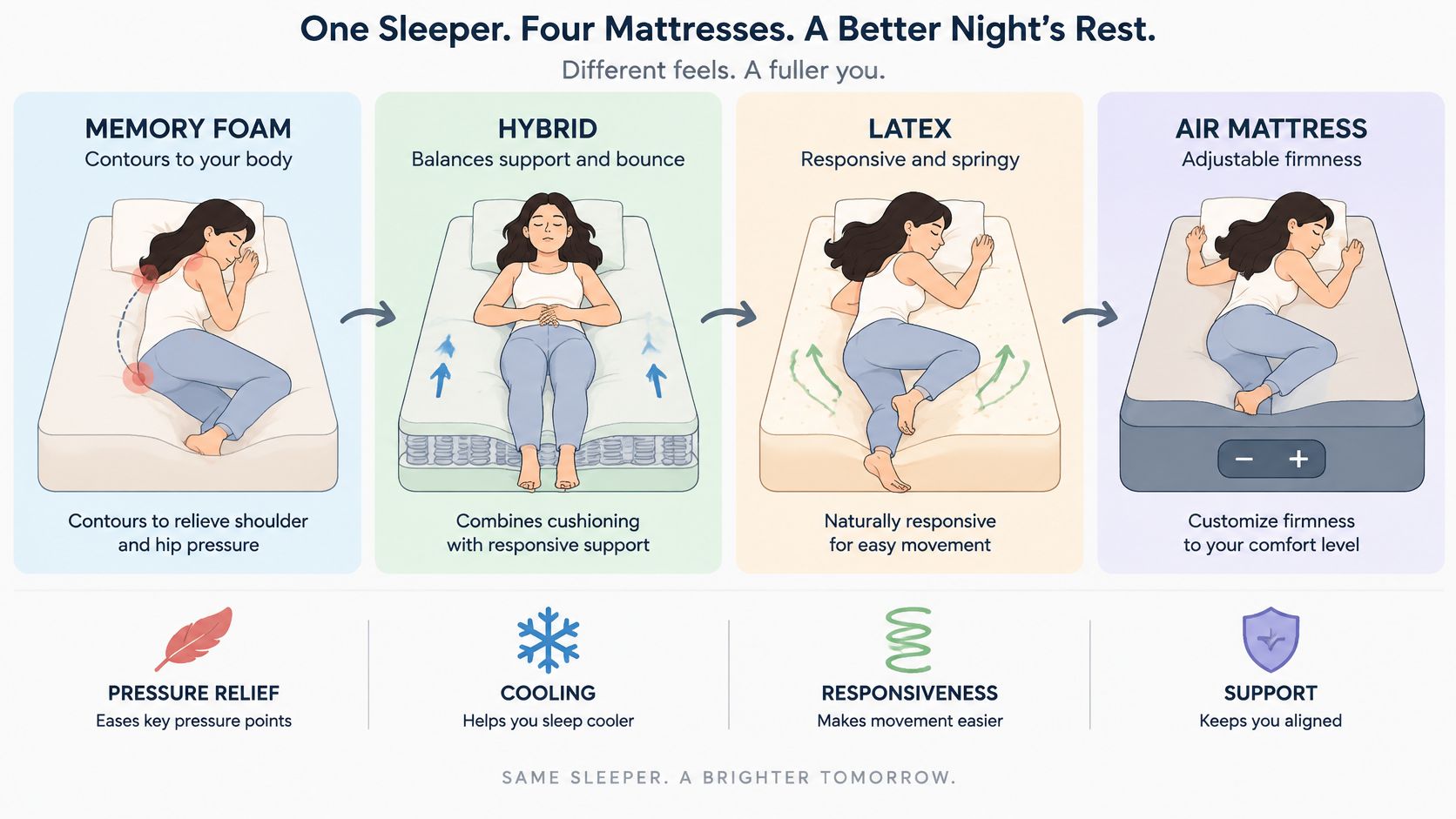
Memory foam emphasizes contouring, hybrids combine comfort layers with coils, latex offers a springier feel, and adjustable air changes support through inflation. None automatically wins for every combination sleeper.
A systematic review indexed by PubMed found 24 eligible studies and reported that subjectively medium-firm mattresses and self-adjusted or custom-inflated systems were most consistently associated with sleep comfort, sleep quality, and spinal alignment. That supports evaluating adjustability without treating it as a universal solution.
Memory foam and hybrids
Memory foam conforms around the shoulder and hip, distributing contact across a broader area instead of concentrating it at prominent points. Tempur-Pedic options are worth comparing when pressure relief is the priority, but deeper contouring can make a turn feel slower.
Some foams retain warmth, and an overly soft assembly can create a hammock sensation. Cooling gel may change initial heat absorption, but it doesn't guarantee all-night cooling; airflow, covers, bedding, and room conditions still matter.
Hybrids pair coil support with foam or other comfort layers. Sealy and Stearns & Foster lines provide options to compare, but thick, slow-recovery comfort layers can still make a coil mattress feel enveloping.
For couples, edge stability and motion transfer deserve separate tests. A lively surface may ease movement while allowing more disturbance when a partner rolls.
Latex and adjustable air
Latex compresses and rebounds readily, producing a more buoyant feel than slow-conforming foam. Ventilated designs can feel cooler, though the complete mattress and bedding assembly matters more than the material name alone.
Latex pricing and firmness differ by model, so a specific showroom comparison is more useful than assuming every latex bed feels alike. Material disclosures also matter for shoppers with allergies.
Adjustable air allows support changes through chamber inflation, sometimes separately across the bed. Custom-firmness hybrids may use a different mechanism, so Sherwood options shouldn't be assumed to contain adjustable air chambers.
A home trial helps sleepers learn which settings suit each side. Constant adjustment isn't helpful if neither partner records what changed.
| Construction | Main trade-off to test |
|---|---|
| Memory foam | Pressure relief versus effort during a turn |
| Hybrid | Easy movement versus partner disturbance |
| Latex | Buoyancy versus preferred contour |
| Adjustable air | Useful fine-tuning versus setting complexity |
The memory foam, hybrid, and innerspring comparison offers additional construction guidance. In a mountain bedroom, breathable covers should be evaluated alongside cooling features rather than treated as an afterthought.
How to Test Back and Side Positions in the Showroom
A useful showroom test recreates the uncomfortable movement instead of avoiding it. Shoes, bulky jackets, and an unfamiliar pillow can distract from mattress fit, so the setup should resemble normal sleep as closely as practical.
Hospital for Special Surgery guidance identifies lower-back sinking below the shoulders and feet as a warning sign of excessive softness, while warning that an overly firm surface can increase pressure-point stress. The goal isn't zero sinking; it's controlled accommodation.
A seven-step transition routine
The following timings are a practical comparison routine, not a validated diagnostic test.
- Begin on the back for three minutes. Notice whether the lower back settles comfortably without an exaggerated hollow or a forced-flat feeling.
- Roll onto the side for three minutes. Let the shoulder and hip settle, watching for concentrated pressure or a need to shift away.
- Return to the back, then try the stomach if relevant. Notice whether the turn requires pushing, bracing, or twisting.
- Repeat side-to-back and back-to-side transitions three times each. If stomach sleeping is habitual, include stomach-to-side movement and identify the most uncomfortable transition.
- Check hip dip on the back. Excessive pelvic descent relative to the shoulders and feet is a reason to compare stronger support.
- Check compression on the side. The shoulder and hip shouldn't feel squeezed, and the waist shouldn't feel unsupported.
- Record the feel after ten minutes. Note any emerging pressure, warmth, or movement resistance that wasn't obvious at first contact.
Rank the weakest result
A phone note can record each model's worst transition as comfortable, noticeable, or unacceptable. A mattress that excels in most positions but causes pain during the habitual turn belongs below a more consistently comfortable option.
A showroom test narrows the shortlist. It can't predict every morning at home.
The Sleep Pros can guide this routine at the Ruidoso showroom without rushing the uncomfortable position. The in-store mattress testing guide helps shoppers arrive prepared to compare consistently.
What Combination Sleepers Typically Spend
In a 2025 survey of 500 U.S. adults who had recently bought or planned to buy a mattress priced at $2,500 or more, 43% of recent purchasers spent $2,500–$3,499, according to the Better Sleep Council survey reported by Sleep Savvy. That figure describes a higher-budget shopping group, not combination sleepers generally.
A Grand View Research mattress-market report cited average online mattress spending of $984 and an online-buyer satisfaction score of 878 out of 1,000 in J.D. Power's 2025 U.S. Mattress Satisfaction Study. These figures offer different spending contexts, not a directly comparable price range or a local quote.
Build a budget around fit
Compare models that support your hardest position change, then weigh their prices within the same firmness band. This helps separate construction differences from a simple soft-versus-firm preference.
Before visiting the shop, choose a spending ceiling that includes the mattress, a necessary foundation, and service costs. On the quote, check the exact model name and size, whether the foundation is included, and what delivery and setup cover.
Compare the complete purchase
The budget innerspring category has no fixed price here, so confirm current models and quotes in store. A lower price only helps if the mattress passes your transition test.
Compare like with like: the same model, size, foundation, and included services. If any of those differ, the quoted totals may not reflect the same purchase.
Living With Mountain Climate and Active Days in Ruidoso
In Ruidoso, a stiff morning can follow a long day outdoors, a change in sleep position, or both. Activity and overnight posture can overlap, so one uncomfortable morning may not tell you whether the mattress is the cause.
For several nights, note the day's activity, the position you woke in, which movement hurts, and whether the discomfort eases after getting up. Comparing similar nights can help distinguish a pattern from the effects of one unusually strenuous day.
Different mountain households need different checks
For a Lincoln County vacation rental, a medium-firm hybrid is a practical starting point for guests with different sleep preferences. Pair it with breathable bedding and lighter layers guests can adjust for warmth.
Couples with different body weights or pain patterns may not agree on one feel. If each partner repeatedly rejects the other's setting, consider split-firmness or adjustable options.
- Cool-night sleepers: Judge comfort under your usual blankets, not only in a climate-controlled showroom.
- Warm sleepers: Look for ventilation and removable bedding layers rather than relying on a cooling label alone.
- Cabin owners: Check base compatibility, rotation guidance, and whether the cover suits frequent laundering.
Keep mattress fit in perspective
Altitude can affect sleep, so Ruidoso's altitude and its possible effects on sleep may help put a disrupted night in context. Track sleep and discomfort alongside mattress fit, rather than expecting one change to explain every restless night.
Persistent or worsening pain with weakness, numbness, or bladder changes needs medical evaluation. AARP's guidance on mattresses and back pain also identifies fever and pain after trauma as warning signs.
Confirm Your Choice With a Local Trial
A mattress that feels comfortable in one position may resist your hardest turn. Keep the shortlist small and judge each finalist by how it handles that transition, then by whether it remains comfortable in your other usual positions. Mattress Pro by Miller Waldrop's showroom is at 2801 Sudderth Drive in Ruidoso.
Turn a preference into a clear decision
A Sleep Pro can discuss your body type, sleeping positions, and budget in a one-on-one consultation. Compare mattress fit first, then consider flexible financing, the Low Price Promise, and Full-Service Delivery with Professional Setup.
Before committing, note the position change that causes the most trouble, compare nearby firmness options, and complete your full showroom routine on each finalist. Ask about the Comfort Promise terms and whether delivery and professional setup are included in your quote. Bring your three most-used sleeping positions to the showroom, test each one, and choose the mattress that handles your hardest transition without creating new pressure points.
Mattress Pro by Miller Waldrop offers personalized mattress comparisons for combination sleepers, including checks for pressure relief, pelvic support, and ease of turning. Visit the Ruidoso showroom to test the position change that causes the most trouble and discuss comfort and delivery terms before choosing.