

In-Store Mattress Testing: A Step-by-Step Sleep Pro Guide

A shopper lies down for thirty seconds, enjoys the softest mattress in the row, and starts thinking about delivery. Then comes the doubt: will that comfortable first impression hold up through a whole night of side sleeping, a partner's tossing, or another morning with an aching back?
In-store mattress testing works better with a timer, a written scorecard, and permission to slow down. The useful question isn't whether a bed feels pleasant at first touch. It's whether that mattress deserves a longer test at home.
Why a Showroom Lie-Down Needs a Plan
A showroom favorite isn't necessarily a sleep favorite. In a controlled RTI International experiment, participants evaluated seven mattresses without knowing their brands, materials, designs, or firmness levels; typical evaluations lasted 10–15 minutes, but their selections didn't reliably identify the mattress that later maximized perceived sleep quality or minimized overnight movement measured through actigraphy.
That finding doesn't make showroom testing pointless. It separates immediate comfort from overnight performance, which includes experiences a short visit can't reproduce.
Screen for problems, not promises
A deliberate visit can reveal uncomfortable shoulder pressure, awkward turning, an unstable edge, or obvious partner movement. It can also establish which surfaces feel supportive in the positions a shopper uses most.
Practical rule: A showroom test earns a mattress a place on the shortlist. It doesn't certify a good night's sleep.
The useful outcome is a repeatable comparison, a six-point scorecard, and two finalists. Only the selected mattress moves into the home evaluation, subject to the store's written terms.
Make the setting relevant
Ruidoso's dry mountain air and cool nights make bedding choices worth discussing. A familiar pillow and a representative light blanket provide a more meaningful setup than a bulky jacket and an unfamiliar display pillow.
A cool showroom also can't establish all-night cooling performance. Warmth, bedding, and time on the surface can change the experience.
On Sudderth Drive, local Sleep Pros serve neighbors from Ruidoso, Alto, and across Lincoln County with hands-on comparisons that a bed-in-a-box website can't physically provide.
How to Run an In-Store Mattress Test Step by Step
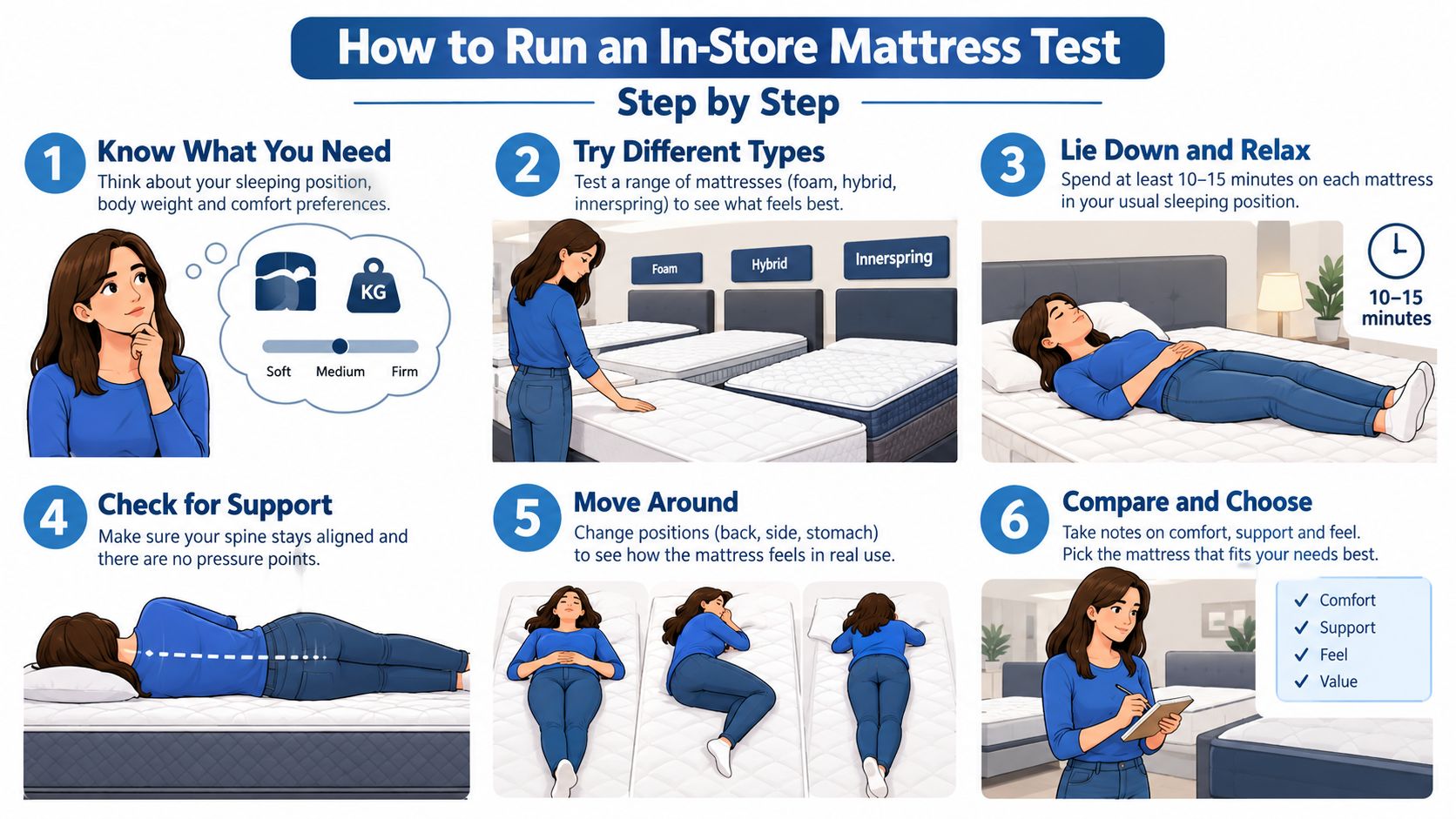
Start with comfortable, close-fitting clothes, without a bulky jacket or heavy jewelry. Bring a light layer and a familiar pillow, or ask for a pillow with similar height and feel.
Before lying down, record the sleeper's primary position, body-size profile, shoulder or hip sensitivity, neck or back concerns, and whether the purchase serves an individual or a couple. That profile gives the Sleep Pro something more useful than a request for a comfortable bed.
Use the same procedure on every candidate
Choose a manageable group. A practical starting set is three to five models. Ask the Sleep Pro to vary the testing order rather than arranging a predictable march from softest to firmest.
Settle into the normal position. Use the timing guide below and keep pillow height consistent. A mattress shouldn't receive credit for comfort created by a better-matched pillow.
Record a complete scorecard. Use a simple scale from one to five for pressure relief, neutral support, ease of movement, temperature, edge support, and partner disturbance. Mark anything untested rather than inventing a rating.
Reset between beds. Sit up or take a short walk before moving on. Record observations immediately so the previous mattress doesn't become a vague reference point.
Retest the finalists. Return to the strongest two candidates and repeat the movements that exposed their differences. Write a concrete reason for the selection, such as less shoulder pressure without difficult turning.
Let observations guide the shortlist
The need for individual comparison is substantial: an RTI field study of 128 adults found that firmness significantly affected 9 of 11 key sleep measures, while the mattress associated with better sleep differed among individuals.
For a sleeper who uses the perimeter, mattress edge support deserves attention rather than an afterthought. A good center-of-bed impression won't answer whether getting out feels stable.
The written scorecard gives a Sleep Pro specific trade-offs to discuss. A single enthusiastic reaction doesn't.
Positions and Minutes Each Lie-Down Needs
The following timing guide is a practical showroom protocol, not a medically validated cutoff or a guarantee of overnight comfort.
Minimum lie-down time and checks by sleep position
| Position | Minimum time | What to check | Common trap |
|---|---|---|---|
| Side sleeping | 5 minutes per side | Shoulders and hips cushioned, waist neither sagging nor hovering | Judging after 30 seconds on the first side |
| Back sleeping | 5 minutes | Lower back supported without arching, neck angle relaxed | Ignoring the gap under the lower back |
| Stomach sleeping | 2–3 minutes | Pelvis not sinking, head and neck rotation comfortable | Lying flat on the back and calling it a stomach test |
| Combination sleeping | 5 minutes per position | Easy transition between side and back | Testing only the position used least |
| Couples, each partner | 5 minutes per side plus disturbance checks | Partner movement barely registers, and each person feels supported | Letting one partner rate the mattress for both |
| Full session per model | At least 10 minutes | A settled comparison after all positions | Stopping at the first comfortable moment |
The full-session minimum is a floor, not a limit. Completing several position checks can take longer, especially when both partners need an independent assessment.
Side and back sleeping
For side sleepers, the shoulder needs room to settle without leaving the waist unsupported. Testing both sides helps distinguish a mattress problem from a sensitivity that appears mainly on one side.
Back sleepers should notice whether the lower back feels supported without being pushed into an exaggerated arch. A hand beneath the waist can help locate a gap, but gap size alone isn't a pass-or-fail test.
Stomach and combination sleeping
Stomach sleepers should use their actual head position rather than an unusually tidy showroom pose. Stop if the position provokes discomfort; there's no benefit in enduring pain to finish a timer.
Combination sleepers need to test the transition as well as each resting position. A surface can feel comfortable while still making rolling unnecessarily effortful.
Why settling matters
A study comparing soft, firm, and custom-arranged surfaces found significant differences in side-sleeping spinal alignment, with the custom arrangement producing alignment closer to neutral than the tested soft or firm surfaces. Position changes how the body loads the mattress, so shoulders and hips need time to settle before judgment.
Those first moments may reflect novelty more than useful support. The timer creates space to notice what happens after the initial impression.
Signs of Good Support Across Alignment, Pressure and Motion
On the side, the useful alignment sign is a reasonably neutral line through the trunk, with support beneath the waist and enough cushioning for the shoulder and hip. Firmer isn't automatically healthier.
A 25-year literature review found the strongest overall support for medium-firm mattresses and described the competing problems: very firm surfaces can concentrate pressure around the shoulders, pelvis, and sacral region, while excessively soft surfaces can allow the pelvis or trunk to sink.
Support signs, what good looks like and the red flags
These are practical screening observations, not diagnoses or predictions of whether a sleeper will awaken.
| Sign | Looks right | Red flag | Test move |
|---|---|---|---|
| Spinal alignment | Waist supported between shoulder and hip on the side | Hips sink noticeably or lower back arches | Lie on the side for five minutes and assess support beneath the waist |
| Pressure points | Shoulders and hips feel cushioned without tingling | Numbness or tingling at shoulder or hip within minutes | Shift from side to back and back again |
| Edge support | Sitting feels stable without a rolling-off sensation | Excessive sinking or a rolling sensation | Sit on the edge for one minute and stand |
| Motion transfer | Partner movement barely registers | Each shift travels noticeably across the bed | Have the partner roll over three times while the other lies still |
| Temperature | No uncomfortable warmth develops under a light blanket | Warm pooling around hips or shoulders | Lie under the blanket for five minutes and note warm patches |
For neutral support, ask a Sleep Pro to observe alignment rather than judging only from the feel of the top layer. For pressure relief, distinguish pleasant cushioning from a surface that merely feels plush initially; the pressure-relief mattress guide provides useful context for that comparison.
Judge the trade-offs together
Ease of movement completes the scorecard: roll, sit up, and change position without pushing excessively through the arms. Deep cushioning isn't an advantage if the sleeper dislikes the effort required to move.
Memory foam and hybrid describe construction, not a guaranteed outcome. Ask how the comfort layers spread pressure and how the support system limits excessive sinking, then test the actual model.
Cooling-gel language also shouldn't substitute for observation. A brief blanket check can identify immediate warmth, but it can't establish temperature regulation through the night.
Comfortable cushioning and stable support need to work together. Neither softness nor firmness deserves an automatic winning score.
A mattress isn't a medical treatment. Persistent pain, recurring numbness, or worsening symptoms deserve clinical advice rather than a more determined showroom test.
How Can Two People Test One Mattress?
In the showroom, give each partner a turn to assess the bed before discussing a shared choice. Independent ratings help keep one person's first impression from setting the decision. The challenge is common: a 2025 survey discussed by AARP found 52% of recent mattress buyers aged 50 and older chose a bed with a partner, and 31% said finding a mattress that worked for both was the hardest part. Use that finding as a reason to score each person's experience separately before comparing preferences.
Run a shared-bed rehearsal
Take turns creating movement. One partner changes position while the other rests normally, then they switch. Note whether the movement feels like a brief ripple at the surface or a larger shift beneath the body.
Practice getting in and out. Each person tries both sides and checks how much the edge compresses and how much effort standing takes. This is useful when partners keep different schedules.
Check the usable sleeping area. Lie near the edge, then closer to the middle. Notice whether either person feels crowded, tilted, or drawn toward the other.
Compare written ratings afterward. Record preferred sides and any unacceptable sensations before discussing the result. Keep each person's support rating visible rather than letting a shared score conceal a weak point.
Choose an acceptable compromise
The guide to mattresses for couples with different preferences can help frame a discussion of conflicting needs. Include both motion transfer and ease of turning in the comparison: a mattress should limit disturbance while still letting each sleeper change position comfortably.
A good compromise leaves both sleepers with acceptable support and no clear weakness.
A model that works reasonably well for both may serve the household better than one person's favorite. The showroom test is a short screening, so use the home trial to check how the choice holds up over time. Each partner can keep separate notes on morning aches and night wakings, then compare them before deciding whether the mattress supports both sleepers.
Questions to Ask Your Sleep Pro Before You Decide
A useful consultation should explain why a mattress belongs on the shortlist, not just repeat its label. Through a one-on-one sleep consultation, a Sleep Pro can compare Tempur-Pedic, Sealy, Stearns & Foster, and Sherwood options against position, body profile, and budget.
Questions worth asking aloud
Which models match this sleep position and body size, and why? A useful answer connects observed support and cushioning to the sleeper, rather than assuming everyone needs the same firmness.
How does this firmness compare with the current mattress? The answer should establish a recognizable reference, including whether the existing surface has softened or developed uneven areas.
Can the test use a familiar pillow and blanket? Matching the home setup helps separate mattress feel from changes in neck support or bedding.
How should both partners test motion and record their ratings? Look for independent assessments and a deliberate disturbance test, not just a shared lie-down.
What does the Comfort Promise cover, and how long is the exchange window? Ask about adjustment requirements, eligibility, charges, and exclusions. Written terms make this protection useful against the fear of picking the wrong bed.
Does the Low Price Promise apply to both shortlisted models? Ask what qualifies for comparison and what documentation is needed, without assuming every offer is equivalent.
What does Full-Service Delivery with Professional Setup include? Confirm foundation requirements, access arrangements, and whether old-mattress removal is included or separately available.
Keep the answers usable
The local business's 70-year Miller Waldrop family legacy provides context for its consultative approach, while the showroom's focus remains sleep. Neighbors in Ruidoso deserve clear answers about both the mattress and the purchase conditions.
Write those answers beside the model names. Reviewing them the next day makes it easier to distinguish a suitable sleep solution from an appealing display.
Turn Your Scorecard Into a Confident Purchase
Start with the two finalists and favor the stronger combination of pressure relief and neutral support, provided neither has an unacceptable weakness. A mattress comfort-level comparison can help describe the difference, but the recorded observations should drive the choice.
Home evaluation addresses what the showroom cannot. A review in Nature and Science of Sleep describes one protocol that tested mattresses for approximately four weeks each, and a separate protocol that used six weeks on the selected mattress, including a two-week adjustment period.
Those are research schedules, not the store's exchange terms. They illustrate why a single night shouldn't be treated as a complete verdict.
Give the selected mattress a fair home test
Confirm protection before payment. Obtain the Comfort Promise terms in writing, including deadlines and required steps. That's the practical safeguard against the fear of selecting the wrong bed.
Start with correct setup. Full-Service Delivery with Professional Setup should establish that the mattress is placed on a suitable foundation. Confirm white-glove service details before delivery day.
Keep a simple sleep notebook. Record morning aches, remembered awakenings, perceived restfulness, and partner disturbance. Note unusual exercise, illness, or bedding changes rather than attributing every difficult night to the mattress.
Discuss persistent problems promptly. Contact a Sleep Pro within the applicable window instead of waiting until options expire. New or worsening pain warrants clinical attention.
The Low Price Promise addresses purchase value; the Comfort Promise addresses fit uncertainty. Neither replaces careful testing, but clear terms make the final decision less pressured.
For timed showroom comparisons, personalized sleep guidance, and options across budgets, visit Mattress Pro by Miller Waldrop at 2801 Sudderth Drive, Suite F, in Ruidoso, Monday through Saturday. Bring a familiar pillow and a list of sleep concerns so a Sleep Pro can help build a shortlist and explain the Comfort Promise, Low Price Promise, and Full-Service Delivery with Professional Setup.