

Does a Good Mattress Improve Sleep? What the Science Shows


Yes, a well-matched mattress can improve sleep comfort and morning back pain, and in one major trial medium-firm sleepers were more than twice as likely to improve in pain while lying in bed than firm-mattress sleepers. A firmer bed isn't automatically better, though, and no mattress treats every sleep disorder.
That raises a fair question. If the bed matters, why do some people buy an expensive one and still wake up tired? The answer usually sits in the fit, not the price tag, and in knowing which problems a mattress can change.
Does a Good Mattress Improve Sleep? The Short Answer
A mattress can affect comfort and pain, but the benefit depends on how well it suits the sleeper. Research on people with chronic low-back pain offers a clear example.
What the strongest trial found
A randomized, double-blind, multicenter trial published in The Lancet assigned 155 people to medium-firm mattresses and 158 to firm mattresses. The 313 participants had chronic, nonspecific low-back pain. After 90 days, the medium-firm group was more than twice as likely to report less pain while lying in bed, with an odds ratio of 2.36 and a 95% confidence interval of 1.13 to 4.93. Improvement in disability also favored medium-firm support, with an odds ratio of 2.10.
The result applies to that group and that outcome. It does not establish one firmness as right for everyone.
The wider evidence points the same way
A 2026 orthopedic literature review in the Journal of Orthopaedics and Traumatology examined 47 studies across approximately 25 years. Its findings most consistently favored medium-firm mattresses over very firm or very soft surfaces for pressure distribution, sleep quality, morning stiffness, and low-back-pain intensity. The authors also cautioned that differences in materials, firmness scales, and outcome measures make studies difficult to compare.
A systematic review of nine studies on chronic low-back pain found that medium-firm mattresses may reduce pain and improve sleep quality more effectively than firmer mattresses. Medium-firm beds and air-overlay systems also showed better pain and sleep outcomes than standard mattresses.
Plain rule: Firmer does not automatically mean more supportive. Comfort depends on how the surface supports your body and distributes pressure.
What the mattress studies found
| Study | Who was tested | What changed |
|---|---|---|
| 2003 randomized trial in The Lancet | 313 adults with chronic low-back pain | Medium-firm beds improved pain in bed (odds ratio 2.36) and disability (odds ratio 2.10) compared with firm beds |
| Home study of seven mattresses | 128 healthy adults, about four weeks per mattress | Firmness affected 9 of 11 sleep measures |
| Eight-week grid mattress study | Adults with nonclinical insomnia symptoms | Participants reported better sleep quality, less perceived pain, and less daytime fatigue |
| 28-day bedding study | 59 healthy adults | Participants reported better comfort, perceived sleep quality, and sleep efficiency over weeks one to four |
| 2026 orthopedic review | 47 studies over about 25 years | Medium-firm mattresses were most consistently favored for pressure distribution, sleep quality, morning stiffness, and low-back pain |
| Systematic review of chronic low-back pain | Nine studies | Medium-firm mattresses and air-overlay systems showed better pain and sleep outcomes than firmer or standard mattresses |
For back pain, the randomized trial and reviews provide the stronger evidence. The smaller home studies suggest that mattress feel may affect sleep measures, but they offer less certainty. A mattress can influence comfort and support; it cannot, by itself, resolve every cause of poor sleep.
How a Mattress Changes the Quality of Your Night
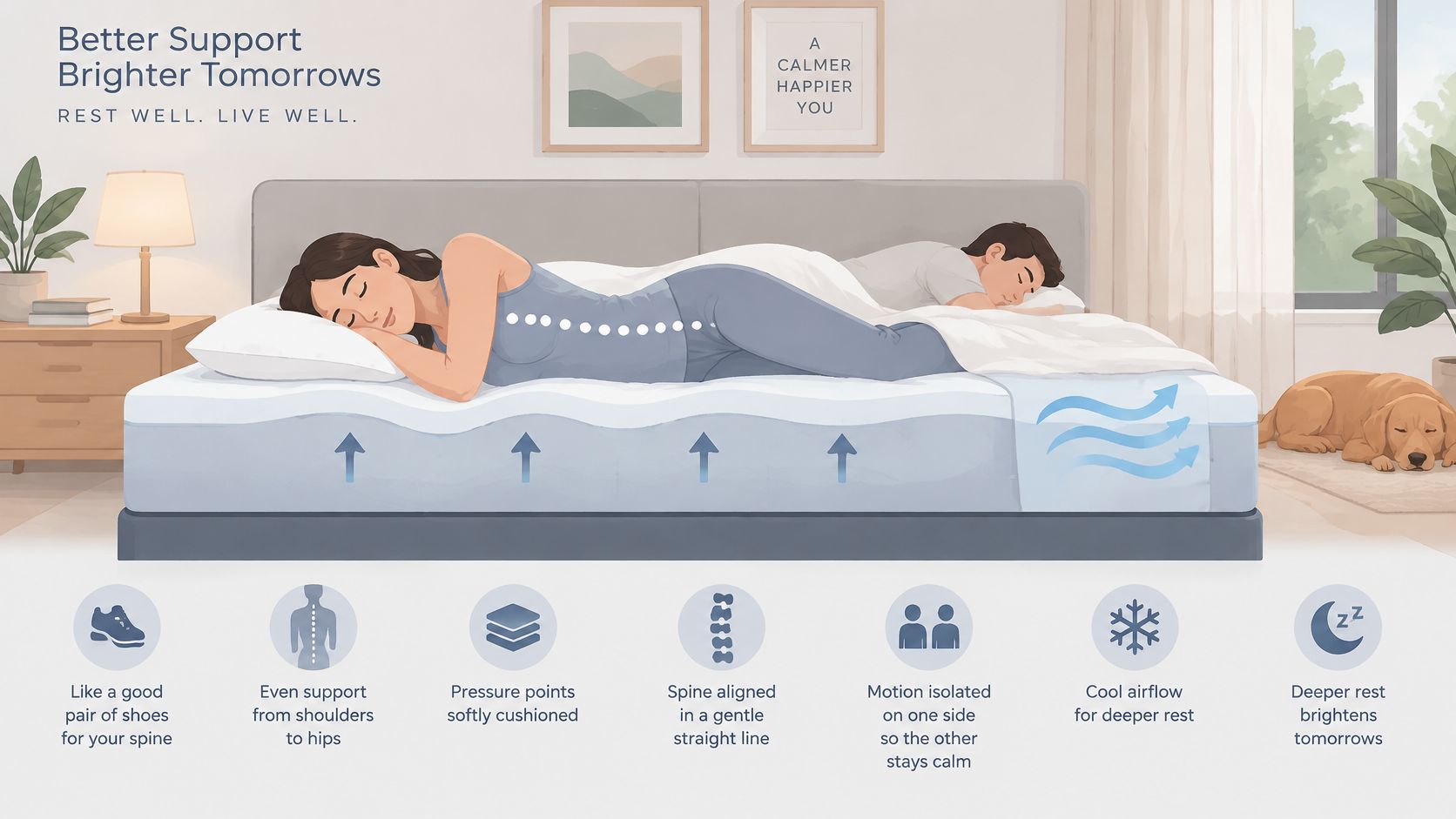
Think of a mattress like a good pair of shoes for the spine. The right pair spreads the load so no single spot takes all of it. The wrong pair feels fine for five minutes, then starts to nag.
Pressure relief at shoulders and hips
Your shoulder and hip carry concentrated weight, especially on your side. When a surface pushes back too hard, blood flow and comfort suffer, and you shift position to escape the pressure. Many of those shifts are small wake-ups you don't remember, but they still fragment the night.
Memory foam helps here because it contours around pressure points instead of bridging over them. The trade-off is heat. Dense foam can trap warmth unless the design uses an open-cell structure or a cooling gel layer.
Alignment and motion control
Spinal alignment is the second job. Your hips and shoulders should sink just enough that the spine stays straight rather than bending like a hammock or arching like a board. Too soft and the middle sags. Too hard and the shoulder gets shoved upward while the waist gets no support.
Movement isolation matters for couples. Foam and individually wrapped coils absorb a partner's turn at the source, so the motion stops before it crosses the bed. Older connected-coil designs pass that movement along like a ripple.
Support is about pressure distribution, not firmness alone. A hard bed can still support you badly.
Heat and materials
Temperature is the fourth mechanism. A bed that traps heat invites tossing, kicking off covers, and broken sleep. Hybrid mattresses pair coils, which allow airflow and add bounce, with foam comfort layers on top. Latex gives responsive support with a springier feel and tends to sleep cooler than dense foam.
An eight-week study in Aerobiologia tested a pressure-releasing, medium-firm grid mattress in adults with nonclinical insomnia symptoms and found statistically significant improvements in sleep quality and quantity, perceived pain, stress, mood, and daytime fatigue, with significance levels below 0.05. The researchers still called for randomized controlled trials in broader populations, so the result supports careful testing rather than certainty.
Ruidoso adds a local wrinkle. Dry mountain air and cool nights at elevation mean a breathable bed can feel perfect in July yet chilly in January under thin bedding. Ask about temperature-neutral materials that neither trap summer heat nor feel cold and stiff on winter mornings.
Signs Your Mattress Is Costing You Sleep
When does a stiff back mean the mattress, and when does it mean something else? The first clue is timing. If the ache fades within minutes of getting up and moving around, the bed deserves suspicion before your body does.
The decline you stop noticing
Mattresses do not fail all at once. Foam softens season by season, coils lose resilience, and support zones compress where you sleep most. Because the change is gradual, you adapt to it until a hotel bed or a guest room suddenly feels better than home.
A visible dip, lumps, a partner's movements waking you, sleeping hot, and morning sneezing or itchy eyes are the usual clues. The practical guidance on when to replace your mattress helps sort age from actual wear, since a lightly used guest bed ages differently than a nightly bed.
A short checklist for your own bed
Press down on the center and edges. A hollow or a soft spot that does not spring back points to compressed layers or broken coils. Lie still while your partner shifts weight. If the movement crosses the bed, the motion isolation has weakened. Wake up sweaty under bedding that used to feel neutral, and the top layers are likely trapping heat. Sneezing or itchy eyes on waking can mean dust mites have settled into an old foam surface, especially if it has no cover. Any of these signs is worth writing down, because one annoying night is weak evidence and a pattern over weeks is stronger.
The signs above are mechanical: pressure, alignment, movement, and heat. They respond to a different surface. Loud snoring, gasping, or an urge to move your legs at night do not.
The dust-mite link is real enough to check. One study in Allergy found the odds of finding dust-mite feces were four times higher in foam mattresses than in spring mattresses, with an odds ratio of 4.0 and a 95% confidence interval of 1.1 to 15.1. For foam mattresses without covers, the odds were eight times higher, with an odds ratio of 8.1. That finding points to construction and covers, not to every old bed being hazardous. If you have asthma or dust-mite sensitivity, a breathable zippered encasement and regular vacuuming of seams and edges are sensible steps this week.
Replacement threshold: Two or more signs from this checklist, in a bed that has lost its support, are a reasonable trigger to start shopping rather than wait for a worse month.
When a Mattress Will Not Fix Your Sleep
A mattress can affect pressure, body support, movement, and heat. It cannot treat insomnia, sleep apnea, restless legs, or other medical conditions. Knowing which kind of problem you are facing helps you choose the right next step.
When should you see a clinician instead of buying a bed?
Loud snoring, witnessed breathing pauses, persistent daytime sleepiness, unexplained pain, or an urge to move your legs at night deserve medical evaluation. A bed change may improve comfort, but it does not address the underlying cause of these symptoms.
A review of therapeutic mattresses in the National Center for Biotechnology Information Bookshelf found the strongest evidence for comfort, movement-related disturbance, and some back-pain outcomes. The review also notes that studies were limited, and some trials found improvements with both firm and medium-firm beds. These findings support a careful distinction: a mattress may help with physical discomfort, but it is not a substitute for clinical care.
A two-part test you can use tonight
- Mechanical problems point to the bed: A sagging surface, pressure discomfort, waking when a partner moves, or feeling overheated may improve with a different sleep surface.
- Possible medical problems point to a clinician: Breathing pauses, ongoing daytime sleepiness, unexplained pain, or nighttime urges to move your legs need assessment rather than a mattress purchase.
Sleep habits can matter alongside either step. Learn how sleep hygiene supports better sleep and consider whether your routine may be contributing to the problem. If changing the bed seems appropriate, give yourself time to notice whether the specific discomfort that prompted the change improves. Seek care promptly for concerning symptoms rather than waiting to see whether a new mattress helps.
Matching Firmness to Your Body and Sleep Position
The firmest bed in a store is rarely the best bed in the store. A home study makes that point clearly.
What happens at both extremes
A peer-reviewed home study from RTI Press enrolled 128 healthy adults who slept on seven mattresses for approximately four weeks each, measured with actigraphy and sleep diaries. Firmness significantly affected 9 of 11 key sleep measures. The least-firm mattress brought more pain, poorer sleep, and worse daytime function, but the firmest also produced more pain and worse self-reported sleep, with no clear advantage in objective sleep indices, daytime sleepiness, or energy.
The useful benchmark is a surface that limits pressure-related awakenings without letting the body sag or the spine twist. That is why the question does a good mattress improve sleep has a different firmness answer for different bodies.
Firmness and what to check by sleeper profile
| Sleeper profile | Typical starting firmness | What to check in store |
|---|---|---|
| Back sleeper | Medium to medium-firm | Spine stays neutral and the lower back is supported without a gap |
| Side sleeper, lighter build | Medium-soft to medium | Shoulder and hip sink in without the spine dropping |
| Side sleeper, heavier build | Medium-firm to firm | Hips are supported and do not sink deeply |
| Stomach sleeper | Firm to medium-firm | Hips stay level and the lower back does not arch |
| Combination sleeper | Medium | Test both positions for 10 to 15 minutes each |
| Couples with different weights | Split or dual-zone support | Test each side separately with your partner lying still |
Why weight changes the answer
A heavier side sleeper compresses comfort layers faster and needs more support at the hips to avoid sinking into a curve. A lighter side sleeper barely dents a firm surface, so the shoulder never sinks and pressure builds instead. Same position, opposite problem.
Couples with different weights or positions may need separate firmness zones or a split design. Reading about how to choose a mattress firmness before a store visit helps narrow the starting point. Hybrid models from Sealy or Stearns & Foster feel different from TEMPUR material beds from Tempur-Pedic, and Sherwood options add other support feels, so guessing from a label alone is unreliable.
The rule that holds up: The right firmness keeps your spine neutral and lets you stay still. If you keep hunting for a comfortable spot during a test lie-down, that bed is telling you something.
How to Test a Mattress Before You Buy
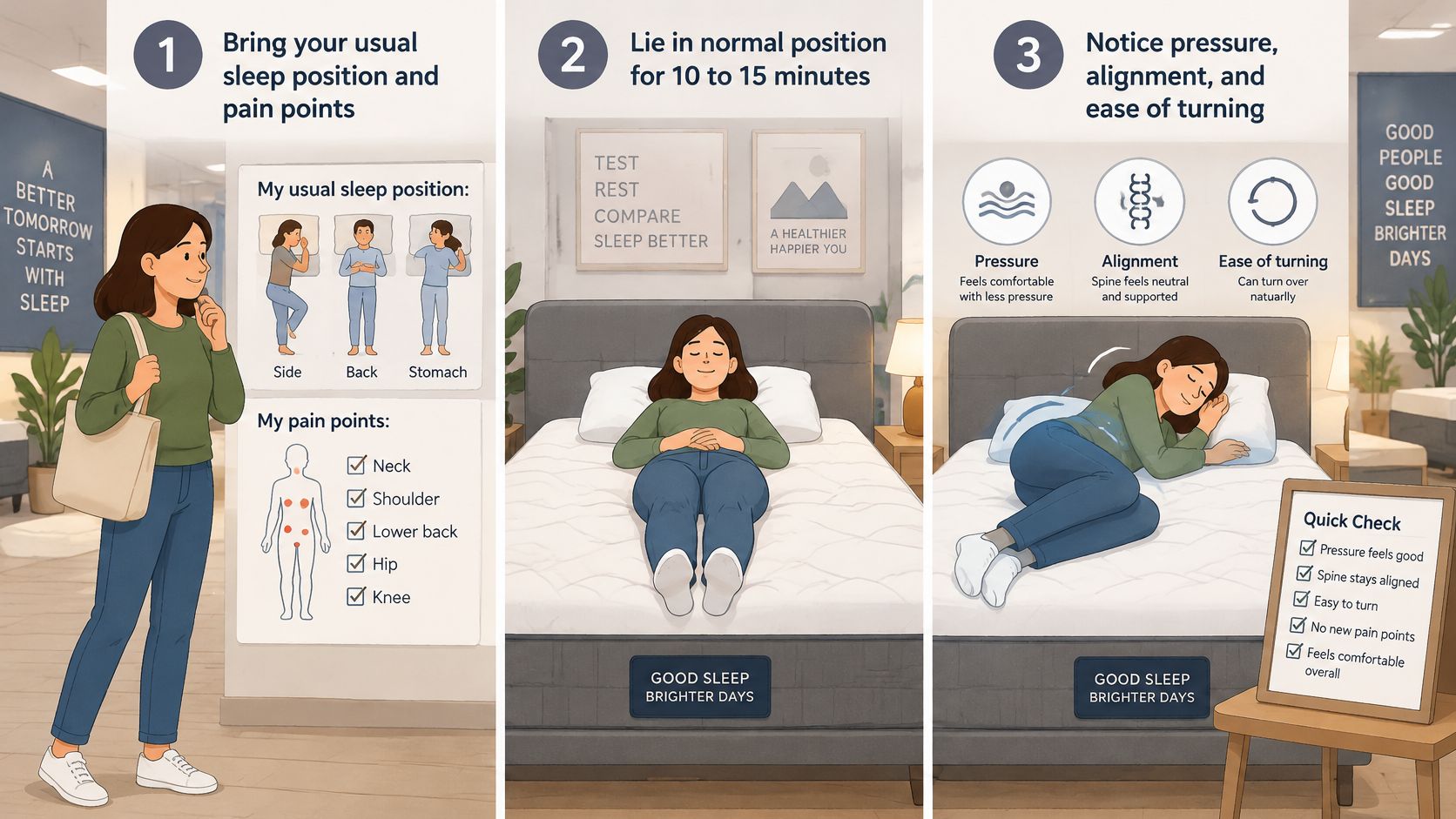
A quick sit on the edge cannot tell you how a mattress will feel through the night. Test it in the position you usually sleep in, and give your body time to register pressure and support.
Steps to better sleep testing
- Describe your sleep habits: Tell the Sleep Pro how you usually fall asleep and where you feel discomfort in the morning. Mattress Pro consultations focus on your sleep habits and desires before you select a mattress.
- Lie down for 10 to 15 minutes: Notice whether pressure builds at your shoulder or hip. A brief test may not reveal discomfort that becomes distracting after you have stayed in one position.
- Check spinal alignment: On your side, look for a straight line from your head through your back. On your back, a hand under your lower back should meet gentle resistance, not fall into a gap or feel tightly squeezed.
- Test together: Lie still while your partner rolls over or sits up. Motion transfer is easier to judge when one person stays still and the other moves.
- Ask about returns before paying: Find out how to contact customer service and what to expect from the return process. The guide to in-store mattress testing can help you prepare for the visit.
During your test, pay attention to how the surface feels after you have been lying still for several minutes. If it becomes uncomfortable, note where and in which position you feel it. That detail can help narrow down what to try next.
Book a Sleep Consult at Our Ruidoso Showroom
Bring a short list to the showroom: your usual sleep position, where you ache when you wake, whether a partner shares the bed, how warm the room runs, and what you plan to spend. Then add the line most shoppers leave out. Note anything that happens at night a mattress cannot touch, such as snoring that stops and starts, or legs that will not settle. Saying those out loud lets a sleep pro separate pressure and alignment problems from the ones that belong with a clinician.
What to expect from the visit
Customers who need help choosing a mattress can connect with a sleep pro through a sleep consultation, and the conversation opens with sleep habits rather than a sales pitch. Mattress Pro by Miller Waldrop is a local, family-owned business, and the showroom carries Tempur-Pedic, Sealy, Stearns & Foster, and Sherwood at 2801 Sudderth Drive in Ruidoso, in comfort levels that run from ultra firm to ultra plush. If you want a head start, answer a few questions in the Mattress Guide and bring the recommendations with you, then lie on the models that match.
What happens after you choose
The Rest Easy Guarantee stays with the decision after delivery. Mattress Pro matches local competitor prices, offers financing that spreads the cost over time, and the personalized setup service has experts position the mattress for optimal comfort, adjusted to your unique preferences.
The point of the visit is a bed matched to your body, sleep position, and budget, tested in person rather than picked from a firmness label. Pressure, alignment, motion, and heat are the four things a mattress can change. Insomnia, sleep apnea, and restless legs are not, and a straight answer at the showroom will tell you which list your problem belongs on.