

How to Choose a Memory Foam Mattress for Heavy People

The most common advice about choosing a memory foam mattress for heavy people is also the least complete: buy something firmer. Firmness isn't the same as support. A hard surface can press against the shoulders while still allowing the pelvis to sink too far into the layers underneath.
A better choice starts with body shape, sleeping position, and the entire support system, including the foundation. At Mattress Pro by Miller Waldrop, that's the purpose of a Sleep Pro consultation: helping Ruidoso and Lincoln County neighbors evaluate how a mattress fits, rather than treating a firmness label as the answer.
Specs a Heavy Sleeper Should Check First
Heavier sleepers don't automatically need the hardest foam available. They need a mattress with an appropriate published load rating, enough cushioning for pressure relief, and underlying resistance that keeps the body from settling unevenly.
Medium-firm is a reasonable starting point, not a prescription. A systematic review in the Journal of Orthopaedics and Traumatology found that medium-firm mattresses generally improved comfort, sleep quality, and spinal alignment, but that doesn't establish a universal firmness for every heavier sleeper.
Start with the construction, not the label
Memory foam is the contouring material near the surface. Its job is different from that of the support core underneath, which must resist excessive compression under sustained load.
A useful construction combines a pressure-relieving comfort layer, a supportive core, a stable perimeter, and a compatible base. A thick, soft surface isn't necessarily an upgrade if the sleeper sinks through it and struggles to turn.
Density needs careful interpretation, too. Density describes material mass within a given volume, not how hard the foam feels. Comfort-layer density and support-core density should be requested separately, rather than accepted as a single high-density marketing claim.
The guide to memory foam mattress density helps distinguish those specifications. There isn't a defensible universal density cutoff in the available evidence that guarantees a mattress will suit every heavier body.
What heavier sleepers should look for in memory foam
| Spec | Target for heavier sleepers | What fails if skipped |
|---|---|---|
| Weight rating | About 250 lb per person on many standard beds; some plus-size designs support up to 1,000 lb total, according to Tom's Guide's 2024 overview | Early sag and a rating that doesn't cover both sleepers |
| Firmness starting point | Medium-firm feel over a stronger support core, not the softest or hardest label | Pelvic hammocking or harsh shoulder pressure |
| Pressure and alignment | A cushioning layer that lowers pressure while the core limits pelvic sink | Spinal distortion or sore hips and low back |
| Foam density | Published comfort-layer and core densities, evaluated alongside durability evidence | Fast softening under a heavier load |
| Edge support | A reinforced perimeter that holds during sitting and lying near the side | A smaller usable surface and a roll-off feeling |
| Foundation | Published combined-load capacity, with center support and close slats when required | Faster sag and a potential warranty problem |
Use each row as a shortlist filter, not a brand ranking. A mattress that clears the weight requirement still needs a position-specific comfort test; a comfortable surface still needs documented support specifications.
The pressure tradeoff explains why softness alone isn't enough. A finite-element analysis comparing foam mattresses found that interface pressure fell from more than 10 kPa to 6.4 kPa as foam firmness decreased, while softer materials also increased spinal distortion, particularly around the pelvis and lower back.
Practical rule: The useful target is cushioning without collapse, not maximum softness or maximum hardness.
A brief sit can reveal an uncomfortable edge or surface, but it can't establish overnight alignment, rated capacity, or long-term durability.
Firmness by Body Shape and Sleep Position
One firmness label won't fit every heavier person. Body proportions and sleeping position change where the mattress needs to yield and where it needs to resist.
In a study of 59 healthy participants, participants with higher body weight showed more neutral spinal alignment on firmer configurations, while lighter participants tended to align better on softer surfaces; height and body shape also affected the findings. That supports individualized testing, not an automatic extra-firm recommendation.
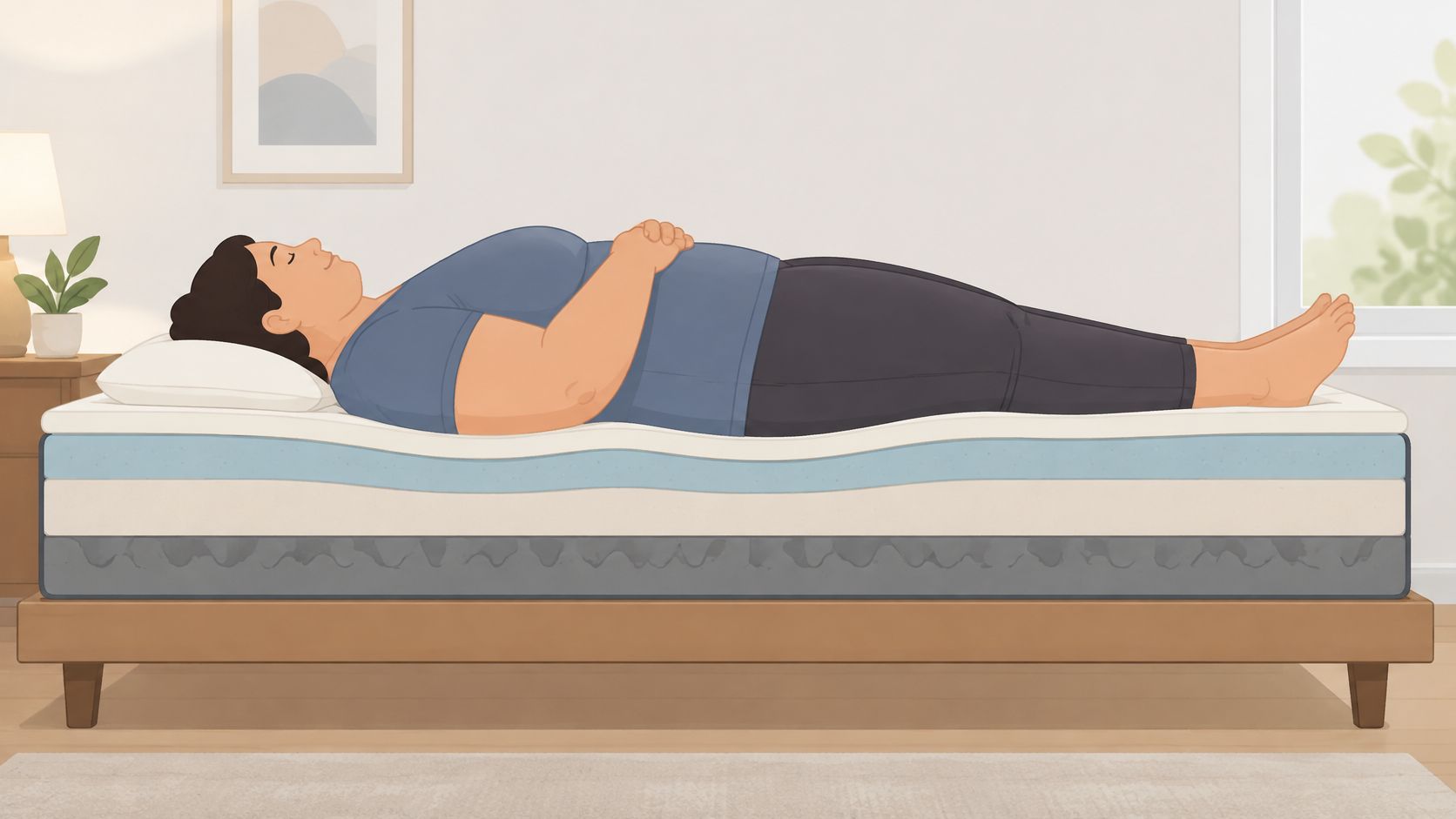
The same weight can need different resistance
A broad-shouldered side sleeper needs room for the shoulder to settle. If the surface holds that shoulder too high, the sleeper may feel pressure around the shoulder and neck even when the mattress seems impressively sturdy.
A back sleeper needs contact through the lumbar region without a deep pocket under the pelvis. A stomach sleeper needs enough surface resistance to prevent the middle of the body from dropping and straining the lower back.
These are different jobs. Support means maintaining a comfortable relationship between body regions, not keeping every part of the body at the same height regardless of position.
The mattress firmness guide can help organize preferences before a showroom visit. The final judgment still belongs to the sleeper's position and pressure points, not the name printed on the tag.
A couple needs separate assessments
Consider a couple with similar body weights: one partner sleeps on the side with broad shoulders, while the other sleeps on the stomach and carries more weight through the middle. The side sleeper may need more surface give, while the stomach sleeper may need greater resistance under the pelvis.
Testing only the middle of the mattress together can conceal that mismatch. Each partner should first settle on the intended side, then turn and change positions while the other remains in place.
If no shared surface meets both needs, a split king may be worth considering. It's an option for an unresolved comfort mismatch, not a requirement because partners have different weights.
How to read alignment by sleeper
| Sleeper situation | Main risk | What the sleeper should feel |
|---|---|---|
| Heavier side sleeper | Too-firm foam concentrates shoulder and hip pressure | Shoulder settles slightly while the spine stays level |
| Heavier back sleeper | A gap at the low back or a sunk pelvis | Lumbar contact without disproportionate pelvic sinking |
| Heavier stomach sleeper | Pelvis sinks and strains the low back | Resistance beneath the pelvis without a board-like surface |
| Partners with different weights | One side hammocks while the other barely contours | Each person remains supported on the intended side |
| Partners with different positions | One surface can't cushion and resist appropriately | Both can turn comfortably without an obvious alignment compromise |
| Cabin or guest use | Unknown body types share the bed | A higher published weight limit and a stable reinforced edge |
For a Ruidoso cabin or Alto guest room, the buyer can't predict every visitor's proportions. A generous documented capacity, dependable perimeter, and broadly comfortable surface make more sense than choosing the plushest first impression.
Guest-room shopping still benefits from a real lie-down test. The person buying the mattress should evaluate how accessible the bed feels, particularly near the edge, rather than judging it only from the center.
How to Test a Memory Foam Mattress in Store
A useful showroom test reproduces normal sleep. Two shoppers with the same body weight can need different foam resistance, because shape and sleep position change where the load concentrates. The goal is to notice excessive immersion, concentrated pressure, and difficult movement before making a purchase.
The systematic review of mattress design and sleep outcomes supports allowing at least 10–15 minutes in the normal sleeping position as part of a practical alignment assessment. Objective firmness, pressure, spinal shape, and perceived comfort don't always move together, so no single sensation settles the decision.
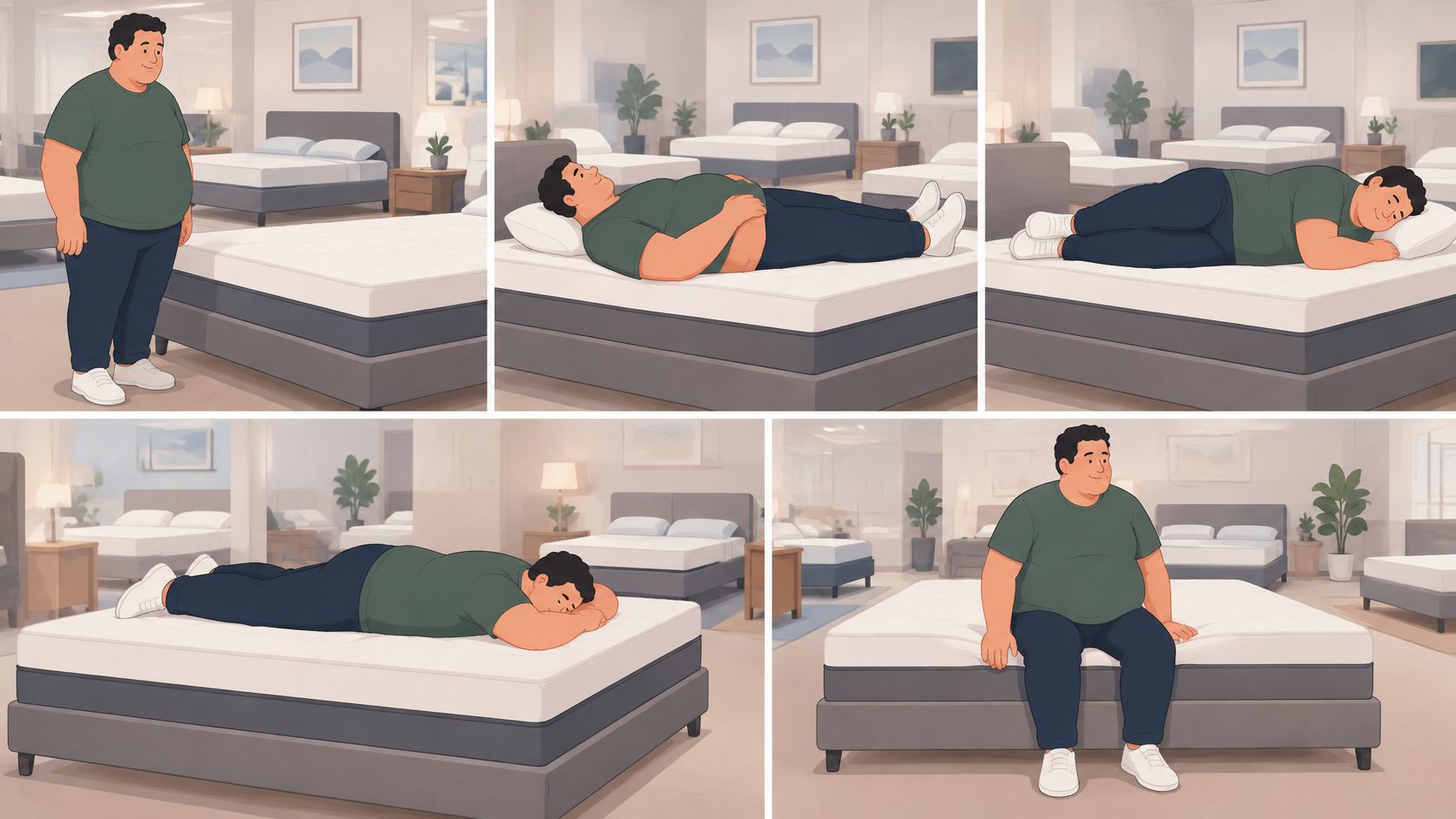
Five checks for the showroom floor
Name the starting conditions. Before lying down, share a weight range, usual sleeping position, and where weight is carried. A floor test only means something when it resembles actual sleep, and the same number on a scale reads differently across body shapes. Common slip: a side sleeper tests exclusively on the back because that feels less awkward in a store.
Stay in the usual position. Memory foam needs time under load to reveal its contouring behavior. The first touch is a handshake; the settled feel after several minutes is the conversation. Let the hips and shoulders settle instead of repeatedly sitting up to compare tags. Common slip: making the decision before the initial surface impression changes.
Check the body's profile. A companion can look at alignment or take a phone photo, with permission and without including other customers. The useful question is whether the pelvis has dropped conspicuously below the shoulders or ribcage. Common slip: assuming an enveloping sensation proves the body is well supported.
Separate lumbar contact from pressure relief. The low back should feel supported without a hard ridge, while the shoulder and hip shouldn't feel pinched. A side sleeper can pay particular attention to whether the lower shoulder has enough clearance. Common slip: dismissing an obvious pressure point because the mattress feels supportive elsewhere.
Use the perimeter and turn. Sit on the edge, lie near the side, then roll toward the center. This reveals whether the edge remains usable and whether the foam makes ordinary repositioning laborious. Common slip: treating a firm label as proof that the edge and deeper layers will hold.
Make the comparison useful
Preparation narrows the field before the first lie-down. You can answer a few questions in the Mattress Guide to receive sleep recommendations, then carry those preferences into the showroom. The in-store mattress testing guide walks through the same process step by step.
Compare mattresses under identical conditions. Test each candidate in the same position for roughly the same stretch of time, and bring the usual pillow or match its height closely. A pillow that sits higher or lower than normal can mimic a mattress problem the mattress itself never caused.
A mattress can feel welcoming at first contact and still be wrong after the body settles.
A compact phone note keeps the comparisons honest once several mattresses start to blur together:
- Pressure: Record the specific location of discomfort instead of a one-word verdict of firm or soft.
- Movement: Note whether rolling requires pushing hard with an elbow or lifting the hips.
- Alignment: Save the observation about pelvic position alongside the initial comfort rating.
- Partner fit: Record each person's response separately before choosing a shared favorite.
Support Core Edge and Foundation Checks
The most useful durability questions are direct: What supports the mattress? What total load is allowed? What does the warranty cover?
A satisfactory answer should identify written requirements, not just describe the mattress as heavy-duty. Mattress and foundation specifications need to work together, particularly when an existing base will remain in use.
Confirm the foundation before paying
According to the Living Spaces guide to mattress bases, a typical foundation may support approximately 500 to 1,500 pounds, counting the mattress and sleepers. That broad range isn't permission to assume an existing frame is adequate; the specific product's rating and support requirements control the decision.
The buyer should locate the base's model information and photograph its support structure. Useful photographs show the slats, center rail, legs beneath the center, and any bowed or damaged components.
The memory foam mattress foundation guide explains the compatibility questions worth resolving. A frame that holds an older mattress isn't automatically approved for a heavier replacement.
Durability questions to ask before buying
| Ask this | A useful answer | Risk if it is vague |
|---|---|---|
| Published load | Stated mattress and base limits covering the intended sleepers | Loading beyond the documented design |
| Foam stack | Identified comfort layers and a separate support core | Excessive sinking with little underlying resistance |
| Edge | An identified reinforced perimeter | Lost sleep surface and edge breakdown |
| Durability evidence | Specific firmness-retention, height-change, or standardized testing information | A density number without performance context |
| Warranty | Named coverage for impressions, height loss, or structural defects | A visible sag that doesn't qualify for a claim |
| Current base | Confirmed slat spacing, center support, and weight limit | Premature sag and possible warranty exclusion |
A layer diagram helps distinguish a cushioning surface from the structure beneath it. Comfort-layer thickness matters because a sleeper may travel through that layer before encountering meaningful resistance.
The edge deserves its own explanation, too. A dense center core doesn't establish how the perimeter will behave under concentrated sitting pressure.
Ask for evidence, then document the setup
ASTM F1566 provides a testing framework covering firmness, firmness retention, durability, impact, and height change. A specific result can help compare constructions, but a result for one design shouldn't be generalized to every foam mattress.
The shopper should also distinguish normal softening, measurable impressions, and covered structural defects. Those terms may lead to different warranty outcomes, so the actual written coverage matters more than an informal assurance that sagging is covered.
At delivery, a simple record makes later questions easier to resolve:
- Photograph the setup: Include the mattress surface and supporting base before bedding hides them.
- Measure consistently: Use the same reference points and measuring method for later comparisons.
- Keep documents together: Save the model information, receipt, foundation requirements, and warranty.
- Follow permitted care: Rotate only when the manufacturer allows it, and don't assume the mattress can be flipped.
A later check after several months can reveal changes worth discussing before they become difficult to document. Neither a high-density claim nor a very firm feel proves durability without construction details, compatible support, and meaningful performance evidence.
Cooling Tips for Dry Mountain Nights
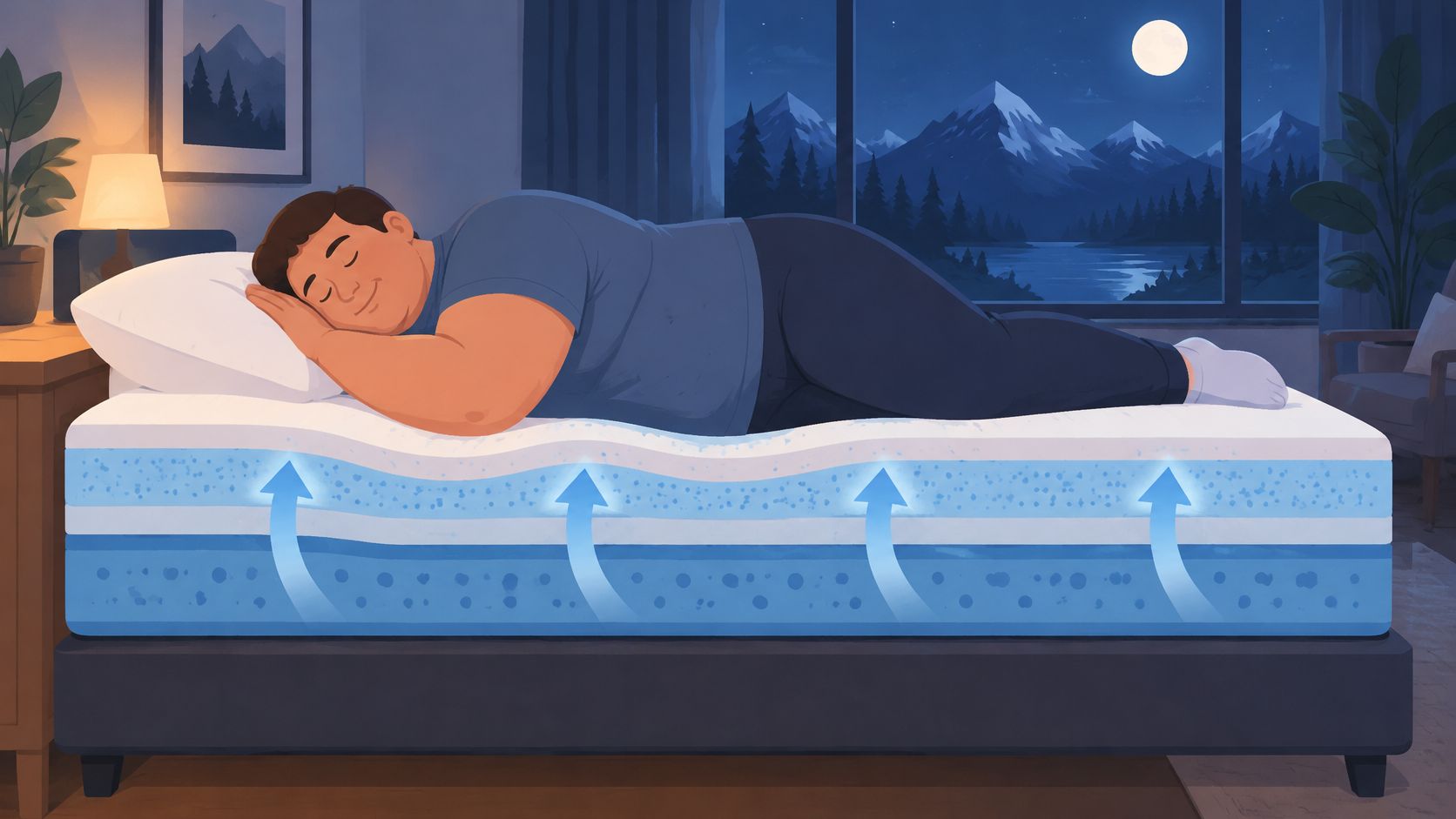
A gel or open-cell label doesn't prove that a mattress will sleep cool. Cooling depends on how the mattress and bedding handle heat around the sleeper, not on an additive named on the hangtag.
Close contouring can leave less air space around the torso, particularly when a sleeper settles into the mattress. The practical question is whether the complete bed allows comfortable ventilation while maintaining the position that passed the alignment test.
Separate cooling construction from cooling language
Gel technology may change the initial thermal feel of a foam layer, but the word gel doesn't establish all-night temperature comfort. Open-cell foam describes a structural approach to airflow, yet the surrounding layers and degree of compression still matter.
A memory-foam hybrid combines contouring foam with a coil support core. The spaces around coils provide potential airflow pathways, whereas an all-foam bed relies on its foam structure, ventilation features, cover, and surrounding setup.
Neither category is automatically right for every warm sleeper. A breathable cover can't fully compensate for bedding that restricts ventilation, and a coil core doesn't eliminate the effects of deep immersion.
The memory foam cooling guide helps frame these construction questions. Sheets, protector, foundation compatibility, bedroom temperature, and partner heat all belong in the same conversation.
Four practical checks for mountain bedrooms
Request construction details. The shopper should identify the cover fabric, ventilation channels, and core design rather than accepting cool as a complete specification. Written details make it easier to compare like with like.
Choose the protector deliberately. A breathable protector is preferable to a thick, poorly ventilated layer for a heat-sensitive sleeper. Its waterproofing and care instructions should be considered alongside its feel, because protection and temperature comfort both matter.
Manage the bedroom environment. Ruidoso's dry mountain air and cool nights don't prevent a heated cabin from feeling warm. Adjusting room temperature and bedding weight is more sensible than selecting softer foam that allows unwanted sinking.
Preserve the tested position. A mattress assessed on the back may feel different during a full night on the side. The chosen sleep position, pillow, and bedding should resemble the conditions used to evaluate comfort.
For homes in Alto and across Lincoln County, seasonal bedding changes can be more practical than expecting the mattress alone to handle every room condition. Couples should also discuss temperature preferences separately, since shared bedding can conceal very different needs.
Keep material transparency separate
Questions about cooling aren't the same as questions about barrier materials or chemical treatments. The Los Angeles Times discussion of mattress chemicals and off-gassing provides context for asking about material transparency rather than relying on broad reassurance.
A sensitive sleeper can request the cover composition, foam information, and fire-barrier details. Those answers describe what the mattress contains; they don't establish whether the bed will feel cool.
Cooling takeaway: No single foam additive replaces a well-matched mattress, breathable bedding, and a comfortable bedroom.
Try It with a Sleep Pro on Sudderth Drive
A spec sheet lists foam density and layer order. The showroom adds the variable that spec sheet is missing: your body, in your shape, under your actual load. Two heavier sleepers can need different foam resistance for the same listed weight, and side-by-side testing is how you find out which response is yours.
The store is a local, family-owned sleep destination backed by the 70-year Miller Waldrop legacy, focused on sleep for Ruidoso and Lincoln County. That context matters because the guidance accounts for how you sleep, not just how much you weigh.
Compare builds with a clear purpose
The floor carries memory foam and hybrid options from Tempur-Pedic, Sealy, Stearns & Foster, and Sherwood. A Sleep Pro can help you repeat the same checks across different constructions while weighing body type, sleeping position, and budget. Arriving with notes on your shape and primary position keeps each test consistent, so a firmer label never gets mistaken for real support.
The Comfort Promise addresses the fear of choosing the wrong bed, and the Low Price Promise matches local competitors' prices. You can raise applicable terms and flexible financing before deciding, so purchase questions get answered before checkout rather than after.
Plan the setup as part of the purchase
Getting a heavy mattress home is only part of the job. The store offers pickup, standard delivery, and Full-Service Delivery with Professional Setup, including white-glove service and professional assembly.
That service gives you a way to coordinate placement on the intended base instead of wrestling a heavy mattress into position alone. Resolve foundation compatibility during selection, since the foundation is part of the support system and delivery day is a poor time to discover a mismatch.
The showroom is at 2801 Sudderth Drive in Ruidoso. Calling (575) 630-1234 before visiting can confirm current hours and help organize questions about comfort, your existing foundation, and delivery needs.
Ready to transform sleep? Visit Mattress Pro by Miller Waldrop at 2801 Sudderth Drive in Ruidoso, where Sleep Pros help heavier sleepers compare memory foam and hybrid support, from luxury brands to budget-friendly solutions. Browse the collection online or stop by to find a better fit and wake up loving the mornings.