

Memory Foam Mattress Foundation: Expert Guide 2026


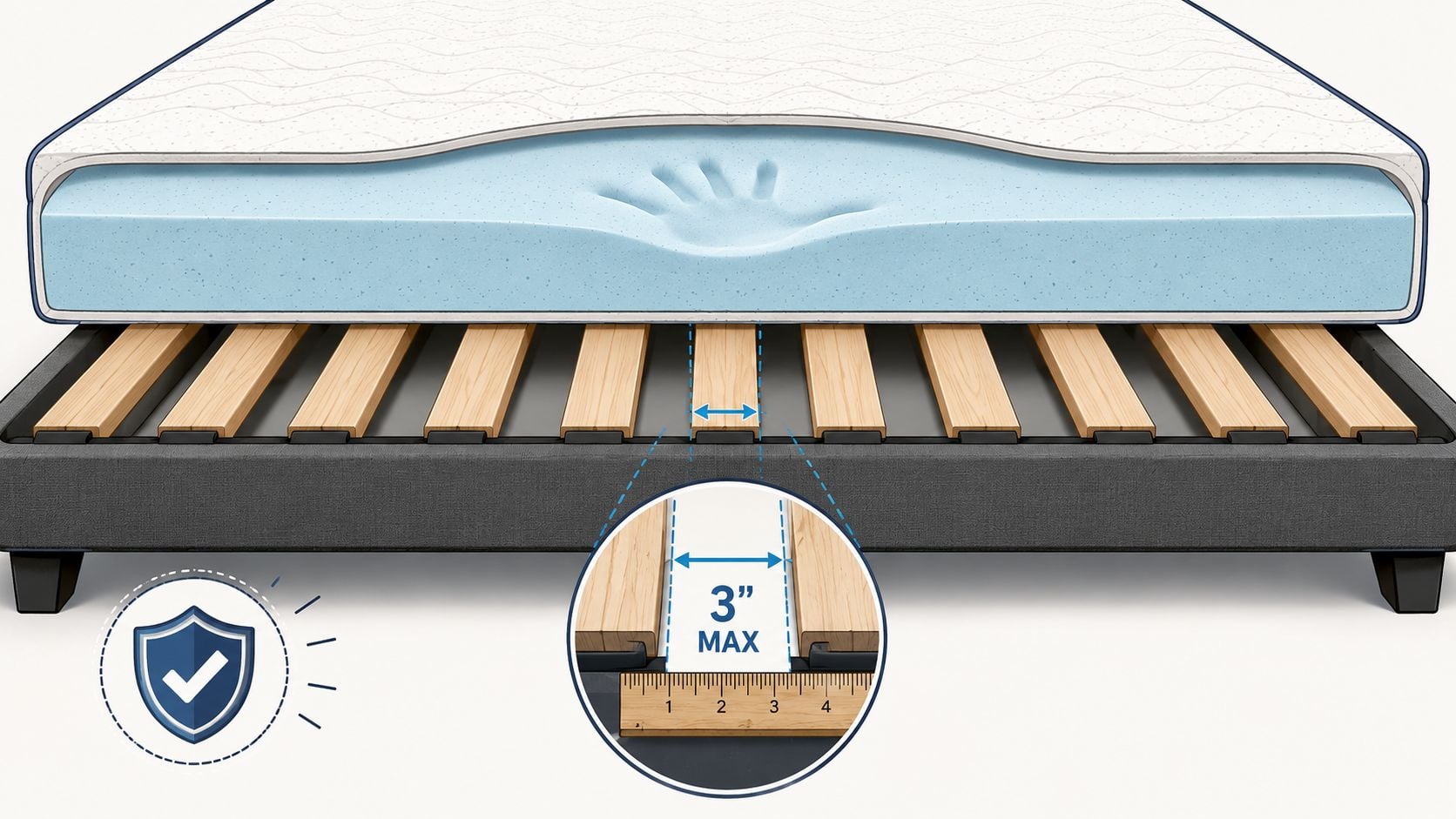
A memory foam mattress needs a firm, flat, and consistently supportive surface, and slats should be no more than 3.0 inches apart. An old or improper base, especially a traditional box spring that isn't specifically approved by the manufacturer, can let the foam sag, wear unevenly, and put warranty coverage at risk.
That's the part many shoppers in Ruidoso discover after the mattress arrives. The bed feels great in the showroom, the delivery is scheduled, and then the practical question shows up fast. What should it sit on?
For memory foam, the base isn't a minor accessory. It's part of the sleep system. The right support helps the mattress keep its shape, deliver pressure relief the way it was designed to, and hold up better over time. The wrong support can undo all of that.
That matters even more in a place like Lincoln County, where homes range from full-time residences to cabins in Alto, guest rooms, and vacation properties with different airflow and setup needs. A good memory foam mattress foundation should support comfort, protect the purchase, and fit the home it's going into.
Table of Contents
- Your Guide to a Perfect Memory Foam Mattress Foundation
- Why Your Foundation Is More Than Just a Stand
- The Best Foundations for Memory Foam Mattresses
- Technical Specs That Protect Your Mattress Investment
- What to Avoid Box Springs and Other Common Mistakes
- Your Ruidoso and Lincoln County Buying Checklist
- Installation Maintenance and Protecting Your Warranty
- Find Your Perfect Foundation at Mattress Pro
Your Guide to a Perfect Memory Foam Mattress Foundation
A new memory foam mattress usually gets most of the attention. The comfort layers, the feel, the pressure relief. Then the foundation question gets pushed to the side, even though it has a big job every single night.

For anyone comparing materials first, this guide works best alongside a clear explanation of what a memory foam mattress is. Once the mattress type is understood, the next step is making sure the base underneath matches it.
In practical terms, a memory foam mattress foundation should do three things well:
- Hold the mattress evenly: Foam needs support across the surface, not just around the edges.
- Limit bending and gaps: Too much flex underneath can create dips and uneven wear.
- Fit the room and sleeper: Bed height, airflow, mobility, and bedroom layout all matter.
Families around Ruidoso often want simple guidance, not jargon. That's where local sleep advice helps. A house on Sudderth Drive, a cabin in Alto, and a guest room elsewhere in Lincoln County may all need different foundation choices, even if the mattress type is the same.
Why Your Foundation Is More Than Just a Stand
A foundation isn't just what keeps a mattress off the floor. For memory foam, it helps determine whether the mattress can contour correctly, support the spine evenly, and stay comfortable night after night.
It supports the mattress the way foam was designed to work
Memory foam responds to body weight and pressure. That's its value. It cushions shoulders, hips, and other pressure points while helping the body stay in better alignment. But that only works when the surface underneath stays level.
If the base bows, flexes, or leaves unsupported gaps, the foam has to compensate for problems below it. Instead of contouring to the sleeper, it starts conforming to the weakness in the foundation.
Practical rule: A mattress and its foundation work as one system. If the bottom half is unstable, the top half can't perform the way it should.
That's why a foundation should be viewed more like the footing under a house than a decorative frame. The visible mattress gets the attention, but the support below it controls long-term performance.
It protects lifespan and day-to-day comfort
Support quality isn't a small detail. Leesa's guide on how long memory foam mattresses last states that memory foam mattresses are typically expected to last 8 to 10 years, and that support quality is a major factor in reaching that lifespan. The same guidance explains that a proper foundation helps preserve the foam's shape and avoid premature wear.
That benefit shows up in everyday sleep, not just years later. A properly supported mattress tends to feel more consistent across the entire surface, especially in the center area where many couples sleep.
A poor base often creates a chain reaction:
- Uneven support: The mattress starts feeling softer in some spots and firmer in others.
- Stress on the foam: Materials compress where support is weak.
- Reduced comfort: Pressure relief becomes less predictable.
- Shorter useful life: Wear appears sooner than it should.
For shoppers considering Sealy, Stearns & Foster, Sherwood, or Tempur-Pedic, this is one of the smartest parts of the purchase to get right the first time.
The Best Foundations for Memory Foam Mattresses
The right choice depends on the bed frame already in the home, the preferred bed height, and whether airflow or adjustability matters most. The common thread is simple. The base should be stable, even, and appropriate for foam.
Solid platform foundations
A solid platform gives the mattress a flat, rigid surface. For many households, that's the easiest default option because it removes guesswork about slat gaps.
This style often works well for sleepers who want a simple setup and a steady feel under the mattress. It can also make sense in older frames where extra rigidity is helpful.
Pros
- Even support: The mattress rests on a continuous surface.
- Straightforward setup: There are fewer structural variables to check.
- Good match for heavy foam beds: Less chance of sinking between support points.
Cons
- Less under-mattress airflow: Ventilation may be more limited than with slats.
- Heavier look in some rooms: Some people prefer a lighter visual profile.**
Slatted foundations
A slatted foundation can be an excellent memory foam mattress foundation when the spacing is tight and the slats are rigid. This option often appeals to sleepers who want support plus better airflow underneath the mattress.
That airflow matters in homes where bedrooms may stay closed up for stretches, or where temperature and moisture changes are part of daily life.
A slatted base can be the better choice when ventilation is part of the sleep problem, as long as the support specs are still met.
Pros
- Better airflow: Air can move under the mattress more easily.
- Balanced support: Properly built slats can hold foam very well.
- Versatile fit: Works with many bed styles and room designs.
Cons
- Must meet support rules: Wide gaps can create problems fast.
- Quality varies: Not every slatted frame is built for foam.**
Bunkie boards
A bunkie board is a thin, supportive layer placed on an existing bed frame. It's useful when someone wants to keep a favorite frame but needs a flatter, more stable surface for a memory foam mattress.
This can also help when bed height is already close to ideal and a taller foundation would make the bed sit too high.
Bunkie boards are often a practical middle-ground option:
- Keeps the existing furniture
- Adds a firmer support layer
- Maintains a lower profile
For shoppers wanting a simple foundation accessory, Tempur flat high profile foundation options are one example of the broader foundation category designed to give a mattress the kind of stable support foam typically needs.
Adjustable bases
An adjustable base uses a supportive deck with moving sections that raise the head, feet, or both. That makes it a strong fit for sleepers who read in bed, want easier relaxation positions, or prefer a more customized setup.
Tempur-Pedic is one of the brands commonly associated with this category, and it's popular with shoppers who want premium comfort features in addition to support.
Pros
- Personalized positioning: Head and foot elevation can improve comfort habits.
- Supportive platform surface: Works with foam when matched correctly.
- Useful for lifestyle comfort: Reading, lounging, and winding down become easier.**
Cons
- Higher cost than basic foundations
- More moving parts
- Not always necessary for every sleeper
Memory Foam Foundation Comparison
| Foundation Type | Best For | Pros | Cons |
|---|---|---|---|
| Solid platform | Shoppers who want a simple, rigid base | Flat support, fewer variables, good for heavier foam mattresses | Less airflow under the bed |
| Slatted foundation | Bedrooms where ventilation matters | Better airflow, compatible when properly built, versatile | Must meet strict spacing and rigidity needs |
| Bunkie board | Keeping an existing frame with a lower profile | Affordable way to add support, low height, adaptable | Depends on the frame below being sound |
| Adjustable base | Sleepers who want custom positioning | Comfort flexibility, supportive deck, premium feel | Higher investment and more complexity |
Technical Specs That Protect Your Mattress Investment
The technical details matter because memory foam is less forgiving of bad support than many people expect. A frame might look sturdy and still fail the actual support test.
The slat rules that matter most
The most important numbers involve slat spacing and slat construction. NapLab's mattress foundation guidance recommends slats no more than 3.0 inches apart, with rigid boards at least 5/8 inch thick and ideally 3.0 inches wide, because wider gaps allow foam to sag into unsupported spaces.
That sounds technical, but its practical meaning is simple. Foam shouldn't be asked to bridge open spaces every night.
Here's a simple way to consider it:
- Gap size: If the open space between slats is too wide, the mattress can dip into those spaces.
- Slat thickness: Thin boards can flex more than they should.
- Slat width: Wider rigid slats spread support more evenly.
How to inspect a frame before the mattress goes on it
A foundation can pass the eye test and still be wrong for memory foam. Before a mattress goes on the bed, it helps to check the support points directly.
Look for these signs:
- Measure the spacing: A tape measure settles the question faster than guessing.
- Press on the slats: If they noticeably bow or feel weak, that's a warning sign.
- Check the center area: The middle of the frame often carries the most stress.
- Inspect the deck surface: A flat surface should feel level across the frame.
Support specs aren't about being picky. They're about preventing the foam from carrying structural work it was never meant to do.
Many shoppers become confused. They assume a stylish bed frame equals mattress support. Sometimes it does. Sometimes it only looks like it does.
What to Avoid Box Springs and Other Common Mistakes
The short answer is clear. A traditional box spring is usually the wrong base for memory foam unless the mattress maker specifically approves it.
Why a traditional box spring causes problems
BedInABox's foundation guide states that memory foam mattresses generally need a firm, stable surface and are often not compatible with a traditional box spring unless the manufacturer says otherwise. That guidance also notes that low-profile or ultra-low foundations are often recommended for foam models because foam mattresses are frequently thicker, and foundation prices range from about $100 to $2,000+, with $300 to $500 described as a common sweet spot.
The mechanical issue is simple. Traditional box springs were built around give and bounce. Memory foam does better with steadiness and even contact.
A box spring can create problems because it may introduce:
- Flex where foam needs firmness
- Uneven support across the surface
- More movement than the mattress was designed for
For readers comparing support systems in plain language, this explanation of box spring vs foundation helps separate the terms that often get mixed together.
Other setup mistakes that shorten mattress life
Box springs get most of the attention, but they aren't the only issue. Several smaller mistakes can also lead to poor support.
Common ones include:
- Old frames with hidden bowing: The surface may sag in the middle even if the mattress is new.
- Slats with wide gaps: The frame may look clean and modern but still fail the support test.
- Uneven floor contact: If the bed rocks or sits off-level, the mattress won't stay evenly supported.
- Using mismatched pieces: A strong mattress on a weak base won't feel or wear as intended.
Many comfort complaints begin below the mattress, not inside it.
Your Ruidoso and Lincoln County Buying Checklist
Foundation advice gets more useful when it matches the home. That's especially true in Ruidoso, Alto, and across Lincoln County, where bedrooms may sit in dry mountain air, cabins may stay closed for periods, and guest spaces may need simple, durable setups.

When airflow should be part of the decision
Airflow often gets treated like a side note. It shouldn't. Beloit Mattress guidance on mattress foundations explains that a slatted foundation can improve airflow under memory foam, but only if spacing is kept at about 2.75 to 3.0 inches or less to balance ventilation with support.
That tradeoff matters in mountain homes. A bedroom may need both firmness under the mattress and room for air to circulate underneath it.
A slatted base may be the better fit when:
- The room tends to sleep warm
- The home is closed up at times
- The owner wants more ventilation under the bed
A more solid surface may be the safer choice when:
- The mattress is especially heavy
- The frame underneath is older
- Maximum evenness matters more than ventilation
A local checklist before buying
Shoppers in this area often do well by asking a few practical questions before choosing a memory foam mattress foundation.
- Where will the bed live: A primary bedroom in Ruidoso may have different needs than a cabin in Alto or a guest room used seasonally.
- How high should the bed sit: Foam mattresses can be thick, so foundation height affects how easy the bed is to get in and out of.
- Does airflow matter in this room: Some spaces benefit from more ventilation under the mattress.
- Will someone set it up correctly: Proper setup matters just as much as the product itself.
For households looking at regional bedding options and bedroom support products, Southwest Mattress Company selections may be part of the broader in-store conversation around practical setups for local homes.
In mountain communities, the smartest foundation choice often comes down to balance. Enough rigidity to protect the mattress, and enough airflow to suit the room.
Installation Maintenance and Protecting Your Warranty
A good foundation still needs proper setup. Loose hardware, uneven floor contact, or a missed center support can create avoidable problems from day one.

A simple setup routine
Once the foundation is in the room, a few checks can help protect the mattress and keep the support system working the way it should.
- Tighten all hardware: Bolts and screws should be snug so the frame doesn't shift under weight.
- Confirm level contact: The frame should sit flat without rocking.
- Inspect the center support: The middle of the bed should feel stable, not springy or bowed.
- Recheck after use: Hardware can loosen over time, especially after moving or rearranging furniture.
Some shoppers prefer professional setup for this reason alone. It removes the guesswork and helps ensure the support system starts out correctly assembled.
What to keep for warranty peace of mind
Warranty protection usually goes more smoothly when records are easy to find and the support system is documented.
Helpful habits include:
- Keep both receipts together: Save the mattress and foundation paperwork in one place.
- Register products promptly: If registration applies, complete it early.
- Take a setup photo: A simple photo can help show the foundation being used properly.
- Review support requirements: Manufacturer details matter, especially if a claim ever comes up.
For anyone reviewing coverage details, the warranty information page is a practical place to start.
This is also where local service makes life easier. Professional delivery and setup can help reduce mistakes that lead to support issues later, especially in homes with stairs, tighter spaces, or heavier foam mattresses.
Find Your Perfect Foundation at Mattress Pro
The right memory foam mattress foundation does more than hold the bed up. It helps the mattress feel the way it's supposed to feel, supports healthier alignment, and protects the investment underneath a sleeper every night.
For many shoppers, the choice comes down to four solid paths. A platform for simple rigidity, a slatted base for support with airflow, a bunkie board for adapting an existing frame, or an adjustable base for more personalized comfort. The right answer depends on the room, the mattress, and how the bed will be used.
That's where careful, local guidance helps. On Sudderth Drive in Ruidoso, families can compare support options in person, ask practical questions, and match brands like Tempur-Pedic, Sealy, Stearns & Foster, and Sherwood to the right base instead of guessing from a product photo.
Ready to transform sleep? Visit the Sleep Pros at Mattress Pro by Miller Waldrop located at 2801 Sudderth Drive, Suite F, in Ruidoso. From luxury brands to budget-friendly solutions, help is available for choosing a mattress and foundation that fit real life in Lincoln County. Browse the collection online or stop by Monday through Saturday.