

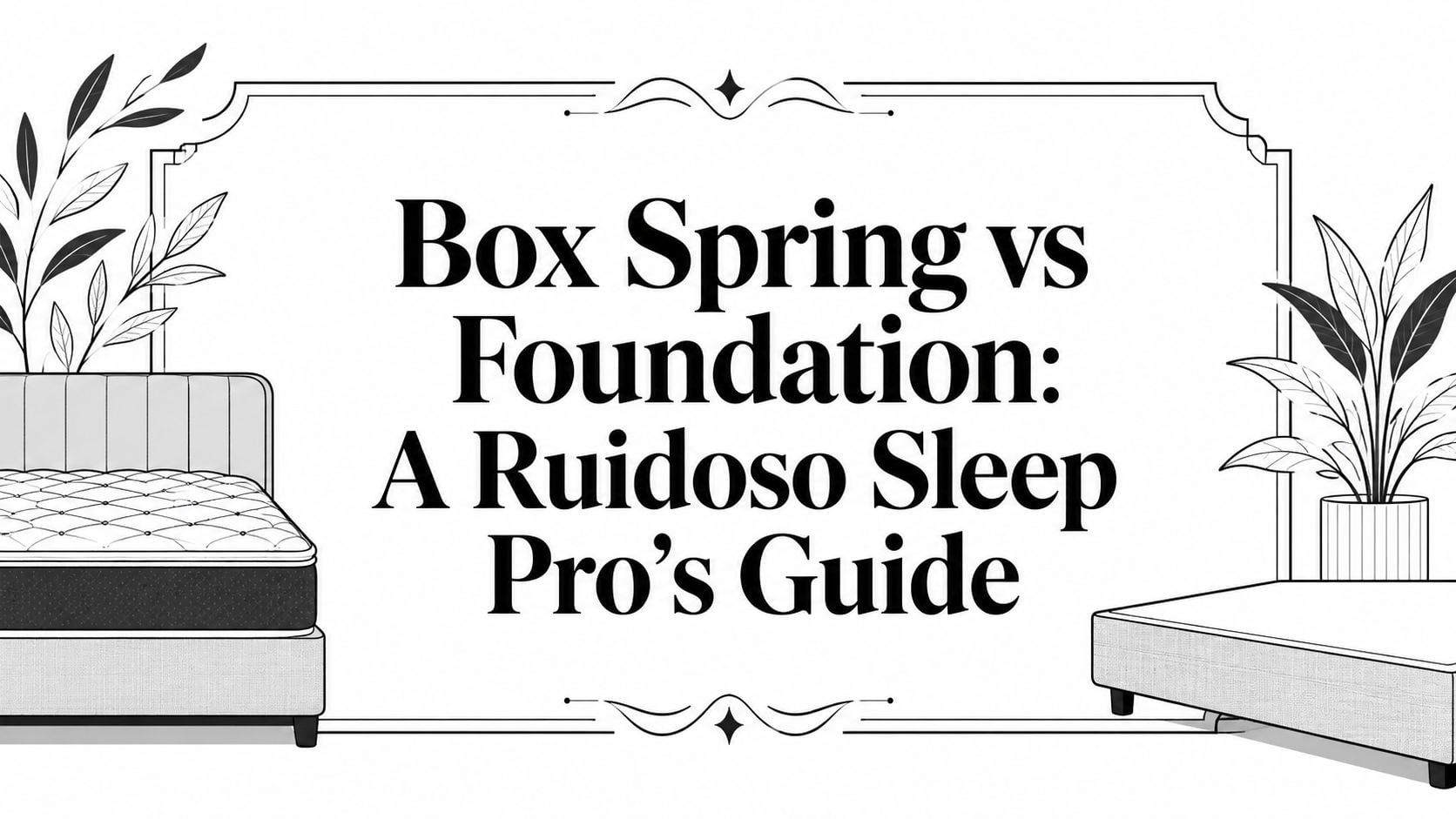
Box Spring vs Foundation: A Ruidoso Sleep Pro’s Guide

A lot of shoppers in Ruidoso get to the same point. The mattress is picked out, the comfort feels right, and then one more question stalls the whole purchase. Should that mattress sit on a box spring or a foundation?
That confusion makes sense. From the outside, both can look similar, both raise the mattress, and both get talked about as if they're the same thing. They aren't. The support underneath the bed changes how the mattress feels, how well it stays aligned, and how well that investment holds up over time.
For households in Ruidoso, Alto, and across Lincoln County, that decision also has a practical side. Cabin bedrooms, guest rooms, tighter stair turns, and mountain-home delivery all affect which setup works best. This guide breaks down box spring vs foundation in plain language so readers can choose the right support the first time.
Table of Contents
- Your Mattress Needs a Partner What Should You Choose
- Defining the Terms Box Springs and Foundations
- Key Differences Support Comfort and Longevity
- The Most Important Question Which One Works with Your Mattress
- Making the Right Choice in Ruidoso and Lincoln County
- So Which Should You Buy A Final Recommendation
Your Mattress Needs a Partner What Should You Choose
A new mattress often gets all the attention. That's natural. Shoppers test the comfort, think about back support, and compare feel from one model to the next. Then the base question comes up, and suddenly the decision feels murky again.
That moment happens every week in local mattress shopping. A couple may choose a Tempur-Pedic for pressure relief, then ask if their old box spring can stay. A cabin owner may buy a guest-room bed and wonder if a foundation will sit too high. A family replacing an older innerspring may hear two different terms from two different stores and assume they mean the same thing.
They don't. The support under the mattress changes performance in a real way. It affects comfort, bed height, mattress stability, and how well the mattress is protected over time.
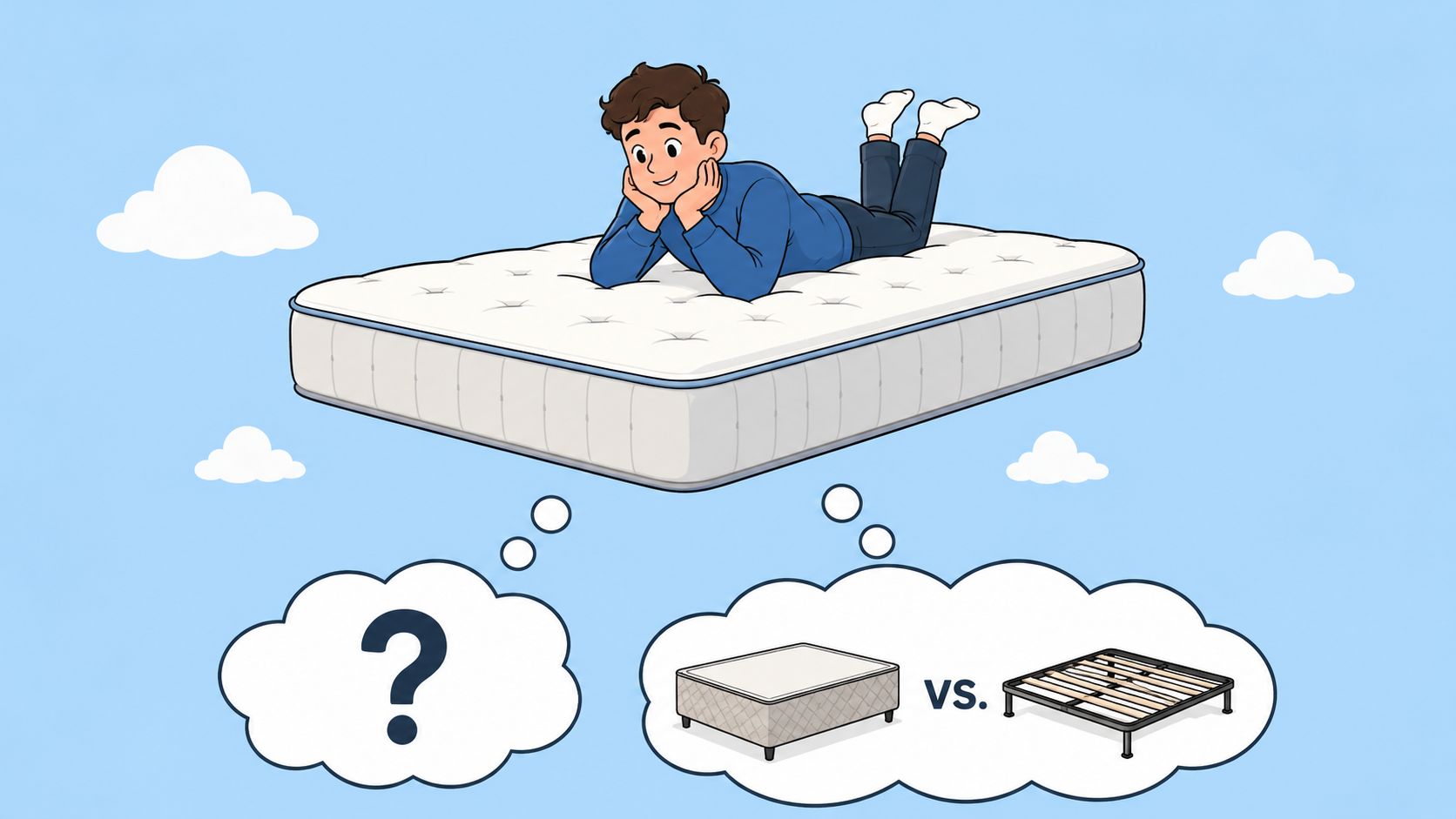
For shoppers looking at affordable platform beds for modern mattress support, this question becomes even more important because some bed frames already provide the support a separate base would normally handle.
Simple takeaway: the mattress and the support system have to work together. A great mattress on the wrong base won't feel or perform the way it should.
That's why this choice matters so much for better sleep. It isn't just about what fits the frame. It's about what helps the mattress do its job night after night.
Defining the Terms Box Springs and Foundations
The easiest way to clear up the confusion is to start with structure. Once readers know what each one is built to do, the decision gets much easier.
The Classic Box Spring
A box spring is the older, traditional support system. It's built around metal coils inside a framed base. According to Saatva's explanation of box springs and foundations, a box spring is a traditional mattress support built around metal coils, and its main performance role is to add bounce and shock absorption.
That design made sense for older innerspring mattresses. Those beds were part of a more traditional coil-on-coil setup. The mattress had springs, and the support underneath had springs too. Together, they created a higher bed profile and a more buoyant feel.
For some sleepers, that feel is still appealing. The bed can feel easier to get in and out of, and the surface has a little more give under the body.
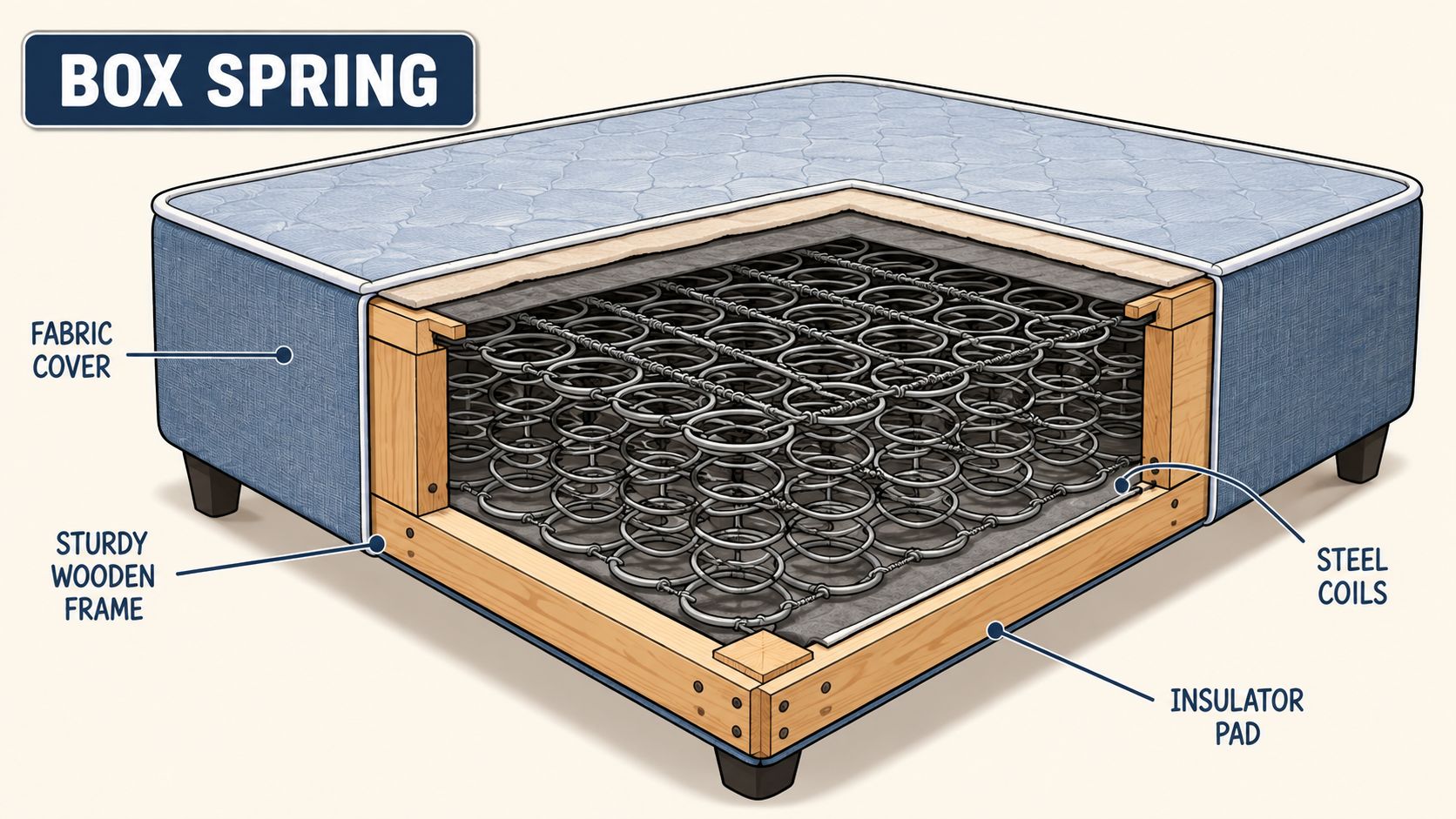
Readers who want a deeper look at older support systems can also review why some beds still use a box spring.
The Modern Foundation
A foundation is different inside, even if the outside fabric makes it look similar. It's a rigid base made from wood, metal, or slats, built to provide a firm, flat surface under the mattress.
That firm support is the big reason foundations became the standard choice for many newer beds. Foam, latex, and hybrid mattresses generally perform best when the sleep surface under them stays even and stable instead of flexing like a spring system.
A rigid base helps the comfort materials work the way they were designed to work. If the mattress is meant to contour, cradle pressure points, and keep the spine level, it needs support that doesn't introduce extra movement underneath.
Foundations have “largely replaced” box springs because they're compatible with modern mattresses, add better support, and last longer, as noted in the Saatva source linked above.
Why the Language Gets Confusing
Retail language causes a lot of the mix-up. Some people call any base under the mattress a “box spring,” even when there are no springs inside. That old habit stuck around longer than the actual product design.
That's where many shoppers get tripped up. They hear “box spring” and picture any fabric-covered support base, but the internal construction is what really matters. If it doesn't contain springs, it isn't functioning like a traditional box spring.
A helpful way to sort it out is this:
- If it flexes with coils inside, it's a box spring.
- If it stays rigid and flat, it's a foundation.
- If the mattress is modern foam, latex, or hybrid, that difference matters more than the label on the sales tag.
For people trying to protect comfort and mattress life, the terms shouldn't be treated as interchangeable.
Key Differences Support Comfort and Longevity
Definitions help, but most shoppers want the practical answer. How does each option affect the way the bed feels and lasts?
Box Spring vs Foundation at a Glance
| Feature | Box Spring | Foundation |
|---|---|---|
| Construction | Built around metal coils | Rigid base made from wood, metal, or slats |
| Feel | Adds bounce and shock absorption | Feels firmer and more stable |
| Best match | Traditional innerspring mattresses | Most modern mattresses |
| Bed height | Often adds noticeable height | Can be standard or lower profile |
| Movement | More give under the mattress | Less flex under the mattress |
| General role | Traditional support style | Contemporary support style |
Support Under the Mattress
Support is the first thing to judge in any box spring vs foundation decision.
A foundation gives the mattress a firmer, flatter base. That matters because modern mattresses use materials that are designed to respond to body weight in a controlled way. If the base underneath moves too much, the comfort layers above it can't stay as consistent.
For a foam or hybrid bed, a stable surface usually does a better job of preserving the mattress shape and sleep feel. The sleeper notices that as steadier support through the hips, shoulders, and lower back.
A box spring behaves differently. Because it introduces bounce and flex, it changes the overall system under the mattress. That can be useful for a traditional innerspring bed, but it's usually not the goal with newer constructions.
Comfort and Motion Between Sleepers
The next issue is comfort feel. Some sleepers like a bed with a little spring to it. Others want the mattress to feel planted and still.
A box spring creates more lift and bounce. That can make a traditional innerspring feel livelier. In a guest room or a more classic bedroom setup, some people still prefer that familiar feel.
A foundation creates a more grounded surface. For couples, that often translates to a calmer bed because the support layer underneath isn't adding extra rebound. If one sleeper changes positions, the bed tends to feel more controlled.
A rigid base doesn't create comfort by itself. It lets the mattress deliver the comfort it was designed to provide.
That distinction is easy to miss. People sometimes blame the mattress when the underlying problem is the support under it.
Longevity and Everyday Wear
Durability matters because the support base is part of the sleep system, not just an accessory.
A foundation uses a simpler structure. Less flex and fewer moving parts usually mean fewer opportunities for the support unit to lose consistency over time. That's one reason many shoppers choose it when they're thinking about protecting a premium mattress purchase.
A box spring has an internal spring system, and any support system with more give can eventually feel less even. If the mattress above depends on rigid support, that mismatch can become more noticeable as the years pass.
That doesn't mean a box spring is always wrong. Sleep365's discussion of low-profile foundations and box springs notes an important nuance. A box spring can still be preferable for a traditional innerspring if the sleeper wants added bounce, shock absorption, or more bed height for easier access.
For readers wondering about the broader life of the entire bed system, how long a mattress should last is closely tied to whether the support under it is still appropriate and stable.
The Most Important Question Which One Works with Your Mattress
This is the question that should drive the decision. Not the old frame in the garage. Not what a previous mattress used. The mattress itself.
Memory Foam and Latex Mattresses Like Tempur-Pedic
For memory foam and latex mattresses, the answer is straightforward. These beds need a foundation or adjustable base, not a traditional box spring.
Foam and latex are designed to contour under body weight while staying properly supported from below. If the surface under them flexes too much, the mattress may not feel the way it was intended to feel. Pressure relief, body alignment, and surface stability all depend on consistent support.
That's especially relevant with premium memory foam models such as Tempur-Pedic. These beds are engineered around a stable base. When shoppers invest in advanced pressure relief and alignment, the support underneath has to match the design.
Hybrid Mattresses Like Sealy and Stearns & Foster
Hybrid mattresses combine multiple comfort elements, often foam on top with coils underneath. That blend gives sleepers a balance of contouring and support, but it still relies on a stable base.
For that reason, a foundation is usually the safer and more appropriate match for hybrids such as Sealy and Stearns & Foster. The foundation supports the mattress evenly while allowing the internal comfort and coil system to do the work they were designed to do.
A box spring adds another layer of movement under an already engineered mattress. That extra flex usually isn't the goal with a hybrid. Most shoppers choosing a hybrid want responsive comfort without making the whole bed feel loose or overly springy.
One practical way to think about it is this:
- Foam comfort layers need consistency underneath
- Hybrid coil systems still benefit from an even surface
- A rigid base helps the mattress keep its intended feel
Readers comparing support options alongside mattress models can use this mattress buying guide to narrow the right pairing.
Traditional Innerspring Mattresses
Traditional innerspring mattresses are the category where a box spring still has a real place.
If the mattress is an older-style or more classic innerspring design, a box spring may be the intended partner. That setup gives the bed more bounce, more shock absorption, and often more overall height. Some sleepers prefer that because the bed feels easier to enter and exit, especially in taller bedroom furniture setups.
Some “foundation is always better” advice leaves out the one category where a box spring can still make functional sense. The classic innerspring bed.
Local, in-person guidance matters. A shopper replacing an older guest room mattress in a Ruidoso cabin may be able to keep the feel they already like with the right innerspring and box spring pairing. Someone upgrading to a newer Tempur-Pedic or Sherwood model usually shouldn't.
The mattress type decides the base, not the other way around.
Making the Right Choice in Ruidoso and Lincoln County
The right support choice isn't only about mattress construction. In Ruidoso and Lincoln County, the home itself often influences the decision too.
Delivery and Setup in Mountain Homes
Many local homes don't have simple, wide-open delivery paths. Cabins in the trees, stair-step entries, tighter hallways, and guest rooms with tricky corners all change how a bed system should be planned.
A bulky traditional box spring can be harder to move through some spaces than a modern foundation with a more flexible setup approach. That matters for homeowners in Alto, vacation-rental owners preparing a room quickly, and families replacing a bed without wanting to wrestle oversized pieces through narrow turns.
That's one reason full-service delivery and professional setup matter so much in this area. The product may be right on paper, but the room still has to accept it cleanly and safely.
Cost and Long-Term Value
Support systems don't just affect the purchase day. They affect how well the mattress holds up over the years.
A lower upfront shortcut can become expensive if the mattress doesn't feel right on the base or if the sleep surface loses consistency sooner than expected. When shoppers are already investing in quality brands like Tempur-Pedic, Sealy, Stearns & Foster, and Sherwood, it makes sense to choose a support system that fits the mattress rather than forcing the mattress onto an older base that happened to be in the house.
Some households also want to balance comfort with budget. In those cases, Southwest Mattress Company support options may be part of the conversation when looking at practical, compatible sleep setups.
The Miller Waldrop Difference
A local sleep decision carries a different kind of trust. People in Ruidoso often want more than a product page and a delivery window. They want someone to help match the mattress, support, height, and room setup to the home they live in.
That's where Mattress Pro by Miller Waldrop fits as a local option. The business focuses on sleep systems, including mattresses and compatible support solutions, with the Comfort Promise, the Low Price Promise, and full-service delivery with professional setup.
The fear behind this decision usually isn't “What is a foundation?” It's “What if the whole bed feels wrong after it's in the room?”
That's why local care matters. In a mountain community with dry air, changing seasons, second homes, and guest spaces that need to work for different sleepers, the right advice is personal, not generic.
So Which Should You Buy A Final Recommendation
For Most New Mattress Shoppers
When buying a new mattress today, the smarter choice is a foundation or an adjustable base.
That recommendation fits the way most modern mattresses are built. If the bed is memory foam, latex, or hybrid, a firm and even support surface usually gives the mattress the best chance to feel right, stay stable, and protect the purchase over time. That's especially important with premium models where support and comfort materials are engineered to work on a rigid base.
For many households in Ruidoso, that choice also simplifies the setup. Foundations fit the needs of modern mattresses and make sense for current bedroom styles, platform setups, and adjustable sleep systems.
When a Box Spring Still Makes Sense
A box spring still deserves consideration in a narrower set of cases.
It can be the better fit when the mattress is a true traditional innerspring and the sleeper wants the classic feel that comes with more bounce and shock absorption. It may also make sense when extra bed height helps with easier entry and exit.
That's the key to the whole box spring vs foundation question. The right answer depends less on habit and more on mattress design, preferred feel, and how the bed will be used in the home.
Ready to transform sleep? Visit the Sleep Pros at Mattress Pro by Miller Waldrop at 2801 Sudderth Drive, Suite F, in Ruidoso. From luxury brands to budget-friendly solutions, the team helps shoppers in Ruidoso, Alto, and across Lincoln County match the right mattress, foundation, or support system to the way they sleep. Browse the collection online or stop by Monday through Saturday.