

Core De Casa: Building Your Home’s Heart Around Better Sleep


You've finished a long day in the mountains, perhaps hiking near Alto, working around Lincoln County, or handling the steady demands of home. The cabin is quiet, but the bedroom doesn't feel restorative. The mattress dips toward the middle, one partner feels every turn, and the room that should help the body recover has become another source of frustration.
That's where core de casa becomes a useful way to think about sleep. The bedroom is the functional heart of the home, and the mattress is the central support system within it. For Ruidoso households, choosing that support system means considering sleep position, body type, temperature, foundation quality, and the kind of service that makes a large purchase feel manageable.
Why Your Bedroom Is the True Heart of Your Home
A mountain home often serves many purposes. It may be a retreat after outdoor activity, a gathering place for family, a vacation rental, or a base for everyday life. Yet the bedroom performs the most important recovery work in the house. It's where the body spends its longest uninterrupted period resting, and where the mattress either supports healthy alignment or works against it.
A typical Ruidoso evening makes the point. After a day outside, tired legs need pressure relief. A back that has carried gear or handled physical work needs stable support. A mind that has stayed busy all day needs a sleep surface that feels predictable rather than distracting. If the mattress allows uncomfortable sinking, traps heat, or transfers movement across the bed, the bedroom stops functioning as a sanctuary.

Sleep affects the whole household
A supportive mattress can make it easier to settle into a comfortable position and remain there. That matters for couples, active sleepers, older adults, and anyone who wakes with sore shoulders, hips, or lower back discomfort. Better comfort can also make the bedroom feel more inviting, which encourages a consistent wind-down routine.
The room doesn't need elaborate decoration to feel special. It needs a mattress that matches the sleeper, a foundation that supports the construction, and enough space for the body to rest without fighting the surface.
Useful bedroom priorities include:
- Stable support: The mattress should hold the body without excessive collapse.
- Pressure management: Comfort layers should cushion areas that press into the bed.
- Temperature awareness: Ruidoso's dry mountain air can feel cool, but bedding and mattress materials still affect heat retention.
- Motion control: Couples benefit when one person's movement doesn't disturb the other.
- Reliable setup: A mattress performs best when its foundation is level and appropriate.
Practical rule: The bedroom deserves the most thoughtful mattress decision because every other room supports activity, while this room supports recovery.
For additional guidance on creating a calmer sleep environment, the relaxing bedroom design guide offers a useful starting point. The central idea remains simple. A beautiful room can feel unfinished if the mattress underneath the experience doesn't serve the person sleeping on it.
What Core de Casa Really Means for Your Living Space
The phrase core de casa joins two ideas: core, the basic and most important part of something, and casa, the word for house or home. Taken as a term, it points toward the essential center of domestic life. In practical terms, that center is the bedroom, because the bedroom supports the daily recovery that makes work, family life, and mountain living possible.
The word casa carries a long history. In Spanish, casa is the standard word for “house,” and it comes from Latin casa, which originally referred to a hut, cottage, or simple shelter rather than a large dwelling. Historical linguists note that Spanish adopted casa as the common term for “house” by the 10th century, replacing the more classical Latin domus for everyday use, as discussed in this linguistic explanation of casa's origin.
From appearance to lived comfort
A home's most important choices aren't always the most visible. Paint color, lighting, and furnishings shape the mood, but the mattress determines whether the room supports the body night after night. That makes mattress selection a deeper form of home care, not merely a decorating decision.
A useful core de casa framework asks three questions:
- What does the sleeper need physically? Side sleepers may need cushioning at the shoulders and hips. Back and stomach sleepers may prefer a more level, supportive feel.
- What does the household need functionally? Couples may prioritize motion isolation, edge stability, or different comfort preferences.
- What will remain practical over time? Materials, foundation compatibility, temperature behavior, and service all affect long-term satisfaction.
This approach also prevents a common mistake, choosing a mattress because it looks appealing in a showroom or sounds impressive online. A mattress should be evaluated through the sleeper's actual habits. Someone who spends weekends hiking may need a different balance of contouring and lift than someone who sleeps lightly, changes positions often, or shares a bed with a restless partner.
The bedroom as a long-term investment
The essential part of a home doesn't have to be the most expensive part. It should be the part selected with the greatest care. A well-matched mattress can support the room's purpose without requiring a complete bedroom redesign.
For Ruidoso residents, that decision may also include guest rooms and vacation cabins. Visitors notice whether a bed feels supportive, too soft, too firm, or difficult to sleep on. A mattress chosen for actual use is more valuable than one selected only for appearance.
The phrase therefore works as a decision filter. If the bedroom is the home's core, then the mattress is the core of that core. Comfort, support, and service deserve attention before decorative details that can be changed more easily.
Understanding Mattress Support Cores and Comfort Layers
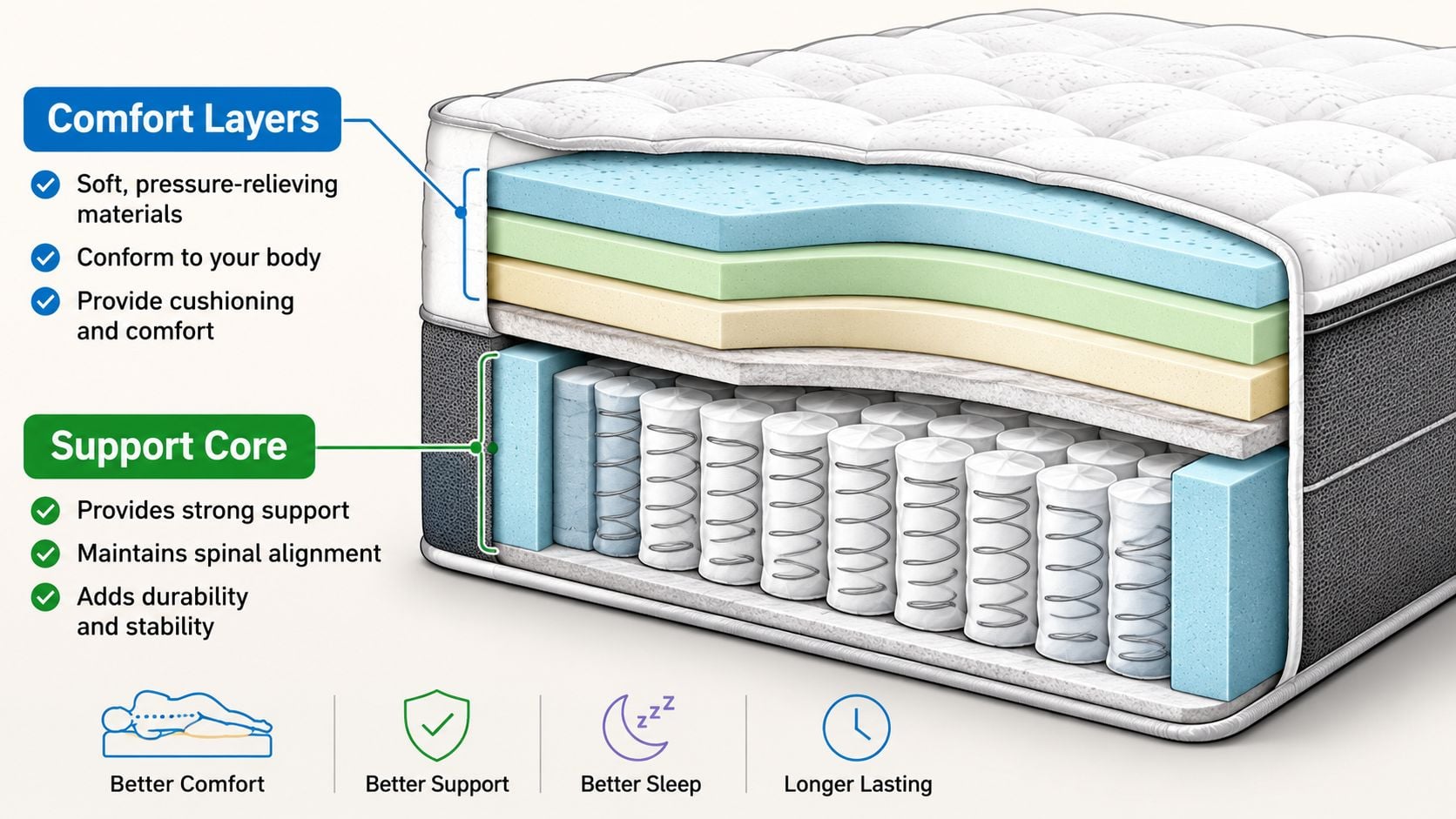
A mattress has two jobs that shoppers often combine into one question: it must support the body and it must cushion pressure points. Those jobs usually come from different parts of the construction.
The support core is the deeper structural base. It helps prevent excessive sinking, supports spinal alignment, stabilizes the mattress, and distributes load across the sleep surface. The support-core mattress guidance explains why this internal base matters to overall performance.
Think of the mattress like a building
A building foundation keeps the structure stable. It doesn't provide the softness of a sofa or the finish of a living space, but without a sound foundation, everything above it performs poorly.
A mattress follows a similar pattern:
- Support core: The structural base that holds the sleeper up.
- Transition layers: Materials that connect firm support with softer comfort.
- Comfort layers: Foam or other cushioning materials that contour around the body.
- Cover: The outer fabric and quilting that influence surface feel.
A sleeper who feels pressure at the hip may need more cushioning, but adding softness alone won't solve a support problem. If the underlying core permits too much sinking, the spine can lose a comfortable, neutral position. Conversely, a very firm surface with little cushioning may create pressure even when the base is stable.
Foundation quality matters
The mattress and foundation work as a system. An uneven or unsuitable base can weaken the feel of a well-constructed bed. Guidance on mattress foundations notes that slat gaps exceeding about 3 inches can contribute to localized sagging and reduced edge-to-edge support, so the foundation should be checked before blaming the mattress.
That's why shoppers should review box spring and foundation differences before placing a new mattress on an existing frame. The right setup depends on the mattress design, the frame, and the manufacturer's requirements.
Match construction to the sleeper
Heavier bodies generally need a support core that resists deep collapse. Side sleepers often need pressure relief without losing alignment. Couples may want consistent support near the edges and less movement across the surface.
A Sleep Pro looks at the entire system rather than recommending softness in isolation. The correct result is a coordinated balance between the support core, comfort layers, foundation, and the sleeper's preferred position.
Memory Foam Versus Hybrid Mattresses for Mountain Living
Memory foam and hybrid mattresses can both provide pressure relief, but they create that experience through different mechanics. Memory foam mattresses use an all-foam construction with deep contouring, while hybrids combine foam comfort layers with a coil support core, as described in this memory foam and hybrid construction comparison.
Memory foam usually responds gradually and conforms closely to the body. That contouring can reduce pressure around the shoulders and hips while limiting motion transfer between partners. Some foam designs also use cooling materials or gel technology to manage heat, although the overall feel still depends on the complete construction and the sleeper's bedding.
Hybrids use springs for support and airflow. The coil system adds lift and responsiveness, while the foam above it provides cushioning. This combination often suits sleepers who want a more buoyant feel, stronger edge support, and greater airflow than an all-foam design, a benefit also noted in this hybrid mattress overview.
Memory foam may fit these preferences
Memory foam can be a strong match for sleepers who:
- Prefer close contouring: The surface molds around the body rather than feeling springy.
- Share a bed: Foam can absorb movement and reduce disturbance.
- Need pressure relief: Deeper cushioning can help soften contact at prominent joints.
- Like a settled feel: The mattress responds more slowly and feels less bouncy.
In Ruidoso's dry mountain climate, a foam mattress may feel comfortable during cooler nights, but sleepers who run warm should pay attention to ventilation, cover materials, and the bed's overall heat behavior.
Hybrid construction may fit other needs
Hybrids may appeal to sleepers who:
- Want easier movement: Springs provide more pushback when changing positions.
- Prefer airflow: Open space around coils can support ventilation.
- Need edge support: Reinforced perimeter construction can make the full surface more usable.
- Favor a lifted feel: The sleeper rests more on top of the mattress than within it.
| Feature | Memory Foam | Hybrid |
|---|---|---|
| Main support method | Foam layers | Coil support core with foam comfort layers |
| Body feel | Deep contouring | More responsive and buoyant |
| Motion isolation | Often strong | Varies by coil and foam design |
| Airflow | Depends on foam construction | Coils generally promote ventilation |
| Edge behavior | Depends on perimeter reinforcement | Often designed for stronger edge support |
| Common priority | Pressure relief and reduced movement | Support, responsiveness, and cooling |
Choosing between the two
Neither construction is automatically right for every sleeper. A side sleeper who values close cushioning may prefer memory foam, while a larger-bodied back sleeper or a person who sleeps warm may prefer the lift and airflow of a hybrid. Couples should test motion transfer and edge support rather than relying on labels.
A local showroom visit, including the memory foam mattress selection guide, gives shoppers a chance to compare those sensations directly. The goal isn't to choose the trendiest construction. It's to find the design that keeps the body supported and comfortable through the night.
How to Test a Mattress Like a Sleep Pro
The best mattress test resembles real sleep, not a quick sit on the edge. A shopper should lie down in the position used most often, relax the shoulders, and allow enough time for the body to notice pressure and support.
The mattress selection guide can help organize the decision before a showroom visit. A Sleep Pro can then turn that general information into a practical comparison based on body type, sleep position, comfort preferences, and budget.
Start with the body's normal position
A side sleeper should check whether the shoulder and hip feel cushioned without the waist dropping too far. A back sleeper should notice whether the lower back feels supported rather than strained. A stomach sleeper should pay attention to whether the hips sink more than the chest.
The test should include:
- Pressure points: Notice tingling, sharp pressure, or the urge to shift.
- Spinal position: Ask whether the body feels level instead of bent or twisted.
- Ease of movement: Roll from side to back and stand up naturally.
- Surface feel: Compare close contouring with a more lifted, responsive sensation.
Test the edges and motion
Edge support matters when getting in and out of bed, sitting while dressing, or using the full width of the mattress. The shopper should sit near the perimeter, then lie close to the edge and assess whether the surface remains stable.
Couples should also perform a simple movement test. One person can change positions while the other stays still, then both can evaluate how much movement travels across the mattress. No single test replaces personal comfort, but it reveals differences that a product description may not communicate.
A useful showroom question: “What part of this mattress provides the support, and how does that construction fit this sleeper's position?”
Compare deliberately
Shoppers can bring a short list of priorities:
- Preferred sleep position.
- Areas that feel sore or pressured.
- Whether either sleeper runs warm.
- The importance of edge support.
- Desired feel, close and contouring or lifted and responsive.
- Existing foundation and frame details.
Mattresses should generally be replaced every 6 to 8 years under normal conditions, according to this mattress replacement guidance. That benchmark doesn't replace an individual inspection. Visible sagging, persistent discomfort, or a noticeable decline in support can justify evaluating a replacement sooner.
The Local Advantage of Buying From a Ruidoso Sleep Expert
A mattress purchase involves more than choosing a surface from a screen. Local guidance lets shoppers describe how they sleep, test construction differences, check foundation compatibility, and address concerns before delivery. That conversation is especially useful in Ruidoso, where mountain living, dry air, seasonal temperature changes, and active routines can shape comfort preferences.
Mattress Pro by Miller Waldrop is a local, family-owned sleep business serving Ruidoso, Sudderth Drive, Alto, and Lincoln County. Its Sleep Pros use a one-on-one consultative process to connect shoppers with options from Tempur-Pedic, Sealy, Stearns & Foster, and Sherwood, considering sleep position, body type, and budget rather than pushing a single construction.
Service reduces purchase risk
The fear of choosing the wrong mattress is reasonable. A bed can feel appealing for a few minutes and still fail to suit a sleeper's nightly habits. The Comfort Promise addresses that concern by giving customers added peace of mind during the decision.
The Low Price Promise also matters for budget-conscious shoppers who want local service without ignoring price. Flexible financing can help households evaluate appropriate sleep solutions without reducing the conversation to the cheapest available surface.
Delivery is part of the solution
A large mattress is difficult to move, position, and install correctly. Full-Service Delivery with Professional Setup removes much of that burden and helps ensure the new sleep system reaches the bedroom ready for use.
That service can be especially valuable for mountain homes, cabins, guest rooms, and vacation properties where stairs, narrow spaces, or changing room layouts complicate delivery. A local team can address practical details that a doorstep shipment leaves to the customer.
Local care continues after the sale
A bed-in-a-box website can provide convenience, but it can't physically evaluate a sleeper's position or guide a couple through side-by-side testing. Local Sleep Pros can answer construction questions in plain language and help shoppers compare pressure relief, support, cooling, and motion control in person.
The local mattress store guide explains why personal service remains relevant for a purchase that affects every night. The Miller Waldrop legacy spans 70 years, with a focus on sleep solutions and neighborhood service rather than just moving products.
Mattress Pro by Miller Waldrop helps Ruidoso and Lincoln County sleepers build a stronger core de casa with personalized mattress guidance, trusted brands, the Comfort Promise, Low Price Promise, and Full-Service Delivery with Professional Setup. Visit Mattress Pro by Miller Waldrop at 2801 Sudderth Drive, Suite F, in Ruidoso, and let a Sleep Pro help find the support and comfort that make better mornings possible.