

Best Sleep Position: How to Find Yours and Sleep Better

There is no single best sleep position for everyone. In a classic clinical study, breathing problems were greater on the back than on the side, with 84.4 ± 4.9 events per hour versus 73.6 ± 7.5, while non-REM results were 103 ± 4.8 versus 80.3 ± 9.2 events per hour.
That finding matters, but it doesn't settle the question for every sleeper. A position that helps someone with snoring may aggravate a sore shoulder, while a posture that supports the lower back may worsen reflux. Pregnancy, body shape, mattress feel, pillow height, and personal comfort all change the answer.
The most useful approach is symptom-first: identify what disrupts sleep, then choose a position and mattress system that supports the body in that posture. That perspective is especially helpful for shoppers in Ruidoso, Alto, and Lincoln County, where dry mountain air and changing temperatures can make pressure relief and cooling just as important as alignment.
Is There Really One Best Sleep Position
The popular advice that everyone should sleep on the side sounds simple, but it leaves out the most important question: side sleeping for what problem? Sleep Foundation explains that there isn't one universally healthiest position, and Harvard Health makes the same broader point in its discussion of sleeping posture. The position that works best depends on symptoms, comfort, and the way the body responds overnight. Read more about the broader relationship between rest and wellness in this guide to sleep health.
A sleeper with loud snoring or obstructive sleep apnea may benefit from avoiding the back. Someone with low-back pain may feel better on the back with the right knee support, or on the side with the pelvis kept level. A person with nighttime reflux may need to favor the left side, while a pregnant sleeper may need a carefully supported side posture later in pregnancy.
Why generic rankings fall short
A universal ranking treats the body like a standard-size object. Mattresses and pillows don't work that way. Shoulder width, hip shape, sleeping temperature, pain sensitivity, and the amount of sink in the mattress all affect whether a position keeps the spine neutral or creates pressure.
Even the same sleeper can need different support over time. A change in activity, injury, pregnancy, aging, or a new symptom can make a formerly comfortable posture feel wrong. Frequent turning may also interrupt rest, so the best position isn't merely the one that looks correct in a diagram. It must be comfortable enough to maintain.
Practical rule: The best sleep position is the one that reduces the symptom causing the most disruption, while keeping the head, ribcage, pelvis, and legs reasonably supported.
Comfort remains part of the evidence
Sleep guidance becomes more useful when it respects real behavior. If a posture causes shoulder pressure, hip pain, numbness, or repeated waking, a strict rule won't improve the night. The right mattress can make a recommended position easier to maintain by cushioning pressure points without allowing the body to twist.
That is why an in-person mattress test can matter. A sleeper can lie in the normal position, notice whether the waist is supported, and check whether the shoulder and hip feel compressed. The position isn't separate from the bed beneath it. Together, they create the sleep surface the body experiences.
The Mechanics of Major Sleep Positions
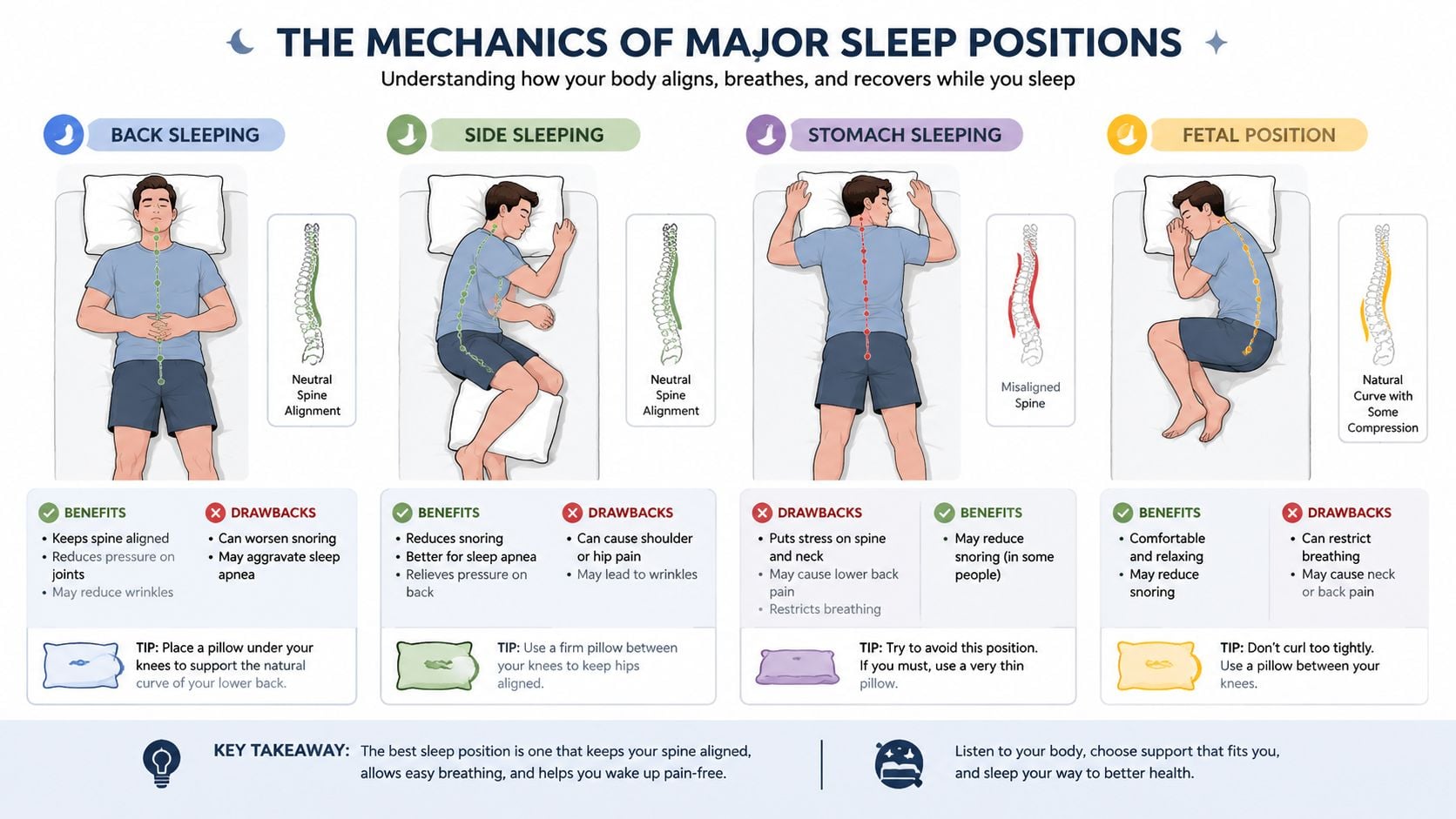
Each position changes how weight, gravity, and joint angles interact. The useful question isn't which posture looks most natural. It's whether the posture keeps the spine supported, the airway open, and pressure distributed comfortably.
Back sleeping
Back sleeping, also called the supine position, can distribute body weight across a broad surface. With a supportive mattress and a pillow that doesn't push the chin toward the chest, it may help maintain a relatively neutral spinal line.
The weakness is airway mechanics. On the back, gravity can allow the tongue and soft tissues to move toward the airway. The clinical evidence is particularly strong for adults with obstructive sleep apnea. The classic study cited above found a higher apnea-hypopnea index on the back than on the sides, and a later review concluded that supine posture is consistently associated with more severe apnea indices in adults. The clinical review of body position and obstructive sleep apnea supports side sleeping as the more practical default for sleepers who snore or have diagnosed apnea.
A back sleeper with lumbar stiffness may benefit from a pillow beneath the knees. That support can reduce the tendency for the lower back to remain overly arched, but the mattress still needs enough structure to prevent the hips from sinking too much.
Side sleeping
Side sleeping often helps reduce airway collapse because the body isn't positioned directly beneath gravity's most unfavorable airway angle. It's broadly recommended for snoring and sleep apnea, and the left side has an added advantage for nighttime reflux.
The main mechanical challenge is pressure. The shoulder and hip carry more concentrated load, while the waist can remain unsupported if the mattress is too firm. A mattress with pressure-relieving comfort layers can allow the shoulder and hip to settle without letting the midsection drop out of alignment.
A pillow between the knees can help keep the pelvis from rotating forward. The head pillow also matters because its height must fill the space between the ear and shoulder without tilting the neck upward. More practical guidance on keeping the body in a neutral line appears in this resource about spinal alignment while sleeping.
The fetal position
The fetal position is a side posture with the knees drawn toward the chest. Many sleepers choose it because it feels secure and reduces the sensation of pulling through the lower back.
The position becomes less helpful when the body curls too tightly. Excessive flexion can make breathing feel restricted and may leave the neck angled downward. A relaxed fetal posture, with the chest open and a pillow supporting the knees, generally creates a more balanced setup than pulling the knees sharply toward the torso.
Stomach sleeping
Stomach sleeping can feel comfortable for people who naturally prefer an open airway, but it creates a difficult trade-off for the neck and lumbar spine. The head must turn to one side for breathing, and the lower back can be pulled into an uncomfortable extension or flattened position.
A thinner pillow may reduce the amount of neck rotation, but it can't remove the underlying challenge. The 2026 systematic review discussed below links prone sleeping with increased lumbar strain and higher low-back-pain risk, making stomach sleeping a poor starting point for someone who wakes stiff or sore.
Matching Sleep Position to Health Conditions
A health condition can change the answer more than a general sleep-position ranking. The table below provides a starting point, not a substitute for medical care or treatment.
| Health Condition | Recommended Position | Why It Helps |
|---|---|---|
| Snoring or sleep apnea | Side sleeping | Side posture is associated with less severe breathing disruption than supine posture in adults with obstructive sleep apnea. |
| Low-back pain | Supine or well-supported side lying | Supine posture supports spinal alignment, while side lying can work when pillows keep the pelvis and ribcage level. |
| Nighttime reflux | Left-side sleeping | Left lateral sleeping produced shorter acid exposure and faster acid clearance than right-side or supine positions in monitored research. |
| Pregnancy | Side sleeping, especially later in pregnancy | Medical guidance favors side sleeping later in pregnancy, with the left side often preferred for circulation and reduced pressure on major vessels. |
| Shoulder or hip pain | The side that reduces pressure, or supported back sleeping | Comfort and pressure distribution may matter more than a universal rule. |
| Stomach-related discomfort | A position that reduces symptoms | Individual response varies, so the posture should be evaluated by symptom relief and sleep continuity. |
For low-back pain
A 2026 systematic review found that supine sleeping supports spinal alignment and is associated with lower low-back-pain prevalence, while prone sleeping increases lumbar strain and is linked to greater back-pain risk. The review is available through this systematic review of sleep posture and low-back pain.
Back sleepers can place a pillow under the knees to reduce lumbar extension. Side sleepers need a mattress that cushions the shoulder and hip while keeping the waist from collapsing downward. In either posture, a medium-to-supportive feel may help the pelvis and ribcage stay level.
For reflux
Left-side sleeping has the clearest position-specific evidence for nocturnal reflux. A monitored study recorded median esophageal acid exposure of 0.0% in the left lateral position, compared with 1.2% on the right and 0.6% supine. Acid clearance was also faster on the left, at 35 seconds, compared with 76 seconds supine and 90 seconds on the right. These findings appear in the monitored study of sleep position and nocturnal reflux.
A mattress can't change digestive anatomy, but it can make left-side sleeping sustainable. Pressure relief at the shoulder and hip, plus a stable pillow arrangement, can reduce the urge to roll onto the back or right side.
For pregnancy
Guidance commonly shifts toward side sleeping from the second trimester and later, with the left side often preferred. Back sleeping later in pregnancy may cause dizziness, shortness of breath, or nausea, while support beneath the abdomen and between the knees can make side sleeping more comfortable. Pregnancy-specific guidance is summarized by the sleeping guidance for the third trimester.
Occasional movement is normal, and there isn't strong evidence that an occasional right-side position is dangerous. The practical priority is a supported posture that allows the sleeper to breathe, rest, and change positions without anxiety.
For readers evaluating how sleep posture relates to other health concerns, this resource on sleep position and high blood pressure offers another symptom-focused starting point.
Choosing the Right Mattress and Pillow Support
Once a sleeper identifies the main symptom, mattress shopping becomes more precise. The objective isn't to buy the firmest or softest bed. It's to find a surface that supports the chosen posture without creating pressure that forces constant movement.
Match the feel to the body
Side sleepers often need contouring around the shoulder and hip. Memory foam can spread pressure across a wider area by conforming to the body, while hybrid designs combine cushioning layers with a spring-based support structure. Cooling gel technology and breathable materials can help manage heat, which matters in Ruidoso's dry mountain climate when a dense comfort layer feels too warm.
Back sleepers generally need steady support beneath the lumbar area and hips. A responsive innerspring or hybrid can provide a more lifted feel, while contouring foam may suit someone who wants less pressure around the lower back. Stomach sleepers need particular care because excessive sink can increase lumbar strain.
The mattress comfort-level guide can help shoppers think beyond a simple soft-versus-firm label.
Use the pillow as an alignment tool
A pillow changes the angle of the neck, so it should be selected with the position in mind.
- Side sleepers: Choose enough loft to fill the space between the ear and shoulder. Add a pillow between the knees to reduce pelvic rotation.
- Back sleepers: Use a lower profile that keeps the chin from tipping toward the chest. A pillow beneath the knees can support the lower back.
- Stomach sleepers: Keep the head elevation minimal, then consider a gradual transition if neck or back symptoms continue.
- Pregnant sleepers: A body pillow beneath the abdomen and between the knees can support the belly, hips, and lower back.
Test the actual posture
A showroom test should resemble a normal night rather than a quick sit on the edge. Lie in the usual position, allow the body to settle, and check whether the shoulder and hip feel compressed. The waist should feel supported, and the neck should remain level with the rest of the spine.
Tempur-Pedic, Sealy, Stearns & Foster, and Sherwood offer different combinations of foam, springs, cooling materials, and support profiles. Mattress Pro by Miller Waldrop provides position-based product labels and one-on-one guidance, allowing shoppers to compare those design characteristics without reducing the decision to a single firmness number.
Transitioning to a Healthier Sleep Posture
Changing a familiar position rarely works through willpower alone. The body returns to the posture that feels easiest, especially after a long day. A better method makes the preferred position comfortable and physically difficult to abandon.
Consider a back sleeper who wakes with snoring concerns. The transition can begin with a side-sleeping setup before bedtime, including a pillow that supports the head and a second pillow between the knees. A full-length body pillow along the front of the body can provide something to hold, while another cushion behind the back can discourage rolling without forcing the body into place.
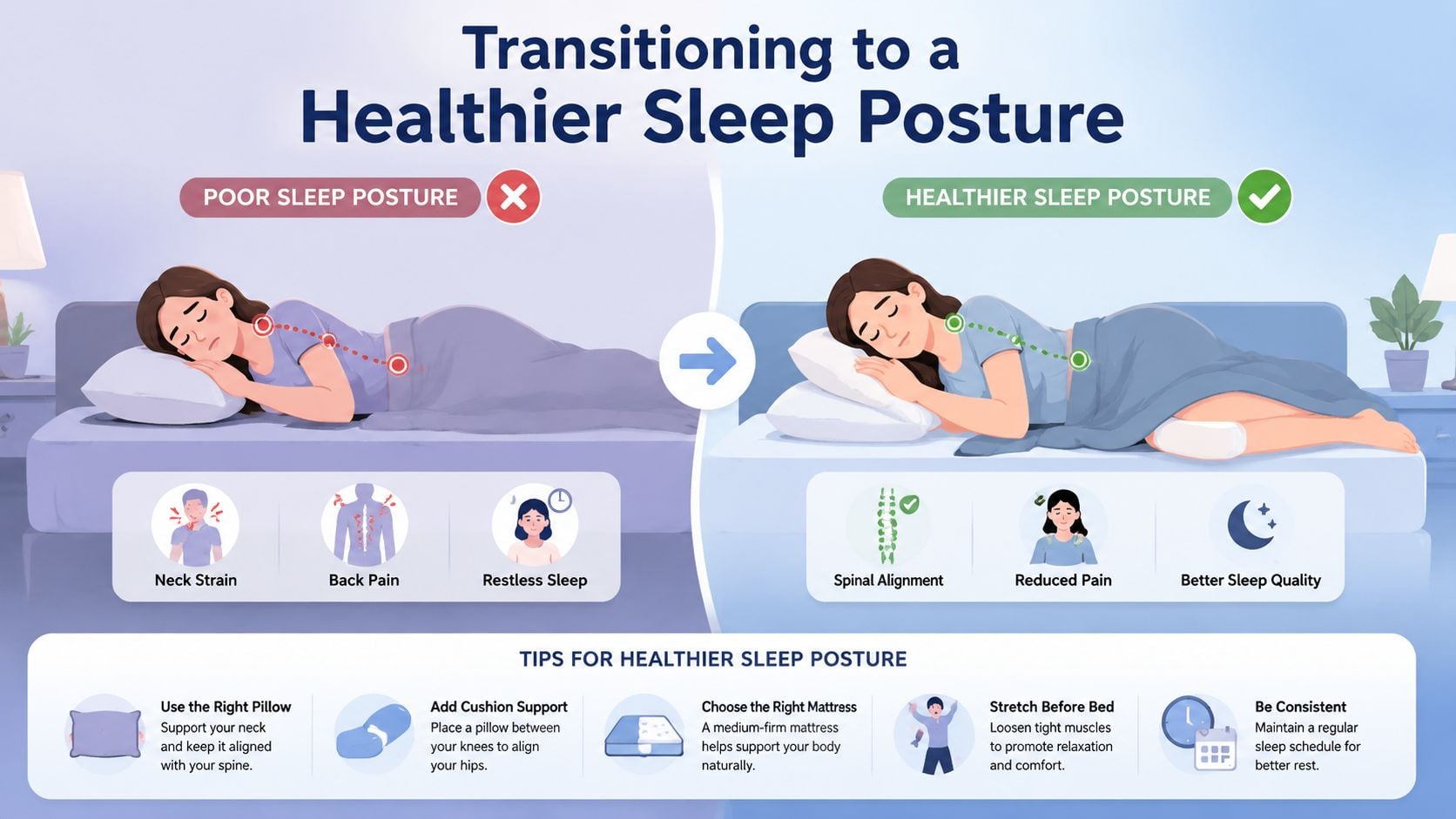
A back sleeper with lumbar discomfort may try the reverse arrangement. The head remains level, a pillow goes beneath the knees, and the mattress must support the hips rather than allowing them to sink sharply. A stomach sleeper can first reduce pillow height, then practice falling asleep on the side with a body pillow before attempting a complete change.
A simple evening routine
- Start in the target posture: Set up the pillows before lying down, not after discomfort begins.
- Remove pressure points: Adjust the knee, hip, or shoulder support until the body feels settled.
- Accept natural movement: Waking in another position doesn't mean the effort failed. Return to the preferred posture without frustration.
- Track symptoms: Note whether snoring, reflux, stiffness, or shoulder pressure changes over several nights.
Consistency matters more than perfection. If pain persists regardless of position, or if breathing repeatedly stops or feels labored, professional medical evaluation should take priority over further mattress experiments.
Find Your Perfect Sleep Solution in Ruidoso
A position guide can narrow the search, but a mattress still needs to fit the individual sleeper. Residents in Ruidoso, Alto, and Lincoln County can compare support profiles in person and explain whether the main concern is snoring, reflux, pregnancy comfort, pressure relief, or morning stiffness.
The 70-year Miller Waldrop family legacy is rooted in local service, not anonymous online transactions. At the Sudderth Drive showroom, Sleep Pros can discuss body type, normal sleep posture, budget, and cooling needs shaped by the local mountain climate. The Comfort Promise helps reduce the fear of choosing the wrong bed, while the Low Price Promise and Full-Service Delivery with Professional Setup add practical reassurance.
A shopper looking for a local resource can learn more about the local mattress store experience before visiting. The right choice may be a pressure-relieving memory foam design, a responsive hybrid, or a supportive traditional construction from Tempur-Pedic, Sealy, Stearns & Foster, or Sherwood. The key is matching the mattress to the position that helps the body rest.
Mattress Pro by Miller Waldrop offers personalized sleep guidance, trusted mattress brands, the Comfort Promise, the Low Price Promise, and Full-Service Delivery with Professional Setup. Residents can visit Mattress Pro by Miller Waldrop at 2801 Sudderth Drive, Suite F, in Ruidoso, Monday through Saturday, to test a mattress in the position that feels most natural and find support for better mornings.