

Mattress Quiz for Couples: Find Your Perfect Fit


A couple can walk into a mattress showroom with the same problem they brought from home: one partner wants a softer, cooler bed, while the other wants firmer support and barely notices movement during the night. After a few minutes surrounded by similar-looking mattresses, the decision can feel less clear than before.
A mattress quiz for couples should do more than produce a firmness label. It should identify whether both sleepers belong on one surface, whether a split setup makes more sense, and which construction can handle differences in movement, body type, temperature, and comfort. For couples in Ruidoso, Alto, and across Lincoln County, that quiz is a useful starting point, but it should lead to hands-on testing with a local Sleep Pro.
Why Couples Need a Different Mattress Quiz
A couple standing between showroom floor models can easily end up voting for two different beds. One person may focus on pressure relief around the shoulders and hips. The other may care more about stable lumbar support, cooling, or the ability to move without disturbing a partner.
A solo mattress quiz usually captures one body, one sleep position, and one comfort preference. A couple needs a paired profile. The 2023 U.S. survey of 519 adults found that nearly two-thirds share a bed with a partner at least once a week, while 45% sleep better alone and 45% sleep better with someone else (Better Sleep's sleep and partners research). Those results make the problem clear. Sharing a bed is common, but shared comfort isn't automatic.
A shared bed is a negotiation
A serious couple quiz compares both sleepers instead of averaging their answers into an unhelpful middle. It should identify:
- Firmness conflict: One partner may need cushioning while the other needs a more stable surface.
- Movement conflict: A restless sleeper and a light sleeper need stronger motion control.
- Temperature conflict: One person may sleep hot while the other prefers a warmer feel.
- Body-type conflict: The same mattress can feel very different to two bodies.
- Space conflict: A queen may feel restrictive even when the mattress construction is sound.
A custom couple profile can flag those pressure points before either partner commits to a mattress. Couples can also use this guide to finding a mattress that works for both partners before heading to a showroom.
The right quiz doesn't decide which person wins. It shows whether one shared mattress, a dual-comfort design, or a coordinated split system gives both sleepers a realistic path to better rest.
The Core Questions Every Couple Quiz Should Ask
A strong mattress quiz for couples should collect answers from both partners separately. If a questionnaire allows only one shared response, it's missing the differences that make couple shopping difficult.
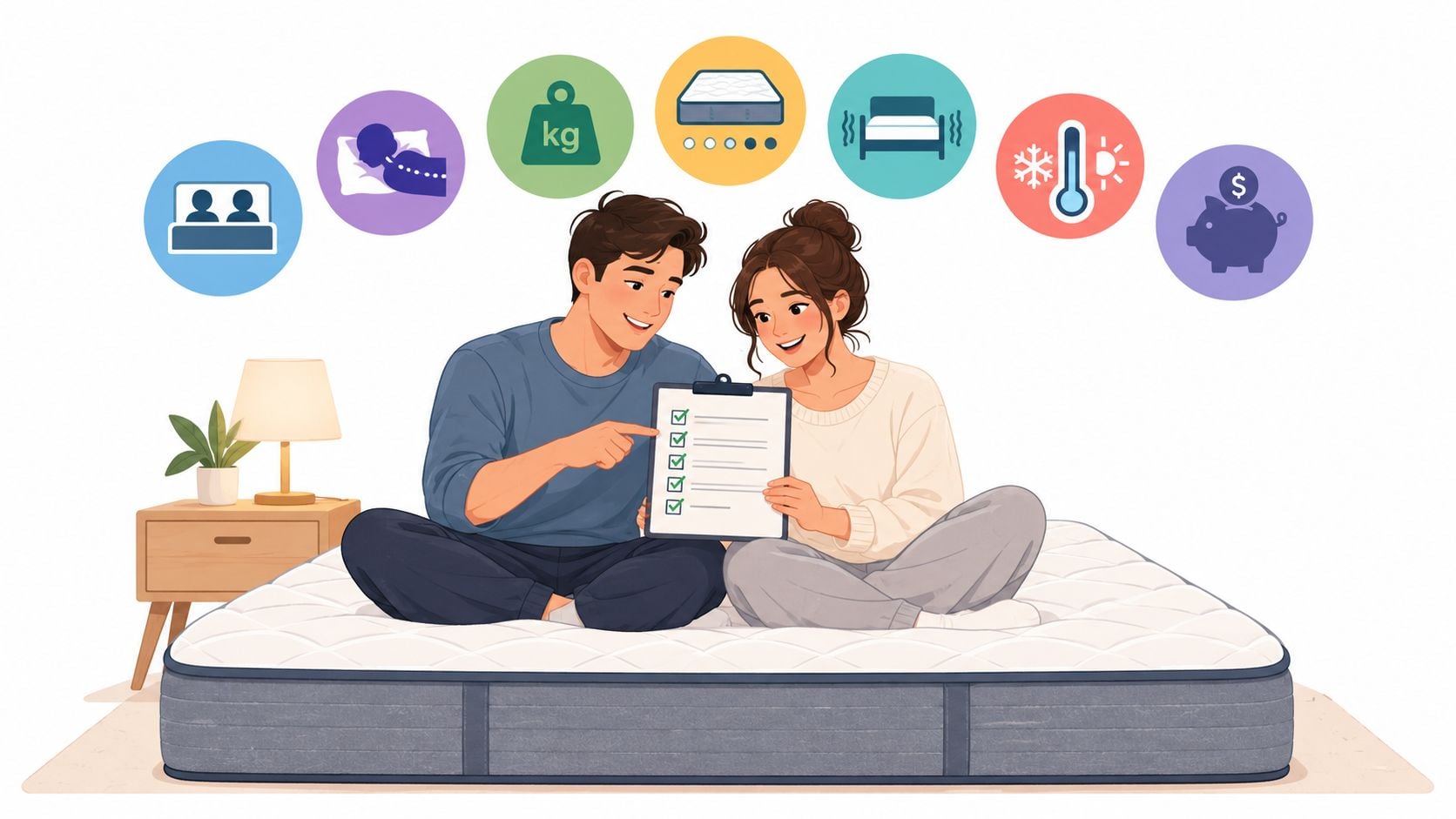
Seven variables that matter
Shared surface or split setup: Start here. If one partner needs a radically different feel, the rest of the recommendation may need to account for two surfaces rather than one.
Firmness preference: Each sleeper should rate the preferred feel on a 1-to-10 scale, rather than choosing only soft, medium, or firm. The scale exposes a meaningful gap between partners.
Body type and weight range: A lighter side sleeper can experience the same mattress as firmer, while a heavier back sleeper may need more substantial support. Each partner's answer matters.
Sleep position: Record side, back, stomach, or combination sleeping for both people. Sleep position affects pressure relief and spinal alignment. This sleep-position guide can help couples describe their habits accurately.
Temperature preference: Mark each sleeper as hot, neutral, or cold. Memory foam can provide close contouring and pressure-point relief, while cooling gel, breathable covers, latex, and coil-based airflow can change the overall temperature experience.
Motion sensitivity: Rate how often one partner wakes when the other rolls, gets up, or changes position. A quiz that skips motion isolation has missed one of the defining issues of a shared bed.
Size and room limits: Include bedroom dimensions, walking space, furniture placement, and whether a taller pillow-top or adjustable base will fit comfortably.
Practical rule: If a quiz skips the shared-versus-split question, body-type information, or motion sensitivity, couples shouldn't treat its result as a complete recommendation.
Quiz-based recommendation systems commonly use sleep position, body weight, motion sensitivity, firmness, temperature, and pain points as core inputs. The more directly a quiz handles both partners, the more useful its shortlist becomes.
Top Third-Party Mattress Quizzes Worth Taking
Couples can use outside quizzes for ideas, but the result should be treated as a direction, not a final verdict. A questionnaire may identify a likely firmness range while failing to account for how both bodies react when they lie on the same mattress.
What each quiz is useful for
A fast quiz suits couples who need a simple starting point. An educational questionnaire helps shoppers who want to understand construction before visiting a store. A deeper interview-style quiz is more useful when the couple has a major firmness gap, motion concerns, or interest in an adjustable base.
| Quiz | Question Depth | Couple-Specific Handling | Time to Complete | Result Clarity |
|---|---|---|---|---|
| Fast visual quiz | Light | Usually limited | Short | Clear starting category |
| Educational quiz | Detailed | Moderate | Moderate | Helpful explanation, generic shortlist |
| Deep interview quiz | High | Stronger conflict handling | Longer | More useful for complicated profiles |
| Adjustable-base quiz | Moderate to high | Focuses on compatibility | Moderate | Clear when base features matter |
The strongest published mattress-quiz case study reported a 60% to 70% completion rate, approximately 6x higher conversion among quiz completers, and over 95% matching accuracy to the brand's lineup. Those figures describe one implementation, not every quiz, but they show why a short, well-structured questionnaire can produce useful shopping engagement.
Choosing a reasonable first step
- Speed-focused couples: Choose a brief quiz that identifies a starting firmness and mattress type.
- Research-focused couples: Choose a detailed quiz that explains pressure relief, support, materials, and sleep position.
- Budget-conscious couples: Look for a questionnaire that separates must-have features from luxury additions.
- Adjustable-base shoppers: Prioritize questions about base compatibility, independent elevation, and dual comfort.
Couples shouldn't let a quiz bury them under product names. A useful result should say what problem the bed needs to solve, which construction fits, and what must be tested in person. For broader sleep-related planning, a sleep health resource can add context, but it shouldn't replace mattress testing.
A Custom Sleep Pro Quiz Built for Two Sleepers
Couples can create a practical profile before visiting a store by answering each question twice. The purpose isn't to produce a scientific diagnosis. It's to turn vague disagreements into specific construction priorities.
Eight paired questions
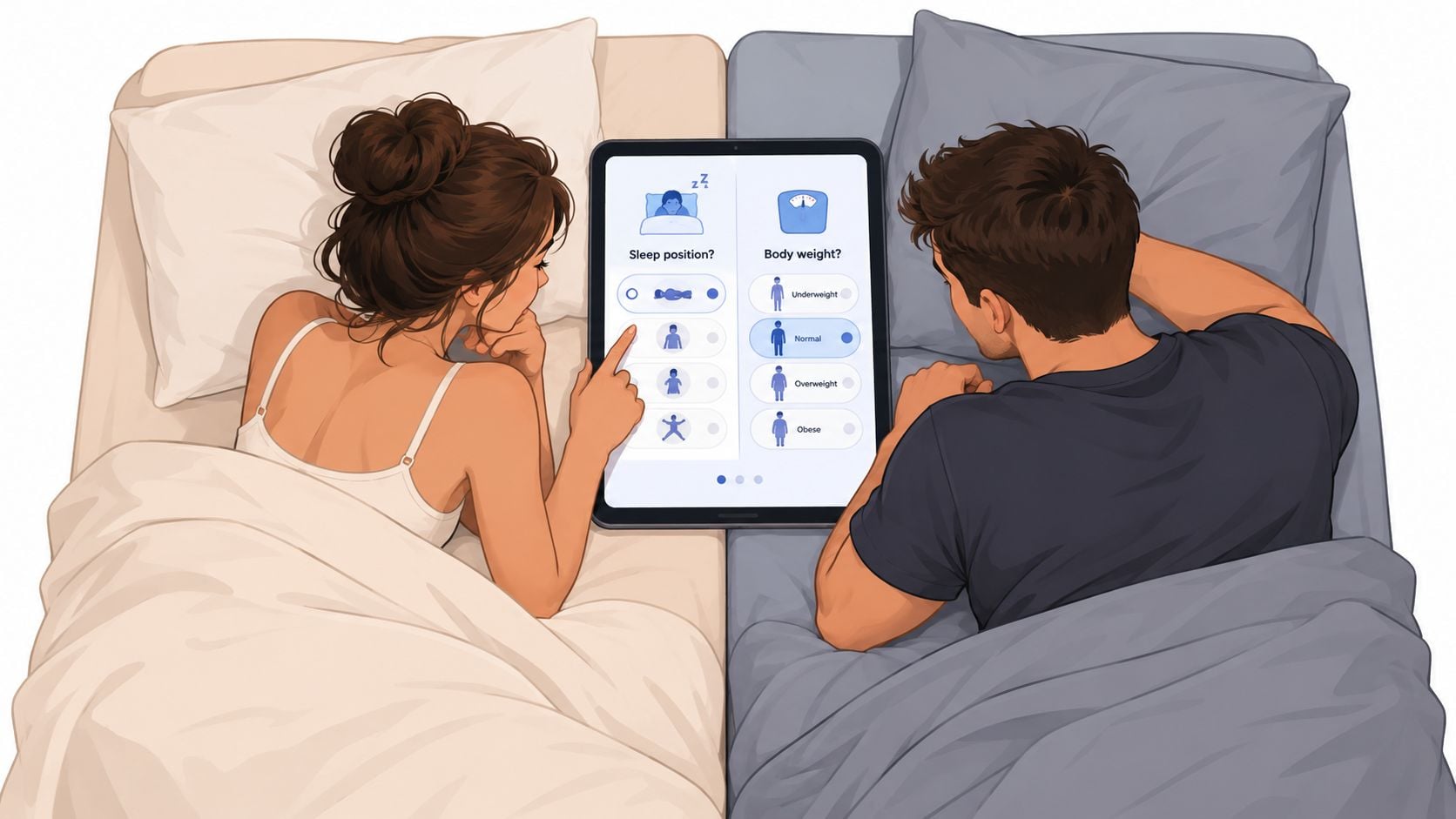
How does each partner sleep? Side sleeping raises the need for pressure relief. Back or stomach sleeping usually raises the need for stable support. Combination sleepers need enough responsiveness to change positions without fighting the mattress.
What body-weight range describes each sleeper? This helps predict how much each person will compress the comfort layers and how much support the core must provide.
Does each partner sleep hot, neutral, or cold? Hot sleepers should compare breathable designs, cooling gel technology, latex, and hybrids with airflow. A cold sleeper may prefer closer contouring and a more insulating comfort layer.
How sensitive is each partner to motion? If one sleeper wakes easily, prioritize motion isolation before adding bounce or responsiveness.
Where does each partner feel pressure? Shoulders, hips, lower back, and knees point toward different comfort needs. Persistent pain deserves professional medical guidance, but the mattress still needs to avoid obvious pressure points.
What has worked or failed before? Ask whether past beds felt too hard, too soft, warm, unstable, or difficult to move on. A failed mattress supplies useful evidence.
What budget ceiling applies? Set a realistic range before browsing. This prevents a couple from falling for a construction that creates financial strain.
Should the bed be shared or split? If answers conflict sharply, compare a single mattress with a split or dual-comfort system.
How the answers become a recommendation
- Firmness gap: A small gap points toward a shared middle feel. A large gap points toward dual comfort or split construction.
- High motion sensitivity: Favor pocketed coils, substantial foam comfort layers, and strong motion-control design.
- Hot-sleeper answers: Give cooling materials and airflow priority over dense, heat-retaining construction.
- Pressure-point answers: Look for contouring that cushions shoulders and hips without allowing excessive sink.
- Frequent edge use: Require reinforced perimeter support so both sleepers can use more of the surface.
- Room and size limits: Choose the largest practical size that leaves safe walking clearance.
A sample result might read: “Shared medium-firm hybrid, strong motion isolation, reinforced edges, breathable comfort layers, and king-size if the room allows.” That output is more useful than a list of products because it tells the couple what to test.
Couples who want a guided handoff can arrange a nearby sleep consultation and bring these paired answers to a Sleep Pro.
Should You Even Share One Mattress
The first question isn't always which mattress should both partners buy. Sometimes the better question is whether both partners should sleep on one surface at all.
A 2023 U.S. survey found that 31% of adults had used a separate sleeping arrangement to accommodate a bed partner (American Academy of Sleep Medicine survey data). Separate sleep can become a sensible response to snoring, incompatible schedules, persistent movement, or major temperature differences. It isn't automatically a sign that a relationship is failing.
Three common couple profiles
- Sharing works: Both partners prefer similar firmness, sleep on compatible schedules, and don't wake easily from movement.
- Splitting wins: One partner sleeps hot and moves frequently, while the other needs quiet, cooler sleep and a different feel.
- Split-king fits: The couple wants one coordinated bedroom setup, but each side needs its own firmness or elevation.
Research on couples' sleep found that co-sleeping can be associated with about 10% more REM sleep, less fragmented REM sleep, longer undisturbed REM fragments, and more limb movements compared with sleeping individually (peer-reviewed couple sleep research). Another study reported average sleep concordance of 66.8% and wake concordance of 6.8%, with wake transmission influenced by bedtime similarity and chronotype (couple-level sleep study). The takeaway isn't that one arrangement is universally superior. The arrangement needs to support both sleepers.
| Setup | Best For | Key Trade-Off | Motion Isolation |
|---|---|---|---|
| Shared mattress | Similar preferences and schedules | Requires compromise | Depends on construction |
| Split setup | Major firmness or schedule differences | A seam or separate surfaces | Stronger between sides |
| Split-king | Different comfort needs in one frame | Higher setup complexity | Strong between sides |
The quiz should therefore begin with a fork: are the partners shopping for one mattress, or for a coordinated sleep system? This couples mattress guide can help frame that decision.
How to Read Your Quiz Results Like a Pro
A quiz result becomes useful when couples translate each score into a physical feature. Firmness, motion, and size aren't just labels. They describe how the mattress should behave under two bodies.
Decode the firmness score
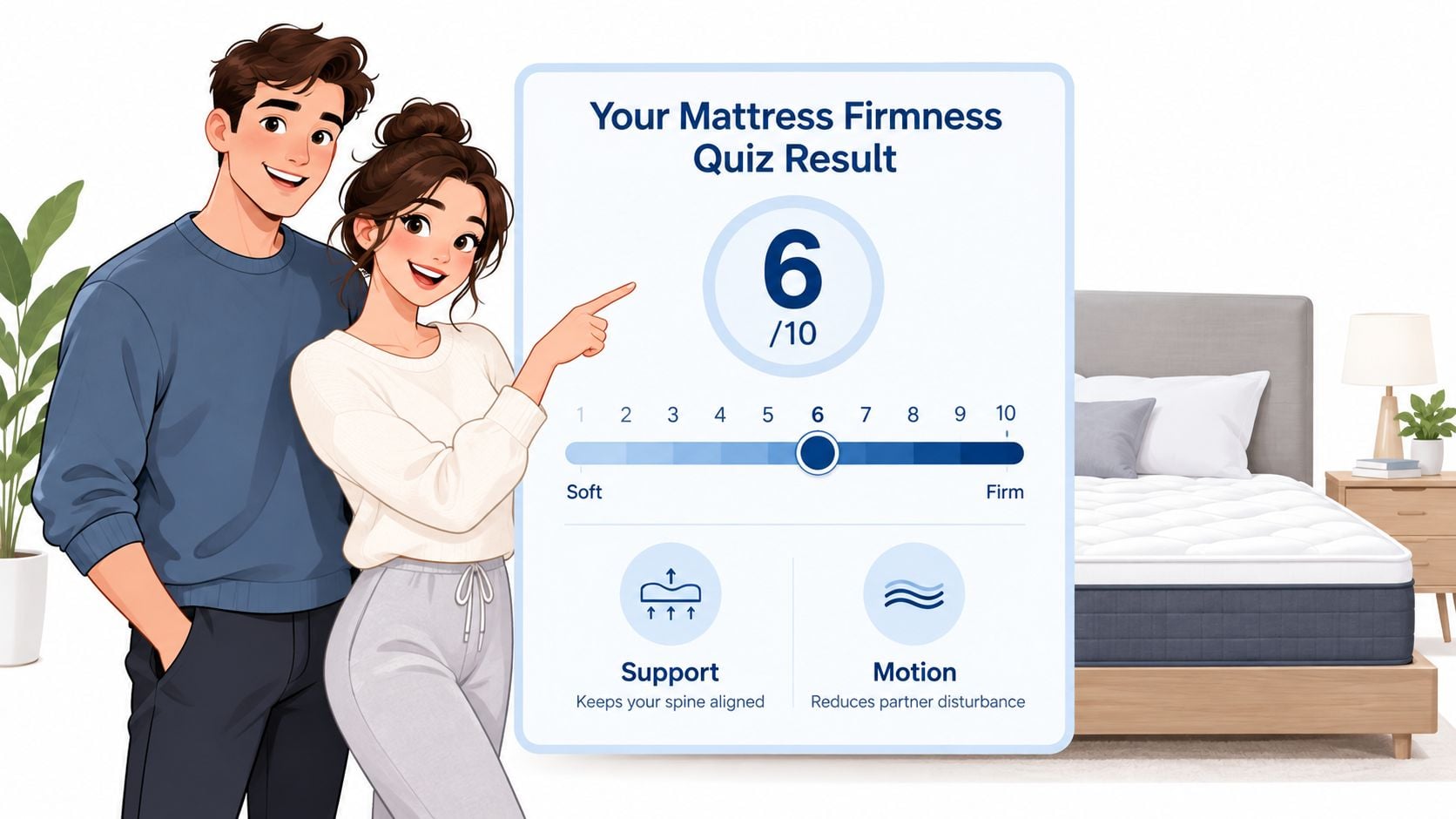
A firmness score on a 1-to-10 scale should be read as a feel direction, not a universal measurement. A lower result generally points toward more surface cushioning and pressure relief. A higher result points toward a more stable, resistant surface. Body weight, sleep position, and construction still affect how that feel is experienced.
If one partner scores softer and the other scores firmer, don't automatically split the difference. A responsive hybrid with targeted support, a dual-comfort design, or separate sides may preserve more comfort than forcing both sleepers onto a compromise surface.
Decode motion and construction
A high motion-isolation recommendation means the mattress should absorb movement rather than send it across the bed. Pocketed coils can limit transfer more effectively than a continuous coil system because the springs respond more independently. Foam comfort layers can further reduce the feel of rolling, getting up, or changing position, although they may affect cooling and ease of movement.
Decode the size recommendation
A queen can work when both adults sleep relatively still and the room requires a smaller footprint. A king becomes the stronger choice when both partners feel crowded, one sleeper moves frequently, or the bed must accommodate children or pets. A California King may make more sense when length matters more than additional width.
Consider a couple whose answers point to a medium-firm hybrid with zoned coils and reinforced edge support. The medium-firm feel creates a practical starting point between cushioning and stability. Zoned coils can provide more targeted support, while reinforced edges preserve usable space and make getting in or out easier.
More Space or Better Construction
Couples often assume a larger mattress will solve partner disturbance. Sometimes it will. More surface area creates distance, but it doesn't stop movement from traveling through the mattress.
Compare the actual fixes
| Factor | Upgrade to King, Same Build | Upgrade Construction, Keep Queen | Split King or Dual-Comfort |
|---|---|---|---|
| Motion isolation | Same behavior, more distance | Better absorption when designed for it | Strong separation between sides |
| Usable surface area | Increases | Stays the same | Increases by setup |
| Cost delta | Depends on size change | Depends on materials | Often includes specialized components |
| Long-term flexibility | Simple, familiar format | Stronger feature performance | Best for changing preferences |
A king upgrade makes sense when both partners feel crowded, one sleeper is unusually restless, or the room can comfortably accommodate more width. Taller sleepers may also value a California King for added length. Room dimensions still matter, especially in mountain homes and cabins where furniture placement can be tight.
Construction should win when the main complaint is movement, heat, or firmness conflict. Pocketed coils, zoned support, breathable layers, cooling gel technology, and dual-firmness designs address problems that extra width can't solve. A high-quality queen can outperform a basic king when the couple's bodies already have enough room.
The better spend: If the quiz identifies motion transfer and pressure relief as the main failures, improve construction first. If both partners report feeling physically crowded, increase size.
A split king, two compatible twin surfaces, or a dual-comfort mattress can preserve the existing room footprint while giving each sleeper a more individualized feel. The correct choice depends on whether the problem is distance, mattress behavior, or both.
Taking Quiz Results Into the Ruidoso Showroom
A quiz result gives a couple a useful script for the showroom. It keeps the visit focused on sleep needs instead of brand names and sales-floor momentum.
Use this six-step showroom plan
Lead with the paired summary. Tell the Sleep Pro that the shoppers are looking for a bed for two sleepers, then describe the shared or split preference.
Share both firmness scores. Mention the gap directly. A couple can say, “Our quiz flagged a firmness gap of three points and motion isolation as a top priority. Where should we start?”
Discuss motion isolation before lying down. Ask which floor models absorb movement and whether the construction uses independently responding coils or substantial motion-dampening comfort layers.
Test the mattress together. Lie in normal sleep positions. One partner should get in, get out, roll, and change position while the other remains still. Stay long enough to notice pressure, heat, and movement response, rather than choosing based on the first impression.
Compare the top two models. Ask the Sleep Pro to place them side by side on feel, support, construction, price, warranty, and trial terms.
Confirm delivery details. Discuss Full-Service Delivery with Professional Setup, room access, frame compatibility, removal options, and how the mattress will be placed.
What Ruidoso couples should test
Dry mountain air can make temperature comfort especially noticeable across changing seasons. Couples should compare cooling covers, breathable hybrid construction, foam density, edge stability, and the feel of the mattress after both bodies have settled into it.
Mattress Pro by Miller Waldrop serves local shoppers from its showroom on Sudderth Drive, with Sleep Pros who can connect quiz results to Tempur-Pedic, Sealy, Stearns & Foster, and Sherwood options. Local guidance also helps couples account for cabins, guest rooms, stairs, frames, and delivery conditions across Ruidoso, Alto, and Lincoln County.
How the Mattress Pro Promises Remove the Risk
A quiz can narrow the decision, but couples still worry about choosing incorrectly. Mattress Pro by Miller Waldrop addresses that concern through three service commitments: the Comfort Promise, the Low Price Promise, and Full-Service Delivery with Professional Setup.
The Comfort Promise addresses feel uncertainty
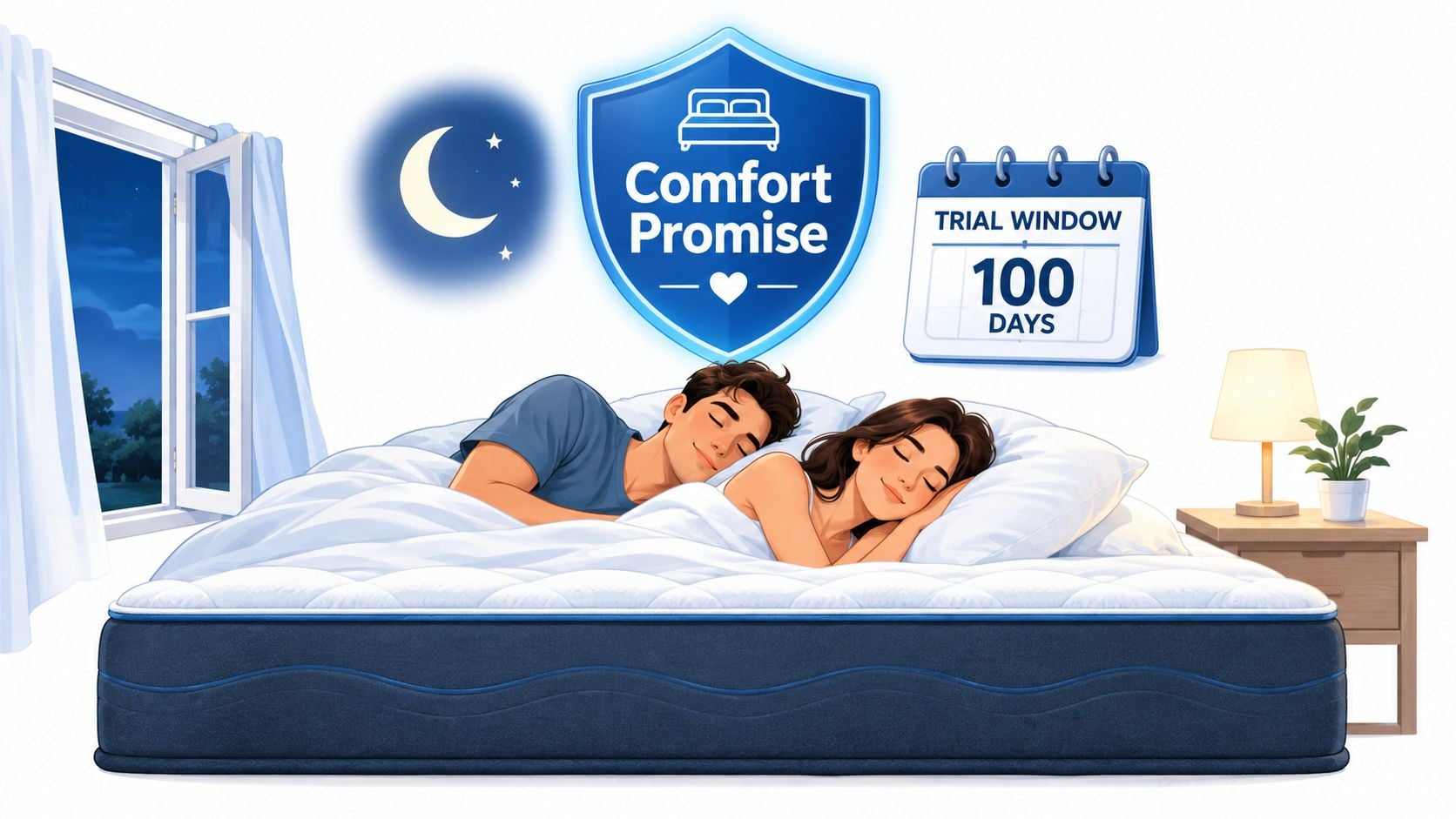
A showroom test can't reproduce every night at home. Couples may discover that a firmness choice feels different after repeated sleep, or that one partner needs more pressure relief than expected. The Comfort Promise is designed to reduce the fear of picking the wrong bed by giving the couple a path to address a comfort mismatch under the applicable store terms.
Industry coverage reports that mattress trials commonly range from 30 to 365 nights, with 100 nights described as a common standard (mattress trial coverage). Couples should confirm the exact terms for the selected mattress before purchase.
The Low Price Promise addresses hesitation
A couple shouldn't have to postpone a well-matched purchase because a competing promotion creates uncertainty. The Low Price Promise provides a local price-match assurance under its terms, helping shoppers compare the recommended model with confidence instead of waiting endlessly for a sale.
Full-Service Delivery addresses logistics
Professional setup matters when a mattress must travel through tight hallways, stairs, or a mountain home's unusual access points. Full-Service Delivery with Professional Setup can turn the final step from a difficult transport project into a coordinated in-home installation.
Together, these promises address three common post-quiz fears: buyer's remorse, price anxiety, and delivery complications. The result is a clearer path from questionnaire to real sleep testing.
Your Couple's Mattress Action Plan
Couples can complete the decision without turning mattress shopping into an open-ended project. The following plan keeps the work focused over the next week.
Write down the seven core variables, about 15 minutes. Each partner records sleep position, firmness, body type, temperature, motion sensitivity, pain points, and room or size needs separately.
Choose shared or split sleep, about 10 minutes. Decide whether the goal is one surface, a dual-comfort mattress, a split setup, or a split king. Don't let a standard bed frame make the decision by default.
Take two outside quizzes and the custom paired quiz, about 30 minutes. Compare the repeated signals, especially firmness direction, motion isolation, cooling, and size.
Visit the Ruidoso showroom, about one appointment. Bring screenshots or printed results, use the firmness-gap script, and ask a Sleep Pro to identify compatible Tempur-Pedic, Sealy, Stearns & Foster, or Sherwood constructions.
Test three mattresses together, then review the promises. Compare movement, edge support, pressure relief, temperature, and ease of movement. Let the Comfort Promise, Low Price Promise, and Full-Service Delivery help remove the final uncertainty.
The goal isn't a perfect quiz score. It's a sleep setup that respects both partners' bodies and makes restful shared sleep more realistic.
Mattress Pro by Miller Waldrop offers personalized mattress guidance, premium and practical sleep solutions, the Comfort Promise, the Low Price Promise, and Full-Service Delivery with Professional Setup for couples in Ruidoso and Lincoln County. Visit Mattress Pro by Miller Waldrop to browse the collection, then stop by 2801 Sudderth Drive, Suite F, in Ruidoso, Monday through Saturday, with the couple's quiz results ready.