

Best Mattress Firmness for Back Sleepers: A Practical Guide

You're waking up with a stiff lower back, even though the mattress looked comfortable in the showroom. Or perhaps there's a hollow space beneath the lumbar curve, your shoulders feel pressed against the surface, and every morning starts with adjustment instead of relief. For back sleepers, firmness usually determines whether the mattress supports the body or lets it settle out of position.
The best mattress firmness for back sleepers is generally medium to medium-firm, with many expert recommendations centered around 6.5 out of 10. That doesn't mean every back sleeper needs the same bed. Body weight, posture habits, mattress construction, climate, and whether a partner shares the bed all change how firmness feels. The practical answer comes from combining the right starting range with an honest in-home evaluation.
Mattress Pro by Miller Waldrop has spent 70 years serving local families in Ruidoso and Lincoln County. A Sleep Pro can help compare Tempur-Pedic, Sealy, Stearns & Foster, and Sherwood mattresses in person, then reduce the risk of a poor choice through the Comfort Promise, Low Price Promise, and Full-Service Delivery with Professional Setup.
Why Back Sleepers Need a Different Firmness Strategy
A back sleeper's problem often starts with a mattress that felt comfortable at bedtime but feels wrong by breakfast. The lower back may feel tight, the hips may sink too far, or the shoulder blades may press against a surface that gives too little. Firmness determines whether your body stays supported or settles out of position overnight.
Back sleeping places your body on a broad, relatively even surface. The mattress must support the pelvis and torso while preserving the spine's natural shape. That requirement differs from side sleeping, where the shoulders and hips need more cushioning, and stomach sleeping, where the midsection needs stronger resistance. Back sleepers need a controlled middle ground, not just the hardest surface available.
Why very firm isn't automatically better
A very soft mattress can let the hips drop ahead of the torso, increasing the bend through the lower back. A very firm mattress can hold the pelvis too high, press against the shoulders, and leave an unsupported space beneath the waist. Spine guidance describes both risks, excessive sinking on soft surfaces and unnatural arching on overly firm ones, in the Hoag Orthopedic Institute's mattress guidance for spine health.
Research on adults with chronic nonspecific low-back pain found that medium-firm mattresses performed better than firm mattresses on several measures, including pain in bed, pain on rising, and disability. The findings support medium-firm as the smarter starting point, not a universal final answer, as summarized in the Sleep Foundation's back-sleeper mattress guidance.
Your body weight changes the result. A lighter sleeper may experience a firm mattress as unforgiving because the comfort layers do not compress much. A heavier sleeper may sink too far into a softer model and need firmer support beneath the hips. Posture habits matter too. If you sleep with one knee raised, shift toward your side, or carry more weight around the midsection, test the mattress in your actual position rather than judging it while sitting on the edge.
Practical rule: Start with medium to medium-firm, then adjust based on hip sinkage, shoulder pressure, and whether the lumbar curve feels supported.
Test Tempur-Pedic, Sealy, Stearns & Foster, and Sherwood models in person, and use Mattress Pro by Miller Waldrop's trial windows, exchanges, and white-glove setup to reduce the cost of getting that choice wrong.
How Back Sleeping Actually Works on a Mattress
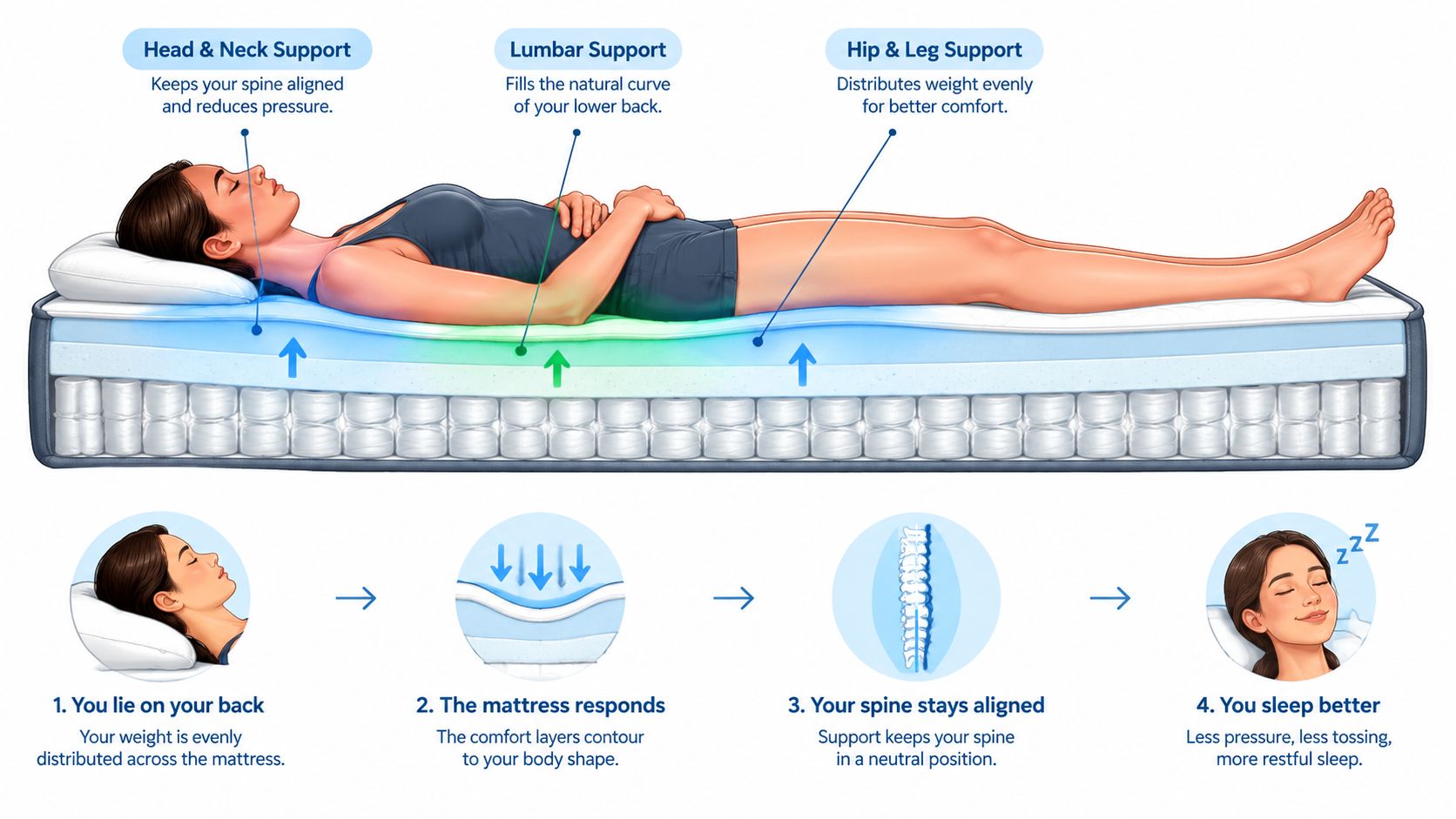
A neutral back-sleeping position keeps the ear, shoulder, hip, and knee generally aligned rather than twisting the body forward or backward. The spine still has a natural S-curve, and the lumbar region needs enough room to preserve that shape without hanging unsupported.
The two main contact zones
The shoulders and pelvis carry much of the body's contact with the mattress. A suitable surface allows both areas to settle without one dropping dramatically lower than the other.
- The pelvis needs controlled sinkage. The hips should dip slightly into the comfort layer, but the mattress must resist a deep drop around the sacrum.
- The shoulders need stable cushioning. Too much resistance can create pressure near the shoulder blades, while too much give can pull the torso out of line.
- The lumbar curve needs measured support. The surface should fill the space beneath the lower back without pushing aggressively upward.
A too-soft bed lets the pelvis descend first. That can exaggerate the lower-back bend and leave the sleeper feeling as if the middle of the body is sagging. A too-firm bed does the opposite. It may hold the pelvis high while failing to conform around the waist, leaving a noticeable gap beneath the lumbar area.
A simple home check
A back sleeper can perform a basic check before shopping. Lie flat on the current mattress and relax the legs, shoulders, and hips. Slide a hand beneath the lower back.
If the hand slides through a large empty space with little contact, the mattress may be too firm or insufficiently conforming. If the hand can't move because the hips have sunk heavily into the surface, the bed may be too soft. The goal is gentle contact, not pressure, with the spine resting comfortably rather than being pushed upward or left unsupported.
Pain can have many causes, so persistent or severe symptoms deserve medical attention. A mattress can improve overnight positioning, but it can't diagnose or treat a spinal condition.
Soft, Medium, and Firm Compared for Back Sleepers
Firmness labels vary between mattress constructions and brands, so “medium-firm” will not feel identical everywhere. Use the categories as a starting point, then judge how the surface responds beneath your shoulders, waist, and pelvis.
| Firmness Level | Ideal Back Sleeper Profile | Key Benefit | Main Drawback |
|---|---|---|---|
| Soft | Very light back sleepers who need substantial cushioning | Deep pressure relief and close contouring | Hips may sink too far and create a hammock effect |
| Medium-soft | Lightweight back sleepers who dislike rigid surfaces | Adds cushioning while retaining some lumbar support | May still allow excessive pelvic sinkage |
| Medium-firm | Most average-weight back sleepers and many couples | Balances spinal alignment, comfort, and controlled contouring | Can feel too firm for very light sleepers |
| Firm | Heavier back sleepers or people who also lean toward stomach sleeping | Limits deep sinkage and keeps the midsection lifted | May create a lumbar gap and shoulder-blade pressure |
Soft and medium-soft
Choose soft only if you are very light and need noticeable cushioning. The surface can relieve pressure around the shoulders and hips, but it may let the pelvis settle below the ribs. That uneven position can leave your lower back tired by morning.
Medium-soft is a better starting point for a back sleeper under 130 pounds who dislikes a rigid feel. It provides more surface give while retaining some support, though excessive pelvic sinkage remains the main risk. Keep your pillow from becoming too tall, since a yielding mattress already lets your upper body settle.
Morning tightness that improves after you move around is a clear reason to test a firmer option.
Medium-firm
Medium-firm is the practical starting point for most back sleepers. A target near 6.5 out of 10 balances a slight hip dip with enough resistance to keep your torso supported. Use this mattress firmness guide to compare how firmness labels translate into actual sleeping feel.
This range also suits sleepers who occasionally roll to another position. A responsive hybrid or latex construction can provide cushioning without making movement feel difficult. If you are comparing brand families in a showroom, test medium-firm models from Tempur-Pedic, Sealy, Stearns & Foster, and Sherwood with your usual sleep posture, rather than relying on the label alone.
Firm
Firm works for heavier back sleepers, people who spend part of the night on their stomach, and anyone who strongly dislikes sinkage. The trade-off is direct. A firm surface can press into the shoulder blades or leave a gap beneath the lumbar area when an average-weight sleeper needs more contouring.
Your best choice is the firmness that keeps the hips from dropping while allowing your waist and shoulders to settle naturally. Ask a local showroom about the trial window and exchange policy before you commit. White-glove setup also helps when the mattress is difficult to move, giving you a cleaner chance to test the bed on its proper foundation.
Matching Firmness to Your Body Weight
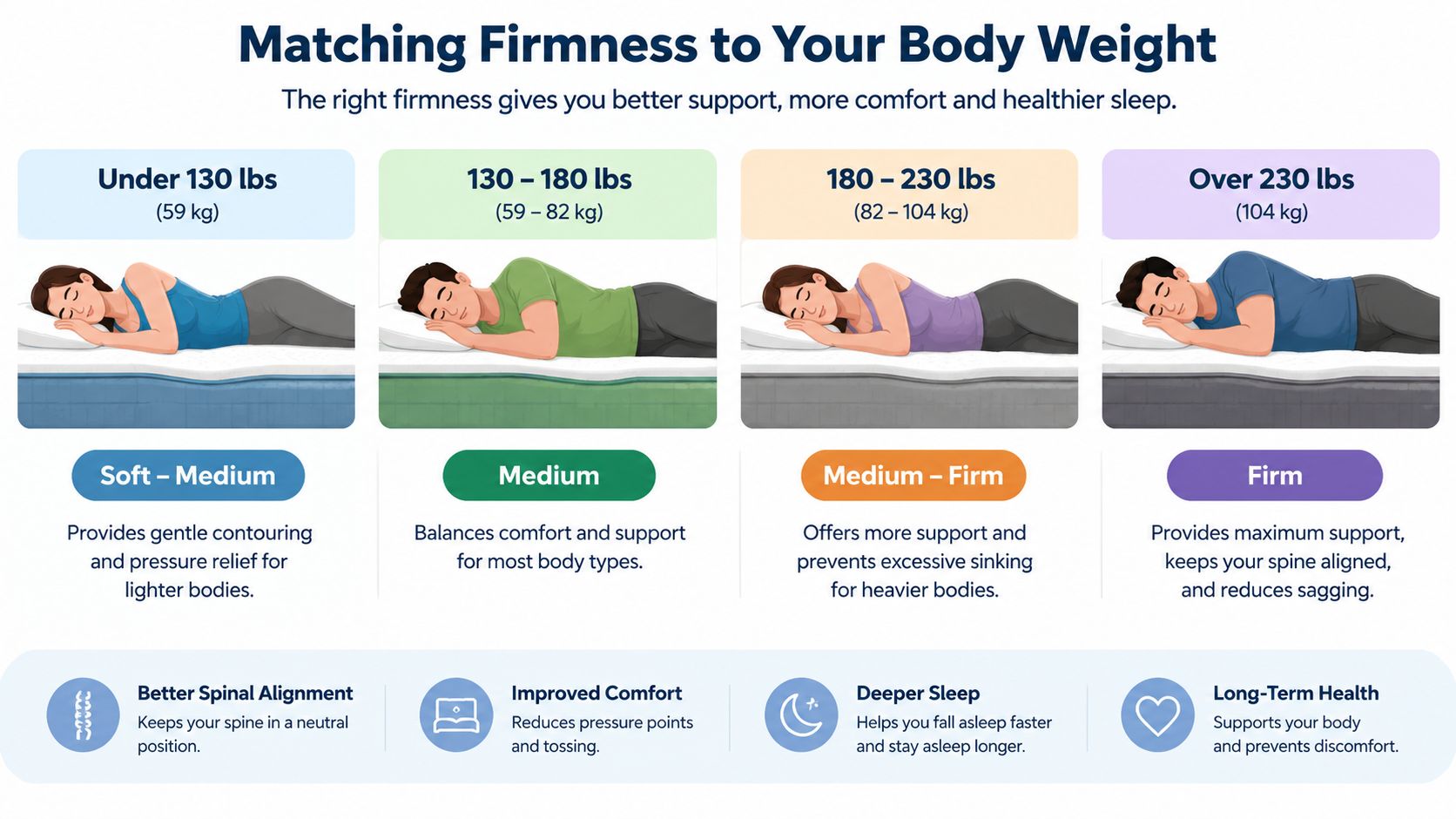
Body weight changes how a sleeper compresses the comfort layers. A mattress that feels firm to someone under 130 pounds may feel closer to medium or medium-soft to someone over 230 pounds. The label stays the same, but the body's interaction with the mattress changes.
Under 130 pounds
A back sleeper under 130 pounds should begin with medium-soft to medium-firm. A slightly more yielding surface can help fill the lumbar space because a lighter body may not compress a firm comfort layer enough to receive contouring.
A lower or adjustable-loft pillow usually pairs well with this range. The failure mode to watch for is a lower-back gap on a hard mattress. If the pelvis and shoulders stay raised while the waist receives no support, the sleeper may wake with stiffness across the lumbar area.
From 130 to 230 pounds
This is the clearest medium-firm starting group. The mattress needs enough pushback to prevent the hips from dropping, but it should still contour around the lumbar curve and cushion the shoulder blades.
A medium-height pillow is a sensible first pairing, with adjustments based on head size, shoulder structure, and how much the mattress allows the upper body to settle. The body-type mattress guide can help shoppers organize those variables before visiting a showroom.
Over 230 pounds
A back sleeper over 230 pounds should start with firm to medium-firm, preferably in a construction with strong central support. The goal isn't a board-like surface. It's enough resistance to stop the pelvis from sinking through the comfort layers.
A medium or slightly lower pillow can help prevent the head from tipping forward on a firmer bed. During testing, the sleeper should focus on the L1 to L5 area of the lower back, not just the shoulder. Pressing the mattress near the lumbar zone and observing how quickly it supports the body gives a better sense of whether the bed will hold the midsection overnight.
A firmness label is only the starting point. The real test is whether the lumbar area feels supported while the hips remain level with the torso.
How Mattress Construction Changes the Feel
Two mattresses can share a firmness rating and still produce very different back-sleeping experiences. The comfort layers, support core, and airflow all influence how the body settles.
Memory foam conforms closely to the lumbar curve and can reduce pressure around the shoulders and pelvis. That contouring also makes foam feel softer or more enveloping than its showroom label suggests, especially when the sleeper stays in one position for a long time. Cooling gel and open-cell designs can help manage heat, but dense foam may still feel warmer than a more breathable construction.
Latex responds faster. It pushes back beneath the hips instead of allowing the body to sink slowly, which can suit heavier back sleepers and people who change position often. Latex generally feels buoyant rather than hugged, so it can offer lumbar support without the stuck sensation some sleepers dislike.
Hybrids combine foam comfort with a coil support system. Coils can improve airflow and provide stronger lift through the center of the mattress, making hybrids practical for Ruidoso sleepers who want contouring without an overly warm feel. Traditional innerspring mattresses can feel even more responsive, but they often need a quality comfort layer to prevent pressure at the shoulder blades and lumbar area.
| Construction | Real-World Firmness Feel | Lumbar Support | Best Back-Sleeper Profile |
|---|---|---|---|
| Memory foam | Deeper contouring and a slower response | Strong contouring, with a softer perceived feel | Sleepers who want pressure relief and motion isolation |
| Latex | Buoyant, responsive, and quicker to push back | Strong lift with less sinkage | Heavier sleepers and people who move often |
| Hybrid | Balanced cushioning, support, and airflow | Strong central support when properly zoned | Couples, hot sleepers, and mixed-position sleepers |
| Traditional innerspring | More surface pushback and less body-hugging | Moderate, depending on the comfort layer | Sleepers who prefer a classic responsive feel |
The practical rule is straightforward: a memory-foam mattress may feel softer than its number, while latex may feel firmer and more buoyant. A shopper comparing constructions should test the lumbar zone, not rely on the rating alone. More guidance on cushioning and pressure relief is available in this pressure-relieving mattress resource.
Ruidoso Climate and Local Sleep Considerations
Ruidoso's mountain setting changes how a mattress feels across the year. Dry air can make the room feel crisp, and seasonal temperature changes can affect the perception of foam. Some foam surfaces feel more resistant in colder conditions and more yielding as the room warms.
That matters for back sleepers because a comfort layer that feels just right in one season may feel different in a cold cabin or a warmer guest room. A sleeper who prefers a firm surface elsewhere may appreciate slightly more conforming support in a cool, dry mountain environment, especially when the bed uses foam that responds to room temperature.
Guest rooms need broader comfort
Cabin owners and short-term-rental hosts face a separate challenge. One mattress may serve a lighter back sleeper one night and a heavier combination sleeper the next. A medium-firm hybrid is often the most practical compromise because it offers central support, some pressure relief, and easier movement across different body types.
A softer mattress may please a narrow group but can let heavier guests sink too far. A very firm mattress may feel durable but leave lighter guests unsupported at the waist. Zoned support, breathable materials, and a balanced comfort layer give the room a better chance of working for varied sleepers.
Why local setup matters
A mattress delivered to a non-climate-controlled room may need time to settle into the local environment. Full-Service Delivery with Professional Setup places the bed correctly on its foundation and removes much of the physical work, which is particularly useful for mountain homes, stairs, and guest-room installations.
Testing on Sudderth Drive also gives Ruidoso shoppers a chance to compare how foam, latex, and hybrids respond under their own posture. The natural sleep solutions guide offers another starting point for shoppers considering materials and comfort preferences shaped by the local climate.
Brand and Model Categories Worth Testing
A focused showroom visit works better than lying on every mattress in sight. Back sleepers should arrive with a firmness range, a body-weight category, and a short list of constructions to compare.
| Brand Family | Model Category | Recommended Firmness | Trial / Exchange Terms | Best-Fit Back Sleeper |
|---|---|---|---|---|
| Tempur-Pedic | TEMPUR-Adapt and ProAdapt lines | Medium-firm for most, firmer for heavier sleepers who need less sinkage | Confirm current Comfort Promise terms and exchange details in store | Sleepers seeking close contouring and motion isolation |
| Stearns & Foster | Lux Estate and Reserve hybrids | Medium-firm with stronger support for average and heavier bodies | Confirm current trial and exchange terms before purchase | Sleepers wanting traditional support with premium cushioning |
| Sealy | Posturepedic Plus and Premium | Medium-firm value-oriented options | Confirm current Comfort Promise and exchange details | Average-weight back sleepers seeking practical support |
| Sherwood | Biltmore and Lux Craft | Medium-firm latex feel, with firmer options for heavier sleepers | Confirm current trial and exchange terms | Sleepers who prefer buoyancy, responsiveness, and natural latex feel |
Tempur-Pedic TEMPUR-Adapt and ProAdapt lines are worth testing first for lighter or average-weight back sleepers who want the lumbar area to contour closely. A firmer version may suit a heavier sleeper, but the test should focus on whether the hips sink farther than the torso.
Stearns & Foster Lux Estate and Reserve hybrids make sense for shoppers who want a more traditional feel with strong support beneath the comfort layers. Sealy Posturepedic Plus and Premium categories can provide a direct medium-firm comparison for value-minded shoppers. Sherwood Biltmore and Lux Craft categories are useful for anyone who prefers faster response and less body hug from latex.
The showroom team should confirm the current trial window, exchange fee structure, and white-glove delivery availability for the exact model. Those terms can vary by product and purchase details, so they shouldn't be guessed from a general brand label.
For a purposeful visit, a light sleeper can begin with a conforming medium option, an average-weight sleeper can start with medium-firm foam and hybrid models, and a heavier sleeper can begin with a supportive hybrid and responsive latex surface. Mattress Pro by Miller Waldrop provides these categories at its Ruidoso location, along with the local Low Price Promise and Full-Service Delivery with Professional Setup.
Finding Your Firmness With the Comfort Promise
The Comfort Promise turns a firmness decision from a blind guess into a managed process. A mattress can feel right for ten minutes and still need adjustment after the body spends several nights on it, so the ability to address comfort matters.
Many premium mattress brands use in-home trial windows ranging from 90 to 120 nights, but the exact terms, required adjustment period, inspection rules, and exchange charges depend on the specific purchase. Shoppers should ask the Sleep Pro to write down the current terms for the selected model, including whether a comfort exchange covers a firmness change rather than only a product defect. The Comfort Promise details provide the local framework.
A sensible first-month check
The first thirty nights should be treated as an evaluation period, not a nightly panic. The mattress and sleeper need time to adjust, while the owner records consistent patterns rather than reacting to one unusual morning.
- First nights: Check whether the lumbar area feels supported and whether pressure appears at the shoulder blades.
- Early observations: Note morning stiffness, hip sinkage, heat, and ease of movement.
- Before an exchange: Contact the Sudderth Drive team if the same comfort problem continues, then review pickup, redelivery, inspection, and any applicable exchange fee.
Local buying makes this process more personal. A Sleep Pro can observe posture on a floor model, compare a softer or firmer sibling, and explain how the base affects the feel before a replacement is arranged. That hands-on guidance is difficult to reproduce through an online-only checkout.
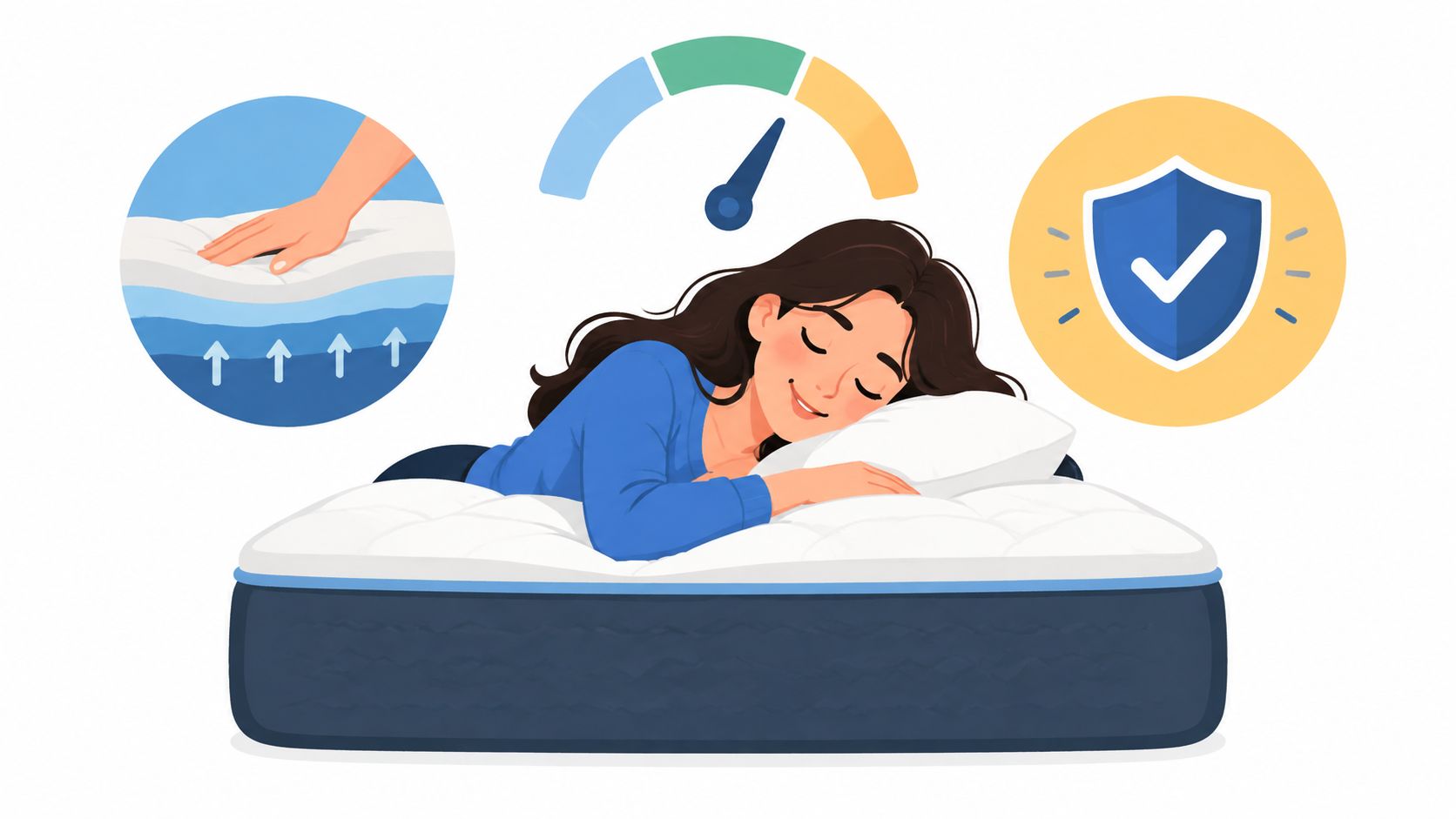
For most back sleepers, the confident starting choice remains medium-firm, near 6.5 out of 10. Lighter sleepers may need more cushioning, heavier sleepers may need more resistance, and couples may need a split or adjustable-comfort solution. The Comfort Promise is the safeguard that lets shoppers make that decision without carrying the entire risk alone.
Mattress Pro by Miller Waldrop helps Ruidoso and Lincoln County back sleepers compare medium-firm foam, hybrid, latex, and traditional support from Tempur-Pedic, Sealy, Stearns & Foster, and Sherwood. Visit Mattress Pro by Miller Waldrop at 2801 Sudderth Drive, Suite F, in Ruidoso to test the right firmness, review the Comfort Promise and Low Price Promise, and arrange Full-Service Delivery with Professional Setup.