

Best Memory Foam Mattress for Back Sleepers: 2026 Guide


Does your lower back ache because your mattress is too soft, or because it holds you in the wrong shape?
Your shoulders and hips weigh more than the small of your back. On a bed with weak support underneath, those heavy points sink while the lumbar curve hangs with an empty gap above the surface. On a surface that barely gives, those same points get pushed up and pressure builds at the shoulders.
The tag that says memory foam does not settle that question. Firmness and the support layers underneath decide whether your spine stays level from neck to pelvis.
You can feel the difference in a few minutes with your own pillow. Lie back, slide a flat hand under your lower back, then have someone check the line from your ear to shoulder to hip.
Firmness Ranges That Suit Back Sleepers
What should your back feel like when you settle onto the right mattress?
Your spine rests in a gentle S curve when you stand. A good mattress keeps that same curve while you lie down. Your shoulders and pelvis sink a little, your lower back keeps contact, and your hips stay level with your torso. A systematic review of 39 studies linked medium-firm mattresses with better comfort, sleep quality, and spinal alignment across differences in age, height, weight, and body-mass index.
Tag words vary by brand. One maker's Firm can feel like another maker's Medium once your weight is on it, so use neutral alignment and steady support as your guide during a test rest. Look for a comfort layer that contours around the shoulders and pelvis without letting the hips drop. More detail on how those ratings relate to back sleep is in this guide to mattress firmness for back sleepers.
| Firmness band | Feel under the back | Fit for back sleepers | Mattress Pro labels to check |
|---|---|---|---|
| Plush or soft | Hips sink well below the shoulders | Usually too soft; the pelvis drops out of line | Plush, Ultra Plush, Luxury Plush, Luxury Ultra Plush |
| Medium | Balanced contouring with moderate sink | Good for lighter back sleepers; check lumbar support | Medium |
| Medium-firm | Cushions shoulders and pelvis while holding the lower back | Best fit in the research for most back sleepers | Medium or Cushion Firm, confirmed on the floor |
| Firm | Little give; the lower back can feel unsupported | Suits heavier sleepers if the pelvis stays level | Firm, Cushion Firm, Luxury Firm |
| Ultra firm | Almost no contouring | Risk of pressure at shoulders and hips | Ultra Firm, Luxury Ultra Firm |
Labels in the store also include NS Soft, plus Cloud 1, Cloud 2, and Cloud 3. Those Cloud names show up on the shop page next to Ultra Firm and Medium. The name alone does not place a Cloud model in a firmness band. Ask a Sleep Pro to help you lie on it and judge the feel from your alignment.
What shifts your band
Three body factors move the right band.
Your weight changes how deep you sink. Heavier sleepers often need thicker, denser support foam so the pelvis stays level, while lighter sleepers often do better with a slightly more conforming comfort layer that keeps pressure from building at the shoulders.
Soreness is a second clue. If your shoulders or hips ache on a hard surface, step one band softer and recheck the lumbar curve for contact without sag.
A partner of a different size is the third factor. Each of you should test the same mattress with your own pillow, because one tag cannot describe two bodies.
Why Medium-Firm Support Helps Your Lower Back
A randomized, double-blind, multicenter trial that enrolled 313 adults with chronic, nonspecific low-back pain lasting more than three months (Lancet report on medium-firm versus firm mattresses) split participants into 155 people on a medium-firm mattress and 158 on a firm mattress. Both groups improved after 90 days. The medium-firm group improved more in pain while in bed and in disability, with odds ratios of 2.36 for less pain and 2.10 for less disability favoring medium-firm.
A 2014 Canadian review (Canadian health-technology review of mattress firmness and back pain) summarized nine studies involving 808 adults, with individual study sizes from 19 to 313 participants. It reported that medium-firm mattresses may reduce back pain and improve sleep quality compared with firmer mattresses.
What the surface is doing
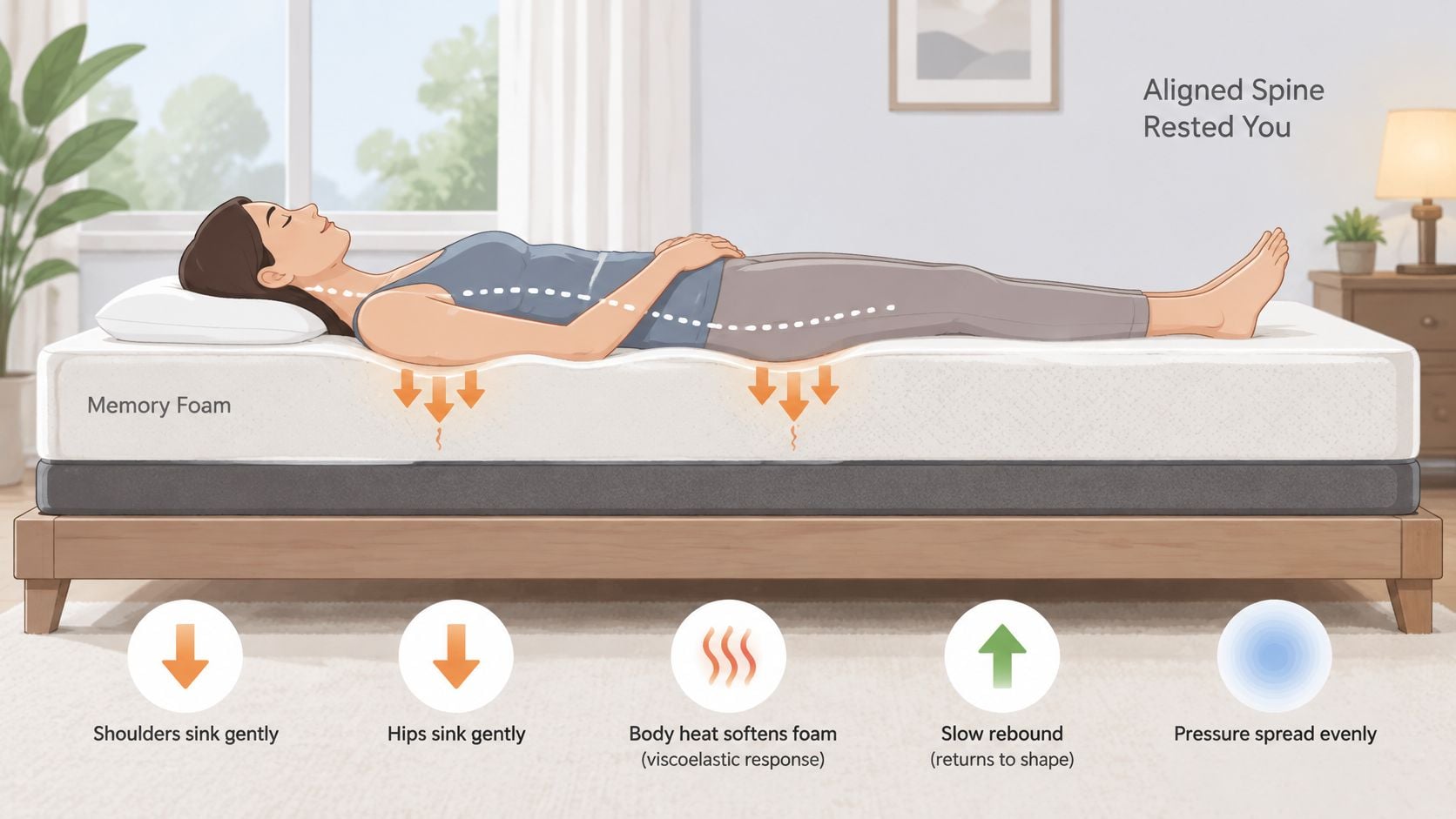
Your shoulders and pelvis carry most of your weight on your back. They settle a little into the top inches. Your lower back needs steady contact underneath that settle.
A medium-firm surface allows that small amount of sink at the shoulders and pelvis while the support core holds the pelvis level, so the spine stays close to neutral. A very firm surface often holds the hips high while the lumbar curve hangs in the air. Muscles work through the night to bridge that gap, and you wake stiff through the low back.
Memory foam comes in many firmness levels. Support depends on density, layer thickness, and the core below the foam, so two foam beds can feel nothing alike.
Practical rule: If a firm bed leaves a gap under your lower back, or you wake stiff, a medium-firm model deserves a real test.
The trial enrolled people who already had chronic pain. That limits what you can take from it if your back feels fine today. Your weight, your alignment on the surface, and your preference still shape the choice, and a comfort-exchange path matters if the first feel proves wrong after several nights.
How Memory Foam Relieves Pressure at Shoulders and Hips
Memory foam is viscoelastic. It softens under your heat and weight, then returns slowly toward its shape. Load spreads across the shoulders and pelvis instead of sitting on two hard points.
Engineer Charles Yost developed a gas-trapping plastic foam in the 1960s, tied to NASA work on aircraft-seat cushioning and impact protection, as described in an interview with The Naked Scientists. Trapped gas made a bubble-like structure that deforms gradually and then recovers. That is the origin of the hug you feel. It is not medical proof that any foam bed is better for your back. Density, thickness, the core under the foam, firmness, and heat management decide that.
Four layers, four jobs
Think of the bed as a stack. The top cradles. The bottom refuses to collapse. If you want the pressure-relief side of this in more detail, this note on a pressure relief mattress walks through how contact area changes the load on hips and shoulders.
| Layer | Job for a back sleeper | What to check in store |
|---|---|---|
| Comfort foam | Contours to shoulders and pelvis and relieves pressure | Density and thickness; does the hip sink too far |
| Transition layer | Smooths the move from soft comfort foam to the core | Whether the surface feels abrupt or gradual |
| Support core | Stops sinking and keeps the lumbar region aligned | Resilience and thickness; the bed should not bottom out |
| Cover and cooling gel | Manages heat and airflow across the night | Breathability of the cover; whether gel claims are specific |
Press a hand into the comfort foam and watch the recovery. Slow return is normal. If your hip keeps traveling until you feel the base, the core is too thin or too soft for you, no matter how nice the top feels for the first minute.
Cooling gel on a mountain night
Gel-infused foam can pull some heat off the surface. The effect is usually modest. Airflow through the cover and the open-cell structure of the foam matter more, especially when a Ruidoso day is warm and the room cools fast after dark. Dry mountain air doesn't trap humidity the way a humid climate does, but a sealed cover still holds heat against your back. Ask what the cover is made of, not only whether the foam is "cooling."
Memory Foam, Hybrid and Innerspring Compared for Back Sleepers
Memory foam wins on pressure relief and motion isolation. A hybrid often wins on edge support, airflow, and ease of movement. A plain innerspring is the weakest choice for pressure relief unless a foam comfort layer sits on top.
| Criterion | Memory foam | Hybrid | Innerspring |
|---|---|---|---|
| Pressure relief at hips and shoulders | Strong, conforms closely | Moderate, depends on the comfort layer | Limited unless topped with foam |
| Lumbar support | Depends on the core; medium-firm is the usual target | Strong, coils support the lower back | Firm support that can feel rigid |
| Cooling | Can trap heat; look for breathable covers or gel | Better airflow through the coils | Best airflow |
| Motion isolation | Strong | Moderate | Weakest |
| Edge support | Often weaker; test it | Stronger | Strong |
| Ease of repositioning | Slower to move on | Easier | Easiest |
Lumbar support depends on the core as much as the foam. Pressure relief depends on the comfort layer. A soft top on a weak core still lets the pelvis drop. A lively core under a thin top still prints pressure into the hips.
The store floor carries memory foam, hybrid, and latex, including Sealy, Tempur-Pedic, Stearns & Foster, and Sherwood. You can feel the three builds side by side instead of trusting a spec sheet. Latex is the responsive cousin of memory foam: contour without the slow sink, which some back sleepers prefer when they change position often. A fuller look at the foam-versus-coil choice is in this comparison of memory foam and hybrid mattresses for back pain.
Which build matches the night you actually have
Choose memory foam if you sleep alone and want the shoulders and hips to soften into the bed. Slow recovery also keeps a partner's movement from traveling, which matters more than the brand story.
Choose a hybrid if you shift a lot, sleep hot, or sit on the edge to tie shoes. Coils move air and hold the perimeter. The foam on top still has to be thick enough to cushion, or you get the hybrid's airflow and the innerspring's pressure map.
Consider latex if you want contour that pushes back when you roll. It is a poor match if you want that deep, still cradle.
Skip a bare innerspring when hip or shoulder pressure is the complaint. Add foam on top or pick another build.
How to Test a Mattress for Back Support in Store
A fair test takes 10 to 15 minutes in your usual position. A 30-second bounce on the edge tells you almost nothing about your lower back.
A 2015 systematic review of 24 controlled trials rated the evidence moderate to high and concluded that subjectively medium-firm mattresses, and self-adjustable mattresses, performed best for sleep comfort, sleep quality, and spinal alignment. The same review notes that foam mattresses performed better than firm mattresses in some low-back-pain comparisons. For memory foam, the useful spec is two-part: pressure-conforming foam above a resilient support core.
You can visit and test before you buy. A consultation starts with your sleep habits and what you want from the night, and the setup can be positioned for your preferences so the first lie-down is a real trial, not a guess.
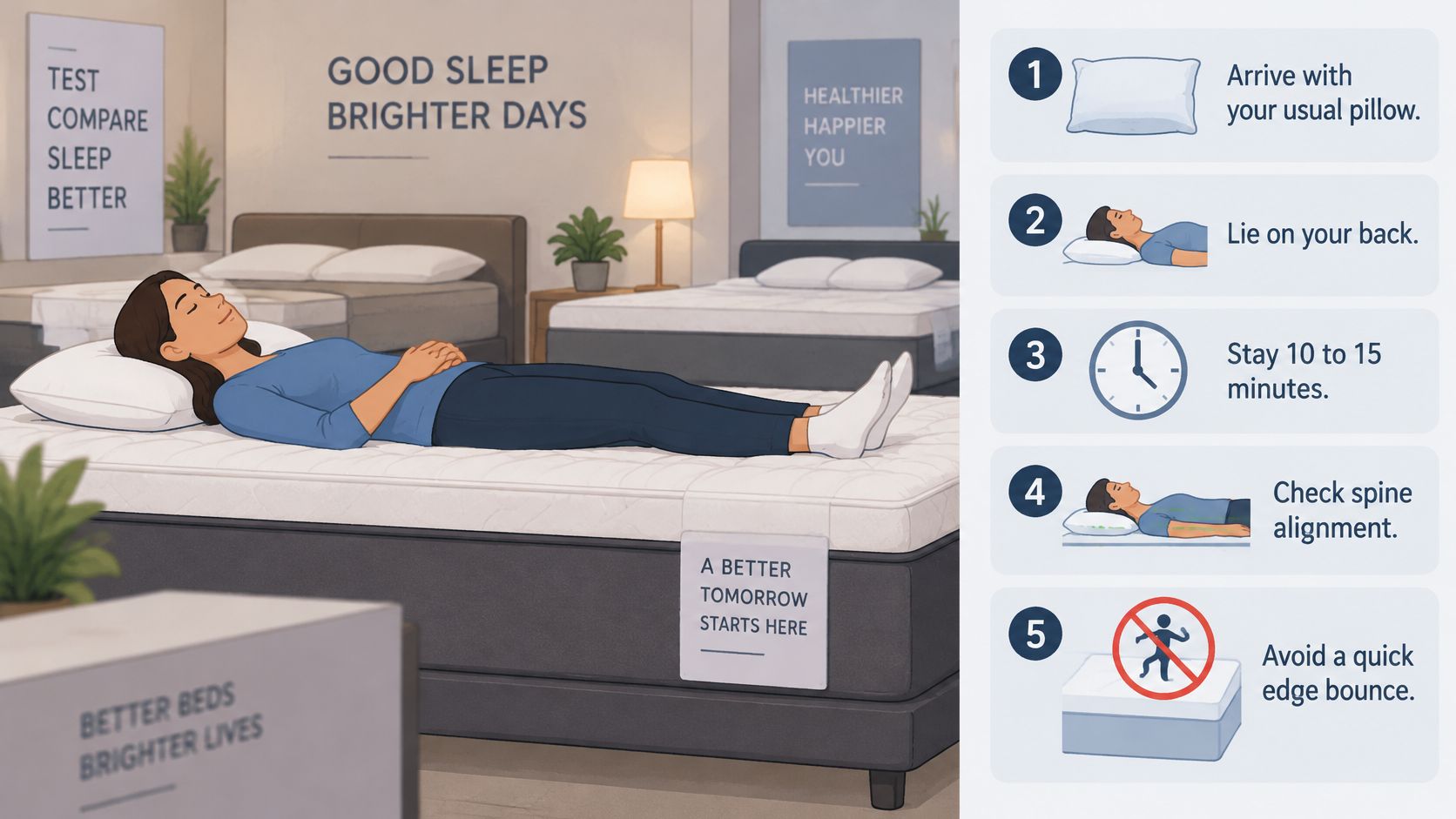
The six checks
- Bring your usual pillow and lie on your back for 10 to 15 minutes. Foam needs time and heat before it shows its true sink. The common slip is judging in the first minute, or testing on a showroom pillow you would never sleep on.
- Check the lumbar region. It should feel supported, not squeezed and not suspended. A flat hand should slide under the lower back with only slight resistance. Lots of empty space means the bed is too hard for you. No space at all, with hips feeling low, means it is too soft.
- Check the pelvis. Hips should sit level with the torso, not drop below it. This is the failure that shows up as morning ache even when the bed felt plush at first.
- Turn onto your side for two minutes. Shoulder and hip pressure tell you whether the comfort layer is only a back-sleeper surface. Many people roll at 3 a.m. even if they start on their back.
- Sit on the edge, then change position and stand. Edge collapse and a surface you can't roll on are real problems, especially with slow-recovery foam. Excessive sink can also pull the spine out of line.
- Ask about the foundation and the support core. A weak base makes a capable mattress feel like a hammock. Recovery after you stand up should be visible, not a crater that stays.
The same short session is the point of in-store mattress testing. While you are there, notice heat at the lower back. Thermal comfort is part of fit, not a side issue.
A good result is quiet. Hips level, lumbar contact without a shove, shoulders cushioned, and you can roll and sit without a fight. If one of those fails, try the next model. Don't talk yourself into a bed that already argues with you.
Which Back-Sleeper Mattress Fits Your Situation
Match the mattress to your night, not to a bestseller list.
You are lighter and want contour. Look at medium-firm memory foam with a softer comfort layer. You don't have enough weight to push a thick, dense top out of the way, so a gentler surface reaches the lumbar curve without a gap. Tempur-Pedic is the usual place to feel that close contour. Sealy foam models sit nearby if you want a similar hug at another price.
You are heavier and the pelvis sinks. Ask for thicker, denser support foam, or a hybrid whose coils hold the hips up. A plush top on a soft core will feel wonderful for ten minutes and crooked by morning. Stearns & Foster hybrids are a fair place to feel that hold, then compare a Sherwood build in the same session so price isn't the only difference you notice.
You share the bed with someone of a different size. You need motion isolation and two separate lie-downs. A Sleep Pro can set that up so each of you tests, instead of one person picking for both. Memory foam damps movement. A hybrid is the compromise when one of you sleeps hot.
You already have back or hip pain. Prioritize a medium-firm feel and an in-person trial. If pain keeps up after the bed is right, talk with a clinician. A mattress can change alignment and pressure. It doesn't treat a medical problem by itself.
You are watching the budget. The Low Price Promise matches local competitors, and financing spreads the cost. You don't have to skip the test to save money. Cabin and vacation-rental owners around Ruidoso should weight durability and a feel most guests can sleep on, which usually means medium-firm rather than a plush specialty bed.
Dry mountain air and wide day-to-night swings in Lincoln County make a breathable cover worth five extra minutes of your test. A family-owned shop that lives with the same weather will talk about that without turning it into a pitch.
When Should You Replace Your Back-Sleeper Mattress?
Does your back feel worse in the morning than it did when you went to bed? That morning test tells you more than any calendar date.
Lifespan follows material quality, design, how you sleep, your body, and basic care. Age is a checkpoint. Condition and symptoms set the timing. A deeper walk-through of those signs is in this guide on signs it is time to replace your mattress.
Warning signs worth trusting
- A visible sag or a dip where your hips rest. That hollow is lost support, not breaking in.
- Morning soreness or stiffness in the lower back or shoulders that eases after you get up and move, even when the bed still feels familiar.
- Sleep that feels less restful than it did when the mattress was new, with more waking and a heavier morning.
For a back sleeper the pattern is easy to misread. One morning is fine and the next is not. You start blaming the pillow, the hike, or the chair at work.
Lie in your usual position for a few quiet minutes and compare the lower back with how this bed felt when it was new. If the gap under your lumbar curve has grown, or the pelvis now sits below the torso, the bed is probably due. A Sleep Pro can look at an older bed and check whether a new mattress or a sturdier foundation fixes the feel. Sometimes the base is the tired part.
Book Your Back-Sleeper Test in Ruidoso
What would your back tell you after 15 quiet minutes on the right support?
Shortlist three mattresses in your firmness band, then test each one for 10 to 15 minutes in the store. Most mattresses last approximately 7 to 10 years before they lose some supportive and pressure-relieving capability, although that span varies with material, design, position, body type, and care, according to the Sleep Foundation on mattress care and lifespan. Use age as a checkpoint, then let the lie-down decide.
Start with notes a Sleep Pro can use. Write down your usual position, approximate weight, and any back or hip pain. Bring the pillow you sleep on if you can. Bring the list to Mattress Pro by Miller Waldrop at 2801 Sudderth Drive in Ruidoso before anyone points at a bed.
Run the same short test on all three finalists. Lie flat, check the space under your lower back with a relaxed hand, roll to your side and back, then sit on the edge. You want steady lumbar contact with no hard push at the shoulders or hips. One position feels easy to hold. That is support doing the work.
Ask about current terms before you decide, including the Rest Easy Guarantee, financing that lets you pay over time, price matching for local competitors, and choice of pickup or full-service delivery with professional assembly. To return a mattress, you contact the customer service team, which guides you through the return process.
Mattress Pro by Miller Waldrop helps you match a medium-firm memory foam feel, or a hybrid with the same support, to the way you sleep on your back. You can test it in Ruidoso, then take it home with delivery and professional setup if it passes your lie-down. Visit Mattress Pro by Miller Waldrop and book that test with a Sleep Pro.