

Double Sided Mattress Guide: Is Flipping Worth It?

If a bed has two sleepable sides, does that mean it will last twice as long? That question trips up a lot of shoppers, because flipping sounds like a built-in durability guarantee. It isn't. A double sided mattress can be a smart buy, but only when the construction, firmness, and care routine match the sleeper. The useful question isn't whether it flips. The useful question is what flipping changes for comfort and wear.
How the Two Designs Differ
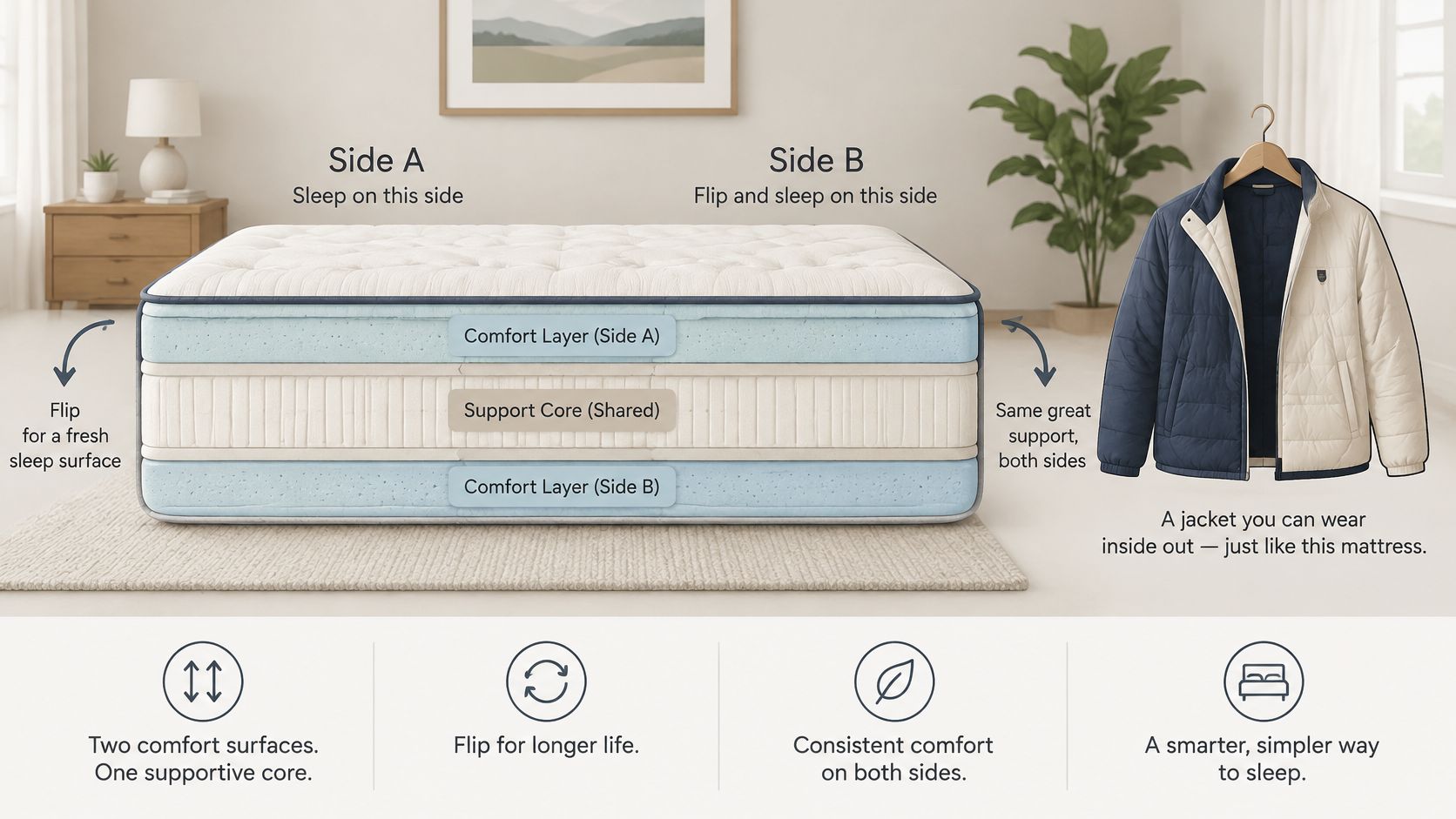
A double sided mattress is built to be slept on both faces, with a comfort layer on each side and a shared support core between them. A one-sided mattress is built to be slept on one face only. That's the core difference, and everything else follows from it.
A reversible jacket works the same way. One garment, both faces finished and meant to be worn outward. A regular jacket has a finished outside and a lining inside, and wearing it inside out doesn't give you a second usable jacket. The NIST mattress construction publication describes the same basic split, with a true flippable design placing sleep-ready comfort material on both faces while most one-sided models place pressure-relieving foam or upholstery on top and reinforcement materials beneath.
Double-Sided Versus One-Sided at a Glance
| Feature | Double-sided (flippable) | One-sided |
|---|---|---|
| Sleep surfaces | Two faces designed for sleeping | One sleep surface on top |
| Layer order | Comfort layers on both faces around a shared core | Comfort layers fixed top to bottom |
| Firmness choice | Some models offer a softer and a firmer side | Fixed firmness |
| Best fit | Couples or sleepers who want to spread wear | Memory foam, hybrid and pillow-top sleepers with one preferred feel |
Older two-sided designs often had matching faces, so flipping mainly refreshed the sleep surface and shifted wear from one face to the other. Newer reversible designs may pair a softer face with a firmer face, giving the sleeper a genuine choice without buying a second bed. The distinction matters for expectations. On a same-firmness model, turning the mattress redistributes wear and changes little about feel. On a dual-firmness model, that same flip changes comfort the very first night.
Shoppers can't assume which type a given model is. The product description, law tag, and care guide need to say so plainly.
What Each Layer Is Doing
Memory foam softens under heat and pressure, so it conforms around shoulders and hips and spreads contact pressure over a wider area. That contouring helps with pressure point relief, but it only works when the foam sits above the support core where the body rests. Flip a one-sided memory foam mattress and that comfort material ends up trapped underneath.
A hybrid pairs coils with foam comfort layers. The coils push back and help keep the spine aligned, while the foam cushions bony areas and absorbs movement. Cooling gel in some foams pulls heat away from the surface for a short period, which matters for sleepers who run warm. For readers comparing coil support more closely, this guide to innerspring mattress construction explains how coil systems carry load.
A familiar logo identifies a product line, not a specific flippable model. Tempur-Pedic, Sealy, Stearns & Foster, and Sherwood all build mattresses across memory foam, hybrid, and traditional categories, so the flipping question gets settled at the model level, where the law tag and care instructions live.
Why Local Testing Helps in Ruidoso
Mattress Pro by Miller Waldrop is a local, family-owned team of Sleep Pros backed by a 70-year Miller Waldrop legacy and based at 2801 Sudderth Drive in Ruidoso, serving Lincoln County. That local setup matters because a bed-in-a-box product page can't let a shopper test both faces in person. Lying down in a normal sleep position shows hip sink and shoulder pressure in a way a firmness rating can't.
Ruidoso's dry mountain air and sharp day to night temperature swings also make a breathable, well-built core worth checking. Dry air is gentler on foam than humid air, but temperature swings still change how foam feels across the year. A mattress in an unheated cabin bedroom may feel firmer on a cold morning than the same mattress in a warm primary bedroom.
One-check rule: Confirm the manufacturer calls the model two-sided or flippable before turning it over. Turning an ordinary one-sided mattress over puts support and comfort layers in the wrong position and can compromise pressure relief.
That single check prevents the most common ownership mistake. If the wording only says rotate, the mattress isn't a flipper. If it says flippable but doesn't describe each face, ask which materials sit on each side before buying.
Does Flipping Really Make a Mattress Last Longer
Alternating surfaces should spread compression across two sides, so body impressions form more slowly. That's the standard promise, and it holds up better in some designs than in others. The honest answer to the question depends on what sits between the two surfaces.
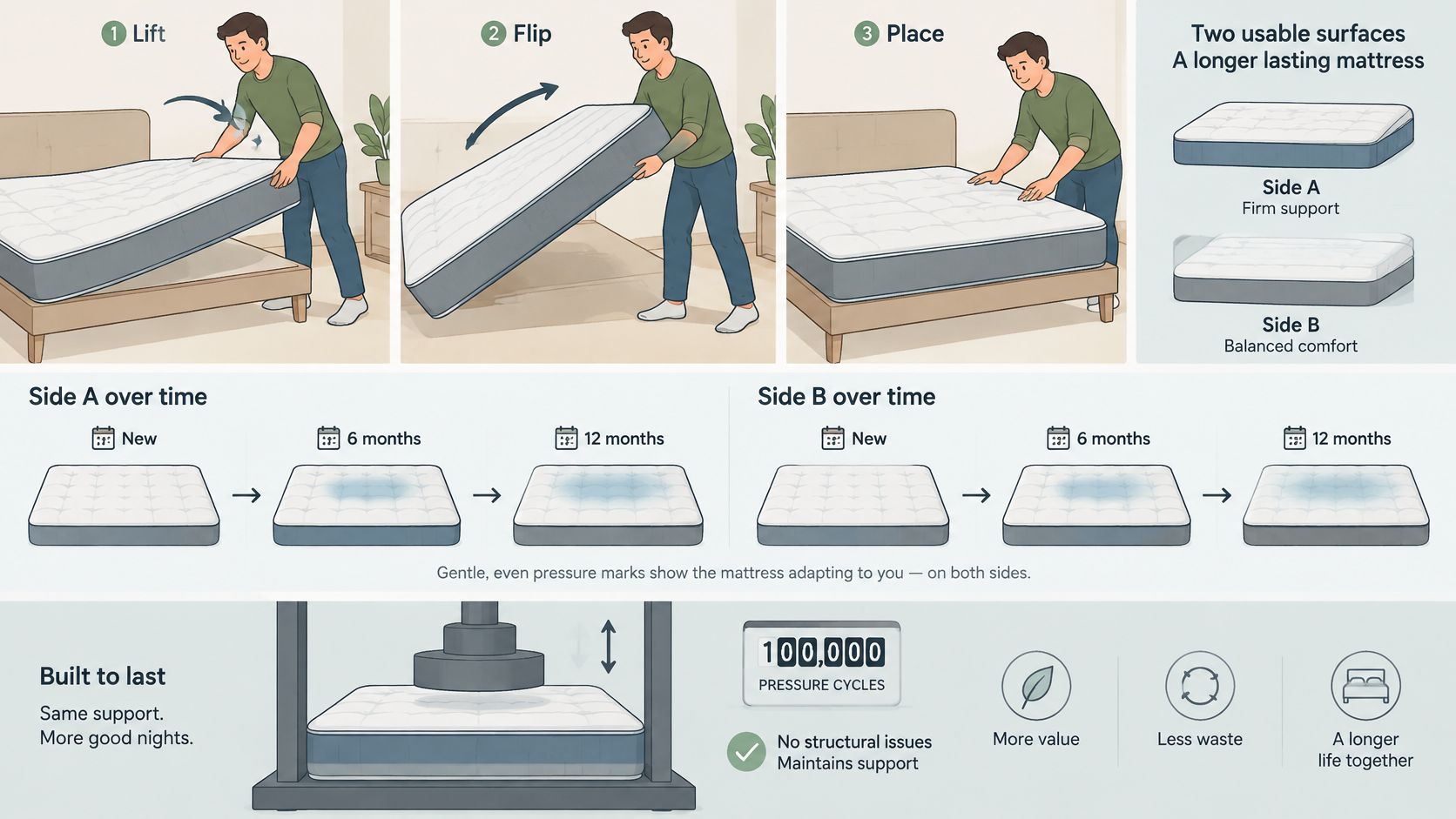
A 2025 durability test commissioned by a mattress manufacturer found virtually identical firmness and height retention after simulated 10 years for tested single-sided and double-sided mattresses. Flipping only helps when the layers are designed to be flipped. Two-sided construction alone never guaranteed a longer service life, and that distinction matters more than the flip habit itself.
What Actually Drives Lifespan
Durability depends on construction quality first. The support core, foam density, springs, quilting, and compression resistance decide how well materials recover after repeated loading. The support core works like the joists under a floor: no matter which rug you roll out on top, the floor stays level only as long as the joists do. A weak core with comfort layers on both faces still has a weak core, and every flip returns the sleeper to that same core.
Dense foam resists permanent impressions better than low-density foam. Sound quilting keeps surface layers from shifting or bunching. Strong edge support protects the perimeter, which is the area most likely to collapse when someone sits to put on shoes each morning. Readers who want the broader timeline can use this guide to how long a mattress should last alongside the ownership checks below.
Industry guidance commonly places a well-made flippable mattress in the 7 to 12 year range with appropriate care. Sleeper weight, foundation support, humidity, materials, and maintenance all move a given mattress within or outside that range, so the number on a tag matters less than the conditions the mattress lives in.
Two Flipping Cases That Are Not the Same
- Dual-firmness model: Flipping changes comfort first and distributes wear second. The owner may keep one preferred face up most of the year, so wear won't be evenly shared.
- Same-firmness model: Flipping is mainly a maintenance habit. Both faces feel broadly alike, so the owner can alternate them without relearning the bed.
- One-sided model: Flipping it puts the support and comfort layers in reverse order, which can reduce comfort, impair support, and accelerate wear.
For Ruidoso homeowners, active sleepers, and vacation rental owners, the better question is which construction and maintenance schedule justify the extra weight, handling effort, and possible cost. A rental bed that's flipped during seasonal turnover gets real value from shared wear. A heavy dual-firmness mattress that one person struggles to lift may never get flipped at all.
Check for a visible dip, edge collapse, or loss of recovery before deciding whether to flip on schedule or start shopping for a replacement.
Loss of recovery is easy to spot. Press a hand firmly into the sleep area, release it, and watch whether the surface rebounds promptly. A surface that stays dented or feels dead under the hips has lost resilience, and flipping spreads wear that hasn't happened yet. Damage that's already set in stays set.
Choosing the Right Side for Your Sleep
Which face belongs on top depends on the sleeper, not on a firmness number. Position, body weight, height, and what hurts in the morning are the better starting clues. Shoulder ache, hip soreness, and lower-back stiffness each call for a different first test.
On a dual-firmness mattress, the flip is a comfort switch. One face gives more, the other holds more, and only one of those faces can be up tonight. On a same-firmness mattress, both faces feel broadly alike, so turning it does not make the night firmer or softer. It only moves the next stretch of use to the other surface. If the sleeper already likes the feel, that turn changes wear, not sleep.
| Sleeper profile | Side to try first | What to check |
|---|---|---|
| Lighter or shorter sleeper | Softer side | Lower back stays near neutral, not sagging |
| Heavier sleeper or stomach sleeper | Firmer side | Hips stay level with no visible sink |
| Side sleeper with shoulder pressure | Softer side that still supports the hips | Shoulder sinks without the hips dropping |
| Back sleeper who wakes stiff | Medium-firm side | Spine stays aligned from shoulders to hips |
| Couple with different needs | Test each side with both partners | Split configuration or adjustable base if needs diverge |
Why Medium-Firm Comes Up So Often
A systematic review summarized in the PMC mattress and spinal alignment review found that medium-firm mattresses generally provide a stronger balance of comfort, sleep quality, and spinal alignment than very firm or very soft designs. A hard surface can still support the body badly. If it bridges the waist and loads only the shoulders and hips, the middle hangs between two high points, the way a board across two sawhorses leaves the center unsupported.
Body shape changes which firmness lines the spine up. Higher-weight sleepers often align better on firmer surfaces. Lower-weight and shorter sleepers often do better with more surface give. Two people can lie on the same side of the same double-sided mattress and disagree, because their bodies load that surface differently.
The Risk at Each Extreme
A face that's too soft lets the pelvis and trunk descend. Neutral spinal posture breaks down, and a back sleeper can end up folded at the waist. A face that's too firm raises contact pressure at the shoulders, hips, and sacrum, which can push the sleeper into frequent position changes. Alignment and pressure matter more than chasing the hardest face or the softest one.
Test each side on its own for pelvic sink, shoulder pressure, and ease of movement. A side that feels plush for two minutes but traps the sleeper while rolling over will frustrate across a full night. Both faces should hold a near-neutral lumbar curve in the sleeper's usual posture. Position basics in this guide to the best sleep position help a shopper name that posture before testing. When both faces already match it, another flip will not improve the night.
Three Local Examples
A couple in Alto differs a lot in body weight. The heavier partner may align better on the firmer face, while the lighter partner may need more surface give. One flippable mattress shows one face at a time, so the compromise can still leave one partner unsupported. A split configuration or an adjustable base may fit that couple better. Turning the mattress cannot put both preferred faces up on the same night.
A cabin owner in Ruidoso furnishes a rental for guests of varied sizes. A medium-firm face usually suits the widest range of visitors. With a same-firmness two-sided model, alternating faces between stays keeps the guest experience steady. Visitors rarely stay long enough to judge a second feel, so consistency beats a choice they will not evaluate.
An active mountain sleeper who wakes stiff after long hikes might use the firmer face on heavy training weeks for easier movement and hip support, then switch to the softer face during recovery. That switch only changes comfort on a dual-firmness build. Injury, weight change, and aging can all change which side works, so the useful habit is retesting rather than a fixed calendar.
Test each side in the normal sleep position, with each partner present, because body mass, hip circumference, height, and sleeping position all change alignment needs.
Flipping Steps and Pre-Purchase Checks
A flip changes which face carries your weight. Treat it as routine care rather than a durability guarantee: on a dual-firmness model it can change feel, on a same-firmness two-sided model it mainly spreads compression, and on a one-sided build rotation is the safe move.
| Mattress type | Flip? | Rotate head to foot? | Schedule |
|---|---|---|---|
| Two-sided or flippable design | Yes, if the maker allows it | Optional | Commonly every 3 to 6 months |
| Memory foam | No | Yes | Per care tag |
| Hybrid | No | Yes | Per care tag |
| Pillow-top or Euro-top | No | Yes | Per care tag |
| Latex | Only if the maker allows it | Yes | Per care tag |
Care tags for mattresses built to be used on both sides often put surface changes on a 3 to 6 month rhythm so compression is shared between the two sleep surfaces. Memory foam, hybrid, pillow-top, and Euro-top mattresses usually keep a fixed top-to-bottom layer order, so those models are rotated head to foot instead of turned over.
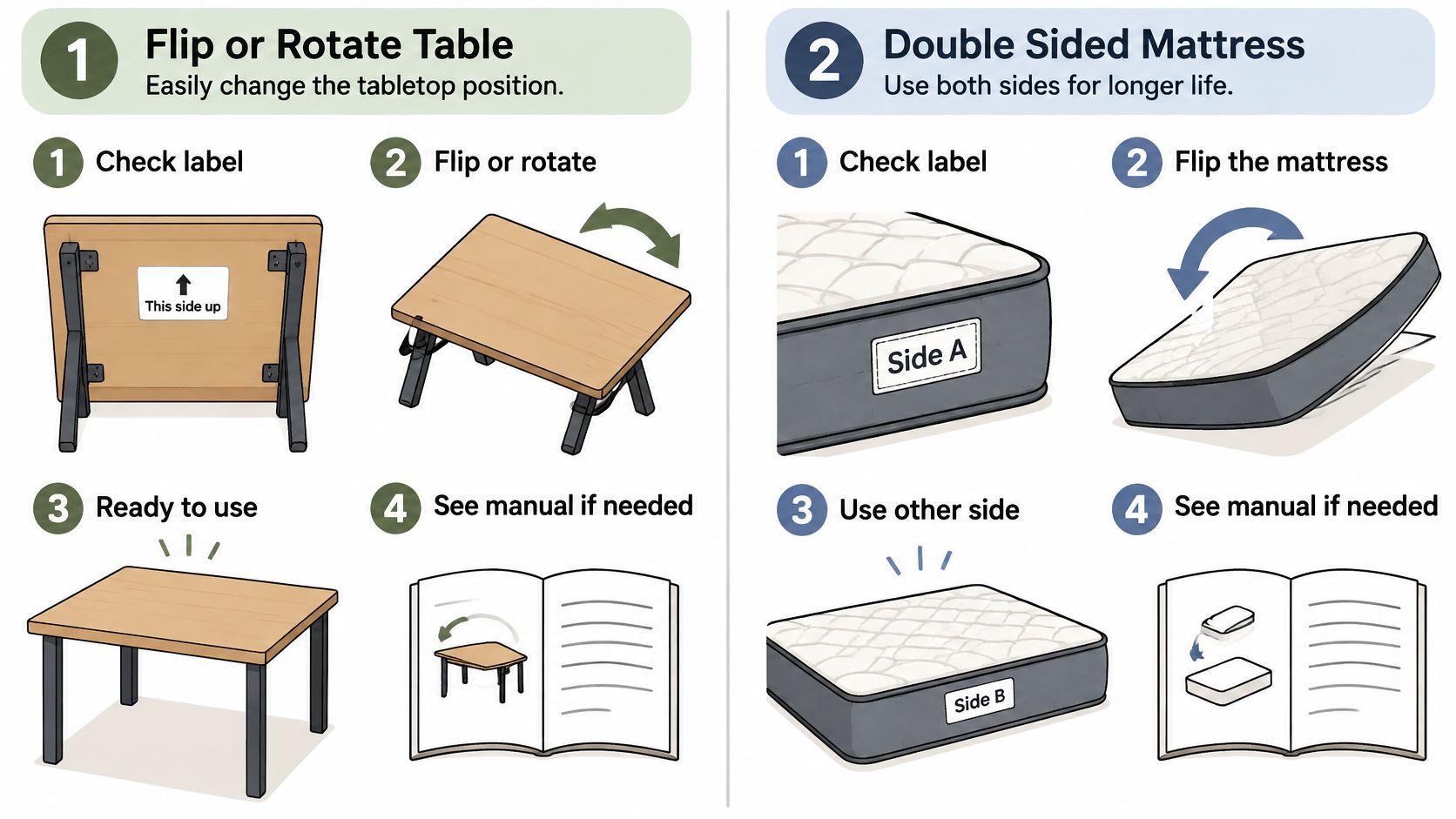
How to Flip a Double Sided Mattress
- Confirm permission: Read the law tag, care instructions, or manual and confirm the label says the model flips.
- Strip and vacuum: Remove all bedding and vacuum the exposed surface, including the seams where dust collects.
- Lift with two people: Raise the mattress with a partner and avoid dragging it across the floor, which can snag the cover and strain the border.
- Turn it over: Roll the mattress so the face that has been slept on ends up underneath, and keep the cover smooth rather than bunched.
- Check edges and corners: Press along each edge as the mattress settles and note any corner that feels hollow or collapsed.
- Mark the date: Write the flip date on a small tag or calendar note and repeat on the care-tag rhythm.
Clear bedside tables and lamps before starting, since a queen or king mattress needs swing room. Bend or fold a mattress only when the manufacturer specifically allows it. If the mattress is too heavy to control, stop and get help rather than muscling it, because a dropped mattress can bend a coil unit or tear handles. Handles on many mattresses are meant for positioning, not for carrying the full weight.
For one-sided models, rotate head to foot so the area under the shoulders moves to the foot end. That shifts the heaviest load to a fresher zone while the layer stack stays upright. The detailed cadence is covered in this mattress rotation schedule guide.
Pre-Purchase Checks That Prevent Problems
Base. Confirm the base gives even support across the full underside, with no wide gaps or sagging slats. Check with the maker before using an adjustable base, because repeated bending suits some cores and damages others. A flippable mattress on a weak base can develop a center dip that no flip schedule can correct.
Edge support. Sit on each long edge and on a corner before buying. Collapsed edges shorten the usable surface on both sides and make getting out of bed harder, especially for older sleepers. Edge strength also shows up during flips, when the perimeter takes handling pressure.
Bedding. Choose deep-pocket fitted sheets that fit both faces, since quoted mattress height can vary slightly from face to face on quilted models. Sheets that fit one side but pop off the other usually mean the pocket depth is marginal. Buy sheets rated deeper than the mattress height to leave room for a protector.
Protector. Use one breathable protector that works on both faces and washes regularly. Transfer the clean protector to the newly exposed face on flip day. A protector matters in Ruidoso rentals and primary homes alike, because spills and sweat reach foam quickly once they pass the cover.
Warranty. Confirm both faces are covered, read the flip terms, and keep written copies of the warranty and care instructions. Warranties usually cover manufacturing defects, while wear from misuse or incorrect maintenance may fall outside coverage. Keep the law tag attached, because warranty claims often require the information printed on it.
In Ruidoso, dry air and seasonal dust make spring and fall a practical rhythm for vacuuming seams, inspecting the base, and checking edges.
That rhythm fits a twice-yearly flipping pattern without adding extra chores. Flip day is also the right moment to look at the underside of the base, tighten loose frame bolts, and confirm the mattress sits squarely. Ten minutes of inspection catches small problems while they are still cheap to fix.
Common Questions About Double-Sided Mattresses
When Should a Mattress Be Replaced?
Replace it when a visible dip, collapsed edge, or lost recovery shows up. Flipping moves the wear to the other face; it cannot rebuild foam that has stopped pushing back or a core that has lost support.
A sleeper who rolls toward the center or wakes stiff in the same spot most mornings is feeling that loss directly. Condition gives the clearer signal. Try a simple ownership test: lie where you sleep, check for a hollow, then use the second face once if the model allows it. If the same sag appears on both faces, the mattress itself is the problem. A guest bed used a few weekends a year may stay sound far longer than a primary bed used nightly.
Can a One-Sided Mattress Be Flipped to Even Out Wear?
No. Flipping a conventional one-sided mattress disturbs the layer order and compromises comfort, so it should be rotated head to foot instead.
Sleeping on the underside puts the sleeper on reinforcement material and buries the comfort foam where it cannot relieve pressure. Rotation spreads wear across the top surface safely. On a true two-sided mattress, turning changes comfort when the faces have different firmness levels and mainly spreads wear when both faces feel the same.
Can Shoppers Get Delivery Setup and Financing in Ruidoso?
Yes. At the Sudderth Drive showroom, Mattress Pro offers pickup, standard delivery, white glove delivery, and full-service delivery with professional assembly, plus financing options. Local price matching and the Rest Easy Guarantee form the purchase safety net, so the decision can stay focused on fit: a dual-firmness model for two feels, or a same-firmness model for maintenance flipping.
Confirm the Right Side Before You Buy
Three checks settle most of the decision.
- Confirm the construction: Get two-sided or flippable in writing. A spec sheet or law tag should say so, because a thick pillow top can look reversible without being built for it.
- Test both faces: Lie on each side in the normal sleeping position, with a partner along if the bed will be shared.
- Match the care rule: Follow the flip or rotate instruction on that model's care label, not a generic internet schedule.
A flippable mattress earns its place when both sides are usable and the owner will maintain them on schedule. A dual-firmness model adds a comfort choice, one face softer and the other firmer. A same-firmness model adds a maintenance tool, a second sleep surface that spreads wear evenly. Either design can make sense, as long as the core, foam density, and edge support are strong enough to justify the purchase.
Testing settles what spec sheets cannot. Customers can visit the store to test mattresses before buying, and in-store mattress testing lets a shopper compare both faces of a double sided mattress in a single visit. A Sleep Pro can then talk through which face suits the primary sleep position, and that conversation sometimes reveals the need is a different support level rather than a second side.
Bring a partner to the showroom at 2801 Sudderth Drive in Ruidoso and spend real time on each face. Mattress Pro carries Sealy, Tempur-Pedic, Stearns & Foster, and Sherwood, and every mattress comes with the Rest Easy Guarantee, so the final call can rest on feel instead of guesswork.
Shoppers weighing a flippable bed against a modern one-sided model can review the care label in person and get a side-by-side read on construction before committing. For that kind of guided comparison, plan a visit with Mattress Pro by Miller Waldrop on Sudderth Drive.