

Best Sealy Mattresses: Lines, Models and How to Choose


A Ruidoso couple wakes stiff after a winter of restless nights. One partner keeps adding cushioning; the other wants a harder surface. Both wonder whether a familiar mattress name will solve the problem or put a new label on the same uncomfortable compromise.
The best Sealy mattresses aren't the same beds for every household. The right choice starts with how each sleeper's shoulders, hips, and lower back settle into the mattress, then considers partner movement, temperature, and budget.
Why Sealy Earns a Place on Your Shortlist
A Sealy label can narrow the field, but it cannot tell you how your shoulders, hips, and lower back will feel on a particular model. Judge each mattress by how it supports your body in your usual sleep position.
An established name with manufacturing roots
Sealy's company history dates its beginnings to 1881, when cotton-gin builder Daniel Haynes made cotton-filled mattresses for friends and neighbors in Sealy, Texas. Haynes patented cotton-compressing machinery in 1889; Earl Edwards adopted the Sealy name in 1906; and the licensing network reached 28 plants by 1920.
That history reflects a long manufacturing record. It gives Sealy a sound place on a shortlist, while the mattress's feel and support determine whether it suits you.
Local guidance matters more than recognition
Mattress Pro by Miller Waldrop is a local, family-owned business with a 70-year family legacy. The store carries Sealy, Tempur-Pedic, Stearns & Foster, and Sherwood mattresses, pairing carefully curated options with personalized guidance.
Bring your specific sleep concern into the fitting:
- Shoulder discomfort: Check whether the surface cushions your shoulder while keeping your torso supported.
- Restless partners: Test how much movement you feel when your partner changes position.
- Morning stiffness: Lie in your usual sleep position long enough to judge whether your back feels supported.
Marketing firmness is only a label. Pay attention to whether your body stays comfortably supported, and whether the surface feels right for the position you sleep in.
Quick-Pick Table of Sealy Lines and Models
Use this table to choose which Sealy models to compare, not to declare a universal winner. Construction and comfort are more useful than the collection name alone.
| Model | Construction | Best fit | Published price or rating |
|---|---|---|---|
| Posturepedic Hybrid Trust Cushion | Hybrid foam and coil | Couples and movement-sensitive sleepers | No published price or rating listed here |
| Posturepedic Plus Deveraux | Not verified. The specific layer design is not established here | Shoppers comparing stable support for back and side sleeping | No published price or rating listed here |
| Posturepedic Hybrid Mattress | Hybrid | Mixed sleep positions | 4.5 of 5 from 37 reviews, published by Sealy |
| Posturepedic Spring Mattress | Innerspring | Shoppers who prefer a traditional spring feel | 4.3 of 5 from 32 reviews, published by Sealy |
| Icon Mattress | Not verified. Construction can vary by selected model | Premium-tier comparison shoppers | $908 current price, reduced from $1,500, listed by Sealy |
| Posturepedic Elite Collection | Not verified. Construction can vary by selected model | Shoppers comparing selected premium models | $1,899 to $2,399 starting prices for selected models, listed by Sealy |
How to read the comparison
Treat “best fit” as a starting point. A customer review rating reflects reviewers' opinions, not a measurement of spinal support. Published prices can also differ from local offers, so compare the same mattress size and model before making a decision.
Where construction is marked “not verified,” use the exact model details on the product listing rather than assuming every mattress in a collection has the same layers. The mattress comparison chart can help organize the options. Mattress Pro's Mattress Guide also offers recommendations based on answers to a few questions.
Why the hybrid label isn't enough
Consumer Reports' mattress buying guide explains that hybrids combine foam and springs, while their layer proportions and designs differ. A more foam-forward feel can contour more closely; a design with less foam may feel closer to a traditional innerspring.
Judge the mattress by lying in your usual sleep position, not by the label or firmness name alone. For couples, both partners should lie down together and check whether each can settle comfortably without disturbing the other.
Shopping rule: Compare the exact mattress, its listed construction, and how it feels to both sleepers.
Hybrid Sealy Models for Pressure Relief and Motion Control
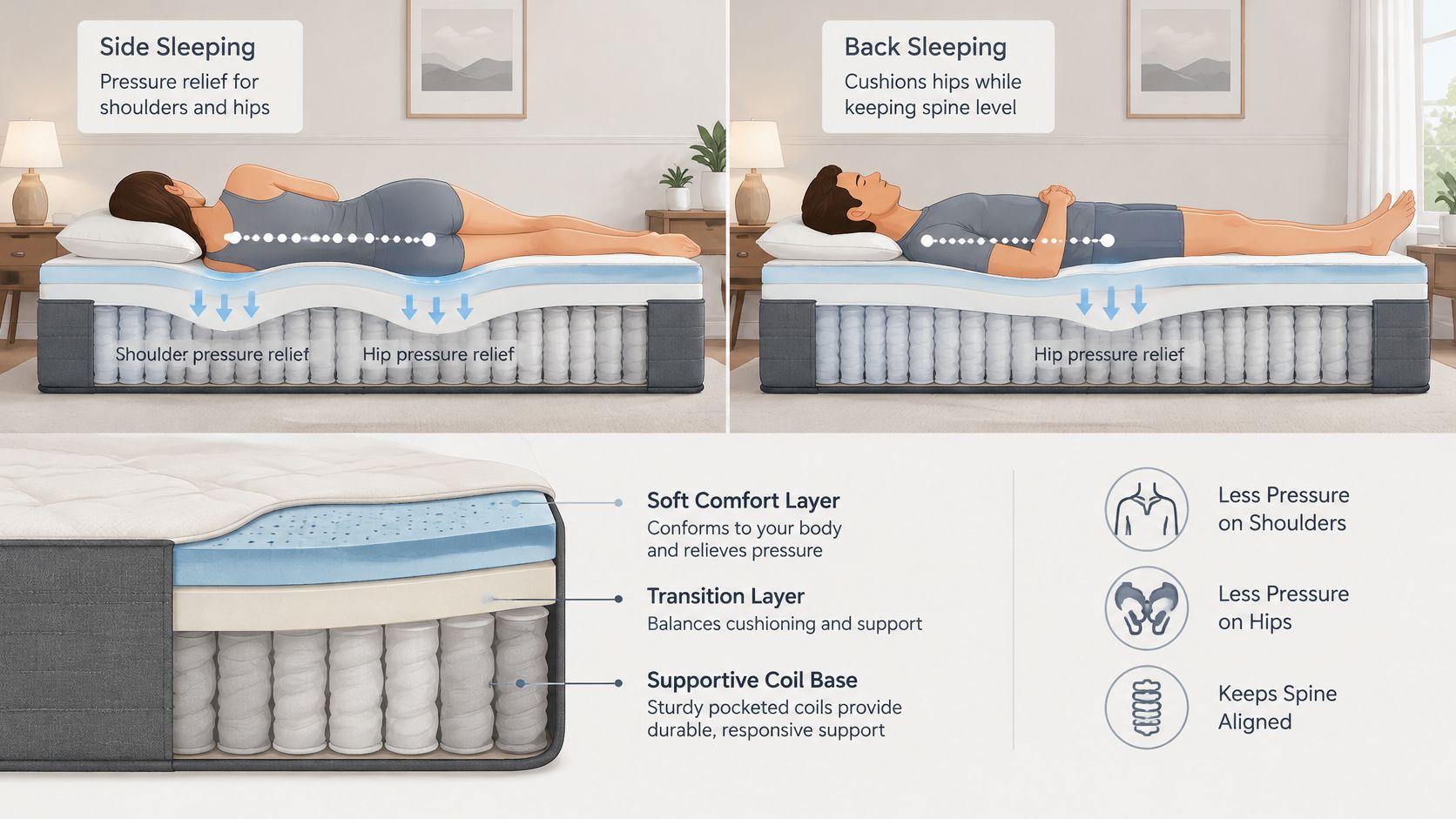
A hybrid is the strongest starting point when pressure-point discomfort and partner disturbance share the top of the complaint list. Its comfort layers allow the shoulders and hips to settle, while the coil support system helps control deeper compression.
The goal isn't maximum sink. It's enough contouring to distribute contact pressure without leaving the pelvis noticeably lower than the rest of the torso.
What the Trust Cushion testing supports
Consumer Reports' evaluation of the Sealy Posturepedic Hybrid Trust Cushion found very good side support, good back support, and excellent simulated durability, with no performance change during testing. Its surface conformed to different body shapes, produced only minor high-pressure areas, and limited vibration transmission sufficiently to earn a very stable assessment.
Those findings make this model a useful comparison point for couples with different schedules. A late arrival or frequent turn shouldn't automatically become the other partner's wake-up call.
The recommendation is model-specific. It doesn't establish that every current Sealy hybrid behaves identically or that this tested model is available in every showroom.
Separate movement control from body support
Customers can test mattresses in store before buying. For an individual hybrid comparison, these checks reveal different strengths:
- Movement isolation: One partner lies still while the other turns, gets into bed, or sits near the edge. The stationary partner notes whether the movement feels like a faint shift or a disruptive wave.
- Position fit: Each sleeper checks the shoulder and hip while side sleeping, then rolls onto the back to assess pelvic sink and lower-back contact.
A mattress can pass the movement test and fail the support test. Excellent vibration control isn't a reason to accept a surface that creates shoulder pressure or feels difficult to leave.
The trade-off worth feeling
A foam-forward hybrid can feel less bouncy than a traditional innerspring. That can suit movement-sensitive partners, but some combination sleepers prefer a quicker surface response when changing positions.
The practical test is a relaxed roll from side to back without pushing forcefully through the elbows. If repositioning feels like climbing out of a hollow, compare a less contouring option.
The hybrid mattress buying guide offers additional construction comparisons. Choose the hybrid that balances cushioning and easy movement, rather than the one that feels softest during an initial sit-down.
Posturepedic Plus and Spring Models for Steady Support
The Posturepedic Plus Deveraux deserves attention when steady torso support matters more than an enveloping feel. Its independent results provide a stronger reason for consideration than a firm label alone.
Consumer Reports' Deveraux evaluation found that it performed very well for back support, assessed at 36 torso points, and well for side support, which evaluates spinal alignment. Its simulated durability test covered firmness changes, sagging, and damage over up to eight years of equivalent use, earning an excellent rating with no observed performance changes.
What steady support should feel like
For an active Lincoln County sleeper, the useful question isn't whether a mattress feels impressively hard after a day outdoors. It's whether the torso can relax without the lower back feeling suspended or the hips settling too far.
A supportive bed shouldn't require constant repositioning to find a tolerable spot. Nor should the sleeper have to brace the abdomen to keep the lower back comfortable.
The Posturepedic Spring Mattress is the more natural starting comparison for someone who prefers a traditional innerspring feel. Its published customer rating belongs in the shopping picture, but buyer satisfaction doesn't establish how a particular body will align.
Run the alignment check
A Sleep Pro can help compare posture while the shopper lies naturally:
- On the back: Look for balanced pelvic support and comfortable contact beneath the lumbar region.
- On the side: Check that the torso doesn't bow downward and the shoulder isn't forced upward.
- During a turn: Notice whether the surface permits a smooth change of position.
- Near the edge: Check stability in the area the sleeper uses, rather than testing only the center.
Hips and shoulders don't need to sit at identical depths. Different body regions need different amounts of compression to keep the spine comfortably aligned.
A mattress that feels firm to the hand can still allow excessive pelvic sink under a sleeping body.
What laboratory results can't decide
Durability testing supports confidence in structural consistency under the test conditions. It isn't a personal comfort guarantee or a promise that every sleeper will get the same useful lifespan.
Body weight, shoulder width, preferred position, and firmness preference still affect the fit. The Deveraux is a strong support-focused comparison candidate, while the spring model gives traditional-feel shoppers a useful alternative. Neither should be purchased solely because a test result or review score looks reassuring.
Premium Sealy Models, Warranty and Long-Term Value
The price gap between the Icon offer and selected Elite starting prices makes feature-by-feature comparison worthwhile. Pay more when a mattress's comfort layers, support design, or temperature-management features address a specific need.
Compare cost per useful year
Use this calculation:
Purchase price ÷ expected years of comfortable use = estimated annual mattress cost.
Include the full purchase cost consistently, including any required foundation. Compare a shorter and longer service-life estimate to see how the annual cost might change.
A lower-priced bed can be poor value if it loses comfortable support early. A higher-priced bed can also disappoint if its feel and support do not suit the sleeper.
Estimate useful life
The Sleep Foundation's mattress-care guidance estimates that mattresses generally last 7 to 10 years. Its material-specific estimates are approximately 5 to 6 years for innersprings, 6 to 7 for foam, 6.5 to 7.5 for hybrids, and 7.5 to 8.5 for latex. These are general estimates, not Sealy-specific forecasts. Material quality, design, sleep position, body type, and maintenance can affect how long a mattress remains comfortable and supportive.
Treat lifespan ranges as planning estimates, not replacement dates. Follow the selected product's care instructions, and check which foundation support and rotation practices it allows.
Read the warranty separately from comfort protection
Sealy's warranty information states that its mattresses and flat foundations carry a 10-year limited warranty. The warranty addresses qualifying defects under its terms; it does not guarantee unchanged comfort throughout that period.
Mattresses come with warranty coverage for manufacturing defects, and specific details are listed with each product. The mattress warranty coverage guide explains what warranty coverage typically addresses.
Mattress Pro by Miller Waldrop will match local competitors' prices and offers a Rest Easy Guarantee. Review the applicable terms before buying. Consider replacing a mattress when visible sagging, reduced support, or worsening pressure relief makes sleep uncomfortable, rather than relying on age alone.
Choosing Your Sealy by Body, Sleep Position and Budget
A mattress that feels supportive in the showroom can still press on a shoulder or let the hips sink too far. Start with your usual sleep position, then check pressure and alignment before choosing a price tier. Pay for the construction that addresses your main concern, not features you do not need.
Match the starting point to the sleeper
| Sleeper profile | Starting guidance | What to check |
|---|---|---|
| Side sleeper, lighter body weight | Posturepedic Hybrid Mattress | Check that the comfort layers cushion your shoulder and hip without letting your torso sink out of alignment. |
| Back sleeper with low-back pain | Medium-firm category guidance, informed by the systematic review below | Compare pressure relief with even support through your lower back. |
| Stomach sleeper | Firmer category guidance | Check that your hips do not sink excessively. |
| Heavier body weight | Hybrid or coil-based category guidance | Check support under your torso and whether your body stays aligned. |
| Partners with different sleep schedules | Posturepedic Hybrid Trust Cushion | Compare how much movement reaches the other side of the bed. |
These are starting points, not guarantees. A lighter side sleeper may find a stiff comfort layer uncomfortable, while a heavier sleeper may sink through a plush layer and feel the support system beneath.
The Sealy mattress guide for side sleepers offers a focused comparison for shoulder and hip pressure. Use it to narrow your options, then test the mattress in your usual sleeping position.
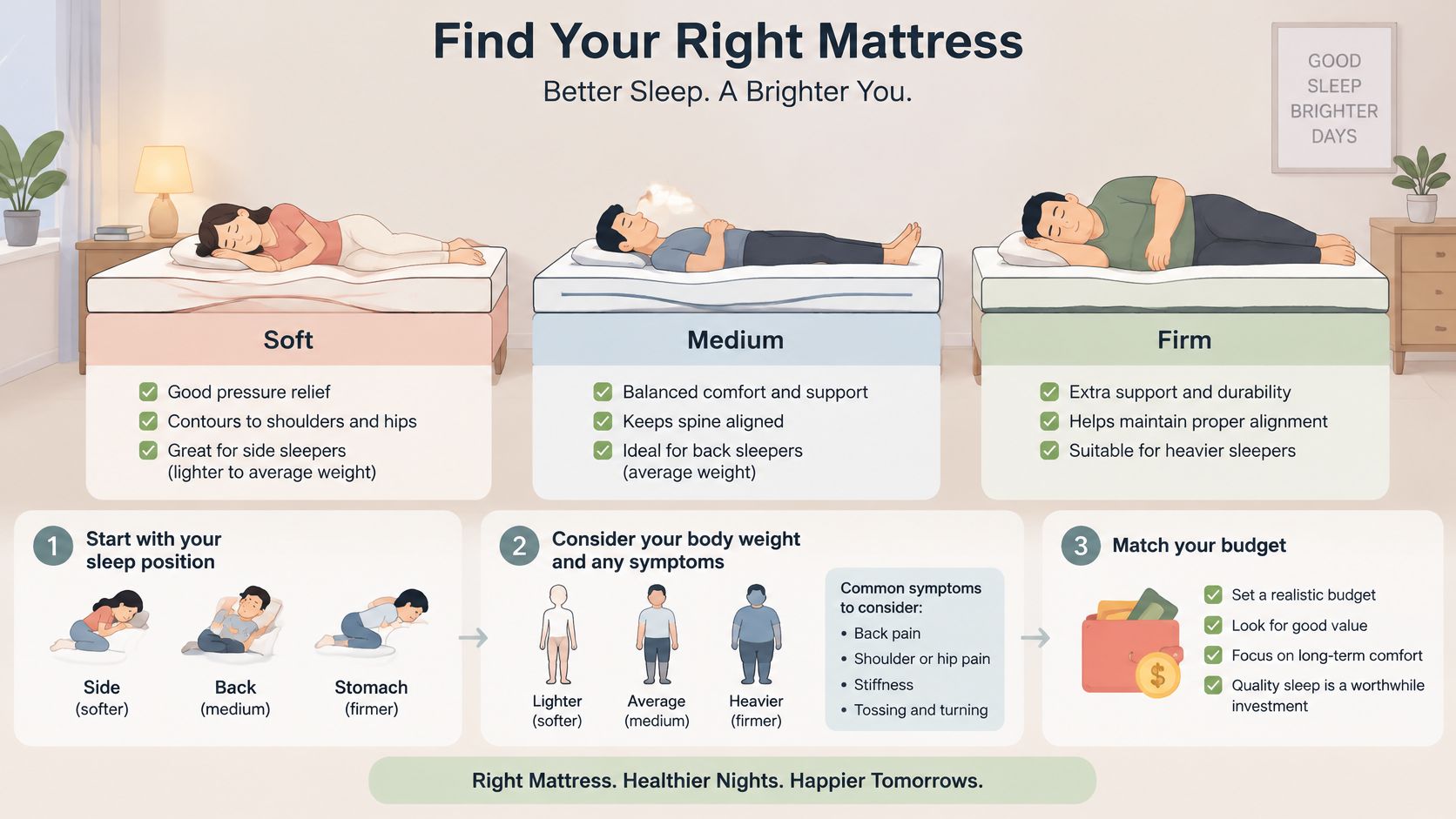
Is firmer always better for back pain?
Mattress firmness and spinal support are related, but they are not the same thing. A systematic review in the Journal of Orthopaedics and Traumatology found that medium-firm mattresses generally improved comfort, sleep quality, and spinal alignment for people with nonspecific low-back pain. The review included a Sealy Posturepedic model, but did not establish one mattress as the right choice for everyone.
A separate NCBI Bookshelf review of mattress firmness evidence describes potential advantages of medium-firm mattresses over firmer ones, while noting that some comparisons were not statistically significant. Test pressure relief and support together instead of choosing a mattress by its firmness label alone.
Distinguish unfamiliarity from a bad fit
A new surface may feel different at first. If pain persists, worsens, interrupts sleep, or comes with numbness or weakness, seek medical advice rather than repeatedly changing mattress firmness.
At Mattress Pro, consultations with sleep specialists begin with your sleep habits and desired improvements. A sleep pro can help narrow the choices by body type, sleep position, and budget, while the Mattress Guide offers another way to get initial recommendations.
Spend on the feature that matters
Ruidoso's dry mountain air does not eliminate the need to consider heat retention. Cooling gel may affect heat handling within a comfort layer, but it cannot guarantee that the whole bed will stay cool. Evaluate the cover, mattress layers, and bedding together.
- Pressure concerns: Choose cushioning that relieves pressure without compromising alignment.
- Overheating: Consider the cover, comfort layers, and bedding as a complete setup.
- Budget limits: Prioritize suitable support before paying for premium extras.
Test Your Sealy Fit Together at Mattress Pro in Ruidoso
A couple choosing a Sealy should test the same mattress at the same time. One partner may need more cushioning at the shoulders, while the other may prefer a firmer feel. Body weight and sleeping position affect how each person experiences the surface, so separate visits can miss an important difference.
A PubMed-indexed study of prescribed sleep surfaces found that replacing mattresses according to dominant sleeping position was associated with improvements in back pain, stiffness, sleep quality, and physical discomfort over subsequent weeks. The practical takeaway is to judge fit by each sleeper's position and comfort, not by a universal prescription.
Make the shared test realistic
Wear comfortable clothes and use a pillow of a familiar height. Lie down together rather than judging a display by pressing a hand into it.
- Settle into your usual positions. Give your bodies time to relax, then describe pressure and support separately.
- Swap sides. Test the center and edges, particularly if either of you sleeps near the side of the bed.
- Move normally. Turn, get in, and get out while your partner stays still. Notice how much movement reaches the other side.
- Pinpoint the disagreement. Decide whether the concern is surface softness, deeper sink, heat, or motion. Each points to a different trade-off.
If one mattress does not suit both partners, consider a split configuration. Confirm the mattress selection and setup requirements before choosing that arrangement.
A sensible starting point for cabins
For vacation rentals around Alto and Ruidoso, compare a medium-firm feel before trying extreme plush or extra-firm options. Treat it as a starting point, not a rule. Check whether guests can reposition easily, use the edges comfortably, and care for the mattress without fuss.
The in-store mattress testing guide can help you prepare for a visit. Comparing actual positions on different surfaces gives couples a clearer sense of how each mattress feels than a product description alone.
Local help after the selection
Mattress Pro by Miller Waldrop offers pickup or full-service delivery with professional assembly. Its personalized setup service positions the mattress for comfort according to your preferences. The store also has information about financing, delivery, and its Protection Plan.
Ask about the Rest Easy Guarantee and local price matching before checkout.
Sleep Pros offer personalized guidance for comparing Sealy mattresses. Visit Mattress Pro by Miller Waldrop at 2801 Sudderth Drive in Ruidoso to compare pressure relief, support, and partner movement in person, or browse the collection online first.