

Best Mattress for Active Sleepers: How to Choose and Test

The hiking boots are off, the legs are tired, and getting into bed should feel like relief. Instead, a sore hip presses against the mattress, the lower back feels unsupported, and another morning starts with stiffness. For someone who trains, hikes, or works hard around Ruidoso, that's a reason to reconsider the bed, not automatically buy the firmest replacement.
The best mattress for active sleepers is the one that fits their sleeping position, cushions tender contact points, and stays comfortable through the night. Mattress Pro by Miller Waldrop brings a 70-year family legacy to that decision, with a local, sleep-focused approach that starts with the person rather than the product label.
Quick Picks by Sleep Position and Activity
Mattress type and firmness by active sleeper profile
| Sleeper profile | Starting mattress type | Firmness starting point | Feature to test |
|---|---|---|---|
| Active side sleeper | Medium-firm memory foam or hybrid | Medium-firm | Shoulder and hip pressure relief |
| Active back sleeper | Medium-firm hybrid with lumbar support | Medium-firm | Pelvic support without a hammock effect |
| Active stomach sleeper | Firmer hybrid or innerspring | Medium-firm to firm | Hips stay level without sinking |
| Combination sleeper | Responsive hybrid | Medium | Easy repositioning during the night |
| Couple with different needs | Medium-firm base with partner-specific comfort layer | Medium, chosen per partner | Motion isolation and edge support |
| Hot sleeper after training | Breathable hybrid or latex | Medium | Airflow and moisture management |
These are starting points for testing, not prescriptions. An active side sleeper with broad shoulders may need more cushioning than another person who sleeps in the same position. A stomach sleeper needs enough resistance beneath the pelvis without uncomfortable pressure against the ribs.
For activity-related back stiffness, medium-firm is a sensible first comparison. A systematic review of mattress trials found that medium-firm designs can improve comfort, sleep quality, and spinal alignment, while excessive firmness or softness can create pressure or positioning problems.
A simple profile match
- Identify the usual position. Start with the position used to settle into sleep, then account for frequent overnight changes.
- Record the soreness. Note whether hiking, lifting, sports, or a demanding shift leaves discomfort around the shoulders, hips, or lower back.
- Choose the closest row. Write down the feature that deserves the most attention during a mattress test.
Someone who hikes and sleeps on their side might write: shoulder cushioning without a sinking waist. A couple with different work schedules might prioritize a stable sleeping surface when either partner gets up.
Practical rule: Firmness names aren't standardized across manufacturers. The mattress belongs on the shortlist because of how it feels under the sleeper, not because its hangtag uses the right word.
Bring that short profile to a Sleep Pro at the Ruidoso showroom on Sudderth Drive. It gives the consultation a useful starting point and keeps browsing focused.
Why Recovery Changes What You Need From a Mattress
A trail runner can log a strong training day in Ruidoso, fall asleep fast in dry mountain air, and still wake with stiff legs and a tight lower back. Hours in bed did not produce steady, comfortable rest.
A 2024 Centers for Disease Control and Prevention analysis found that 30.5% of U.S. adults slept fewer than 7 hours per night on average, while only 54.8% reported waking well-rested most or every day. Research on active populations points to a related pattern, where athletes often report broken sleep and lingering soreness even when total sleep time looks adequate.
Judging a Mattress by Fit and Recovery Needs
A mattress is a nightly recovery tool, so judge it by fit. Alignment, pressure relief, and temperature control in your own sleep position decide whether sore shoulders, hips, and backs settle or stay restless. That matters more in high elevation, where cool nights and low humidity can leave airways dry and joints feeling achy by morning.
Pick the mattress that keeps you in place through the night:
Uninterrupted rest means fewer position searches. Support should hold the spine steady so discomfort does not force repeated tossing.
Comfort after hard days means cushion without collapse. Sore spots need give at the surface with firm support underneath, especially for side sleepers with shoulder and hip pressure.
Low partner disturbance means separate motion stays separate. Different work or training schedules should not turn every exit and entry into a shared wakeup.
The guide to exercise and sleep quality gives added background for connecting training habits with sleep needs. Use it to clarify whether heat, pressure, or motion wakes you most, then test for that specific problem.
No single model guarantees recovery. A Sleep Pro consultation connects activity level, sleep position, body shape, and recurring soreness with practical choices from curated leading brands. That personalized guidance is available near Sudderth Drive, in Alto, and across Lincoln County.
Firmness, Alignment and Pressure Relief Explained
After hard training days around Ruidoso, judge the mattress as a recovery tool. Alignment, pressure, and temperature in your own sleep position decide how you wake up. Firmness labels alone do not.
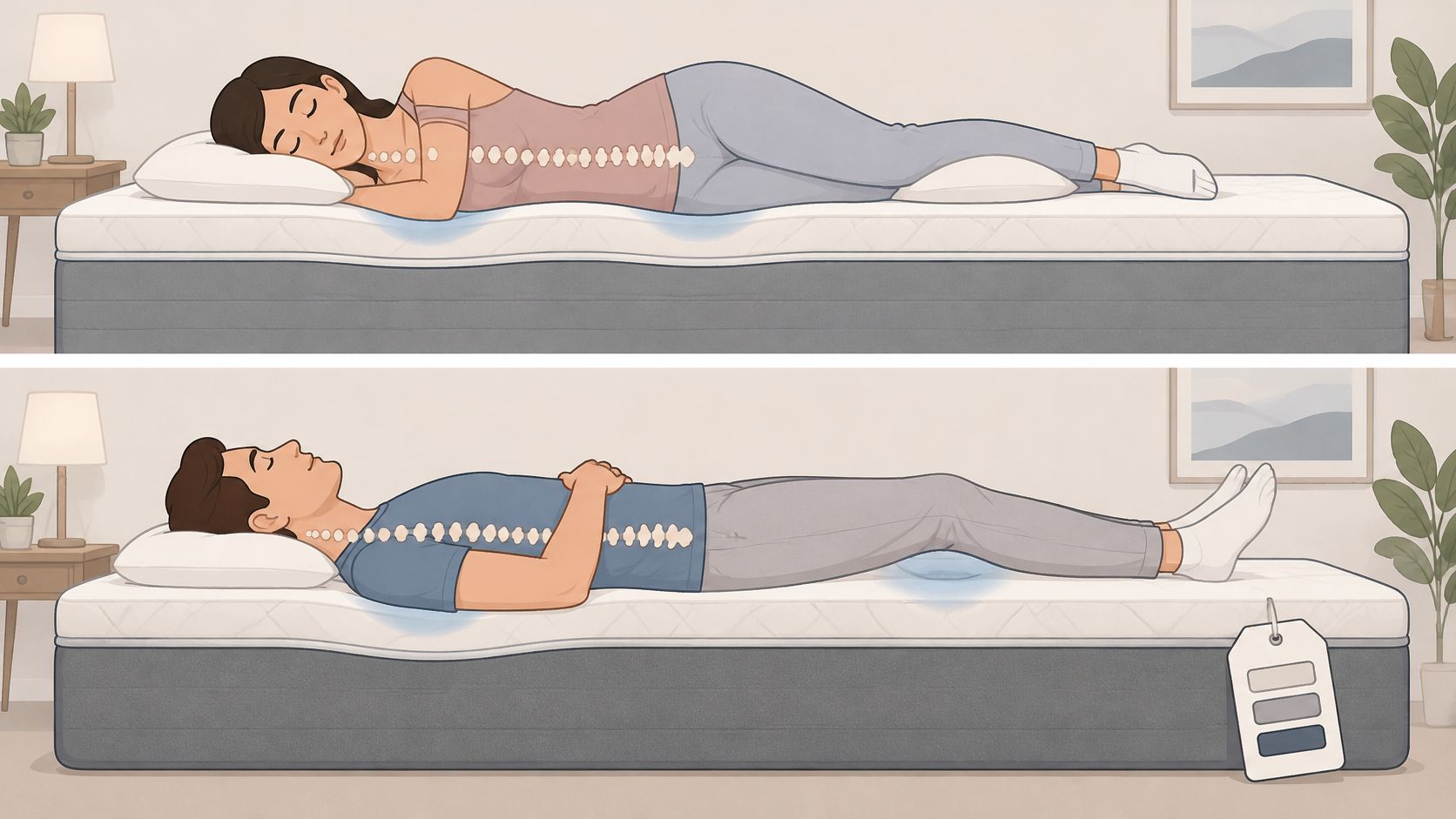
Firmness describes surface feel. Support describes how the mattress holds the body. One brand's medium-firm often feels different from another's, which is why dry mountain air and cool nights still leave many sleepers stiff when support misses.
For a side sleeper, the spine should hold roughly straight from head to hips. A surface that is too soft lets the pelvis sink into a hammock shape. A surface that is too rigid concentrates load under the shoulder and hip. Back sleepers need support that preserves natural spinal curves instead of forcing the back flat.
What the firmness evidence supports
A 2003 randomized, double-blind, multicenter trial published in The Lancet followed 313 adults with chronic nonspecific low-back pain for 90 days, finding better outcomes with medium-firm mattresses than firm mattresses.
Medium-firm outcomes versus a firm mattress
| Measure | Result | Study detail |
|---|---|---|
| Pain while lying in bed | Odds ratio 2.36 for improvement on medium-firm in the 2003 Lancet trial of 313 adults with low-back pain | 90 days, randomized and double-blind |
| Disability | Odds ratio 2.10 for improvement on medium-firm in the same 2003 Lancet trial | Same adult low-back pain group |
| Pain on rising | Improved versus the firm-mattress group in the Lancet trial summary | Ratio not reported |
| Comfort, sleep quality, and alignment | Medium-firm designs improved these versus firmer surfaces in the clinical evidence review through NCBI Bookshelf | Excess firmness raised shoulder and hip pressure |
Use this evidence as a starting point for testing, since no firmness level suits every athlete or body type. Pick a candidate range from the guide to choosing mattress firmness, then confirm alignment and pressure in your usual position.
The checks that matter
Test like you recover. Lie still for several minutes, then roll.
- Alignment: The body rests without an obvious pelvic dip or forced arch.
- Pressure distribution: Shoulders and hips feel cushioned rather than sharply loaded.
- Movement: Rolling stays easy, with no struggle out of a deep indentation.
Persistent or radiating pain needs clinical assessment. A mattress works alongside that care for nightly comfort and support.
Memory Foam, Hybrid, Latex and Innerspring Compared
Sore shoulders after a long hike tell you more than any firmness label. Each material produces different comfort outcomes, so compare them on pressure, movement, and budget priorities for the way you sleep.
Memory foam conforms gradually, which increases contact around the body and spreads load away from shoulders and hips. Dense comfort layers can feel warm or restrictive when you try to change position fast. A hybrid puts foam or latex comfort layers over a coil support core, so you get cushioning on top with responsive support and open space for airflow below.
Latex gives a buoyant, springy pushback instead of that slow memory foam sink. Innerspring designs rely on coil-based support, usually with thinner surface padding, so contouring depends heavily on how much padding sits above the coils.
Compare the trade-offs
These are general tendencies, not guarantees for every model.
Mattress materials compared for active sleepers
| Material | Pressure relief | Responsiveness | Cooling | Edge support | Best for |
|---|---|---|---|---|---|
| Memory foam | High at shoulders and hips | Slow to rebound | Can trap heat in dense foam | Moderate | Side sleepers who want contouring |
| Hybrid | Moderate to high with comfort layer | Moderate to high | Good airflow through coil core | High with perimeter reinforcement | Couples and mixed sleep positions |
| Latex | Moderate | High | Breathable | Moderate | Hot sleepers and frequent movers |
| Innerspring | Lower at contact points with thin padding | High | Good airflow | Stronger with reinforced perimeter | Stomach sleepers who want firm support |
Judge durability by construction: foam quality, comfort-layer thickness, coil design, and foundation all matter. A strong support core cannot fix a thin or mismatched comfort layer that bottoms out under hips and shoulders.
The latex versus memory foam comparison lays out the choice between a buoyant surface and deeper contouring for shoppers stuck between those two feels.
Bounce is useful, but it is not a recovery guarantee
A small study involving young athletes found some performance improvements with high-rebound toppers after four to six weeks, including statistically significant gains in 40-meter sprint or star-drill performance. Those small youth-athlete samples do not prove faster recovery for adults.
Pick responsiveness for a practical reason. Easier rolling and push-off. A springy surface should let you turn without fighting a deep indentation or bouncing a partner awake, which matters after training days in dry Ruidoso air when muscles already feel stiff.
Mattress Pro by Miller Waldrop carries memory foam, hybrid, and latex mattresses, plus TEMPUR material and spring options from Tempur-Pedic, Sealy, Stearns & Foster, and Sherwood. The selection also includes mattresses using cotton, Egyptian cotton, foam, and rayon from bamboo. A Sleep Pro can narrow those choices around pressure, movement, and budget instead of declaring one material the winner for every active sleeper.
Cooling, Edge Support and Motion for Mountain Living
Ruidoso's high elevation and dry mountain air don't eliminate nighttime overheating. Cool evenings, substantial day-to-night temperature changes, and cabins with uneven heating can leave a sleeper comfortable at bedtime but too warm beneath the covers later.
The right mattress needs to work with that bedroom environment. Someone returning from evening training may have different thermal preferences from a partner who reaches for another blanket.
Cooling claims need a closer look
An athlete bedding review describes a study of 24 Division I female soccer players in which a temperature-controlled topper added 32 minutes of sleep, without a statistically significant improvement in recovery score. It also describes a field study of elite male Australian-rules football athletes reporting roughly 29 additional minutes of sleep with temperature-controlled bedding.
Those findings don't establish the same result for every adult, and they don't prove faster muscle repair.
Passive breathability and active temperature regulation are different:
- Passive construction: Ventilated comfort layers, coil cores, and heat-dissipating covers help manage heat without powered temperature control.
- Electrically regulated systems: These actively adjust the sleeping environment rather than relying only on material properties.
- Gel-infused foam: Gel is intended to influence heat transfer, but its presence alone doesn't guarantee lasting cooling.
A cool-to-the-touch cover isn't enough. The important question is whether the complete mattress stays comfortable beneath the sleeper's usual bedding.
Test the perimeter and the partner effect
Edge support matters when sitting down after training or standing up with tired legs. The mattress edge support guide explains what a stable perimeter contributes to usable sleeping space.
Motion isolation deserves a separate test. A surface can feel easy to move on yet still transmit enough movement to bother a light-sleeping partner.
Local Sleep Pros live with the same mountain conditions as their neighbors. A showroom comparison can reveal surface warmth and movement characteristics, while the Comfort Promise helps address uncertainty about comfort at home, where heating, humidity, and bedding differ.
How to Test a Mattress in Our Showroom
A useful mattress test resembles actual sleep, not a quick sit on the corner. Customers can visit the showroom at 2801 Sudderth Drive to compare mattresses before buying.
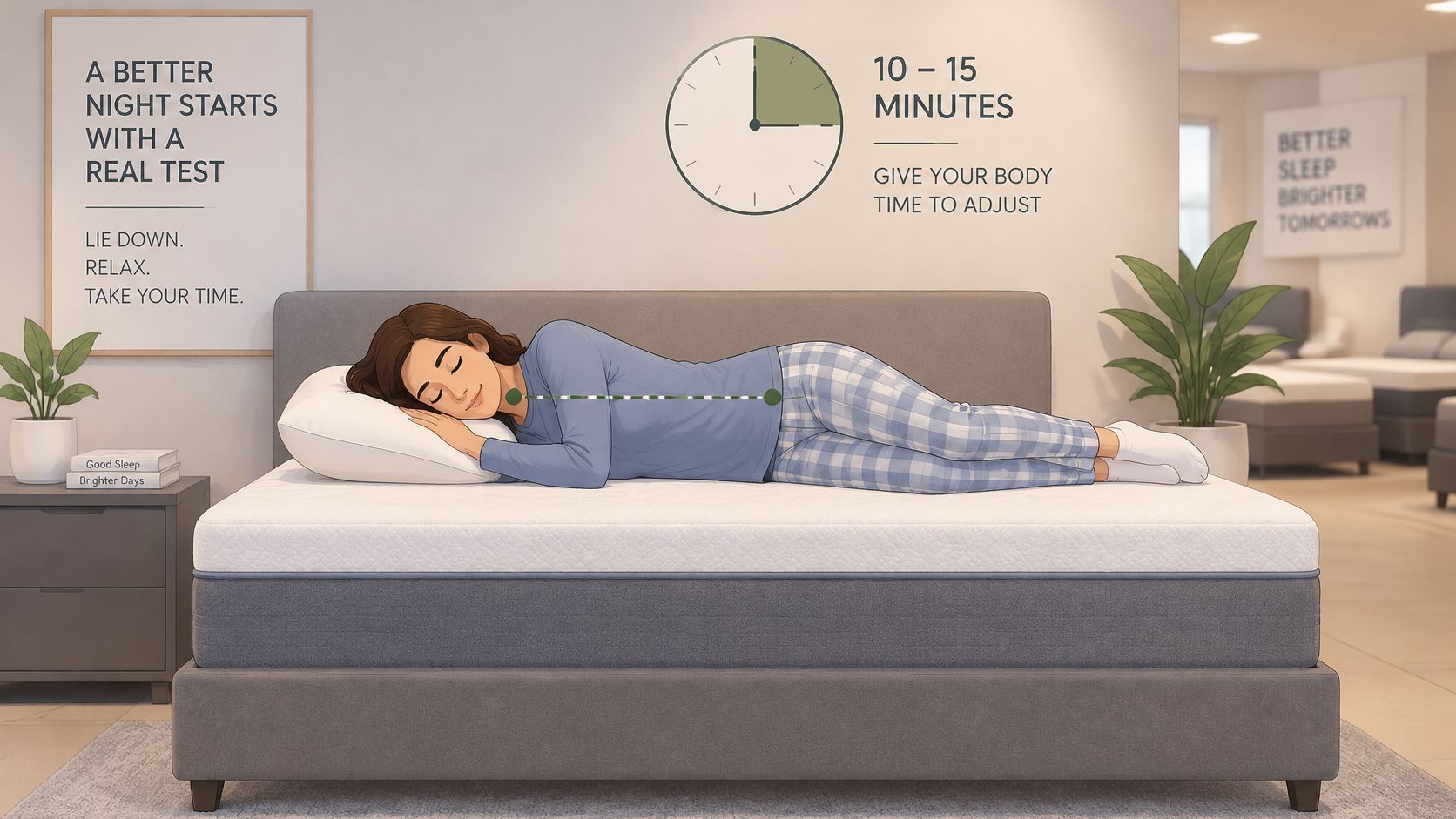
Use a repeatable fitting routine
Bring the usual pillow. Wear comfortable clothing similar to sleepwear. Pillow height changes neck position, while restrictive clothing can distract from the mattress feel.
Settle into the usual sleeping position. Stay long enough for the body and comfort layers to settle. A brief lie-down mainly measures the first impression, not sustained pressure comfort.
Check alignment and contact pressure. A Sleep Pro can help assess positioning while the sleeper notices whether shoulders and hips feel evenly supported. Trying to tolerate a sharp pressure point isn't a successful fit.
Roll, then test the edge. Move between side and back, sit at the perimeter, and stand. The goal is comfortable movement without excessive sinking or an unstable edge.
Test with the sleeping partner. One person stays still while the other rolls or gets up, then they exchange roles. Both sleepers need to judge the disturbance from their own side.
Notice developing warmth. Pay attention after settling in rather than relying on the initial coolness of the cover. Record whether the surface starts feeling stuffy or restrictive.
Repeat across different constructions. Compare a short list using the same pillow, positions, and movements. Changing the test between mattresses makes the results harder to interpret.
Include the setup conversation. Mattress Pro by Miller Waldrop offers personalized setup in which experts position the mattress for comfort according to the customer's preferences. Full-Service Delivery with Professional Setup also deserves consideration before arranging transportation.
Record sensations, not just favorites
Useful notes are concrete: less shoulder pressure, easier rolling, or too much movement from the other side. Those observations give a Sleep Pro something more actionable than liking a mattress.
The in-store mattress testing guide can help shoppers prepare. The Comfort Promise addresses the fear of choosing the wrong bed, while careful showroom testing reduces avoidable guesswork before purchase.
Care Habits That Make an Active Mattress Last
Replace a mattress when comfort declines, not when a set number of years passes. Construction, body weight, training load, support, and daily care decide how long alignment, pressure relief, and temperature control hold up.
Active sleepers put more demand on the recovery tool. Sweat, body oils, and dust build fast, and routine cleaning protects the feel you chose in the showroom. Ruidoso dust settles quickly in dry, high-elevation air, so plan on regular surface care.
Keep the sleeping surface clean and supported
Sweaty nights call for a simple reset. Pull the bedding back for an hour, ventilate the room, then make the bed. That habit lets trapped moisture escape before the next night, which helps the surface feel fresher and more consistent for pressure relief.
- Rotate when the model permits. Follow the mattress-specific rotation schedule to distribute wear. Flip only a mattress explicitly designed for sleeping on both sides.
- Vacuum the surface and seams seasonally. Use an upholstery attachment and gentle suction to remove dust without damaging the cover.
- Choose a breathable, washable protector. It should manage everyday moisture without noticeably changing the intended mattress feel.
- Protect the support system. Keep the mattress on the foundation specified for that model and retain purchase and care information.
Regular care can help preserve warranty eligibility, but it does not expand coverage beyond the written terms. A heavy soaking or an unsuitable foundation creates problems that routine surface cleaning will not solve.
Watch for changes in comfort
Replacement deserves consideration when there is:
- Recurring morning discomfort that eases after getting up.
- A visible sag or dip that changes the sleeping position.
- Persistent body impressions that do not recover.
- Continued poor mattress comfort after cleaning, appropriate rotation, and checking the foundation.
Use those signs as a cue to reassess alignment and pressure in your usual sleep position. Bring the notes to a fitting and compare how the current bed supports recovery against a properly set up option.
Book Your Fitting and Choose Your Mattress
Walk in with a clear sleeper profile. You train, hike, or work on your feet all day in dry, high-elevation air, so judge each mattress as a recovery tool for alignment, pressure relief, and temperature in your own sleep position. Written fitting notes should record which model kept your spine level and shoulders comfortable, side, back, or stomach.
Fear of picking the wrong bed should not force a rushed compromise. Ask a Sleep Pro to explain the Comfort Promise and the Rest Easy Guarantee before you buy. Neither guarantee replaces a careful fitting.
Put comfort and cost in the same conversation
The Low Price Promise means Mattress Pro will match the prices of its local competitors. Flexible financing is also available, which gives you another way to plan the purchase around your budget and any sleep-system changes.
Bring three priorities to your one-on-one consultation:
- A clear comfort target: the position and soreness notes that matter most after a hard day.
- A realistic budget: for the preferred mattress plus protector or foundation updates.
- A delivery plan: pickup or full-service delivery with professional assembly, based on what your household needs.
That focused visit beats wandering the floor bed by bed. The family-owned business draws on its 70-year Miller Waldrop legacy with a focus entirely on sleep solutions. A local showroom gives you an in-person conversation and a physical comparison.
Ready to wake up loving your mornings? Visit the Sleep Pros at the Mattress Pro showroom at 2801 Sudderth Drive in Ruidoso. Contact the Ruidoso showroom to confirm current hours. Browse mattresses and sleep accessories online, then test your short list in person and pick the setup that helps your body recover.
Mattress Pro by Miller Waldrop offers personalized mattress fittings, leading sleep brands, and delivery options for active mountain households. Visit the Ruidoso showroom to compare pressure relief, support, and movement in person and find a mattress suited to the way the body rests after a demanding day.