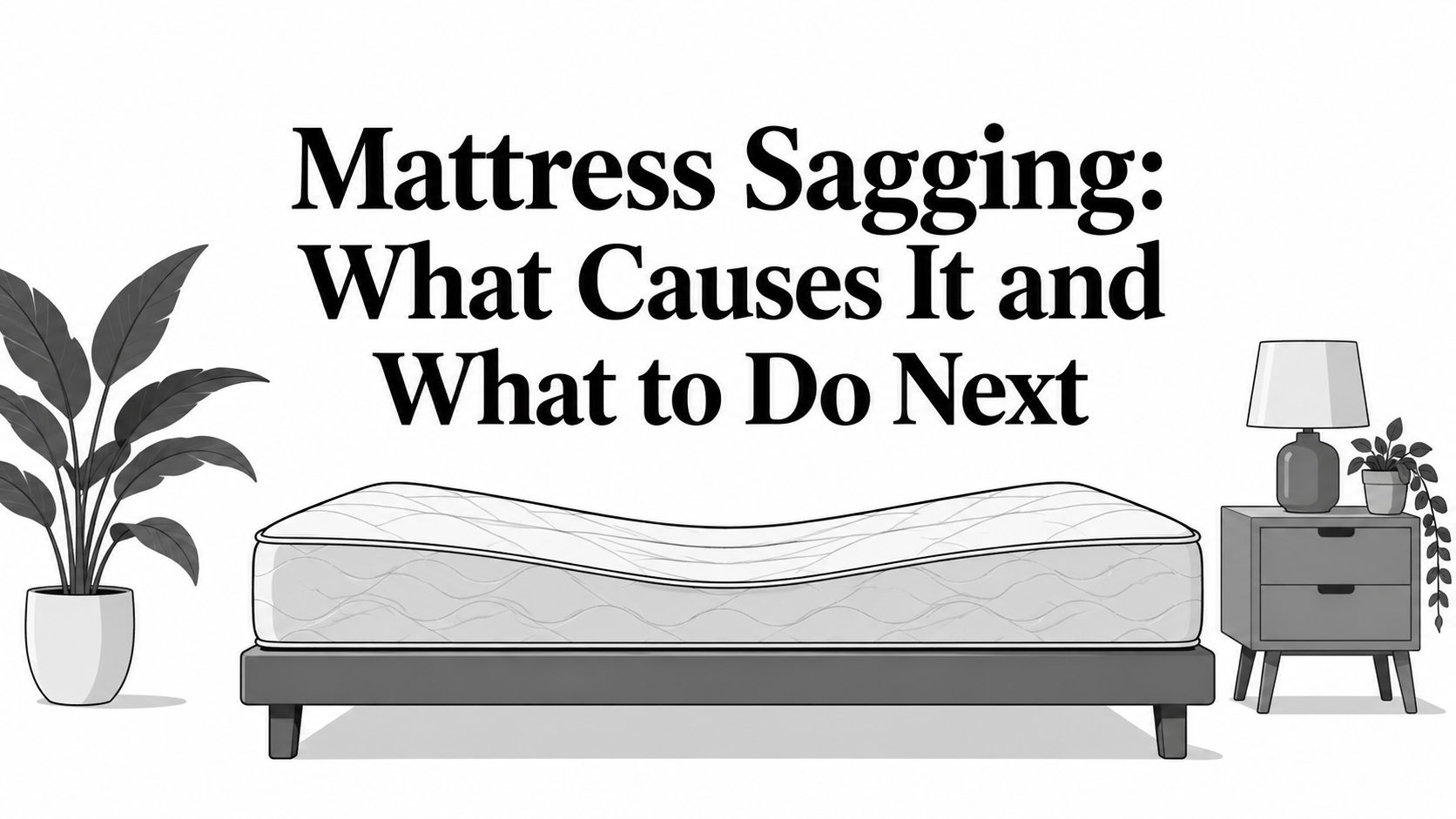


What Does a Mattress Warranty Cover


A mattress warranty generally covers manufacturing defects such as broken coils, cracked foam, and body impressions deeper than the brand's stated threshold, often around 1.5 inches, not normal softening, comfort changes, or stains. The warranty is a defect contract, not a promise that the mattress will feel perfect forever.
That distinction challenges the most popular mattress-buying advice. A long warranty can sound like total protection, but the fine print decides whether a problem qualifies, what remedy is available, and which costs remain with the buyer.
For shoppers in Ruidoso, Alto, and across Lincoln County, the smartest approach is simple: read the warranty before buying, compare it with the retailer's Comfort Promise and return policy, and protect the mattress from day one. A Sleep Pro can also help separate a true structural defect from a comfort issue that belongs under an exchange or trial policy.
Why a Long Warranty Is Not Automatically Good Protection
A long warranty doesn't automatically mean better protection. The test that matters is whether the document clearly defines covered defects, sets a measurable threshold, explains exclusions, and states who pays for inspection, transportation, labor, or replacement delivery.
The Federal Trade Commission advises consumers to review which parts and repairs are expressly covered. Items not listed shouldn't be assumed to qualify. The FTC's consumer warranty guidance also explains that warranty terms should be available before purchase, not hidden until a claim becomes necessary.
The defect definition matters more than the headline
A warranty can last for many years while still narrowing coverage through technical conditions. It may cover a permanent structural failure but exclude normal softening, ordinary body impressions, stains, or a mattress that no longer feels comfortable.
That's why shoppers should ask four direct questions:
- What defect qualifies? Does the document name broken coils, foam failure, seam separation, or a specific indentation depth?
- What remedy applies? Will the company repair the mattress, replace it, or issue a refund?
- What costs remain? Are transportation, inspection, handling, or prorated charges excluded?
- What use is required? Does the mattress need an approved foundation, a particular support configuration, or a protective cover?
A shorter warranty with plain language can be more useful than a longer warranty filled with exclusions. The practical comparison should focus on the protection a sleeper can use, not the largest number printed in a sales description.
Practical rule: A warranty's length tells shoppers how long the contract may remain active. Its definitions tell them whether the contract will help.
Comfort protection is separate
A mattress can feel too firm, too soft, or unsuitable for a partner without having a manufacturing defect. That's where a comfort exchange or return policy matters. Shoppers should compare the warranty with the retailer's comfort terms before choosing between memory foam, hybrid, or traditional construction.
Readers evaluating expected service life can also review this guide on how long a mattress should last. The important point is that expected lifespan, comfort preference, and defect coverage are separate questions.
The Manufacturing Defects Most Warranties Cover
Manufacturing warranties generally address failures in materials or workmanship. Common examples include defective coils, broken structural components, cracked foam, failed seams, defective fabric, and permanent body impressions that exceed the written threshold, as described in the published mattress warranty terms.

What a qualifying defect looks like
A broken coil may create a clear structural problem, while cracked foam or a failed seam can change how the mattress supports the body. A qualifying impression is more technical. It must remain after the mattress is unloaded, and the applicable warranty must identify the required depth.
One industry comparison identifies 1.5 inches as a common benchmark, while another published warranty defines a qualifying depression as at least 2 centimeters when no weight rests on the mattress. Those figures come from different warranty documents, so the brand's own written threshold always controls. See the guidance on mattress sagging for the measurement issue.
How to measure an impression at home
A subjective feeling of poor support isn't enough for most claims. A simple measurement creates stronger evidence:
- Unload the mattress. Remove bedding and allow the surface to sit without anyone lying on it.
- Place a straightedge across the depression. Keep it level over the surrounding surface.
- Measure the deepest point. Use a ruler from the underside of the straightedge to the mattress surface.
- Photograph the setup. Capture the straightedge, ruler, and the full mattress in separate images.
- Compare the result with the written warranty. Don't rely on a general industry benchmark when the brand specifies another threshold.
Foundation support also matters. Widely spaced slats, inadequate center support, an incompatible base, excess moisture, or concentrated loading can accelerate compression and may affect eligibility. Ruidoso's dry mountain air makes cooling and material care especially important, but the manufacturer's foundation rules remain the authority.
Common Exclusions That Catch Buyers Off Guard
The most common warranty dispute starts with a reasonable but incorrect assumption: the mattress changed, so the warranty must apply. Warranties usually cover a defined defect, not every change a sleeper notices during ownership.
The exclusions are practical, not theoretical. A family in Ruidoso, a vacation cabin owner in Alto, or a busy household elsewhere in Lincoln County can unintentionally create a condition the warranty excludes.
Normal softening and comfort changes
Foam and upholstery can settle with use. A sleeper may notice a softer feel or less pressure relief without finding a measurable structural depression that reaches the brand's threshold.
That's a comfort concern, not automatically a warranty defect. The same applies when a couple discovers that one partner prefers a firmer surface or that a back-pain concern requires a different support profile. The solution may be an exchange under the retailer's comfort policy, not a manufacturer claim.
Damage caused by use or the environment
Most warranty documents exclude conditions such as:
- Stains and unsanitary conditions: A spill, pet accident, or rental-property mishap can make inspection difficult and may exclude coverage.
- Burns, rips, and tears: Surface damage usually reflects an outside event rather than a materials defect.
- Misused handles: Handles are generally intended for positioning, not carrying the full mattress weight.
- Folding or bending: A mattress forced into an unsuitable space can damage internal layers and support components.
- Improper foundations: An incompatible frame or inadequate slat support can change load distribution and undermine a claim.
- Physical abuse or misuse: Jumping, concentrated loading, or other unusual treatment can fall outside the contract.
A quality protector is one of the easiest preventive steps. The guide to what a mattress protector does explains why surface protection supports both hygiene and long-term ownership.
Prevention protects the claim
The buyer should keep the warranty, receipt, model information, law label, and foundation specifications together. A protector, correct base, and careful handling help preserve the mattress and make the owner's documentation more persuasive if a structural problem appears.
How Federal Rules Shape Every US Mattress Warranty
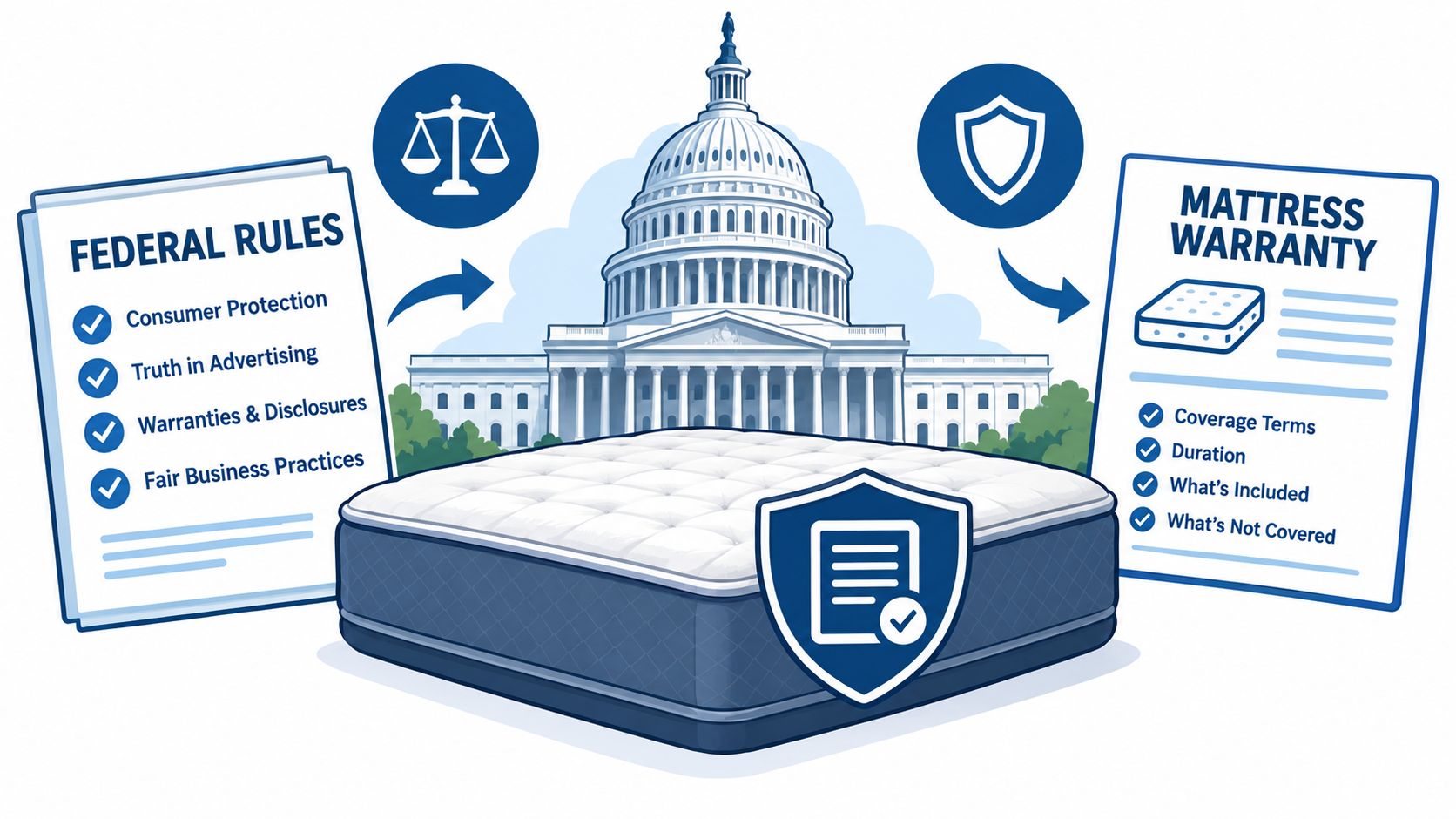
A mattress warranty operates inside a federal consumer-protection framework, not just a store's private policy. The Magnuson-Moss Warranty Act, enacted in 1975, requires written warranty providers to communicate coverage, responsibilities, duration, service procedures, and dispute handling clearly when a written warranty is offered. The Federal Trade Commission's Magnuson-Moss overview explains the framework.
What buyers should see before purchase
The written warranty should be available before the transaction. It should identify the product or covered components, eligible users, coverage period, exclusions, claim instructions, and whether the remedy is repair, replacement, or refund. The FTC disclosure rules for written consumer warranties require terms to be presented in language consumers can readily understand.
For a mattress costing more than $10, federal rules distinguish written warranties as either full or limited, as described in the FTC framework. That label matters because it signals how much responsibility the warrantor accepts.
Full versus limited coverage
A full warranty carries stronger consumer protections. Under the framework summarized by Thomson Reuters Practical Law), a full warranty must provide eligible consumers service during the warranty period, remedy covered defects within a reasonable time and without charge, and provide a refund or replacement if the product remains defective after a reasonable number of repair attempts.
A limited warranty may prorate replacement costs, restrict eligibility to the original purchaser, require proof of purchase, or assign transportation and handling charges to the customer. The label doesn't replace careful reading. A limited warranty can still offer useful protection, but buyers need to understand where costs and conditions shift.
A warranty with a familiar brand name still deserves the same close reading as any other written contract.
Federal rules also address branded parts and service requirements. A manufacturer generally can't condition coverage on using a specified part or service unless that part or service is provided free or the company receives an appropriate waiver, according to the FTC's warranty guidance for businesses. Damage caused by an unauthorized part or service can still be excluded.
Warranty Lengths and Coverage by Brand
The four primary brands available through the local showroom, Tempur-Pedic, Sealy, Stearns & Foster, and Sherwood, shouldn't be judged by warranty length alone. Their written terms can differ by model, construction, defect definition, foundation requirements, remedy, and whether costs are prorated.
A reliable comparison therefore requires the exact warranty document for the mattress being considered. The table below is a buying framework, not a substitute for current brand terms.
| Brand | Typical Warranty Length | Qualifying Impression | Prorated or Non-Prorated |
|---|---|---|---|
| Tempur-Pedic | Check the model-specific written warranty | Use the stated measurable threshold | Check the written remedy and cost schedule |
| Sealy | Check the model-specific written warranty | Use the stated measurable threshold | Check whether replacement costs are prorated |
| Stearns & Foster | Check the model-specific written warranty | Use the stated measurable threshold | Confirm the model's applicable structure |
| Sherwood | Check the model-specific written warranty | Use the stated measurable threshold | Confirm eligibility, handling, and replacement terms |
How to compare the four options
Tempur-Pedic and other memory foam designs may offer pressure-point relief and contouring, while cooling gel technology can help manage heat within the foam system. Hybrid mattresses combine foam comfort layers with coil support, often balancing pressure relief, responsiveness, and airflow. Sealy, Stearns & Foster, and Sherwood may offer different constructions within their ranges, so the sleeper's position, body shape, temperature preference, and partner movement matter as much as the warranty.
A buyer seeking a detailed mattress comparison chart should still ask for the warranty attached to the exact model. The useful questions are whether the impression threshold is measurable, whether the remedy changes over time, and whether a claim requires the original purchaser and proof of purchase.
The right fit depends on the sleeper
A side sleeper may prioritize pressure relief around the shoulders and hips. A back sleeper may focus more on spinal alignment and even support. An active mountain sleeper in Ruidoso may also care about temperature regulation, especially when a dense foam design retains more warmth than expected.
Warranty comparison becomes meaningful only after comfort and support needs are clear. A generous defect policy won't compensate for choosing a mattress that never supported the sleeper properly.
How to File a Mattress Warranty Claim the Right Way
A strong claim is organized, measurable, and tied to the written warranty. The owner should document the condition before moving, repairing, cleaning, or disposing of the mattress.
Follow an orderly process
- Locate the purchase records. Gather the original receipt, order details, model name, law label, and warranty document.
- Confirm the foundation. Record the frame, slat spacing, center support, and any manufacturer specifications.
- Describe the defect by category. Identify a broken coil, cracked foam, failed seam, or measurable indentation instead of just stating that the mattress feels bad.
- Measure any impression. Use a straightedge and ruler with the mattress unloaded, then photograph the measurement.
- Photograph the full condition. Take wide images and close-ups that show the defect without exaggeration.
- Contact the retailer or manufacturer. Start with the local retailer when possible, because the retailer can help identify the correct process and documentation.
- Ask about charges before authorizing service. Confirm inspection, transportation, labor, handling, replacement delivery, and any prorated amount.
The mattress slats and support guide is useful before a claim because an unsuitable support system can affect both mattress performance and eligibility.
Don't confuse comfort with defect evidence
A mattress that feels less comfortable may not meet the warranty's technical definition. A claim should describe observable conditions and connect them to the specific language in the document.
A different-branded foundation or protector doesn't automatically void coverage. The FTC states that a warrantor generally can't require a particular branded part or service to preserve coverage unless the item is provided free or the requirement receives an appropriate waiver. However, the manufacturer can deny damage caused by the part or service itself.
Where local help matters
A local Sleep Pro can help the owner photograph the right details, check whether the foundation matches the model requirements, and organize the paperwork before submission. That's a more practical path than trying to interpret a warranty alone after buying a bed online with no nearby point of contact.
Getting Real Peace of Mind with a Local Sleep Pro
A warranty becomes more useful when the buyer has help before and after delivery. Mattress Pro by Miller Waldrop connects mattress selection, foundation support, delivery setup, comfort guidance, and warranty documentation in one local buying experience.
The family business has served Ruidoso for 70 years, with a focus on sleep rather than general home furnishings. That local relationship matters in a mountain community where dry air, changing temperatures, cabin use, vacation rentals, and active lifestyles can influence the way sleepers evaluate cooling, support, and material care.

Comfort protection reduces the wrong-bed risk
The Comfort Promise addresses the fear of choosing the wrong bed. It's separate from a manufacturing warranty, which is exactly why buyers should understand both before committing to a mattress.
A Sleep Pro can compare pressure relief, spinal alignment, cooling needs, and partner preferences across Tempur-Pedic, Sealy, Stearns & Foster, and Sherwood. Memory foam can contour closely around pressure points, while a hybrid can provide a different balance of airflow, responsiveness, and coil support. The correct choice depends on the sleeper, not the warranty headline.
Setup protects long-term performance
The Low Price Promise helps budget-minded shoppers compare the purchase more confidently. Full-Service Delivery with Professional Setup also matters because the team can place the mattress on the correct foundation from the beginning, reducing avoidable support problems.
That service is especially valuable for homes around Sudderth Drive, Alto, and the wider Lincoln County area. A local team can answer questions about the frame, document the delivery, and remain available if the owner later needs help understanding a warranty process.
The best protection combines a suitable mattress, a compliant foundation, clear comfort terms, and a warranty the buyer has read before purchase.
Mattress Pro by Miller Waldrop helps Ruidoso and Lincoln County sleepers compare Tempur-Pedic, Sealy, Stearns & Foster, and Sherwood mattresses alongside the Comfort Promise, Low Price Promise, and Full-Service Delivery with Professional Setup. Visit Mattress Pro by Miller Waldrop to review sleep solutions and get local guidance before a warranty question ever becomes a problem.