


New Mattress Smell: Causes, Safety and Fast Fixes

The first night in a new bedroom can bring a sharp, fresh-paint smell as soon as the mattress is unwrapped. In a Ruidoso cabin closed up between visits, or an Alto bedroom kept shut against the cold, that odor may feel especially noticeable.
The smell often fades within days to a few weeks, but odor is a poor measure of what remains in the air. Some emissions can continue after the scent is gone, so ventilation matters even when the room smells fresh again.
Why a Brand-New Mattress Smells the Way It Does
That smell is normal off-gassing from polyurethane foam, the adhesives that hold its layers together, the textile cover and ticking, and the finishes applied during manufacturing. Treat it as an indoor-air issue to ventilate, not as proof of danger.
Every one of those materials releases volatile organic compounds, or VOCs, which are chemicals that evaporate from solids or liquids into indoor air. The U.S. Environmental Protection Agency's indoor air quality guidance reports that the agency's Total Exposure Assessment Methodology studies, completed in 1985, found concentrations of roughly a dozen common organic pollutants were about 2 to 5 times higher inside homes than outdoors, even when those homes stood in rural or highly industrialized areas. That finding lands differently in Lincoln County, where a house can sit on acreage with clean outside air and still hold one closed-up bedroom with its own private chemistry.
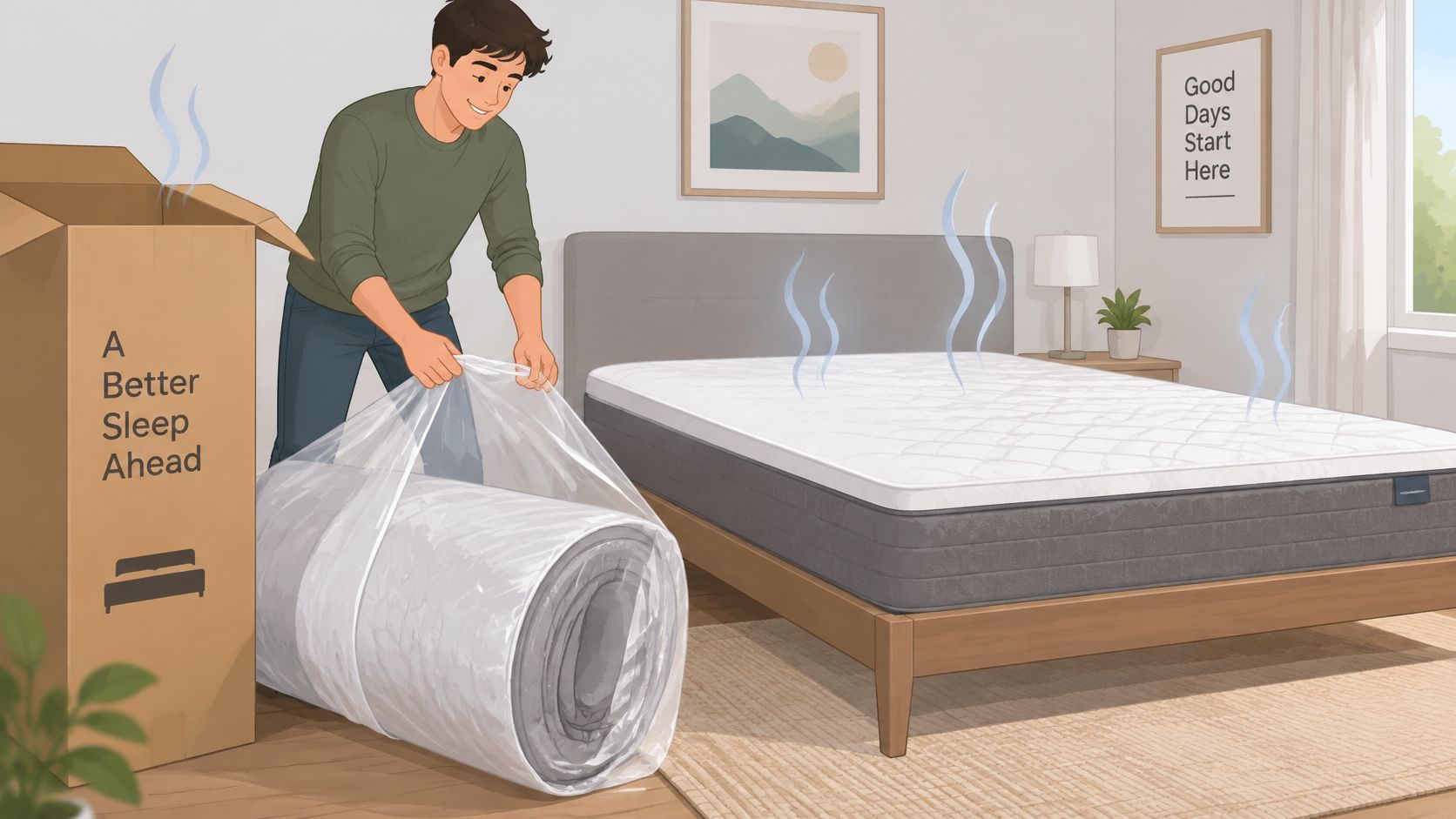
Packaging explains the first hour. A rolled mattress ships compressed and sealed, which traps whatever the foam released during manufacturing inside the plastic. Cut the wrap and the concentration that built up over weeks comes out all at once.
Think of a jar of pickles. The brine smells sharp the second the lid comes off, and after that it stops mattering how strong the first whiff was, because the only thing that clears the kitchen is air moving through it. Ventilation is the lid coming off.
Odor intensity is not a reliable gauge of total emissions or of health risk. Exposure depends on which chemical is present, how concentrated it is in the air, and how long and how often someone breathes it. A room that smells mild can still be a room with no air exchange at all.
Odor tells you a mattress is releasing something. It never tells you whether that something matters.
Ruidoso's dry mountain air helps the moment it's allowed in. The catch is that the same climate pushes people to seal bedrooms against cold nights and leave cabins buttoned up between visits, and closed rooms are exactly where concentrations rebuild. The EPA's indoor air guidance makes that point plainly: concentrations can climb again after windows are closed, so a single afternoon of airing isn't the same as a week of it.
The key questions, then, are how much you're breathing and how quickly it clears. Both have practical answers.
How Long New Mattress Smell Really Lasts
A chamber study of two memory-foam mattresses found that VOC emissions were highest on the first day and declined over 31 days. The study's modeled first-year average concentrations were 2.7 and 4.2 µg/m³, both below the health benchmarks it reported, according to a review of mattress off-gassing research. The finding helps explain why odor and emissions don't follow the same clock: a smell can fade while low-level emissions continue.
New mattress smell timeline by stage
| Stage | Typical timing | What is happening | What to do |
|---|---|---|---|
| Unboxing day | First 24 hours | Emissions and odor are at their strongest | Unwrap in the best-ventilated room and open windows |
| Early airing | Roughly days 2 to 7 | Odor noticeably softens for most sleepers | Ventilate daily and keep the mattress uncovered |
| Settling period | Roughly weeks 2 to 4 | Emissions move toward a steadier rate | Keep the bedroom ventilated and watch for irritation |
| Long tail | Month 2 and beyond | Smell is usually undetectable while low-level emissions may remain | Maintain bedroom airflow and respond to any symptoms |
UL Solutions guidance, described in materials information from Sleep Sanitation, describes a similar pattern: emissions from many new products are highest on the first day and settle toward a steadier rate after several weeks.
Why the smell fades before the emissions do
Your nose is a poor stopwatch. It adapts to a constant smell, and the compounds that seem strongest at first may not be the ones that linger longest. Use the room's airflow and the passage of time as practical guides, rather than relying on odor alone.
For example, a mattress may smell faint after a few days but still release low levels of VOCs. Airing it in a room with outdoor-air exchange helps carry those compounds away. The EPA advises repeated or extended ventilation for some new furnishings because indoor concentrations can rise again when a room is closed.
What stretches the timeline
A few conditions can slow how quickly odor clears:
- A closed room. Without air exchange, released compounds remain in the room.
- A warm room. Heat can speed evaporation, making odor more noticeable as the mattress warms.
- A dense foam core. More material may take longer to release residual compounds.
- A mattress still in plastic. The wrapping traps odor instead of letting it disperse.
In a Ruidoso home or cabin, airing during the day may mean opening windows, then closing them again against a cold night. If the bedroom stays shut afterward, keep in mind that a single airing period may not clear the room for good. Pair ventilation with a proper mattress break-in routine while allowing the mattress time to expand and soften.
A smell that lessens over time fits the usual pattern. If it remains sharp well beyond the settling period, check the mattress for a defect and contact the retailer.
Is New Mattress Smell Safe for Your Household
Formaldehyde exposure above 0.1 parts per million (ppm) may cause watery or burning eyes, nose and throat irritation, nausea, coughing, chest tightness, wheezing, skin rashes or allergic reactions, according to the EPA's formaldehyde health guidance. For a household, symptoms and who is sleeping in the room are more useful safety cues than odor alone.
What the formaldehyde question asks
Formaldehyde is a colorless gas with a strong, pungent smell. Indoor levels depend on the emission source, temperature, humidity and air exchange. More outdoor air can lower indoor levels.
The EPA guidance lists mattress ticking among products that may contain formaldehyde-based materials. Pressed-wood products, household products and combustion appliances are more common household sources.
Symptoms worth paying attention to
High levels of VOCs can cause eye, nose and throat irritation, headaches, dizziness, nausea and respiratory discomfort. If these symptoms appear in the bedroom, leave the room and improve ventilation before sleeping there.
Practical rule: If symptoms ease after you leave the bedroom, avoid sleeping there until the air has improved. If they persist elsewhere in the home, contact a healthcare provider.
Who should air the mattress longer
People with asthma or chemical sensitivities, pregnant people, infants and young children may need extra care before sleeping on a new mattress. Infants sleep close to the mattress surface, where warmth can affect exposure.
A 2024 peer-reviewed study of 20 indoor events, indexed in PubMed, identified 96 distinct VOCs across 12 chemical categories. The study included ethylene oxide from new mattresses in warm, humid conditions among key contributors to modeled exposure risk. A 2025 report on research into 16 newly purchased children's mattresses, published by The New Lede, said investigators detected 21 semi-volatile organic compounds when simulating a child's body weight and body temperature. For households weighing material options, this guide to hypoallergenic mattress materials can help focus the comparison.
Three ways this plays out locally
A cabin rental near Ruidoso gets a new mattress in the master bedroom. The owner unwraps it well before the next booking and airs the room when the weather allows, giving the space time to clear before guests arrive.
A Ruidoso parent buys a first “big kid” bed. They allow extra airing time and review the mattress material information before placing it in the child's room.
An Alto couple notices irritation when spending time in a bedroom with a new mattress. They stop using the room and seek medical advice if symptoms continue beyond it.
Air Out and Clean a New Mattress Step by Step
A new mattress arrives at a Ruidoso cabin just before a cold night. You can still air it out without leaving windows wide open: remove the packaging, use a fan to direct indoor air outside, and give the room time to clear before making the bed.
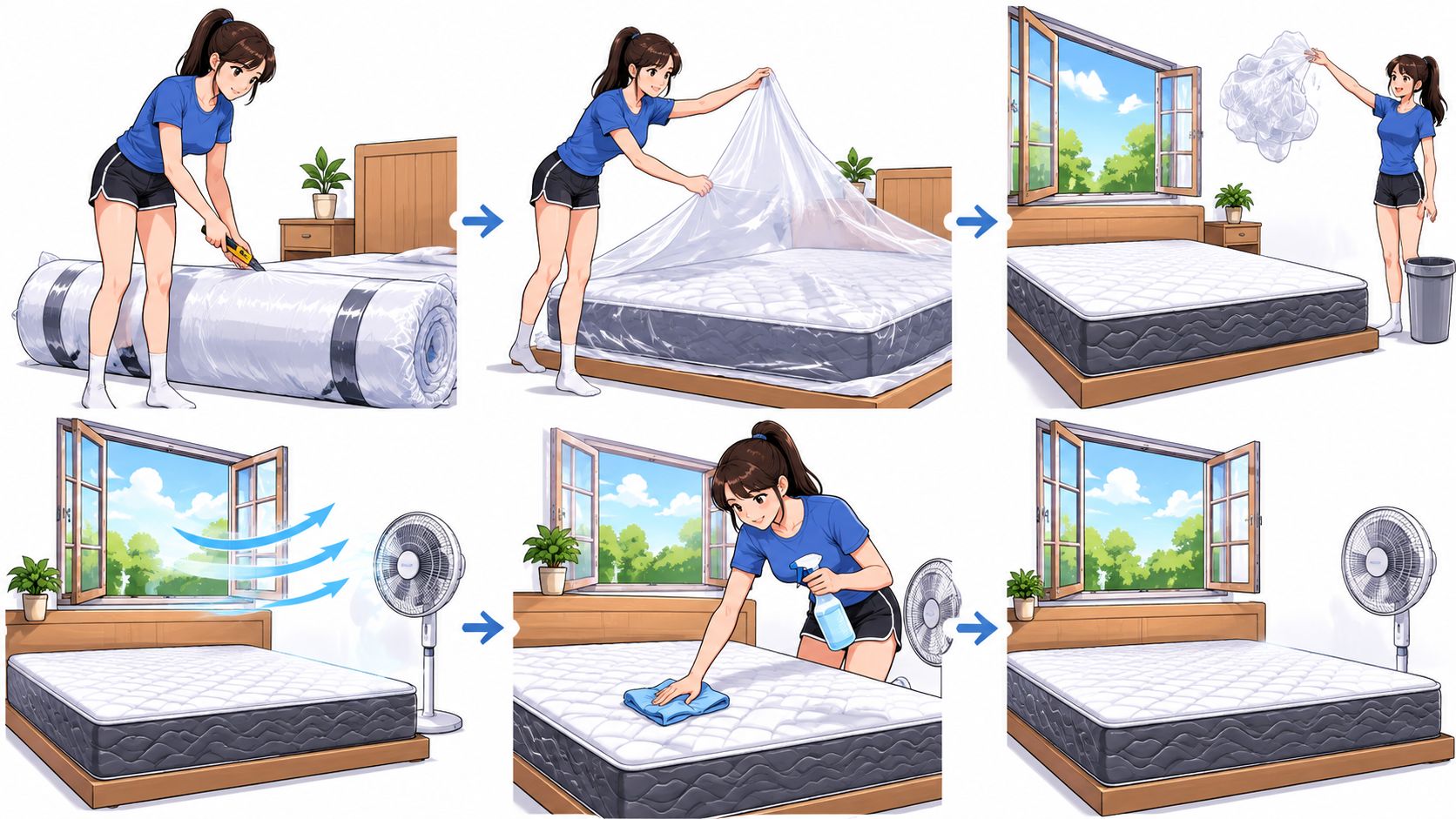
- Remove the plastic as soon as you can. Take off all packaging, even if the bed frame is not ready yet.
- Open windows where conditions allow. In a Ruidoso home or cabin, a brief airing can be more practical than leaving windows open all night, especially in cold weather.
- Set a box fan in a window facing outdoors. This helps carry indoor air outside. Avoid aiming the fan at the ceiling, where it only moves air around the room.
- Leave the mattress uncovered at first. Wait before adding sheets, a pad or a protector.
- Keep the room cool. Skip space heaters while the mattress is airing. The EPA's guide to indoor air quality recommends fresh-air ventilation and extra fans for products that release VOCs.
- Give it extra time in rooms used less often. Guest rooms, cabins and nurseries may not get the same regular window-opening and airflow as an occupied bedroom.
- Make the bed when the odor has softened. Avoid placing fragrance sprays beneath the bedding, where they can mask whether the smell is changing.
Cleaning methods compared
| Method | Best for | Watch out for |
|---|---|---|
| Open windows and run a fan | Airing the room | Direct the fan toward an open window |
| Vacuum with upholstery attachment | Dust and packaging debris | Use it on seams and edges; keep the mattress dry |
| Baking soda, then vacuum | Surface odor | Test a hidden corner first and leave it for several hours |
| Spot-clean with mild soap and water | Stains and spills | Blot lightly, avoid soaking foam and let it dry fully |
| Fragrance spray | Masking odor | It can hide whether the smell is fading, so skip it |
For routine care, vacuum seams and edges with the upholstery attachment. If you use baking soda, test a hidden corner, sprinkle a thin layer, leave it for several hours and vacuum it up. Blot spills with mild soap and water, then let the surface dry completely.
Skip harsh all-purpose cleaners and ozone generators. A breathable protector can help keep dust and body oils off the mattress once it has aired. For more guidance, see these mattress maintenance and cleaning tips.
Normal Smell or a Defect? How to Tell the Difference
A fresh, chemical smell that softens with airing is normal, while a musty, sour or scorched odor that doesn't fade points to moisture or a manufacturing problem.
Normal off-gassing smells sharp and new, like a car interior or fresh paint. It's strongest in a warm room and weaker after a week of open windows. Anything that reads as damp, sour, mildew-like or burnt is a different category of problem.
Run this check in a clean, ventilated room.
- Smell the top, the sides and the seams separately. An odor confined to one spot suggests a damaged seam or a residue, not the foam core.
- Look for damp patches, staining, discoloration or visible mold. Any of those means moisture got in.
- Inspect the box and packaging for water damage or crushing. Delivery damage shows up on the carton first.
- Compare after a week of cool-room airing. Note whether the smell weakened, held steady or got stronger.
- Write down the date, the smell type and any symptoms. That record turns a vague complaint into something a retailer can act on.
A mattress that passes every check but still smells strong after several weeks is a materials question, not automatically a defect. It's also worth knowing what a mattress warranty covers before you assume odor qualifies. If the checks turn up moisture, mold or a burning smell, stop using the mattress in that room and call the retailer.
When to Call Your Retailer or Return the Mattress
A smell that lingers is only one reason to contact the retailer. Call promptly if the odor is accompanied by a new physical problem with the mattress, such as a visible defect, or if symptoms make the room difficult to use. Since smell can fade before all emissions stop, odor alone cannot confirm that a mattress is ready for every sleeper.
When to contact the retailer
| Situation | Recommended action | Next step if unresolved |
|---|---|---|
| A seam, surface or other part of the mattress appears damaged | Photograph the issue and note when you found it | Contact the retailer and ask whether it falls under the product warranty |
| The mattress has visible mold or moisture damage | Stop using it and keep the affected area separate from household fabrics | Contact the retailer about the condition and return options |
| Symptoms continue or worsen when the mattress is in use | Stop sleeping on it and seek medical advice about the symptoms | Contact the retailer to discuss the mattress and possible next steps |
| You want to return the mattress | Review the product's return terms | Contact the customer service team, which will guide you through the return process |
Mattress Pro by Miller Waldrop offers a Rest Easy Guarantee. Mattress warranties cover manufacturing defects, and the specific details are listed with each product. For return questions, contact the customer service team for guidance. Before buying, review the mattress trial period details so you understand the terms that apply.
Keep a simple record of the delivery date, the issue you noticed and any symptoms. This helps the retailer understand what you're reporting and whether the next step concerns a return or warranty coverage.
For help choosing a different mattress, customers can speak with a sleep pro or visit the store to try mattresses before buying. Mattress Pro carries memory foam, hybrid and latex options, along with mattresses from Tempur-Pedic, Sealy, Stearns & Foster and Sherwood.
Contact Mattress Pro by Miller Waldrop at (575) 630-1234 or visit the showroom at 2801 Sudderth Drive in Ruidoso.