

Memory Foam Hybrid Mattress Buying Guide for Ruidoso


You're awake before sunrise in Ruidoso, one shoulder aching from a firm innerspring and your partner complaining that the all-foam bed feels warm. In the cabin down the road, a guest mattress may be doing neither job well. A memory foam hybrid mattress can solve that mismatch, but only when its foam, coils, cover, and firmness work together.
The right choice depends on three questions: does the construction fit the sleeper's body, can it manage heat in dry mountain air, and does the service behind the purchase justify choosing a local showroom? Mattress Pro by Miller Waldrop has spent 70 years serving local families, with Sleep Pros who match beds to sleep position, body type, budget, and the realities of life in Ruidoso and Lincoln County.
Why Ruidoso Sleepers Are Asking About Hybrid Mattresses
A Ruidoso couple may arrive at the showroom after months of compromise. One partner wants the contouring relief of foam for sore hips and shoulders. The other wants easier movement, stronger edge support, and less heat around the body. A traditional spring mattress can feel lively but unforgiving, while a thick foam bed can feel comfortable at first and restrictive later.
Mountain living adds another layer. Ruidoso's dry air can feel pleasantly cool, yet bedding, mattress protectors, and heavy comfort layers still affect how heat builds during the night. Sleepers who spend their days hiking, skiing, working outdoors, or managing a vacation property need a bed that supports recovery without creating a new problem.
Altitude can influence how rested a sleeper feels, which is why local shoppers should consider the broader sleep environment alongside the mattress. The practical background is covered in this guide to how altitude affects sleep.
The local sleep problems that keep appearing
Three situations come up often:
- The active couple: Pressure relief matters, but excessive sink makes turning difficult and lets one partner feel every movement.
- The cabin owner: A guest bed must suit different body shapes and sleeping positions without relying on a single narrow comfort preference.
- The replacement shopper: A worn innerspring may still have usable bounce, but it no longer cushions the shoulders, hips, or lower back.
A memory foam hybrid addresses these needs by placing contouring foam above a coil support system. That combination can provide pressure distribution, airflow, movement support, and a more usable edge than many all-foam designs.
Local rule: A hybrid label isn't enough. The foam and coil system must be judged separately, then tested together under the actual sleeper.
That is the approach used at Mattress Pro on Sudderth Drive. The goal isn't to push the thickest mattress or the most expensive brand. It is to identify the construction that keeps the spine supported, the pressure points comfortable, and the night cool enough to sleep through.
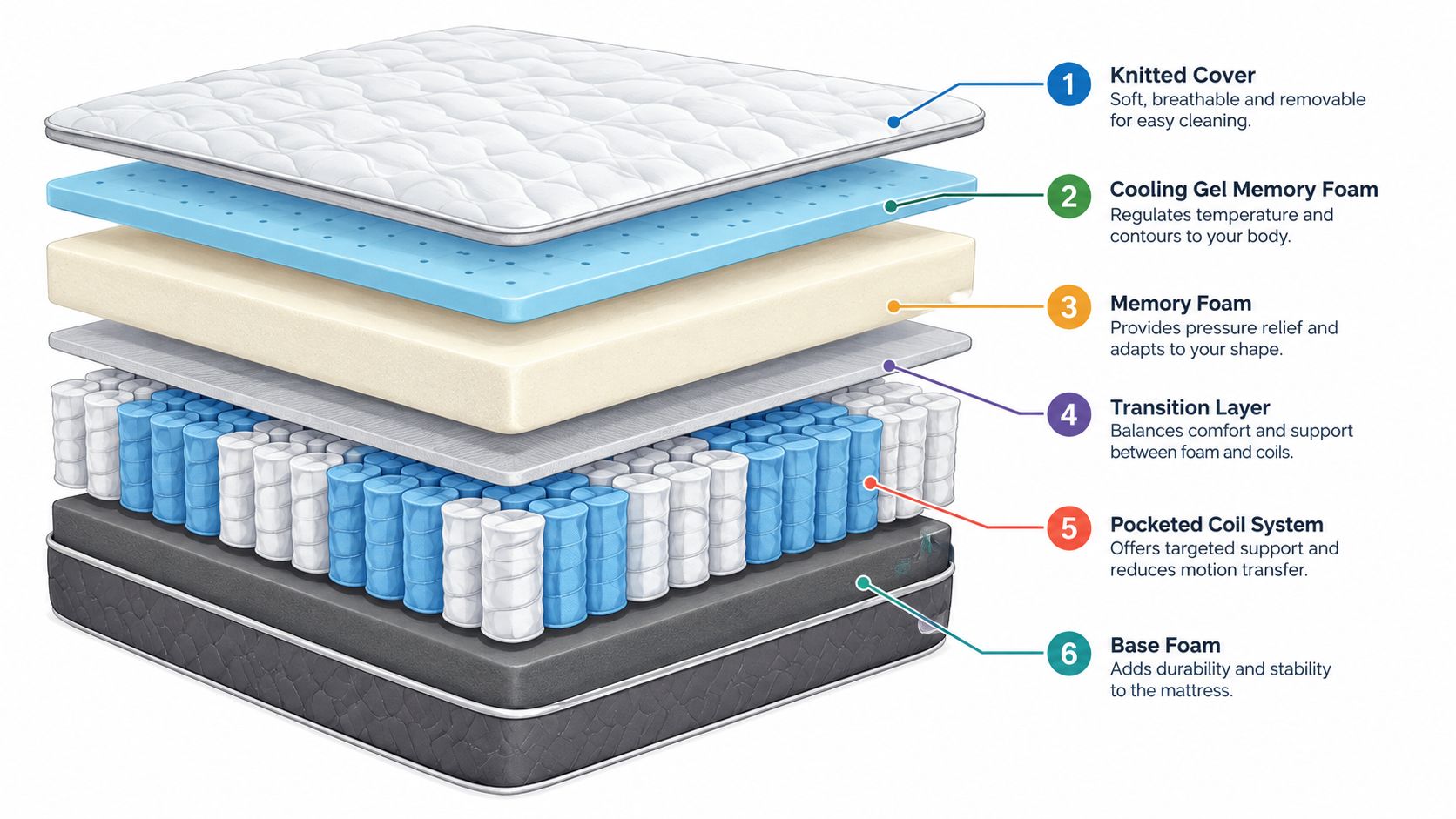
How a Memory Foam Hybrid Mattress Is Actually Built
A hybrid mattress should be read from the bottom upward. Every layer has a job, and a weakness in one layer can change how the entire bed feels.
Start with the support core
The coil unit supplies the main structural response. Pocketed coils move independently, so pressure under a shoulder or hip can be localized instead of moving the entire surface. That usually provides more targeted support and less disturbance than older connected-coil designs.
Ask about coil gauge, coil count, perimeter reinforcement, and edge construction. A shopper who sits on the mattress to dress or uses the full sleeping surface needs more than a strong center. Edge support should feel stable without creating a hard strip along the outside.
The history of the foam itself is distinctive. Memory foam originated in 1966 through a NASA contract at Ames Research Center, where engineer Charles Yost developed open-cell viscoelastic polyurethane. The material later entered the public domain during the 1970s and 1980s, and the first consumer memory-foam mattress reached the U.S. market in 1992, according to the history of mattress materials and recycling.
Check the transition and comfort layers
A transition layer sits between the coils and the softer comfort foam. Its purpose is to distribute pressure, prevent the sleeper from feeling the coil unit, and control how far the hips and shoulders settle.
Memory foam supplies the familiar pressure-conforming feel. It responds to heat and pressure, allowing broader areas of the body to contact the mattress instead of concentrating force at the shoulder or hip. The thickness matters. More foam can increase contouring, but it can also increase sink, heat retention, and difficulty turning.
Density and firmness aren't the same measurement. Foam density describes mass per unit volume, while indentation force deflection, or IFD, measures the force needed to compress foam by a specified amount. ASTM D3574 treats IFD, compression set, resilience, airflow, and fatigue as separate properties, so a density number alone can't establish durability, cooling, support, or firmness. The testing distinction is explained in this guide to foam density and mattress construction.
Finish with the cover
The cover is part of the performance system. A breathable fabric can help heat and moisture move away from the surface, while dense quilting or a low-breathability protector can blunt the benefit of an open coil core.
A useful showroom checklist includes:
- Foam details: Ask for the density and thickness of each major foam layer.
- Coil details: Ask about coil gauge, count, pocketing, and perimeter support.
- Transition support: Ask how the middle layer limits pelvic sink and protects against coil feel.
- Cover performance: Ask which protectors and sheets preserve breathability.
- Fatigue testing: Ask which method was used on the model being sold.
That vocabulary works across Tempur-Pedic, Sealy, Stearns & Foster, and Sherwood models. Shoppers comparing construction can also review the differences in pocket-coil mattresses before visiting the floor.
Hybrid vs All-Foam and Traditional Innerspring
No mattress type wins every category. The best choice depends on whether the priority is contouring, airflow, movement, edge stability, or price.
| Factor | Memory Foam Hybrid | All-Foam | Traditional Innerspring |
|---|---|---|---|
| Pressure relief | Strong contouring with coil support underneath | Deep contouring and close body conformity | Usually less cushioning at shoulders and hips |
| Motion transfer | Moderate control with independent coils | Usually the strongest motion isolation | More noticeable movement across the surface |
| Ease of movement | More responsive than all-foam | Can feel slower or deeper | Lively and easy to reposition on |
| Airflow | Coil channels can improve ventilation | Depends heavily on foam and cover design | Open structure often feels airy |
| Edge support | Often strong when reinforced | Can compress more at the perimeter | Usually stable, depending on construction |
| Best fit | Sleepers wanting contouring plus lift | Sleepers prioritizing pressure relief and motion control | Shoppers prioritizing bounce and a lower-cost feel |
What the temperature testing tells shoppers
A hybrid often sleeps cooler than an all-foam bed, but “often” isn't a guarantee. In controlled testing, two all-foam memory mattresses increased surface temperature by 8.1°F and 9.8°F over 15 minutes, while tested hybrids rose by 6.3°F and 7.3°F. One hybrid cooled at roughly twice the rate of a tested foam mattress after the tester got up, as reported in controlled mattress thermal testing.
Those results describe a test condition, not an entire night in a Ruidoso bedroom. Thick foam, a protector, winter bedding, body weight, and room temperature still influence the outcome.
Match the construction to the household
A guest cabin with difficult access may benefit from a mattress that balances manageable surface comfort with a stable edge. A primary bedroom with different temperature preferences may need moderate foam thickness and a breathable cover rather than an aggressive cooling label. A vacation rental needs a construction that remains usable for guests with different body types and sleeping positions.
The decision rule is straightforward:
- Choose a memory foam hybrid for contouring, coil airflow, responsive support, and stronger edge stability.
- Choose all-foam when deep pressure relief and maximum motion isolation matter most.
- Choose a traditional innerspring when bounce and budget matter more than close contouring.
The local comparison between these constructions is also outlined in innerspring versus hybrid mattresses.
Finding the Firmness That Fits Your Body
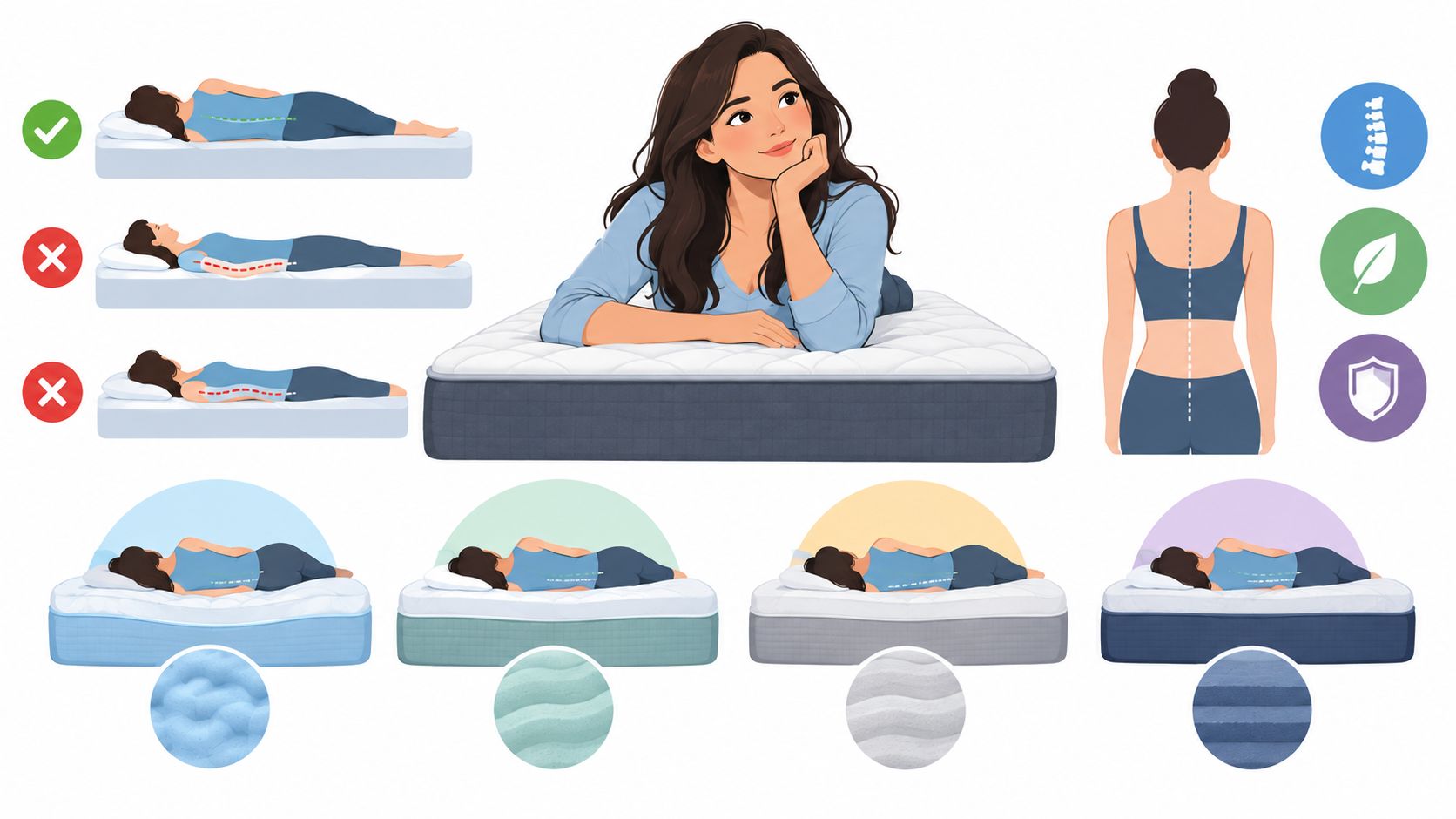
Medium-firm is a starting point, not a verdict. A mattress that feels balanced to one sleeper can let another sleeper's pelvis sink too far or press sharply against the shoulders.
A systematic review found that medium-firm mattresses generally improved comfort, sleep quality, and spinal alignment across different ages, heights, weights, and body-mass indexes. The same review found that heavier sleepers tended to align better on firmer surfaces, while lighter and shorter sleepers often suited softer surfaces, as detailed in the systematic review of mattress firmness.
Read body position, not showroom labels
A heavier back or stomach sleeper usually needs enough coil resistance and transition support to keep the pelvis from dropping below the torso. A lighter side sleeper often needs more surface give so the shoulder and hip can settle without pressure. Taller sleepers may need a different balance again because body proportions change where pressure lands.
A mattress can be labeled medium-firm while producing very different results across these body types. The comfort foam controls surface pressure, while the coils limit deeper sag. Both must suit the sleeper.
Use a real showroom test
A quick sit isn't a mattress test. The body needs time to settle into the comfort layers, especially when comparing slow-response foam with a more responsive hybrid.
- Lie in the primary sleep position. Stay on the bed for at least five minutes rather than judging the first impression.
- Ask for a side view. A partner or Sleep Pro can check whether the spine looks reasonably neutral.
- Check shoulder and hip pressure. Side sleepers should notice cushioning without sharp contact or numbness.
- Turn naturally. If repositioning requires a full push from the elbows, the comfort layer may be too deep or soft.
- Test the edge. Sit and lie near the perimeter to assess stability.
Tempur-Pedic, Sealy, Stearns & Foster, and Sherwood each offer different feels across their collections, so brand recognition should never replace testing the specific model. The Comfort Promise matters here because fear of choosing the wrong firmness is reasonable. The practical guidance in how to choose mattress firmness helps shoppers turn a broad label into a personal fit decision.
Cooling Performance in Dry Mountain Air
A memory foam hybrid doesn't sleep cool because it contains coils. Cooling depends on the path heat takes from the sleeper, through the cover and foam, and into the air around the mattress.
Viscoelastic foam contours closely around the body. That contact can reduce convective heat loss, especially when the comfort layers are thick and dense. Pocketed coils can create open channels beneath the foam, but those channels help only when the transition layers, cover, foundation, and bedding don't block the movement.
Ignore the ingredient shortcut
Gel, copper, graphite, and phase-change materials can influence the initial feel, but none should be treated as proof of all-night cooling. Phase-change materials absorb heat temporarily. They don't eliminate heat, and a surface that feels cool for several minutes may still feel warm later.
Controlled research on polyurethane foam found that ventilation and phase-change materials can improve heat dissipation, with the strongest results when thermal storage works alongside airflow. The construction matters more than the label attached to one ingredient.
For Ruidoso sleepers, dry mountain air can feel naturally refreshing, but the sleep system still includes:
- The cover: Breathable fabric helps preserve surface comfort.
- The foam profile: Moderate memory-foam thickness usually creates less heat buildup than excessive contouring.
- The transition layer: Ventilation should not be blocked by a dense solid slab.
- The coil core: Open space below the foam can support air movement.
- The bedding: Flannel sheets, thick quilts, and protectors can change the final result.
Test the complete sleep setup
A cooling test should include the sleeper's normal position and, when possible, the protector and sheets used at home. A surface that feels cool on the first contact isn't enough. The better question is whether the mattress remains temperature-neutral after the body has settled into the foam.
The most useful showroom questions are:
- Does the cover breathe?
- How thick are the memory-foam comfort layers?
- Is the transition layer ventilated?
- Does the coil unit leave meaningful open space?
- Which protector is recommended?
- Will the mattress feel different under winter bedding?
More practical guidance on separating real airflow from cooling language appears in memory foam mattress cooling.
Who a Memory Foam Hybrid Is Best For
A hybrid works best for sleepers who want foam's pressure relief without giving up the lift and movement of coils. The match becomes clearer when the shopper starts with the daily problem rather than the product category.
The active mountain couple
A couple who hikes, skis, or spends long days outdoors may need cushioning for tired joints and enough responsiveness to change position easily. Pocketed coils can reduce the locked-in sensation of deep foam, while separate coil movement and memory foam help limit disturbance between partners.
The showroom test should focus on shoulder and hip relief in side sleeping, pelvic support in back sleeping, and whether one partner can turn without shaking the other side. A medium or moderately supportive hybrid is a sensible starting point, but body weight and proportions still decide the final fit.
The Alto cabin owner
A cabin or vacation rental in Alto needs a more forgiving choice because guests won't share one body type or sleep position. A balanced comfort layer, dependable edge support, and a breathable cover matter more than an extreme plush or firm feel.
The owner should test the mattress from several positions and ask how the support system handles different loads. Sealy, Sherwood, Stearns & Foster, and Tempur-Pedic models can provide starting points for comparing contouring, responsiveness, and surface feel without relying on online descriptions alone.
The value-focused homeowner
A local homeowner replacing an old innerspring may want a noticeable comfort improvement without moving straight to the highest price tier. This shopper should compare hybrid support with traditional spring bounce, verify the foam construction, and ask what the warranty covers if comfort layers develop impressions.
The Low Price Promise helps address the concern about paying more than necessary. Flexible financing can also make a properly fitted mattress easier to consider without choosing solely by the lowest ticket price.
The right value is the mattress that continues to support the sleeper, not the mattress with the smallest number on the tag.
Local service changes the calculation. Comfort Promise protection, Full-Service Delivery with Professional Setup, and service across Ruidoso and Lincoln County can matter as much as the initial feel, especially when a mattress must reach a cabin or be installed in a difficult bedroom.
What to Ask and Test at the Showroom
A productive visit to Mattress Pro on Sudderth Drive should feel like a sleep consultation, not a rushed sales interaction. The same testing sequence works across Tempur-Pedic, Sealy, Stearns & Foster, and Sherwood models.
Follow five practical steps
- Wear comfortable clothing. Bulky layers can distort the feel of the comfort foam.
- Lie down properly. Spend at least five minutes in the primary sleep position.
- Check alignment. Ask a partner or Sleep Pro to view the spine from the side.
- Test the edge. Sit, lie near the perimeter, and notice whether support remains stable.
- Recreate home conditions. Ask about the recommended protector, sheets, foundation, and bedding.
A Sleep Pro should also ask about the sleeper's weight range, height, sleep position, pain points, current mattress, and ease of movement. Those details produce a more useful match than a generic soft, medium, or firm recommendation.
Ask before signing
The following questions expose the construction and the purchase terms:
- Foam construction: What are the density and thickness of each major layer?
- Coil construction: What are the coil gauge, count, and support zones?
- Perimeter support: How is the edge reinforced?
- Durability testing: Which fatigue method applies to the model being sold?
- Warranty: What body-impression threshold applies, and what does the warranty exclude?
- Comfort Promise: What happens if the firmness feels wrong after the adjustment period?
- Delivery: Does Full-Service Delivery include professional setup and removal options?
Consumer-health reporting lists typical service lives of roughly 6 to 7 years for all-foam mattresses and 6.5 to 7.5 years for hybrids. The steel-coil base can add durability, while foam comfort layers may develop permanent impressions before the support core fails, as explained in this mattress replacement guide.
Local delivery across Ruidoso and Lincoln County is part of the buying experience, not an afterthought. A proper setup protects the mattress and removes the guesswork from getting the new sleep system ready.
Your Next Step Toward a Better Night's Sleep
A strong mattress decision comes down to a short checklist:
- Confirm that the hybrid suits the sleeper's body type and sleep position.
- Prioritize a breathable cover, moderate foam depth, and an open coil core.
- Spend real time on each candidate instead of judging the first few seconds.
- Ask about warranty terms, the Comfort Promise, and Full-Service Delivery.
- Use the Low Price Promise to compare value without sacrificing fit.
The Comfort Promise addresses the fear of choosing the wrong bed. The Low Price Promise addresses the fear of overpaying.
Mattress Pro by Miller Waldrop offers Sleep Pro consultations, Tempur-Pedic, Sealy, Stearns & Foster, and Sherwood mattresses, plus Full-Service Delivery with Professional Setup for Ruidoso and Lincoln County. Visit Mattress Pro by Miller Waldrop at 2801 Sudderth Drive, Suite F, in Ruidoso, browse online, or stop by Monday through Saturday to test a memory foam hybrid mattress built for better mountain sleep.