

Memory Foam Mattress Cooling: A Practical Guide

You know the drill. It's late in Ruidoso, the house has finally gone quiet, and the only thing louder than the ceiling fan is the feeling that the mattress is holding yesterday's heat. You flip the pillow, kick off the blanket, and wonder why a bed that felt perfect in the showroom is turning into a sauna by 2 a.m. That's not a personal failing. It's usually the mattress system, the room, and the base working against you.
Why Memory Foam Runs Hot in the First Place
A memory foam bed can feel great for pressure relief and still sleep warm. The reason is the material itself. Memory foam has a dense, viscoelastic structure that limits airflow and keeps body warmth close to the surface, so heat does not move away as quickly as it does in more open materials. That is why so many sleepers describe the category as warm rather than neutral. Independent guidance also points to the same complaint showing up often, with one source saying over 60% of memory-foam users report sleeping hot and another putting the main-issue share at about 31%. Source data on common heat complaints and test temperatures
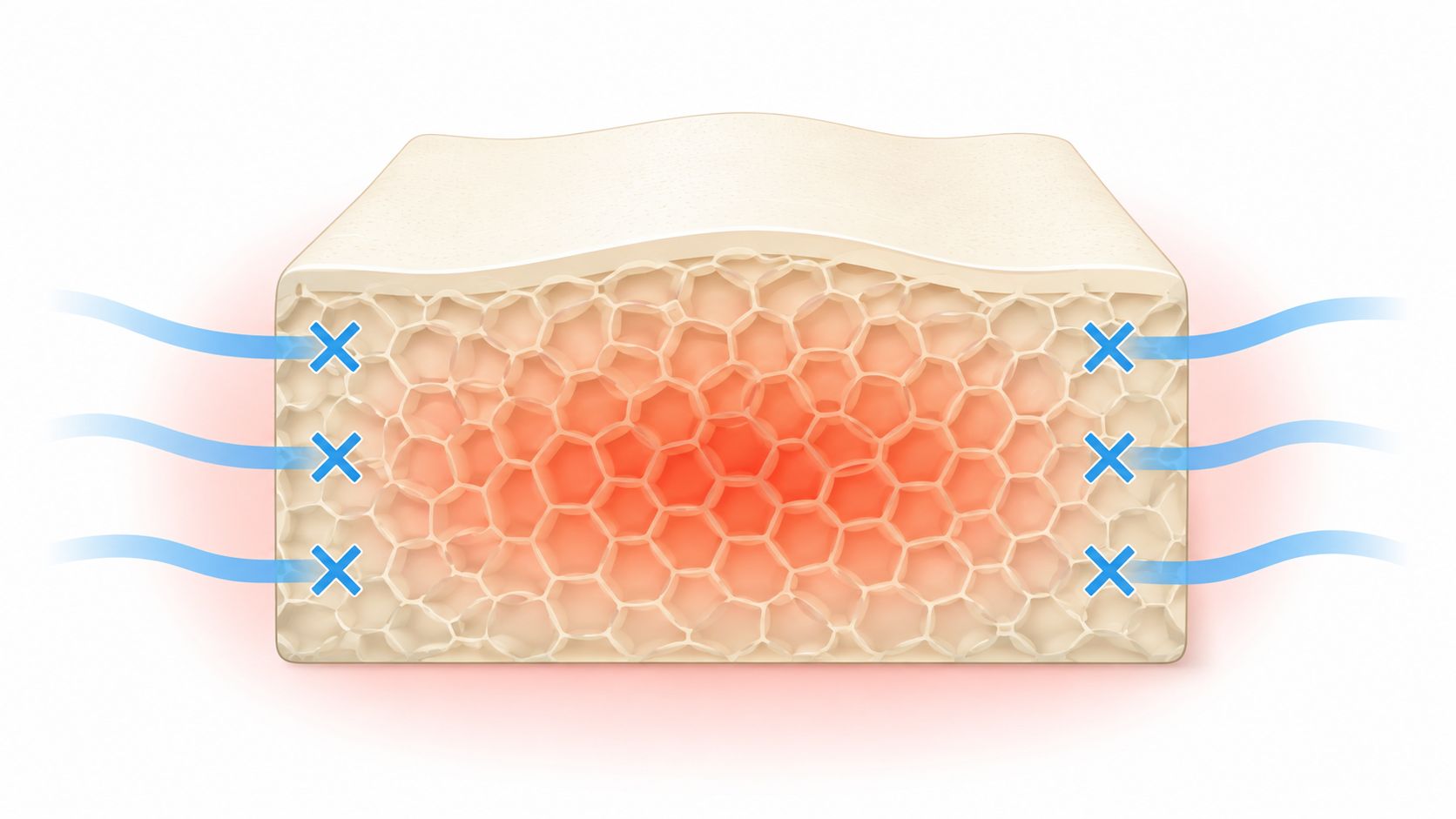
Picture memory foam as a cooler wrapped around your body
Memory foam slows heat movement instead of letting warmth escape. That is useful for pressure relief, but it is a poor setup for overnight cooling.
Practical rule: If the foam hugs every inch of the body, it is usually also holding onto body heat.
Surface testing backs that up. Standard memory foam has been measured 3–7°F warmer at the surface than cooler-leaning alternatives, which is one reason cooling features became such a big part of the category. Measured surface difference in testing
Why Ruidoso sleepers notice it differently
Ruidoso's high-desert climate changes the equation. Cool evenings can make a bed feel fine at bedtime, then the room shifts overnight, especially in summer or when a woodstove or heater warms a closed bedroom. A mattress that feels comfortable for the first hour can still turn sticky by dawn.
A smart buyer stops blaming the foam and starts looking at the whole system. The mattress surface, the foundation, the sheets, and the room all affect temperature, and each one can either help heat escape or trap it longer. For a plain explanation of what memory foam is doing in the first place, see our guide to memory foam construction and heat retention.
The Cooling Technologies Worth Knowing
What changes the temperature
Most cooling claims fit into four buckets, and they do not work the same way. Gel infusions, open-cell foam, copper or graphite particles, and phase-change material, or PCM each try to move heat away from the sleeper in a different way. Some only change how the surface feels for a short stretch, while others have a better chance of affecting the whole night.
Open-cell foam is the most straightforward. By creating interconnected cells, it gives air more room to move, which helps heat escape instead of settling in the foam. Traditional viscoelastic foam has low airflow and low thermal conductivity, so once heat gets into the bed it tends to stay there unless the design gives it a better exit path. Why airflow and thermal transfer limit cooling
The short list, ranked by real-world impact
| Technology | How it works | Sustained cooling | Price premium |
|---|---|---|---|
| Open-cell foam | Adds pathways for air circulation | Better than basic foam | Moderate |
| Copper or graphite particles | Conducts heat away from the body | Can help, but depends on the full build | Moderate to higher |
| PCM | Absorbs heat as it changes phase near body-adjacent temperatures | Good early, often fades later | Moderate |
| Gel infusion | Draws heat into gel material | Usually modest | Low to moderate |
Gel sounds impressive, but the testing story is thin. The Sleep Foundation reports gel memory foam typically lands only “fair” to “good” on temperature neutrality and says gel is probably not a feature shoppers need to chase because it offers minimal, if any, cooling benefit over traditional memory foam. Gel foam testing verdict
PCM is more interesting. It absorbs heat as it shifts from solid to liquid at a microscopic level, which can help early in the night, but the effect is often short-lived rather than constant. That makes PCM useful, just not magical. PCM cooling behavior
What to pay for
For a shopper reading a spec sheet, the order of importance is clear. Airflow beats a buzzword, and heat transfer beats a cool-sounding label. If a memory foam mattress adds open-cell structure or a breathable build, that matters more than a bare gel claim.
For a closer look at how these features are supposed to work in a mattress, our guide to temperature-regulating mattresses is the right place to start.
Bedroom Setup That Changes the Temperature
The room does more than the foam
A cooling mattress cannot fix a hot room. That is the hard truth shoppers miss, and it explains why a new bed can still leave you waking up sweaty. Bedding, ventilation, and the base under the mattress often do more than a thin cooling layer on top.
Start with the sheets. Cotton percale, Tencel, and linen move heat and moisture better than heat-trapping synthetics, especially for warm sleepers. Keep the room closer to a cool sleeping range, because the mattress has less heat to fight all night.
Plain truth: A slatted base and breathable sheets usually do more than a flashy cooling label.
What helps, what hurts
A few setup choices help the bed breathe, and a few make a memory foam mattress feel hotter fast.
- Cotton percale sheets: Light, crisp, and better at letting air move.
- Tencel or linen bedding: Better for moisture control and a drier feel.
- Thick polyester layers: More likely to trap warmth and reduce airflow.
- Ceiling fan or cracked window: Useful on a cool Ruidoso night, especially when the room has been closed up.
- Solid, non-breathable foundation: Can choke off airflow under a memory foam mattress.
That foundation issue matters more than people think. A solid box spring or tight platform can block airflow under the bed, and memory foam already struggles to shed heat. Put it on a slatted or ventilated base, and the mattress gets a real chance to dump heat instead of storing it.
The local reality in Lincoln County
In Ruidoso and Alto, weather swings can make bedtime deceptive. A room can feel crisp at 10 p.m. and stuffy by 3 a.m., especially in a cabin or a home with uneven airflow. That is why a bed that feels cool when you first lie down can still sleep warm through the night.
I would start with the room, then the base, then the bedding. If the mattress still feels too warm, compare setup changes with the build of the bed itself, and use our guide to temperature-regulating mattress features as a reference point.
For shoppers comparing what a topper can do before replacing the whole bed, this memory foam mattress topper guide helps frame the decision.
Toppers, Covers, and Bases for a Cooler Bed
Start with the easiest upgrade
If the mattress itself is staying put, the quickest fix is usually the layer on top or underneath. A latex topper tends to sleep cooler and feel bouncier than extra foam, while a PCM-infused topper can help early in the night if the bed surface heats up fast. Moisture-wicking protectors also matter, because sweat that stays on the surface makes any bed feel warmer.
What to try first
- Swap the protector first. A moisture-wicking protector can reduce that clammy, sticky feeling without changing the mattress.
- Check the topper material. Latex is the safer cooling move. Thick memory foam toppers can make the whole bed warmer.
- Fix the base. A slatted foundation or ventilated platform helps air move under the bed.
- Use lightweight bedding. Heavy quilts can overwhelm any cooling layer.
- Watch cabin setups. In a mountain rental or second home, temperature swings make quick-fix pads less reliable than airflow improvements.
A cooling mattress pad can help if the bed already breathes well, but on a fully memory foam surface it can sometimes backfire by trapping more heat above an already warm core. That's why the whole build matters more than one add-on.
For shoppers considering a topper instead of a full replacement, this memory foam topper page can help frame the decision.
What I'd do in a real bedroom
If the budget is tight, the order is clear. Fix the base, change the protector, and only then consider a topper. A topper should improve comfort, not hide a bad airflow problem.
If the room still runs hot after that, the bed is probably the wrong category, not just the wrong layer.
When a Hybrid Beats Cooling Memory Foam
Some sleepers should stop forcing foam to do a coil job
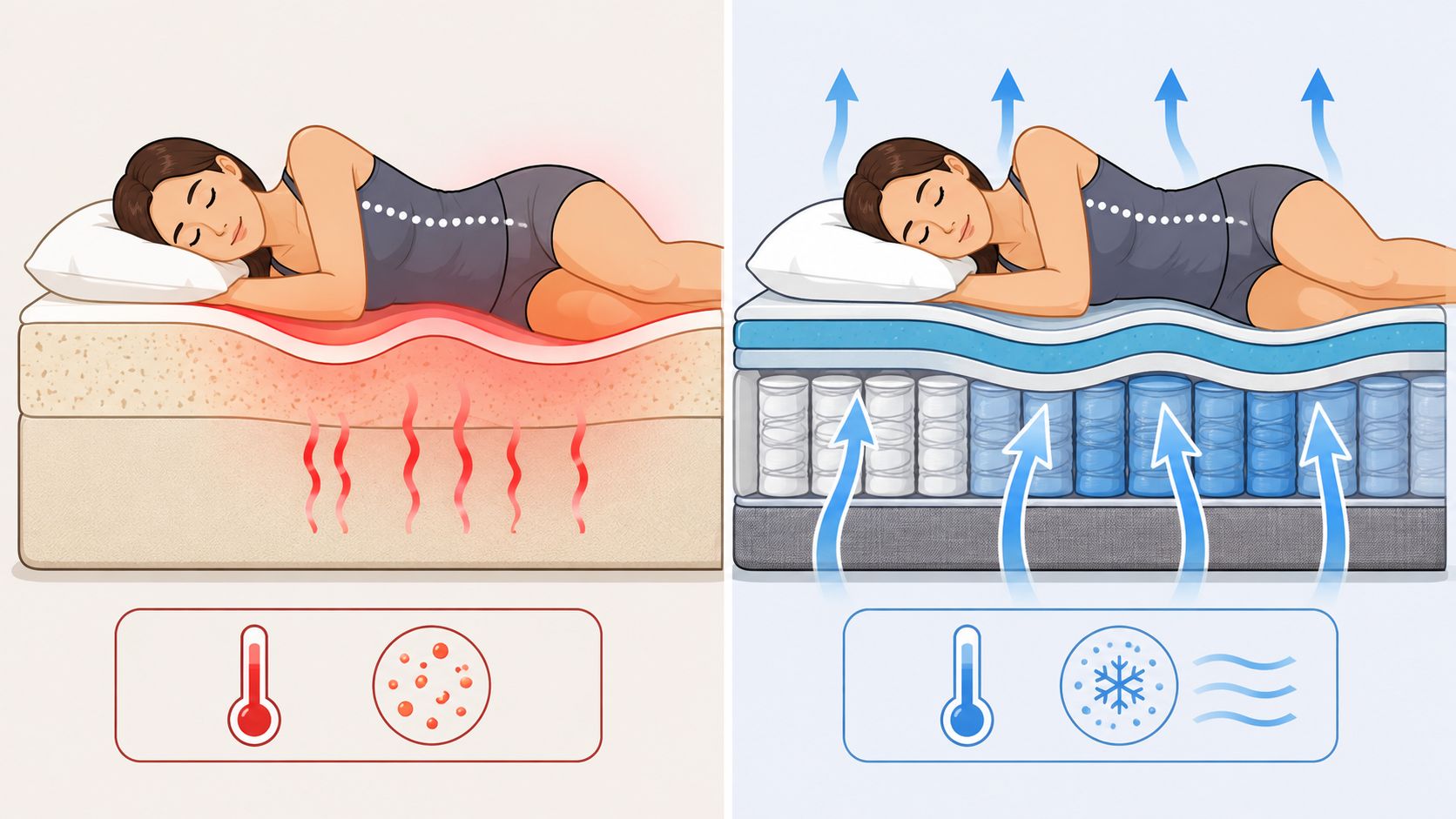
For couples, heavier sleepers, and people who sleep hot every night, a hybrid usually makes more sense than a fancier all-foam build. Coils create airflow, improve edge support, and keep the body more on top of the mattress instead of sinking into a heat-holding cradle. Foam still handles pressure relief, but the spring unit does the cooling heavy lifting.
That tradeoff is why hybrids have become the practical answer for many shoppers. The emerging direction in mattress buying is system-level cooling, not one miracle ingredient. Mattress, foundation, bedding, and room control all matter together. Why hybrids tend to sleep cooler
Who still benefits from all-foam
- Strict side sleepers: More contouring can ease shoulder and hip pressure.
- Pressure-sensitive sleepers: Memory foam's conforming feel can be the right call.
- Light sleepers: Foam can reduce motion transfer better than springier builds.
That said, hot side sleepers often need a hybrid with a softer foam comfort layer, not a dense all-foam bed that cooks them by sunrise. The right answer depends on whether pressure relief or temperature control is the bigger problem.
Research on bedding interventions adds one more caution. A review in PubMed found that different bedding strategies showed no differences in sleep onset latency, sleep efficiency, sleep stage proportions, wake after sleep onset, or total sleep time, even though some setups did lower core body temperature. Review of bedding interventions In plain English, a bed can feel cooler without automatically making sleep better.
The honest recommendation
If the sleeper is hot, shares the bed with someone warmer, or wants better airflow under a heavier body, go hybrid first. If the sleeper is mainly chasing pressure relief and doesn't fight heat, memory foam can still be the right pick.
For a clean comparison of feel and construction, this latex versus memory foam guide helps sharpen the decision.
How a Ruidoso Sleep Pro Matches You to the Right Bed
Start with the sleeper, not the label
A good sleep consult starts with a few direct questions. What's the body type, what position does the sleeper stay in most of the night, does a partner run hot or cool, and is there neck, shoulder, or back pain to account for? Those answers matter more than any single cooling buzzword on a tag.
Here's the way to think about the major brands in the showroom:
- Tempur-Pedic is often chosen for deep pressure relief and a very conforming feel.
- Sealy is a practical fit for balanced support across budgets.
- Stearns & Foster leans into premium craftsmanship and comfort detail.
- Sherwood can make sense for value-focused shoppers who still want a solid sleep surface.
A real Sleep Pro also looks at the whole room setup, not just the mattress feel for five minutes in a showroom. That's where local experience matters. People in Ruidoso, Sudderth Drive, Alto, and Lincoln County live with dry mountain air, temperature swings, and homes that don't all sleep the same.
Comfort Promise thinking: The fear of picking the wrong bed drops when there's a local path to work it out.
That's the point of the Comfort Promise. It turns mattress buying from a gamble into a guided choice, which is exactly what hot sleepers need when they're already worried about making the wrong call.
For a one-on-one mattress consult, this sleep consultation page is the right place to begin.
Bringing It All Together for Cooler Sleep in the Mountains
Memory foam cooling is not one problem, it's a whole system. The foam chemistry matters, but so does the foundation, the sheets, the room temperature, and whether the sleeper really belongs on foam at all. In Ruidoso, that matters even more because dry nights, summer humidity spikes, and winter heating all change how a bed feels by morning.
The three most effective moves are simple. First, choose a mattress structure that matches the sleeper, not the marketing. Second, make the room and base breathe. Third, use a local consult so the choice fits the body and the climate.
Mattress Pro by Miller Waldrop has spent generations serving Ruidoso families with the Low Price Promise, the Comfort Promise, and Full-Service Delivery with Professional Setup. That local help is hard to replace when you want a bed that sleeps cool, not just one that looks cool online.
Ready to transform your sleep? Visit our Sleep Pros at the Mattress Pro showroom located at 2801 Sudderth Drive, Suite F, in Ruidoso. From luxury brands to budget-friendly solutions, we're here to help you wake up loving your mornings. Browse our collection online or stop by Monday through Saturday at Mattress Pro by Miller Waldrop.