

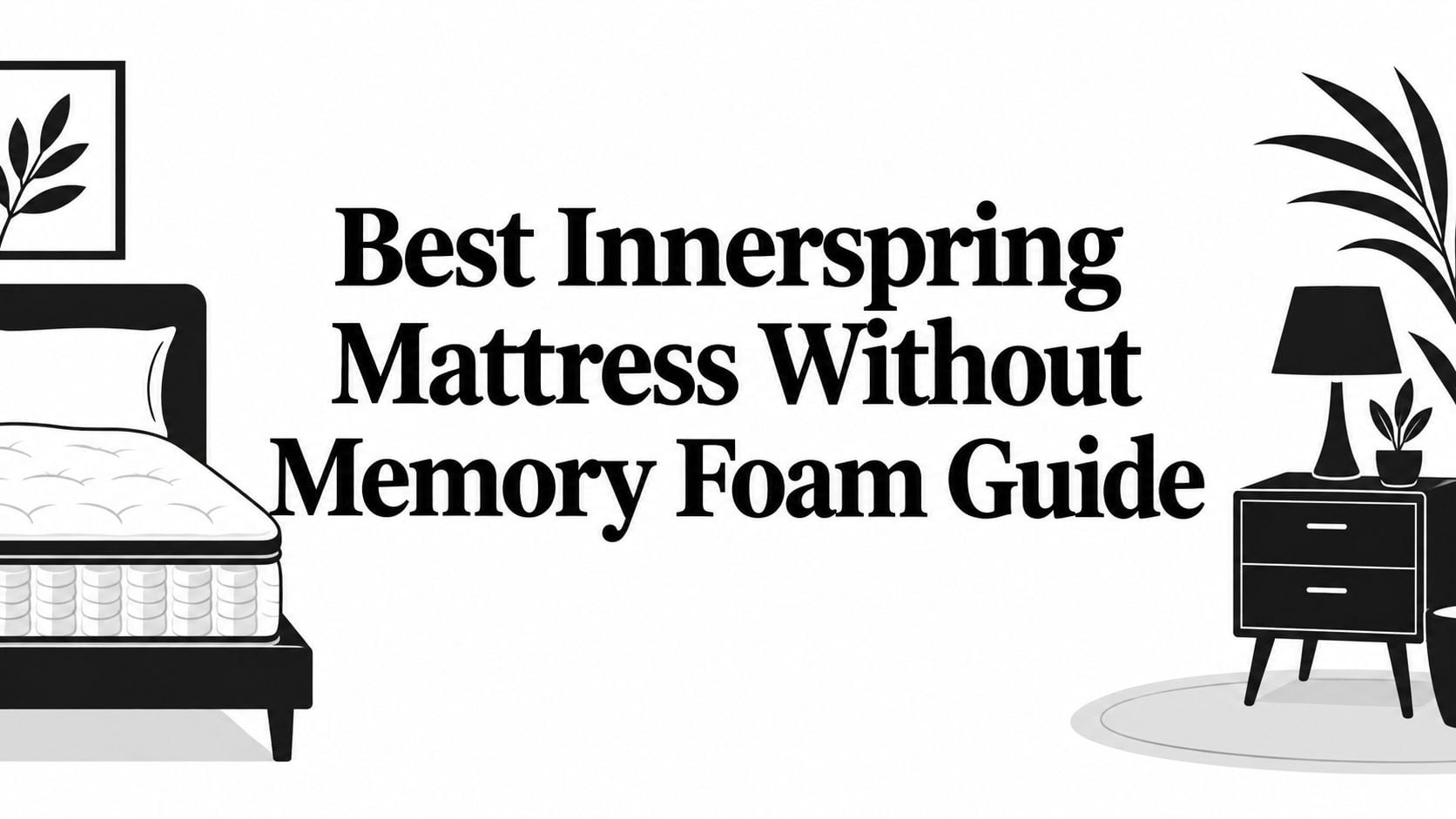
Best Innerspring Mattress Without Memory Foam Guide

A shopper in Ruidoso can spend an evening comparing mattress ads and still feel stuck. One model promises a deep memory-foam hug, another promotes cooling foam, and a third uses “hybrid” language without clearly explaining what sits above the coils. Meanwhile, the problem remains unchanged: the current bed sleeps hot, feels difficult to move on, or leaves the shoulders and hips sore by morning.
The best innerspring mattress without memory foam isn't the one with the biggest coil number or the firmest showroom feel. It's the mattress whose steel support unit, comfort materials, firmness, and edge construction match the sleeper. The guide below gives shoppers in Ruidoso, Alto, and Lincoln County a practical way to compare traditional spring beds without confusing a completely foam-free mattress with one that just replaces memory foam with conventional polyurethane foam.
Why So Many Sleepers Want an Innerspring Without Memory Foam
A shopper may walk into a showroom after weeks of restless nights and describe the same pattern. The mattress feels comfortable at first, but the sleeper gradually sinks into it, overheats under the covers, or struggles to roll over without fighting the surface. Couples often add another complaint: one person moves, and the other person feels too much of it.
That shopper usually isn't rejecting comfort. The shopper is looking for a responsive, breathable, traditional-feeling bed that supports movement instead of holding the body in a slow contour. An innerspring can provide that familiar pushback, but the coils alone don't determine whether the bed feels comfortable.
The phrase “without memory foam” covers two different constructions:
- Foam-free: The mattress uses steel coils with materials such as cotton, wool, latex, or polyester fiber above them.
- Memory-foam-free but not foam-free: The mattress avoids viscoelastic memory foam but still contains conventional polyurethane foam in the quilted cover or upholstery.
That distinction matters for shoppers who want a specific material profile, not merely a different marketing label. A mattress can feel buoyant and cool at first contact while still using foam in the comfort stack.
The traditional feel has a clear appeal
Innerspring mattresses have been a mainstream foundation for more than 150 years, and the category remains substantial. A market estimate places innerspring products at approximately 45% of the U.S. mattress market in 2023, while another estimate reports about 48 million innerspring units among 145 million mattress shipments worldwide in 2024, or roughly 33% of global volume. These are market estimates, not universal official statistics, but they show that spring construction remains relevant rather than outdated.
The appeal is straightforward. Coils can make it easier to change positions, provide a noticeable lift near the edge, and allow air to move through the support cavity. Those qualities can suit active mountain sleepers who want to get in and out of bed without feeling trapped.
The trade-off is equally important. A direct coil feel can expose the shoulders and hips to too much pressure when the upper upholstery is thin or the surface is too firm. That's why a traditional spring bed should be judged as a complete sleep system, not as a coil unit in isolation.
For a deeper construction comparison, the guide to innerspring versus memory foam can help shoppers identify which feel they are seeking.
| What the shopper wants | Construction feature to prioritize | Trade-off to accept |
|---|---|---|
| Fast response and easy movement | Traditional or pocketed steel coils | Less deep contour than memory foam |
| Reduced partner disturbance | Individually pocketed springs | A higher price may accompany more refined construction |
| A cooler-feeling surface | Open coil cavity with breathable upholstery | Thicker cushioning can reduce some airflow |
| Shoulder and hip cushioning | Latex, wool, cotton, fiber, or suitable foam | More upholstery can soften the direct spring feel |
| Strong sitting and sleeping edges | Reinforced perimeter support | Edge reinforcement doesn't replace proper internal support |
The safest buying process starts with a simple question: What replaces the memory foam? Once that answer is clear, the comparison becomes much more honest.
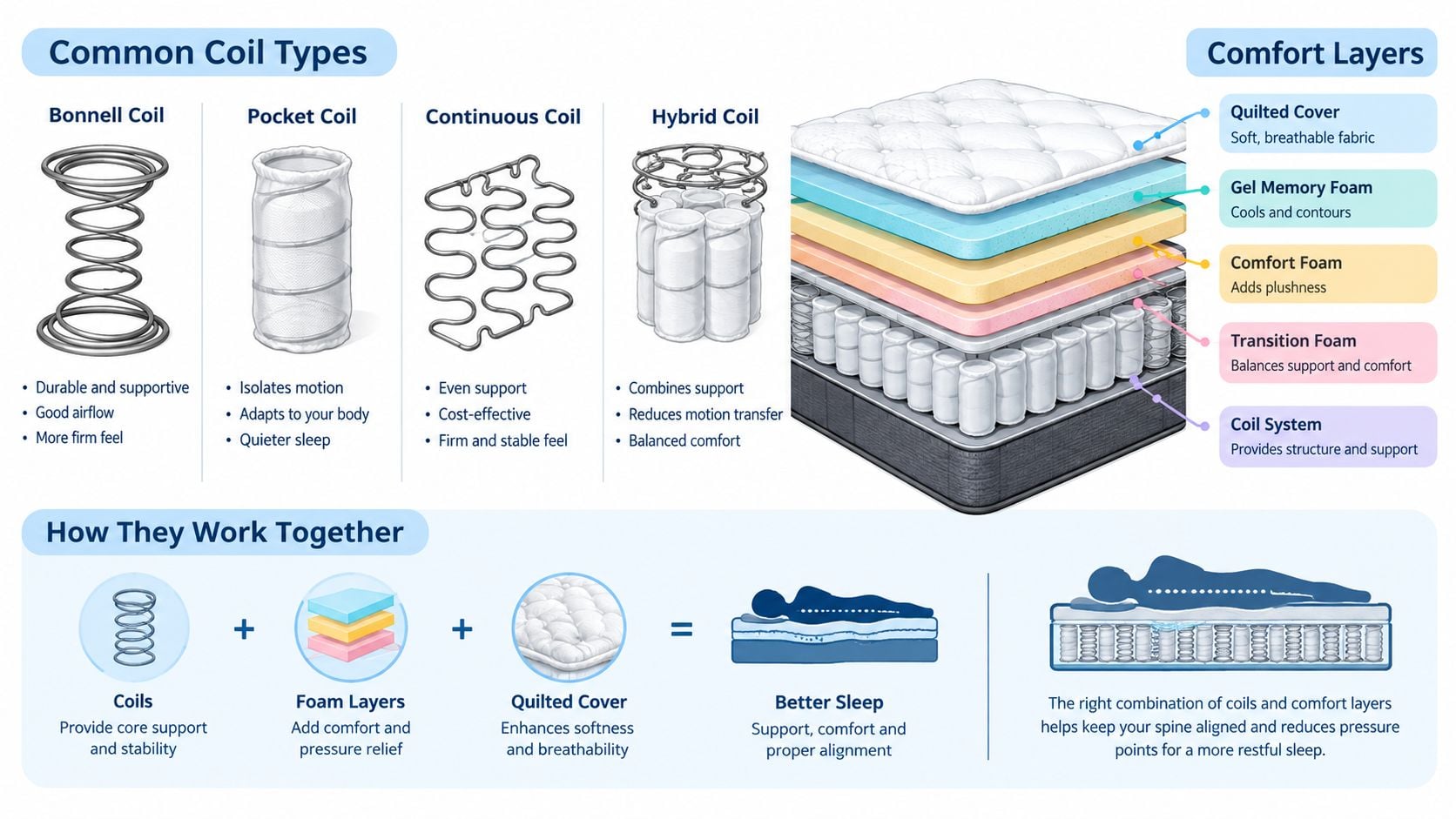
Understanding Coil Types and Comfort Layers
Practical rule: The steel unit supports the body, but the upholstery determines much of what the shoulder and hip feel.
Start with that rule when comparing an innerspring mattress. An innerspring is built around a steel-coil support system, while the comfort layers above it may contain latex, cotton, wool, polyester fiber, polyurethane foam, or other materials. Construction research on steel coils and mattress durability offers useful background on how the support unit functions. (Steel-coil construction and mattress durability research)
| Coil architecture | How it is built | What it usually feels like | Main trade-off |
|---|---|---|---|
| Bonnell coils | Hourglass-shaped springs wired to neighboring coils | Noticeable bounce and a connected, traditional response | Movement travels more easily across the unit |
| Offset coils | Shaped, connected coils that flex under pressure | Supportive response that varies with wire design and upholstery | The label alone does not predict firmness or cushioning |
| Continuous coils | Rows of connected wire rather than separate springs | Stable, responsive support | Partners may feel each other's movement more readily |
| Individually pocketed springs | Each coil sits in its own fabric pocket | More independent compression and improved contouring | The surface still depends heavily on the comfort layers |
For couples who want a traditional spring feel with less disturbance, individually pocketed coils are the strongest starting point. Shoppers who prefer a lively, connected bed may favor Bonnell, offset, or continuous construction. The right choice depends on how much bounce, separation, and surface cushioning you want.
The guide to what an innerspring mattress is provides a plain-language explanation of these support structures.
Comfort materials change the surface
The coil unit supplies the support core. The upper layers decide whether that support feels firm, buoyant, springy, or cushioned. Cotton and polyester fiber create light padding with a quick response. Wool adds upholstery and moisture management without the slow feel associated with memory foam. Latex offers more contouring while staying springier than viscoelastic foam.
A mattress marketed as “without memory foam” may still contain conventional polyurethane foam in its quilting or comfort layers. That does not make it a poor mattress, but it does make the label incomplete. Ask whether you want to avoid memory foam specifically or every type of foam.
A foam-free mattress may rely on latex, wool, cotton, or fiber, while another model may replace memory foam with polyurethane. Read the material list before assuming the two beds are equivalent.
Before buying, ask:
- Coil architecture: Are the springs Bonnell, offset, continuous, or individually pocketed?
- Comfort stack: Which materials sit above the coils, and how thick is each layer?
- Foam disclosure: Does polyurethane foam appear even though memory foam is absent?
- Edge construction: Is the perimeter reinforced with stronger coils, a border rod, or another method?
- Material documentation: Can the retailer identify the cover, adhesives, upholstery, and fire-barrier materials?
In a mountain-climate showroom around Ruidoso, test the actual surface while checking the written material list. Lie on your side, notice shoulder and hip pressure, then compare that feel with the construction details. A transparent specification sheet is more useful than an “advanced comfort” label.
The Truth About Cooling and Pressure Relief
Skipping memory foam doesn't automatically make a mattress cooler, healthier, or more comfortable for a side sleeper. The coil cavity can encourage airflow, but cooling and pressure relief are separate performance variables.
Traditional buying guidance often describes innersprings as breathable because air can move through the open spaces around the coils. That description is directionally useful, but it leaves out the surface. Thin upholstery and a firm sleep surface can create sharp pressure at the shoulder and hip. Thicker latex, wool, cotton, or fiber cushioning can soften those zones, but additional material may reduce some of the airflow advantage.
Why side sleepers need more than open space
A side sleeper places more concentrated weight through the shoulder and hip than a back sleeper. If the comfort layer doesn't allow enough give, the body may feel pushed upward at those contact points rather than supported evenly. The sleeper may then shift repeatedly, wake with soreness, or assume that every foam-free mattress is unsuitable.
The answer isn't automatically a softer bed. A side sleeper can look for individually pocketed coils paired with a pressure-relieving material such as latex, wool, cotton, or fiber. The right combination should allow the shoulder and hip to settle without letting the midsection collapse.
A lighter sleeper may need more surface cushioning than a heavier sleeper on the same firmness label. Body shape, sleep position, and personal sensitivity matter more than a showroom sign that says “firm” or “extra firm.”
A surface that feels supportive to a back sleeper may feel unforgiving to a lighter side sleeper because the shoulder and hip need more room to settle.
Cooling depends on the complete build
Ruidoso's dry mountain air and cooler nights can make a mattress feel different from the same model in a warmer, more humid environment. A breathable coil cavity may help, but the cover, upholstery density, bedding, room temperature, and the sleeper's own heat response also affect the night.
The sensible test is physical rather than promotional. A shopper should lie on the mattress in the usual sleep position, relax the shoulders, and notice whether the hip sinks enough to feel supported without creating a hollow. The shopper should also roll, sit on the edge, and remain still long enough to notice pressure building.
A showroom test can't reproduce every night at home, but it can expose an obvious mismatch. Someone who sleeps on the side shouldn't test only on the back. Someone who changes positions often shouldn't judge the bed from a single static pose.
For practical bedroom changes that support a cooler sleep environment, the local guide to how to sleep cooler at night offers useful context. The mattress still has to provide adequate cushioning. Airflow isn't a substitute for pressure relief.
Durability and Edge Support Without the Marketing Hype
A large coil-count label does not tell you how a mattress will perform after years of use. Durability depends on the support unit, steel treatment, coil construction, perimeter reinforcement, foundation, and the materials placed above the springs. Research on coil count, gauge, and innerspring performance is useful background, but shoppers should judge the complete build rather than one headline specification.
Ask the retailer for the coil gauge and tempering specification in writing. Ask how the coils are joined, whether the center has added support, and whether the perimeter uses dedicated reinforcement. If the retailer cannot provide those details, treat coil count as marketing rather than proof of durability. Gauge can help compare similar models, but it does not determine comfort by itself.
Tempered steel helps springs retain their shape under repeated loading. Coil height and the number of turns affect how each spring compresses and rebounds. Those details matter alongside the upholstery, since a well-built support unit can still feel harsh when the comfort layer is thin, or develop body impressions when the upper materials lack resilience.
Material transparency matters for another reason. A mattress that skips memory foam may still contain polyurethane foam, and that is not the same as a completely foam-free design. Ask for the full material list, including the cover, padding, fiber, latex, and any polyurethane components. A foam-free mattress can provide a more direct spring feel, but side sleepers still need enough cushioning at the shoulder and hip to limit pressure. Removing memory foam does not automatically make a mattress healthier, cooler, or more durable.
Edge support should survive daily use
Perimeter construction affects more than the outer few inches of sleeping space. A stable edge makes sitting down easier, supports getting in and out of bed, and lets couples use more of the surface without rolling toward the middle. Sit on the edge for a moment, then rise slowly. If the border collapses sharply, ask whether the model uses a reinforced rail, stronger perimeter coils, or the same spring unit throughout.
The mattress edge-support guide explains why perimeter construction deserves attention before purchase. Test the edge in the position you use at home, not only by pressing it with a hand. A bed can feel firm in the center and still provide weak support along the border.
Sagging reflects construction and setup
Repeated weight-bearing can fatigue springs and compress upholstery. Over time, that may create visible sagging, reduce center support, and change the pressure response. The foundation also matters. An unsuitable base can leave a sound mattress flexing incorrectly, so confirm the manufacturer's foundation requirements before buying.
Laboratory durability testing provides a useful comparison, although no test guarantees identical results in every home. A Consumer Reports procedure rolls a wood roller weighing more than 300 pounds across a mattress surface 30,000 times, intended to simulate approximately eight to 10 years of typical use.
Before buying, ask:
- Warranty terms: Which defects are covered, and what exclusions apply?
- Edge reinforcement: What supports the perimeter?
- Material wear: What sits above the coils, and how should it respond over time?
- Foundation requirements: Which base preserves proper support?
- Service options: What happens if the mattress arrives damaged or feels unsuitable?
A local showroom in Ruidoso can answer these questions while you test the edge, lie in your usual position, and inspect the material label. That hands-on check reveals more than a coil-count badge.
Matching the Mattress to Your Sleep Position and Body
The right firmness is personal, but the evidence favors a medium-firm surface over an extremely firm or very soft bed for general back comfort. A 25-year orthopedic review associated medium-firm mattresses with better pressure distribution, improved sleep quality, less morning stiffness, and lower low-back-pain intensity. The review also emphasized matching firmness to body shape, age, sex-related body measurements, sleep position, and thermal comfort.
Sleeper Type to Mattress Match
| Sleeper Type | Coil Configuration | Comfort Layer | Firmness Guidance |
|---|---|---|---|
| Side sleeper | Individually pocketed coils with responsive zoning or flexible support | Latex, wool, cotton, or fiber with noticeable shoulder and hip cushioning | Medium or medium-soft, depending on body shape |
| Back sleeper | Pocketed or reinforced coils with stable center support | Moderate latex, fiber, or upholstery that prevents excessive sinking | Medium-firm is the strongest starting point |
| Stomach sleeper | Firm, stable coil unit with reliable center and perimeter support | Thin, resilient upholstery that limits hip sink | Firm, but not so hard that the ribs and pelvis feel pressured |
| Couple | Individually pocketed springs with reinforced edges | Separate cushioning that balances contour and movement | Medium-firm to firm, adjusted for the softer sleeper |
| Heavier sleeper | Thicker-gauge coils, strong perimeter support, and center reinforcement | Dense, resilient upholstery that won't bottom out easily | Medium-firm or firm, tested for pressure relief |
| Active mountain sleeper | Responsive pocketed or reinforced coils for easier movement | Latex, wool, cotton, or fiber to cushion tired shoulders and hips | Medium-firm, unless side sleeping requires more surface give |
A side sleeper shouldn't choose a firm mattress just because it feels stable for a few seconds. The shoulder needs room to settle, while the waist and pelvis still need support.
Back and stomach sleepers usually need more resistance beneath the midsection. That doesn't mean every such sleeper needs the hardest bed available. An overly rigid surface can create its own pressure problem, particularly around the ribs, hips, and shoulders.
Couples should pay close attention to how each person experiences the surface. Individually pocketed coils can reduce motion transfer compared with interconnected coils, but the comfort layer still determines whether one partner feels too much bounce or too little cushioning.
Heavier sleepers should assess edge compression, center support, and the feel of the mattress after sustained pressure. Active sleepers from Ruidoso's hiking, skiing, and riding communities may prefer a responsive surface that cushions tired muscles without creating a deep, restrictive cradle.
The correct test isn't whether a mattress feels impressive for a moment. It's whether the sleeper can maintain a relaxed spine and comfortable pressure distribution in the position used most often.
Shopping Local in Ruidoso and Lincoln County
A mattress can look convincing online and still feel wrong in a bedroom. In-person testing matters even more for shoppers in Ruidoso because dry mountain air, cooler nights, and changing seasonal conditions affect how warmth and breathability are perceived. A mattress that seems pleasantly substantial in a product description may feel too warm or too firm once the sleeper rests on it.
A sustained showroom test on Sudderth Drive gives the shopper information that a bed-in-a-box website can't provide. The sleeper can compare a direct spring feel with a pocketed-coil feel, lie in the normal sleep position, test the edge, and notice whether the shoulders and hips remain comfortable.
Material transparency belongs in the test
“Natural,” “clean,” and “foam-free” can mean different things unless the retailer provides details. A careful shopper should ask about:
- The cover: What fabric and treatment does it use?
- The fire barrier: What material provides flame resistance?
- The adhesive: Are layers bonded, quilted, stitched, or attached through another method?
- The upholstery: Does the mattress use cotton, wool, latex, fiber, polyurethane foam, or a combination?
- Emissions documentation: Which certified material or emissions standards apply to the finished product?
Recent mattress testing detected semivolatile compounds, including phthalates and organophosphate flame retardants, and found that body heat and weight can change emissions. Those findings don't establish that every adult innerspring mattress creates a health hazard, but they do show why a product label alone isn't enough. Full material disclosure and meaningful certifications deserve more weight than vague “natural” language.
Local service reduces buying risk
A local, family-owned mattress business with a 70-year Miller Waldrop legacy can address practical concerns that national websites often leave to the customer. The local model includes one-on-one guidance, in-store comparisons, delivery coordination, and help interpreting the construction details.
The Comfort Promise addresses the fear of choosing the wrong bed. Instead of asking a shopper to make a permanent decision from a short product page, the local Sleep Pros can help identify whether the issue is firmness, pressure relief, motion transfer, or an unsuitable comfort layer.
The Low Price Promise, flexible financing, and Full-Service Delivery with Professional Setup also matter for homeowners and second-home owners. A mattress is not finished when the payment clears. It has to arrive safely, fit through the home, sit on a compatible foundation, and be placed correctly.
Homeowners and vacation-rental operators in Alto and across Lincoln County should also ask about removal and disposal. Mattresses containing steel, foam, fiber, and upholstery generally fall within mattress-recycling definitions, but disposal rules vary by state and locality. Delivery take-back, replacement logistics, and local disposal requirements should be settled before an old mattress is left at the curb.
For local shopping guidance and showroom details, the Ruidoso mattress store resource provides a useful starting point.
Our Recommendations by Sleeper and Budget
The right innerspring mattress depends on the sleeper, the amount of cushioning needed, and the room's purpose. A side sleeper in a primary bedroom needs a different comfort stack from a back sleeper in a guest room or a frequently used vacation rental. The budget should guide the construction you choose, not replace a close look at the materials.
Premium choice for support-focused sleepers
A premium pocketed-coil model with reinforced perimeter support is the strongest direction for shoppers who want a responsive feel, refined construction, and dependable edge stability. Look for tempered pocketed coils, latex or wool upholstery, and documented edge reinforcement. Those details provide support without creating the deep sink associated with memory foam.
This tier suits a primary bedroom and sleepers who prefer to move easily across the surface. Side sleepers still need enough upholstery over the shoulder and hip zones. A thin comfort layer can make a strong coil unit feel harsh, while excessive cushioning may soften the spring response. Test the complete mattress, then ask for a written breakdown of every comfort material.
Mid-range choice for versatile comfort
A mid-range pocketed-coil mattress works well for couples who need a balance of movement control, stability, and surface cushioning. Choose the model only after verifying the coil type and requesting the full foam disclosure sheet. A mattress can skip memory foam while still containing polyurethane foam, so “without memory foam” does not automatically mean foam-free.
That distinction matters for shoppers who want an open, traditional innerspring feel or who are specifically avoiding polyurethane. Compare the shoulder and hip response in the showroom, especially if one partner sleeps on a side and the other prefers a firmer surface. The best mid-range choice offers clear material information and enough cushioning for the lighter-pressure areas of the body.
Luxury contouring for couples
Couples who want stronger pressure relief and reduced partner disturbance can consider a spring-based hybrid-style construction with a more embracing comfort layer. It can provide more contour than a lightly upholstered innerspring while keeping coils in the support foundation.
This tier requires the most careful material check. Confirm whether the upholstery uses latex, polyurethane, fiber, or another material, and decide whether the mattress meets your definition of foam-free. More contour can improve shoulder and hip comfort, but it also reduces the open, buoyant feel that many shoppers want from a traditional innerspring. Side sleepers should spend enough time testing the surface before choosing this direction.
Value direction for guest rooms and rentals
For a guest room, cabin, or vacation rental, a value-oriented innerspring should provide dependable support without an elaborate comfort system. Confirm the coil gauge and foundation requirements in writing. Also check the edge construction, because guests may sit on the mattress edge and the bed may receive frequent use.
A very firm surface can disappoint side sleepers, while thick plush upholstery may respond differently under repeated turnover. Choose a balanced comfort level when the bed will serve people with different sleep positions and body shapes. Material transparency matters here too. Ask whether the mattress is completely foam-free or only excludes memory foam.
The safest way to choose
Use the Comfort Promise to address the risk of choosing the wrong pressure response. Local Sleep Pros can help compare firmness, support, body position, pressure points, and the difference between foam-free construction and polyurethane-containing comfort layers. That conversation is most useful after you have tested the mattress and reviewed its material disclosure.
Visit Mattress Pro by Miller Waldrop at 2801 Sudderth Drive, Suite F, in Ruidoso, to compare innerspring builds, comfort layers, edge support, and firmness in person. The showroom setting also lets you judge how materials feel in the mountain climate rather than relying on a product description alone. Browse the collection at Mattress Pro by Miller Waldrop, or stop by Monday through Saturday for guidance on a mattress suited to the room and the people sleeping on it.