

King vs California King Mattress: Which Fits Your Room

You've got a tape measure in one hand, a paint swatch in the other, and two browser tabs open that contradict each other. One says a California king is the bigger bed. The other says it isn't. The bedroom is taped off on the floor, the delivery window is three weeks out, and nobody has told you the thing that settles this: both beds hold almost the same amount of sleeping space.
The king vs California king mattress decision is a shape decision, not a size contest. You're moving four inches from one axis to the other and living with the consequences for the next decade. Get the shape wrong and you'll walk sideways past the footboard every morning. Get it right and you'll stop thinking about the bed at all, which is the entire point.
The measurements come first. Then the room around them. Then the mattress itself.
King and California King Dimensions Side by Side
A standard king measures 76 inches wide by 80 inches long. A California king measures 72 inches wide by 84 inches long. The Sleep Foundation reported those figures in its king size bed dimensions guide in 2023, and the trade is visible in a single glance. One bed hands you four more inches of width. The other hands you four more inches of length.
| Measurement | King | California King | What It Means |
|---|---|---|---|
| Width | 76 inches | 72 inches | King gives 4 extra inches side to side |
| Length | 80 inches | 84 inches | California King gives 4 extra inches of length |
| Sleep surface | 6,080 sq in | 6,048 sq in | Only 32 sq in apart, about 0.5 percent |
That last row settles most arguments. Forbes reported in 2024 that a standard king offers 6,080 square inches of surface against 6,048 square inches for a California king, a gap of 32 square inches (Forbes comparison of California king and king mattresses). Thirty-two square inches is roughly the cover of a paperback. Nobody has ever felt it with their shoulders.
So the question isn't which bed is bigger. They're the same size in every way your back can detect. The question is where you want the surplus, at your elbows or at your feet.
One caution before a number wins you over. These are mattress-only measurements. A headboard, footboard, side rails and a thick protector all add inches, and so does the overhang of a duvet. Mattress Pro by Miller Waldrop stocks both sizes across a lineup that runs from Twin to Split King, so the exact spec for the model you like is confirmed before you commit.
Write this down before reading any further: the usable width and usable length your bedroom can accept, measured in inches, with the door closed and the dresser where it actually sits.
Everything below gets easier once you have those two figures on paper.
Which Size Suits Your Sleepers
A couple shares the bed, a dog claims the middle, and one sleeper stretches out flat. That household's needs are easier to understand when you look at who sleeps in the bed, how they sleep, and where the mattress's extra inches would help. The standard king is wider, while the California king is longer, so each shape suits a different sleep profile.
The names also carry a bit of history. The conventional king took hold in the U.S. market during the 1950s. The California king emerged as a distinct format in California during the 1960s and reached broader mass production in the 1970s, amid demand for longer beds in larger homes, as Cowboy State Daily's look at how bed sizes evolved describes. You may also hear Western king for the California size and Eastern king for the standard one. Those labels refer to geography, not quality.
Five sleeping arrangements and the size that fits
- A sleeper around 6 feet 6 inches. Someone who lies flat on their back or stomach may find the California king's added length helpful, with more room between their head and the headboard and their feet and the footboard. A side sleeper who bends their knees may fit comfortably in either size.
- Two adults who want elbow room. The standard king's added width gives each person roughly two extra inches at the shoulder. That small difference can matter when both sleepers prefer to keep some space between them.
- A couple plus a toddler or a dog who migrates at 2 a.m. The standard king provides more side-to-side room and a wider buffer down the middle, which can help when another sleeper joins the bed.
- A solo sleeper who rolls. The standard king's width gives a restless sleeper more space to move before reaching an edge.
- A cabin or vacation rental host. Guest needs vary, so consider who is most likely to share the bed and how they sleep. A couple may value room to spread out, while a particularly tall guest may appreciate extra length.
A 2025 BedTimes report found that among consumers who bought a mattress during the previous year, 39 percent chose a king and 16 percent chose a California king (BedTimes on 2025 mattress buying). Those figures show that both sizes have a place in the market, though a popular choice cannot tell you which one suits your household.
For couples, dimensions are only part of the decision. Different firmness or comfort preferences can affect how well two people sleep on the same mattress, so compare mattresses built for couples with different preferences alongside the size options. A clear picture of your usual sleepers and their habits makes the measurements more useful.
Matching the Size to Your Bedroom and Clearance
A bed can fit on paper and still block a closet, crowd a dresser, or leave too little room to walk. The difference often comes from the whole installed sleep system: mattress, frame, headboard, furniture, and the paths people use every day. A California king's extra length can occupy space that doors and circulation need, while a standard king's extra width affects side-to-side clearance.
The diagram shows both mattress footprints with walking space included. Treat it as a starting point, then account for the furniture and doorways in your room.
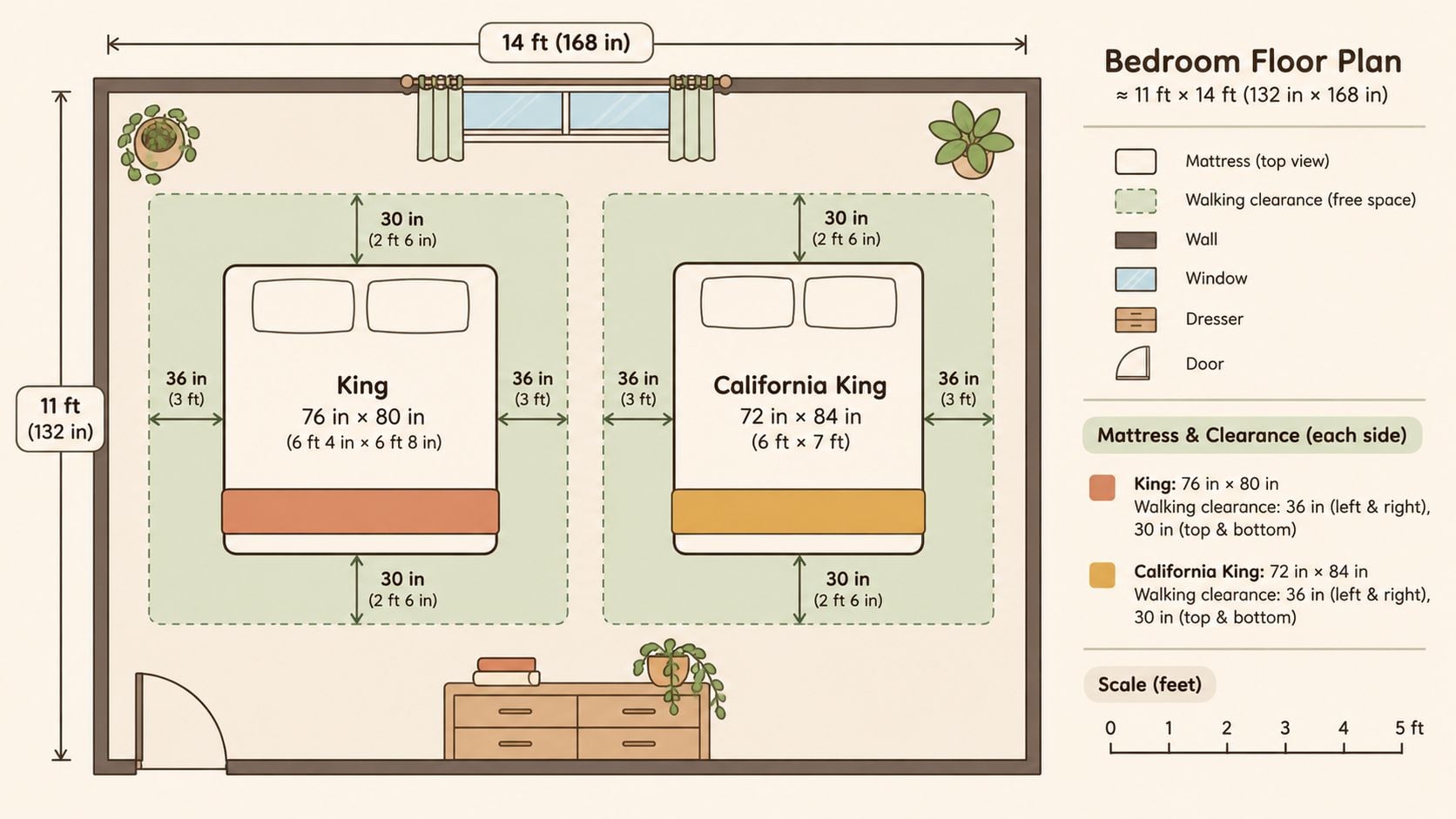
Planning guidance commonly places both king sizes in a room of about 11 by 14 feet. That estimate describes a simple rectangle, not a room already filled with nightstands, dressers, and doors that swing open, as NCOA mattress size guidance explains. The usable floor plan is what matters.
| Bedroom Situation | Usually Better Fit | Why | Clearance to Check |
|---|---|---|---|
| Long, narrow bedroom | California king | Extra length uses the room's depth | Door swing and closet access |
| Wide room with a dresser on one side | King | Extra width affects side-to-side movement | Nightstand and dresser placement |
| Sloped ceiling or compact cabin | Measure first | Frame and headboard add footprint | Full installed footprint |
| Standard bedroom with walk-around space | Either size | Both need open space around the bed | About 24 inches around the bed |
| Wheelchair or walker user | Either size, with clearance | Accessibility needs open floor space | About 36 inches on three sides |
A measurement worksheet for the room you have
- Floor dimensions. Measure wall to wall at the widest point and again at the narrowest. Cabins in Alto and the surrounding hills may have irregular layouts.
- Door swings and closet doors. Open each door and trace its arc on the floor with painter's tape.
- Nightstands and dressers. Measure them in their intended positions, not as they appear on a floor-plan sketch.
- Frame and headboard footprint. Add the depth of the rails and posts to the mattress dimensions.
- The delivery route. Check hallway width, stair turns, the landing, and the front door.
Clearance is part of the measurement, not an afterthought. About 24 inches of walking room beside the bed is a workable planning baseline for many bedrooms, according to this room-planning guidance for king and California king beds. For wheelchair or walker access, plan for about 36 inches on three sides. Measure the route into the house as carefully as the room itself; a mattress and frame need to reach their final position. Mattress Pro offers pick up or full-service delivery with professional assembly, so the room and access route can be considered when arranging the setup.
Cabins and short-term rentals call for the same careful measurements, with guest use in mind. These cabin bed ideas for making small mountain bedrooms work harder can help you consider how the bed and other furnishings share the available floor space.
How Mattress Type Shapes Comfort in Either Size
Dimensions decide how much floor space a bed occupies. Construction decides how the inside of that space feels at 3 a.m., and it's the half of the decision most shoppers skip entirely.
The comparison below shows how two common builds handle a body lying on them.
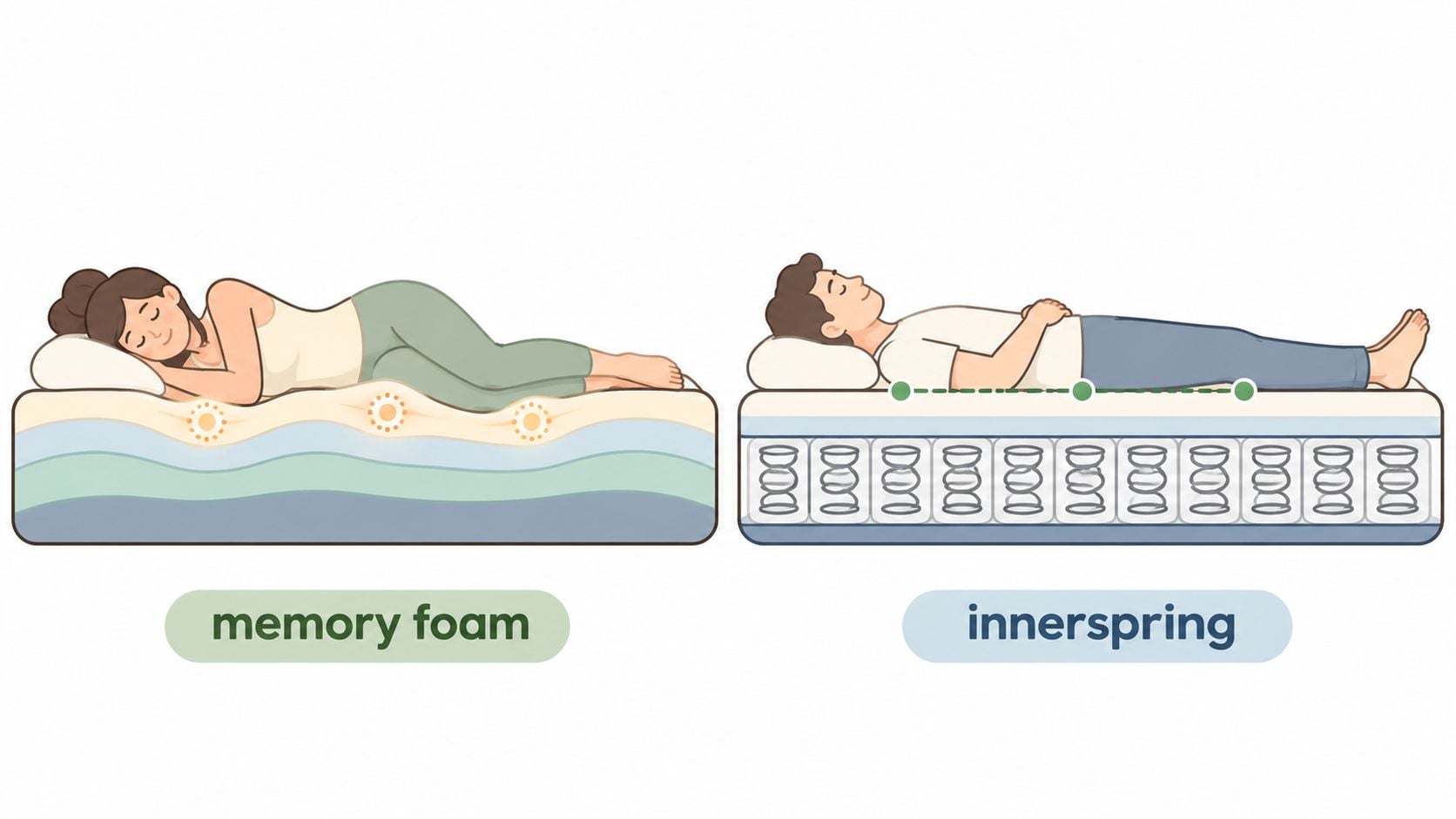
- Memory foam. The cells compress where weight concentrates and push back everywhere else. Under a shoulder, hip or knee, that spreads the load across a wider patch of surface, which is why side sleepers describe the first minute as sinking rather than lying down. The test is whether ear, shoulder and hip form a straight line.
- Hybrid. A coil core carries the weight while foam layers handle contact. Coils give the perimeter something to push against, so the edges stay firm instead of sloping toward the floor. In a shared king, that edge support is what lets two people use the full width rather than drifting to the middle.
- Latex. Quick to spring back and firmer at the surface. Sleepers who change position several times a night often prefer it because they don't have to climb out of a rut.
- Cooling gel. A layer engineered to pull heat away from the surface. It helps, and it doesn't substitute for airflow through a warm room.
Heat deserves its own note in this climate. Ruidoso sits high and dry, with cool nights and thin air, so a sleeper who overheats at sea level often runs cooler here. A gel layer is a small assist on top of the mattress, not the whole answer. Breathable bedding and a cooler bedroom do more of the work.
The build matters more than the size label for comfort, which is why memory foam, hybrid and innerspring mattresses are worth comparing in one afternoon rather than across separate browser tabs. The showroom carries memory foam, hybrid and latex builds from Sealy, Tempur-Pedic, Stearns & Foster and Sherwood, so the same body can test several constructions without starting over.
Practical rule: settle the feel first, then confirm the size gives that feel room to work. A plush mattress wedged against a wall loses the edge support you paid for.
A king in the wrong build is an expensive way to learn that firmness matters more than four inches. A California king in the right build disappears under you, which is what a bed is supposed to do.
Bedding, Frames and Foundations That Must Match
A king fitted sheet will not fit a California king mattress, and a California king fitted sheet will not fit a king. Buy every piece by its size label rather than guessing from a photograph.
Everything surrounding the mattress is cut to that label: sheets, protectors, foundations, adjustable bases, rails. Manufacturers also vary a little, so the same nominal size can run about 1 to 2 inches different depending on who built it, as the Sleep Foundation's mattress shopping guidance points out. Measure the actual mattress or read the product spec before ordering anything that has to fit around it.
The order that prevents the most returns
- Confirm the size against your room measurements. Use the width and length from the clearance worksheet, not the number printed on your old bed's receipt.
- Confirm the foundation or adjustable base is built for that exact size. A split foundation lines up with a split king. It will not line up with a California king.
- Order the fitted sheet and protector with the same size label as the mattress, in the same transaction if possible.
- Check the headboard and footboard footprint against the room, including how far the posts project past the mattress edge.
An undersized or flexing foundation is one of the most common causes of a mattress that sags early, so it's worth reading a mattress support system guide before pairing anything new with an old base.
Full-Service Delivery with Professional Setup from Mattress Pro by Miller Waldrop handles the piece that's often underestimated. Standard delivery and white glove delivery are both available, and the setup team positions the mattress for optimal comfort, adjusted to the customer's preferences once it's in the room.
The fear underneath these questions is simple: picking wrong. A correctly sized set removes most of that risk before the wrap comes off, and the Comfort Promise is the backstop for the part measuring can't predict, which is how the mattress feels after a week of real sleep.
What Each Size Costs and Where Value Comes From
Price depends more on construction and brand than on size. When comparing the same construction in king and California king, the price difference can also reflect whether the brand makes that model in both sizes, rather than the four inches of length redistributed between them.
King and California king mattresses in the research cited by U.S. News 360 Reviews on California king vs king ranged from about $250 to nearly $8,000. That broad span is a reminder to compare the mattress type and brand, not just the size label. Memory foam, hybrid and latex mattresses use different materials, while brands such as Sealy, Tempur-Pedic, Stearns & Foster and Sherwood offer distinct choices.
The mattress price is only one part of the total.
Before comparing quotes, include the other pieces of the sleep system:
- Frame or adjustable base. Check that it matches the mattress size, and include its cost in the comparison.
- Sheets and protector. Moving up from a queen may mean buying bedding in a different size.
- Delivery and setup. Include these options when calculating the full purchase cost.
Mattress Pro by Miller Waldrop carries mattresses from Sealy, Tempur-Pedic, Stearns & Foster and Sherwood, with options across a range of price points. It will match the prices of its local competitors. For a starting point on cost, browse mattresses under $1,500 and compare the mattress, base, bedding and delivery together. A lower mattress price may not mean a lower total if the other parts of the setup differ.
Choose Your Size Before You Shop
A mattress can fit the bedroom on paper and still make the whole room awkward. Measure the usable floor area with the frame and nightstands in place, then check the walking space around them and the route from the truck to the bedroom, including stair turns.
The two beds in one line: the same mattress, turned ninety degrees and four inches redistributed. The room decides which direction that turn belongs in.
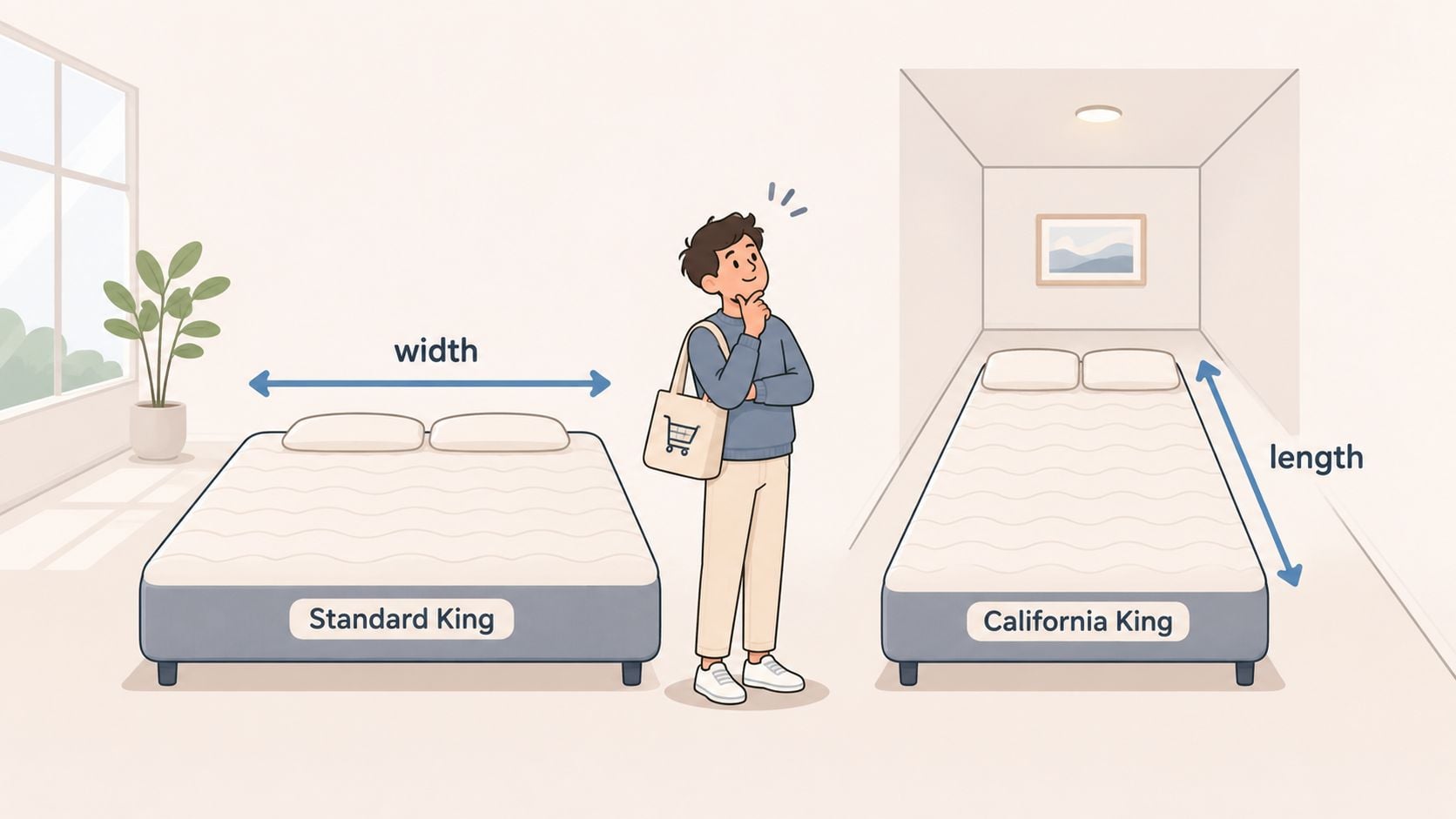
Before you choose, write down three things: who needs the most sleeping space, how much floor area remains after the frame and nightstands are placed, and whether the mattress can make it through the entryway and turns. That gives you a clearer comparison than the mattress dimensions alone.
The deciding factor may be the full setup rather than the sleeper's height. A wider mattress can change the space beside the bed, while a longer one can affect the walkway at its foot. If both layouts leave comfortable clearance, compare how each mattress feels and what fits your budget.
Customers can visit the store to test mattresses before buying. If you would like a starting point before you go, answer a few questions in the Mattress Guide to get sleep recommendations.
Mattress Pro by Miller Waldrop offers mattresses in King and California King sizes, along with other options. A sleep pro can help you consider your sleep habits and preferences before selecting a mattress. Bring your room measurements, then test mattresses in person to see how the feel and full setup work for you.
For a final check, stand where the bed will sit and picture the frame, bedding and nightstands together. If the mattress fits through the delivery route and the room still feels usable, you are comparing two workable sleep systems. The better choice is the one that fits both your nights and your floor plan.