


Why Do I Wake Up Tired? Causes and Fixes That Work

The alarm sounds, the bedroom is quiet, and getting out of bed still feels like hard work. After a full night under the covers, heavy eyelids and aching shoulders can make a sleeper wonder whether the mattress, the bedtime routine, or something less obvious is responsible.
That frustration deserves more than an automatic recommendation to buy a new bed. A useful Sleep Pro approach separates temporary morning grogginess, interrupted sleep, and a possible sleep disorder, then considers where mattress comfort fits.
The Most Common Reasons You Wake Up Tired
A sleeper who reserves eight hours for bed but feels drained at the 6:30 alarm is usually dealing with one of several overlapping problems. Morning tiredness commonly comes from too little sleep, fragmented sleep, sleep inertia, sleep apnea, insomnia, circadian misalignment, or an unsupportive mattress. From the pillow these feel identical, yet each calls for a different fix.
Time under the covers includes the minutes spent falling asleep, lying awake, and shifting away from discomfort, so a long night can still leave a person groggy. A long car trip stuck in traffic is similar: hours pass, distance barely accumulates.
Likely causes of waking tired, with the first check for each
| Likely cause | What it feels like | First check |
|---|---|---|
| Too little sleep | Short nights followed by midday tiredness | Log bedtime, estimated sleep onset, and waking |
| Fragmented sleep | Plenty of time in bed without feeling refreshed | Note nighttime waking and ask a partner about movement |
| Sleep inertia | Fog immediately after waking that gradually clears | Check wake-time consistency and snooze use |
| Sleep apnea | Loud snoring, gasping, morning headaches, or reported breathing pauses | Ask a partner to document symptoms and discuss screening with a clinician |
| Insomnia | Recurring trouble falling asleep or staying asleep | Track symptoms and their effect on daytime activities |
| Circadian misalignment | Drowsiness after shift work, travel, or changing bedtimes | Compare workday and nonworkday sleep schedules |
| Unsupportive mattress | Morning aches, stiffness, or a dip in the surface | Inspect the mattress and its foundation for uneven support |
Include the bedroom in the investigation
Ruidoso's dry mountain air belongs in the conversation, alongside medical symptoms. Nasal discomfort, bedding that becomes too warm, and an uneven sleep surface are worth recording separately rather than treating every restless night as the same problem.
The local guide to how altitude can affect sleep offers additional context for mountain residents. A comfortable mattress may address physical discomfort, but it shouldn't become the default explanation for every tired morning. A new bed can fix the last row of that table. It cannot shorten a breathing pause, quiet a racing mind at 2 a.m., or reset a body clock.
Starting point: Track when the tiredness clears, what happens overnight, and whether discomfort accompanies it.
How Much Sleep and Sleep Quality Affect Morning Energy
A sleep log rarely shows one clean block of rest. In bed by nine, asleep closer to eleven, awake for a stretch in the middle of the night, then up with the alarm. The hours are logged. The night arrived in pieces. Two people can report the same night length and wake with opposite levels of energy.
For adults regularly sleeping 7 to 9 hours but still waking tired, continuity, timing, and underlying sleep problems deserve attention alongside duration, according to the adult sleep overview hosted by the National Library of Medicine.
What the national figures reveal
In the CDC's 2024 adult sleep report, 30.5% of U.S. adults reported averaging fewer than 7 hours, while only 54.8% reported waking well-rested; 15.4% had trouble falling asleep and 18.1% had trouble staying asleep. Those measures describe different aspects of sleep, so they shouldn't be subtracted from one another to estimate how many adequately rested sleepers have a disorder.
Someone may allow enough time for sleep yet lose portions of it to wakefulness. Duration answers how much was available. Continuity answers how much was collected, and that second figure is the one shaping your morning.
The American Academy of Sleep Medicine and Sleep Research Society recommend that healthy adults regularly obtain at least 7 hours, while the AASM adult sleep advisory also emphasizes appropriate timing, regularity, and freedom from sleep disorders. A reassuring bedtime alone doesn't settle whether sleep is healthy.
Count sleep opportunity separately from sleep
Repeated awakenings can interrupt normal sleep progression. That doesn't mean every remembered awakening eliminates deep sleep, or that a person who remembers none slept continuously.
A useful bedside record distinguishes:
- Sleep opportunity: When the sleeper went to bed and got up.
- Estimated sleep: How long falling asleep and nighttime wakefulness seemed to take.
- Morning response: Whether alertness returned after getting up or remained poor.
- Physical clues: Whether heat, shoulder pressure, or back discomfort accompanied waking.
The guide to improving sleep quality can help organize those observations. The goal is a clearer account than “the night seemed long enough.”
Breathing and Insomnia Problems That Mimic Tiredness
Loud snoring, gasping, or witnessed breathing pauses call for a medical screening before any mattress shopping. Sleep apnea is an airway problem, and a new bed cannot diagnose or treat it.
When breathing disrupts sleep
With obstructive sleep apnea, the upper airway repeatedly narrows or closes during sleep. Breathing disturbances can trigger brief arousals and oxygen disruption without producing an awakening the sleeper remembers. The morning result can look like ordinary tiredness, even when the sleeper believes the night was long enough.
The California Correctional Health Care Services sleep-apnea guideline describes an apnea-hypopnea index threshold of at least 5 events per hour and cites Wisconsin Sleep Cohort estimates of approximately 9% of women and 24% of men in a middle-aged employee sample. Those figures are sample estimates, not a personal risk calculation, yet they explain why persistent unrefreshing sleep deserves more than a comfort check.
Signals worth reporting include:
- Breathing changes: Habitual loud snoring, gasping, or witnessed pauses.
- Daytime impairment: Unintentional dozing or difficulty remaining alert.
- Associated concerns: Morning headaches or difficult-to-control high blood pressure.
- Risk factors: Obesity can increase concern, but its absence does not rule apnea out.
A clinician can decide whether a validated home sleep-apnea test or laboratory polysomnography is appropriate. Partner observations help, while recordings and consumer sleep estimates do not establish a diagnosis.
When difficulty sleeping becomes persistent
Chronic insomnia means difficulty falling asleep, staying asleep, or obtaining restorative sleep. The National Heart, Lung, and Blood Institute describes it as occurring on at least 3 nights per week for more than 3 months, when another health problem does not fully explain it. An occasional restless night is different, and so is a bed that feels uncomfortable. Persistent insomnia is its own sleep problem.
Do not wait for that threshold if symptoms already interfere with daily life. The mattress-focused guide to insomnia and ways to help can support a more informed conversation without replacing clinical assessment.
Unintended dozing, repeated breathing pauses, and significant daytime impairment warrant prompt medical attention. A more comfortable bed may improve the sleep environment, but it should not delay that appointment.
How Your Mattress and Bedroom Climate Shape Your Mornings
You wake, and before your feet reach the floor you notice your shoulders. Or you remember rolling over five times before dawn. When tiredness arrives with physical clues, such as shoulder tenderness, back stiffness, or repeated repositioning, the bed becomes a fair suspect. Keep the scale honest, though. A mattress can smooth the edges of a fragmented night, and it cannot reopen an airway that keeps closing or reset a body clock that never settles. Sleep inertia, repeated breathing interruptions, and insomnia each follow their own rules.
Mattress types compared for morning comfort
Two ideas anchor the comparison. Pressure relief distributes load instead of concentrating it at the shoulder or hip, the way a wide strap spreads the weight of a heavy bag. Spinal support lets those areas settle without letting the torso sag excessively.
| Mattress type | Pressure relief | Spinal support | Temperature | Best for |
|---|---|---|---|---|
| Memory foam | Contours around hips and shoulders | Helpful when firmness and depth prevent excessive sinking | Dense constructions can retain warmth; cover and foam design matter | Side sleepers with concentrated pressure |
| Hybrid | Foam comfort layers cushion above coils | Coil support can help maintain alignment when appropriately matched | Coil spaces allow airflow, though upper layers still matter | Combination sleepers and those seeking a more responsive surface |
| Gel-infused foam | Similar contouring to other memory foam | Determined by the support core and overall construction | Gel can help manage initial heat; it doesn't guarantee all-night cooling | Sleepers comparing temperature-focused foam designs |
Fit decides more than the category on the label. Body shape, sleep position, layer thickness, and firmness work together. A hybrid's support depends on how its coils are matched to the sleeper above them. A memory foam bed can feel firm or soft depending on its density and depth. Edge reinforcement likewise varies from model to model, so press down on the perimeter if you sleep near the edge or sit there while getting dressed.
Inspect the whole sleep system
Visible dips, persistent body impressions, lumps, and a tilted foundation deserve inspection. Age gives context, and no universal replacement birthday proves a bed has failed.
A simple check includes:
- Surface condition: Remove bedding and look across the mattress for uneven areas.
- Foundation condition: Check for loose components, damaged supports, or an unsuitable base.
- Position-specific comfort: Notice whether shoulder pressure or waist sagging appears in the usual sleeping position.
- Heat sources: Consider the protector, sheets, blankets, and afternoon sun, not just the mattress.
Ruidoso bedrooms may need adaptable bedding as outdoor conditions change. Breathable layers that can be removed are often more practical than assuming the same heavy covering suits every night; the guide to temperature and mattress comfort explains the connection.
Mattress Pro by Miller Waldrop carries Tempur-Pedic, Sealy, Stearns & Foster, and Sherwood, and Sleep Pros help customers compare individual constructions while weighing body type, sleep position, and budget. The Comfort Promise addresses the fear of choosing the wrong bed, with its terms reviewed before purchase.
Test Sleep Inertia and Your Cause in Two Weeks
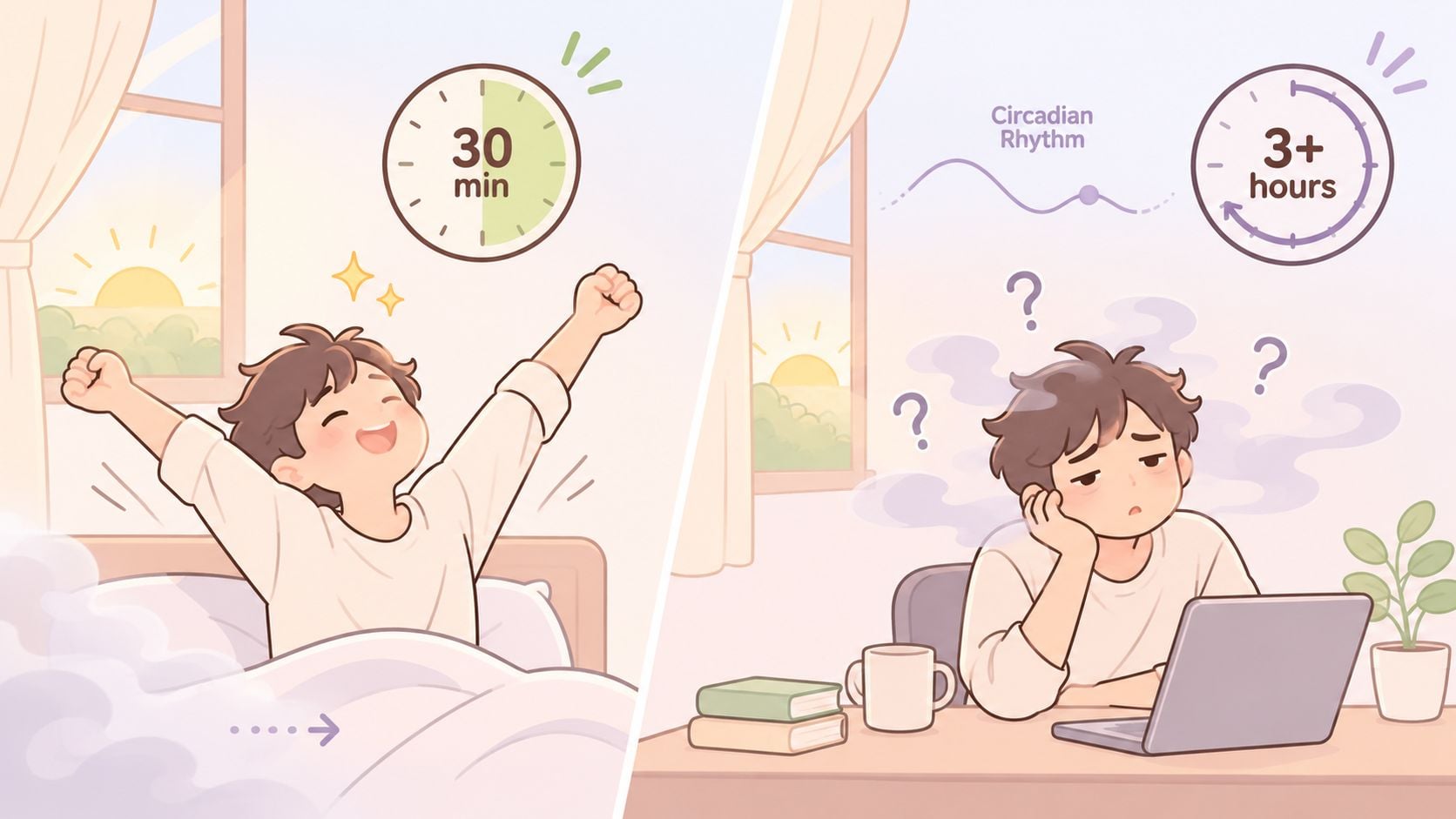
Sleep inertia is the temporary fog after waking, and it is not by itself evidence of a failed night. A laboratory study published through PubMed Central found its strongest effects during the first 30 minutes, with greater impairment after sleep loss or deeper sleep and approximately 3.6 times larger immediate impairment during the biological night than the biological day.
A computer starting up offers a useful analogy: the system is running before every function is fully responsive. Alertness, reaction time, memory, and decision-making may recover at different rates, so being awake doesn't immediately mean being ready for demanding tasks.
Three different problems look identical from the pillow. Inertia clears on its own within that early window. Fragmented sleep leaves you foggy because the night was broken into pieces. An airway problem or ongoing insomnia keeps producing heavy mornings however long you stay in bed. The log below is built to separate them and to show which one a new mattress could plausibly touch.
Build a record without turning bedtime into homework
Treat the two-week observation period as a practical organizing exercise that sorts patterns; it won't diagnose anything or promise improvement. Changing habits gradually makes patterns easier to read than changing everything on the first night.
Record the night and the recovery. Note bedtime, estimated sleep onset, nighttime waking, and final wake time. Use a simple grogginess scale from 1 to 5, with the same meaning each day, and note whether fog clears after getting up or persists into normal activities.
Stabilize the wake time. Choose a realistic daily target and keep it close on nonworkdays too. A narrow personal window, such as about 30 minutes, is an experiment in consistency; bedtime still needs to allow adequate sleep opportunity.
Add morning outdoor light. Plan a brief outdoor routine soon after waking, such as stepping outside with breakfast or taking an easy walk. Ruidoso's mountain sunshine makes this practical on suitable mornings, though looking directly at the sun is neither necessary nor safe.
Replace repeated snoozing with a deliberate start. Set an alarm for the intended waking time and place it where dismissing it requires getting up. Repeated returns to sleep make the final part of the morning harder to interpret, especially when the actual rise time keeps shifting.
Review evening caffeine and alcohol. Move caffeine earlier and keep alcohol away from bedtime, noting each change. Anyone who drinks heavily should get medical guidance before stopping abruptly; the aim is safer observation rather than a risky self-directed withdrawal.
Make the bedroom comfortably cool and the evening less bright. Adjust bedding before assuming colder is always better. Dim room lighting, reduce bright screen exposure, and note whether feeling hot or chilled lines up with a rough morning.
Mark where the morning hurts. In the same log, note which mornings bring the sharpest discomfort and where it lands, such as shoulder pressure or lower-back ache. A photograph of visible wear alongside that note makes a showroom conversation more concrete.
Understand what the pattern can and cannot show
The National Institute of General Medical Sciences explains that circadian rhythms follow an approximately 24-hour cycle, with light and darkness providing the strongest environmental influences. That helps explain why a stable wake routine and morning daylight are reasonable things to test.
A shift worker may need a different light-and-sleep plan from someone working daytime hours. Consistency works best when it bends around real responsibilities.
Safety check: A scheduled pause after waking doesn't make a still-sleepy person safe to drive. Readiness decides whether you drive.
Comparing several mornings may reveal that fog fades after getting moving, that discomfort tracks a particular sleep position, or that rough mornings follow irregular nights. Each pattern points somewhere different: inertia, support, or a broken schedule. None of them proves a diagnosis.
If the log shows no improvement by the end of the observation period, a clinician can use it to guide further questions. Breathing symptoms, dangerous sleepiness, or substantial impairment justify seeking help sooner rather than finishing the exercise first.
Decide Between a New Mattress and a Doctor Visit
A mattress evaluation makes sense when visible wear, poor support, or position-related aches interfere with comfort. A clinician belongs in the decision when breathing symptoms, persistent insomnia, or daytime sleepiness remain unexplained. Some sleepers need both kinds of help.
The tricky part is that three morning problems can look the same from the pillow: sleep inertia that fades after you get moving, fragmented sleep that leaves you groggy, and an airway or insomnia issue that no mattress can reach. The sleep log is the separator. If fog clears after a shower and breakfast, inertia is a likely contributor. If you remember waking repeatedly, or a partner describes snoring, gasping, or pauses in breathing, the mattress is not the first suspect.
Choose the next action from the strongest clue
A sleeper who consistently rolls into a central depression has a concrete support problem to investigate. A sleeper whose partner reports breathing pauses needs medical screening even if the mattress also feels uncomfortable.
Those decisions can sit side by side:
- Prioritize a mattress consultation when discomfort, surface damage, or an unsuitable feel is the clearest issue.
- Prioritize clinical assessment when symptoms suggest a sleep disorder or interfere with safe daytime functioning.
- Pursue both when a worn sleep surface and concerning symptoms occur together.
The discussion of whether a good mattress improves sleep can help set realistic expectations. Better comfort is a worthwhile goal without promising that a purchase will resolve every cause of fatigue.
Make a local consultation useful
A consultation at Mattress Pro by Miller Waldrop begins with sleep habits and preferences before mattress selection. Customers can answer a few questions in the Mattress Guide for recommendations or connect directly with a Sleep Pro.
Bring the sleep log. Note usual position, areas of discomfort, temperature preferences, partner movement, and what has already been tried. Testing a mattress in the normal sleep position offers more information than briefly sitting on its edge.
The Comfort Promise addresses fear of choosing the wrong bed, while the Low Price Promise and full-service white-glove delivery simplify a local purchase. Ask how each promise applies and confirm delivery arrangements before committing.
Backed by a 70-year family legacy, this family-owned Ruidoso business focuses on sleep and serves Ruidoso and Lincoln County from Sudderth Drive. An in-person conversation offers what an online-only purchase cannot: a chance to describe the problem, compare physical comfort, and ask follow-up questions with someone who lives in the same mountain community.
Ready to transform your sleep? Visit our Sleep Pros at the Ruidoso showroom, 2801 Sudderth Drive in Ruidoso. From premium sleep systems to budget-friendly options, we're here to help you wake up loving your mornings. Browse our collection online or stop by.