


Best Bed Frame for Heavy Couples: What to Look For


A couple in Ruidoso can choose a mattress that feels supportive in the showroom, then discover months later that the frame creaks whenever one person turns, the center sags, or the entire bed shifts against the floor. That frustration usually comes from treating a bed frame as a simple platform instead of part of the sleep system.
The best bed frame for heavy couples starts with verified load capacity, rigid center support, tight slat spacing, and correct setup. Mattress weight matters, movement creates dynamic loading, and a frame that looks substantial can still fail where the rails, slats, or center legs carry the stress.
Why the Wrong Frame Fails Heavy Couples
A couple in Alto once described the familiar progression. Their new frame felt solid during the first few nights. Then a faint creak appeared near the middle, followed by more motion whenever one sleeper climbed in or rolled over. Eventually, the mattress began feeling softer in the center, even though the mattress itself hadn't seemed defective.
The problem wasn't necessarily one dramatic break. Small structural compromises add up:
- Flexible slats allow the mattress to dip between support points.
- Wide gaps leave foam and hybrid materials unsupported.
- Weak center legs let a queen or king rail bow toward the floor.
- Loose hardware creates lateral movement and noise.
- Undersized rails struggle with the combined weight of sleepers and mattress.
A generic “sturdy” label doesn't tell a shopper how the frame handles those loads. A frame can feel firm when empty and still deflect once two adults, bedding, and a substantial mattress are in place.
What disrupted sleep looks like
Frame movement affects more than noise. When one partner changes position, the other may feel the vibration through the mattress. A bowed rail can change the way the mattress supports the hips and shoulders, while unsupported foam may develop uneven wear more quickly.
That matters for couples managing back discomfort, shoulder pressure, or different sleeping positions. A supportive Tempur-Pedic, Sealy, Stearns & Foster, or Sherwood mattress still needs a foundation that keeps its intended shape.
A useful explanation of the difference between support systems appears in this guide to box springs and foundations. The key point is simple. The frame, foundation, and mattress must work together rather than being selected as unrelated purchases.
Practical rule: A heavy-duty frame isn't defined by thick-looking metal or a bold product name. It's defined by how its load rating, center support, slats, and legs work together.
Ruidoso homes also experience movement from everyday use that online product photos don't reveal. A frame needs to remain stable when someone sits on the edge, gets into bed after a long day outdoors, or shifts position during the night. For Lincoln County couples, the right purchase begins by identifying those failure patterns before comparing finishes or headboards.
Understanding True Weight Capacity
The listed capacity is only useful when it includes the mattress and leaves room for movement. A couple should calculate the combined load, then choose a frame with meaningful headroom instead of matching the rating to body weight alone.
Independent review coverage notes that an average frame holds about 300 to 400 pounds per side, while heavy-duty frames commonly support 1,000 to 2,000 pounds total, and some models are tested up to 2,500 pounds. Those benchmarks are summarized in this heavy-duty frame guide.
The load equation
The calculation is:
Sleeper one + sleeper two + mattress + bedding = static load
That number still isn't the final target. Sitting on the edge, getting in and out, and repositioning create changing forces that a perfectly still weight test doesn't capture. Guidance for heavy-duty frames recommends leaving roughly 20% to 25% headroom above the combined occupant and mattress load, with the need to count mattress weight explicitly supported by this capacity analysis.
Queen and king mattresses alone can weigh roughly 100 to 150 pounds, depending on construction, as the same guidance explains. A dense memory-foam or hybrid mattress can therefore consume a substantial portion of a frame's headline rating before bedding and sleepers are added.
A 1,000-pound rating is often the floor for shared sleep once body weights and mattress weight are combined. A rating of 1,500 to 2,000 pounds offers a more forgiving margin for nighttime movement, according to the cited heavy-couple capacity guidance.
How to read the label
Before buying, a couple should ask:
- Is the rating for the complete frame or only a component?
- Does it include the mattress?
- Is the capacity stated for the actual size, such as queen or king?
- Does the design include center support legs?
- Does the mattress manufacturer approve that foundation?
A frame rated below the combined load is already disqualified. A frame that barely clears the static calculation may also be a poor choice because the remaining capacity disappears when one sleeper sits near the edge.
The frame rating should be checked alongside the mattress foundation requirements. Couples considering memory foam can review foundation guidance for memory-foam mattresses before committing to a platform or foundation.
Structural Features That Actually Hold Up
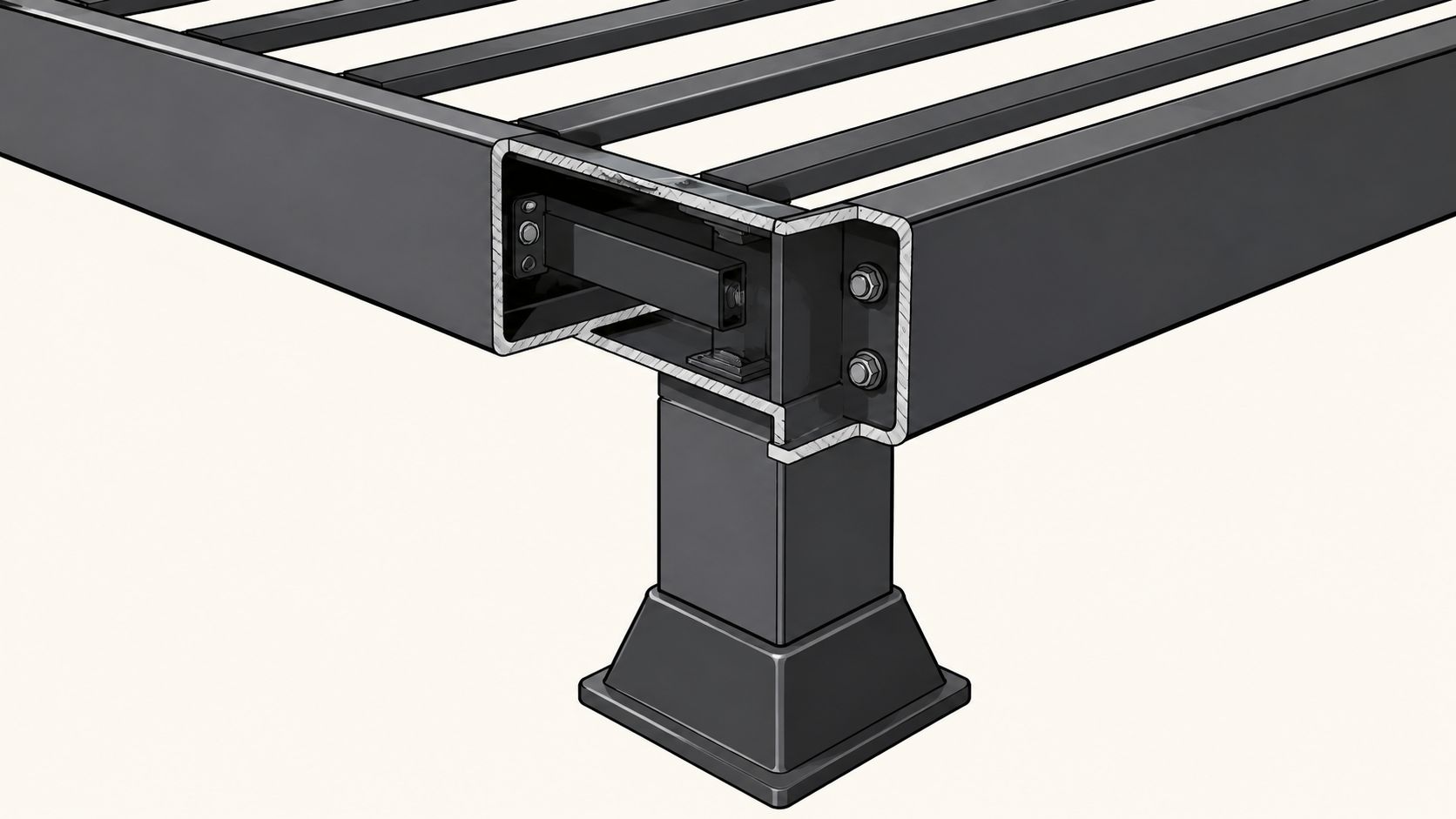
A high capacity number can't compensate for poor geometry. The best bed frame for heavy couples needs a floor-contacting center support system, closely spaced slats, and rails that resist bowing.
Multiple mattress-support sources converge on a practical maximum slat gap of about 3 inches for foam and hybrid mattresses, although some designs allow 3.5 to 4 inches. The tighter standard is the safer choice for heavier couples, especially with all-foam beds, as explained in this slat-spacing and center-support guide.
Inspect the center rail first
Queen-size and larger frames should have a head-to-foot center rail or beam. The support legs must reach the floor and remain firmly planted, because the center rail carries load that would otherwise force the side rails and slats to span too far.
A practical inspection looks like this:
- Queen support: At least one properly placed center leg is a minimum structural checkpoint.
- King support: At least two center legs are commonly recommended.
- Contact: Every center leg should touch the floor without rocking.
- Rail strength: The beam should feel rigid rather than springy when pressed.
- Attachment: The rail should connect securely to the head and foot structures.
Missing center legs create a weak midpoint. Under combined load, that midpoint can deflect, transferring stress into the mattress and causing more movement between partners.
Check the slats
Slats should run the full bed length where the design calls for it, sit securely in their brackets, and remain close enough together to support the mattress surface. Wide spaces are particularly troublesome for memory foam because the material can settle into the gaps instead of maintaining even support.
Many attractive wood frames disappoint. A lower-cost frame may have a substantial outer rail but thin interior slats or inadequate legs. Couples browsing affordable platform beds should inspect the support structure rather than judging quality by finish alone.
Pass or fail: If a listing doesn't clearly state slat spacing, center support, and complete-frame capacity, it hasn't provided enough information for a heavy-couple purchase.
Comparing Frame Types for Heavy Couples
No single frame style suits every couple. The strongest choice depends on mattress construction, desired height, storage needs, and whether powered positioning matters.
Industry guidance treats all-foam and memory-foam mattresses as the least tolerant of flex. It recommends slats no more than 3 inches apart, ideally running the full bed length, with enough legs to prevent rail bowing as outlined in this foundation guidance.
Metal platforms and foundations generally distribute load more effectively than basic wood frames. Typical heavy-duty steel designs can reach 800 to 1,200 pounds, while reinforced models can exceed 3,500 pounds. Many wood platform beds are cited at 400 to 600 pounds, so construction details matter more than appearance.
Frame Type Comparison for Heavy Couples
| Frame Type | Typical Capacity Range | Best Mattress Match | Key Trade-Off |
|---|---|---|---|
| Heavy-duty metal platform | 800 to 1,200 pounds, with reinforced designs exceeding 3,500 pounds | Hybrid, memory foam, and other mattresses needing rigid support | Strong load distribution, but may offer a more utilitarian look |
| Reinforced wood platform | 400 to 600 pounds in many cited designs | Mattresses approved for tight, well-supported slats | Warmer styling, but capacity varies widely by construction |
| Box-spring foundation | Varies by construction and manufacturer | Traditional mattresses and compatible hybrids | Familiar height and feel, but the foundation and outer frame must be evaluated together |
| Adjustable base | Varies by model and manufacturer | Compatible foam and hybrid mattresses | Positioning flexibility, but mechanical components and mattress compatibility require careful checking |
Platform beds
A reinforced metal platform is the clearest starting point for couples prioritizing load distribution and firm support. A rigid wood platform can work well when its slats, center rail, legs, and verified capacity meet the mattress manufacturer's requirements.
Foundations and box springs
A foundation can suit couples who prefer traditional bed height or already own a compatible mattress. The outer frame still needs adequate capacity, and the foundation must not introduce flexible or unsupported spans.
Adjustable bases
An adjustable base can help partners find separate head and leg positions, which may improve comfort for reading, relaxation, or pressure management. The base must be approved for the chosen mattress and rated for the complete combined load. Adjustable technology is useful, but it doesn't excuse weak capacity or poor setup.
Matching Your Mattress and Local Climate
A frame should be selected with the mattress, not before it. Memory foam needs closely spaced, stable support because its pressure-relieving structure depends on an even surface beneath it. If slats flex or gaps are too wide, the foam can dip between support points and create uneven feel.
Hybrid mattresses usually combine foam comfort layers with coil support, but the upper foam still benefits from rigid support below. All-foam Tempur-Pedic models, pressure-relieving Sealy designs, and luxury constructions from Stearns & Foster or Sherwood should be paired with the foundation specifications assigned to that mattress.
Foam, hybrid, and alignment
Memory foam responds to body heat and pressure, allowing it to cushion shoulders and hips while helping maintain a more continuous contact surface. That pressure-point relief works best when the foundation doesn't add an unintended hammock effect.
Hybrids use coils for deeper support and can feel more buoyant, but a heavy couple still needs a frame that controls flex. A stable base helps the mattress preserve spinal alignment instead of allowing the pelvis to settle too far toward the unsupported center.
Ruidoso's dry mountain air
Ruidoso's dry mountain air and changing temperatures make cooling and airflow practical concerns, especially for couples who share body heat. A slatted platform bed can allow air to circulate below the mattress, while breathable covers and cooling gel technology address heat within the comfort layers.
Airflow isn't a substitute for capacity. It helps the complete sleep system manage the local environment more comfortably. Couples comparing materials and cooling features can review temperature-regulating mattress options while checking that the selected base meets the mattress's support requirements.
A good local consultation also accounts for cabin use, seasonal occupancy, bedroom height, and whether a low or high frame fits the room. The right foundation should support the mattress and match how the couple sleeps in Lincoln County.
Assembly, Delivery, and Long-Term Care
A frame can have excellent engineering and still perform poorly if the assembly is rushed. Heavy-duty components place more importance on level rails, secure fasteners, and center legs that contact the floor.
The 25% headroom approach is especially useful because it accounts for real-world use rather than treating the rating as a perfect static limit. Mattress weight must be included, and queen and king mattresses can weigh roughly 100 to 150 pounds, as explained in this practical capacity guide.
Setup checks that matter
- Level the frame: Confirm that the rails don't twist and the bed doesn't rock.
- Secure every fastener: Tighten bolts evenly so the frame doesn't rack to one side.
- Seat the center legs: Adjust them until each leg rests firmly on the floor.
- Verify slat placement: Make sure every slat sits fully in its bracket or ledge.
- Keep instructions: Warranty support may depend on correct foundation use.
Professional setup is valuable for couples who don't want to wrestle with heavy rails or locate a hidden center-support problem after delivery. Full-Service Delivery with Professional Setup also gives the household a chance to confirm that the mattress, foundation, and frame fit together before the delivery team leaves.
A simple maintenance rhythm
Hardware can loosen during the early settling period, so the couple should recheck the fasteners after the first few weeks. The center rail and legs deserve special attention because even a small loss of floor contact can transfer load to the outer rails.
Mattress care should follow the manufacturer's instructions. If rotation is permitted, repositioning the mattress can distribute wear across the support surface. Couples should never force rotation on a mattress that isn't designed for it, and they should check warranty requirements before changing the foundation configuration.
Those basic checks reduce noise, protect alignment, and help the frame deliver the support the mattress was designed to provide. Guidance on professional preparation is available through this white-glove delivery tip.
Why Local Expertise Matters for This Purchase
A heavy-couple sleep system deserves more than a capacity number copied into an online listing. The shopper needs someone to compare the mattress construction, frame geometry, sleeping positions, room layout, and budget at the same time.
Miller Waldrop has served Ruidoso for 70 years, with a family-owned presence built around local relationships rather than anonymous transactions. A Sleep Pro can help a couple test pressure relief, evaluate spinal alignment, and confirm whether a Tempur-Pedic, Sealy, Stearns & Foster, or Sherwood mattress is compatible with the intended foundation.
Local support removes guesswork
Buying locally also creates a real point of contact after delivery. If a center leg needs adjustment, a foundation question arises, or the couple worries that the feel isn't right, a Ruidoso showroom can address the concern directly. A bed-in-a-box website may provide instructions, but it can't offer the same hands-on assessment of the complete setup in the home.
The Comfort Promise addresses the fear of choosing the wrong bed. Instead of asking a couple to accept uncertainty after an online purchase, the promise provides a de-risking layer while they evaluate comfort and support.
The Low Price Promise helps budget-conscious shoppers compare value without sacrificing the conversation about capacity and compatibility. Full-Service Delivery with Professional Setup completes the process by placing the sleep system correctly, an important advantage when a frame has multiple support points and heavy components.
Mattress Pro by Miller Waldrop offers mattress and adjustable-base options at 2801 Sudderth Drive, Suite F, in Ruidoso, serving nearby communities including Alto and the wider Lincoln County area. The showroom gives couples a place to test support in person and discuss the frame requirements before ordering.
Ready to build a more stable sleep system for two? Visit Mattress Pro by Miller Waldrop at 2801 Sudderth Drive, Suite F, in Ruidoso, where Sleep Pros can help match a compatible mattress, foundation, or adjustable base to the couple's combined support needs. Stop by Monday through Saturday to use the Comfort Promise, Low Price Promise, and Full-Service Delivery with Professional Setup while choosing a foundation that holds up night after night.