

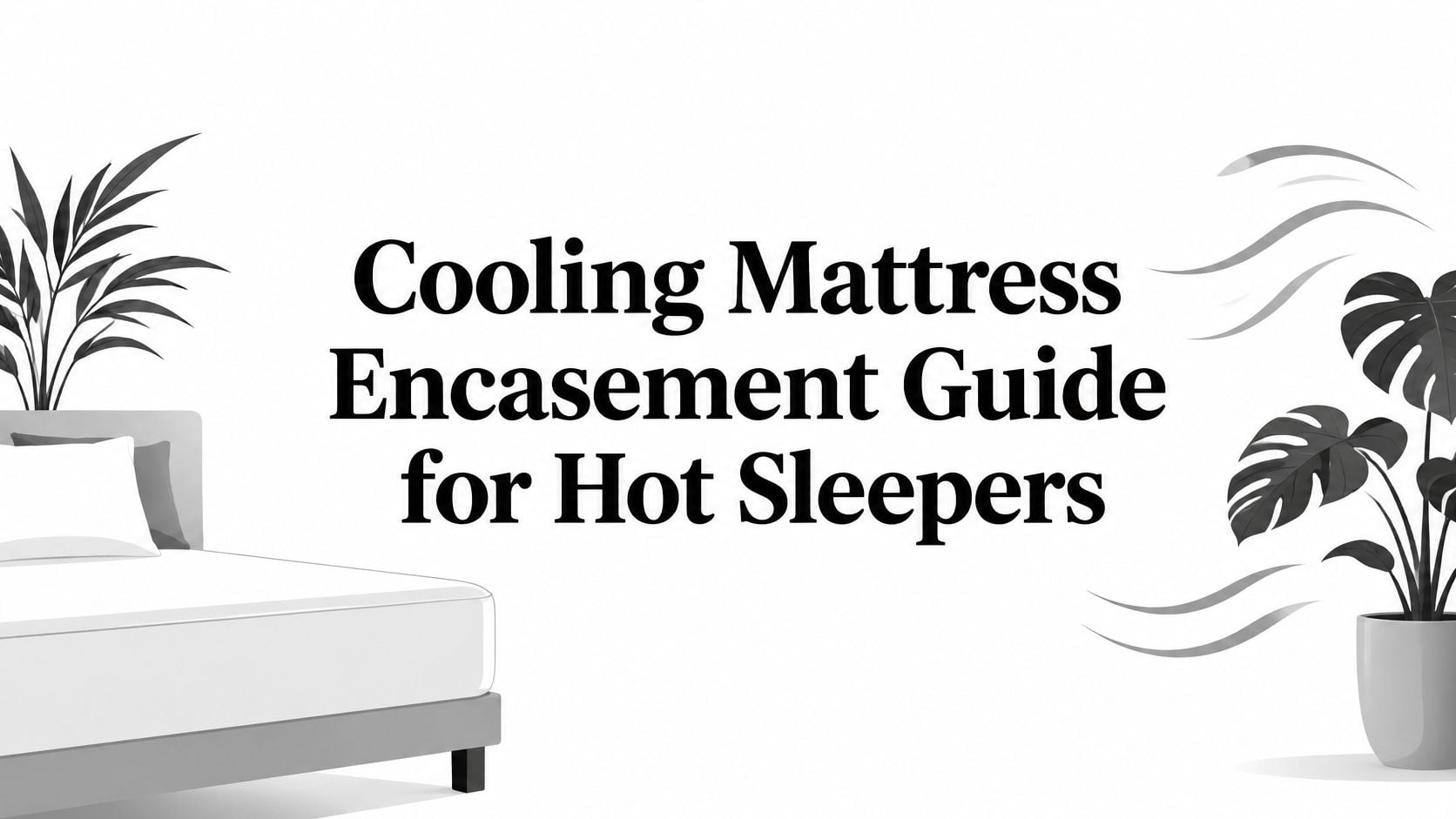
Cooling Mattress Encasement Guide for Hot Sleepers

A Ruidoso bedroom can feel cool when the day winds down, yet the mattress may still hold warmth from hours of use. That can be especially noticeable on memory foam or in a cabin that's been closed up during the day. A cooling mattress encasement may help, but its comfort claims need to be weighed against what the cover is meant to protect.
A full encasement wraps the mattress, usually on all six sides. Unlike a top-only pad, it can create a barrier around the mattress while also changing how heat and moisture move through the bed. The right choice depends on the main need: a cooler-feeling surface, easier moisture release, allergen separation, spill protection, or help spotting bed bugs in a rental.
Why a Cooling Mattress Encasement Matters
After a warm day in Alto, the room may cool before the mattress does. If you settle onto a bed that still feels warm, the cover between you and the mattress can affect how that first contact feels. Its fabric and construction matter, though a cool-feeling surface alone does not show that you will sleep longer or better.
A full encasement differs from a pad or protector that covers only the top. It wraps all six sides, usually closing with a zipper. Depending on its design, it may help limit liquid exposure or create a barrier against allergens. The same layers also affect airflow and moisture movement, so protection and comfort need to be weighed together.
One cover, several possible jobs
You might want a more comfortable-feeling surface, separation from dust-mite reservoirs, or help protecting the mattress from spills. In a guest room or rental, a fully enclosed mattress can also make bed bugs that leave the mattress easier to spot. These jobs are different. The word “cooling” alone does not tell you whether a cover provides a particular kind of protection.
Fit affects both function and feel. A cover made for a thinner mattress can pull tight over a thick hybrid, strain the zipper, or sit differently on foam. Whether the bed uses dense memory foam, a zoned hybrid, or a lighter foam core, the construction beneath the cover can influence the final feel. Check the mattress dimensions and depth before choosing.
Start with the job, not the label
First, decide what problem you want the cover to address. If warmth is the main concern, look at surface feel and how readily the fabric allows moisture to move. If you want allergen separation, check that the barrier and full coverage suit that purpose. For a cabin, fit, washability, and ease of inspection may matter more in everyday use.
Ruidoso's dry mountain air does not guarantee a cool-feeling bed. Your body still releases heat and perspiration against the bedding, and an added layer can change how that feels. If you share the bed, consider whether both sleepers prefer the same surface feel; a cover that feels cool to one person may not feel that way to the other. Choose for the mattress and the protection you need, then judge the cooling claim as a comfort feature rather than proof of improved sleep.
What Cooling Really Does for Sleep
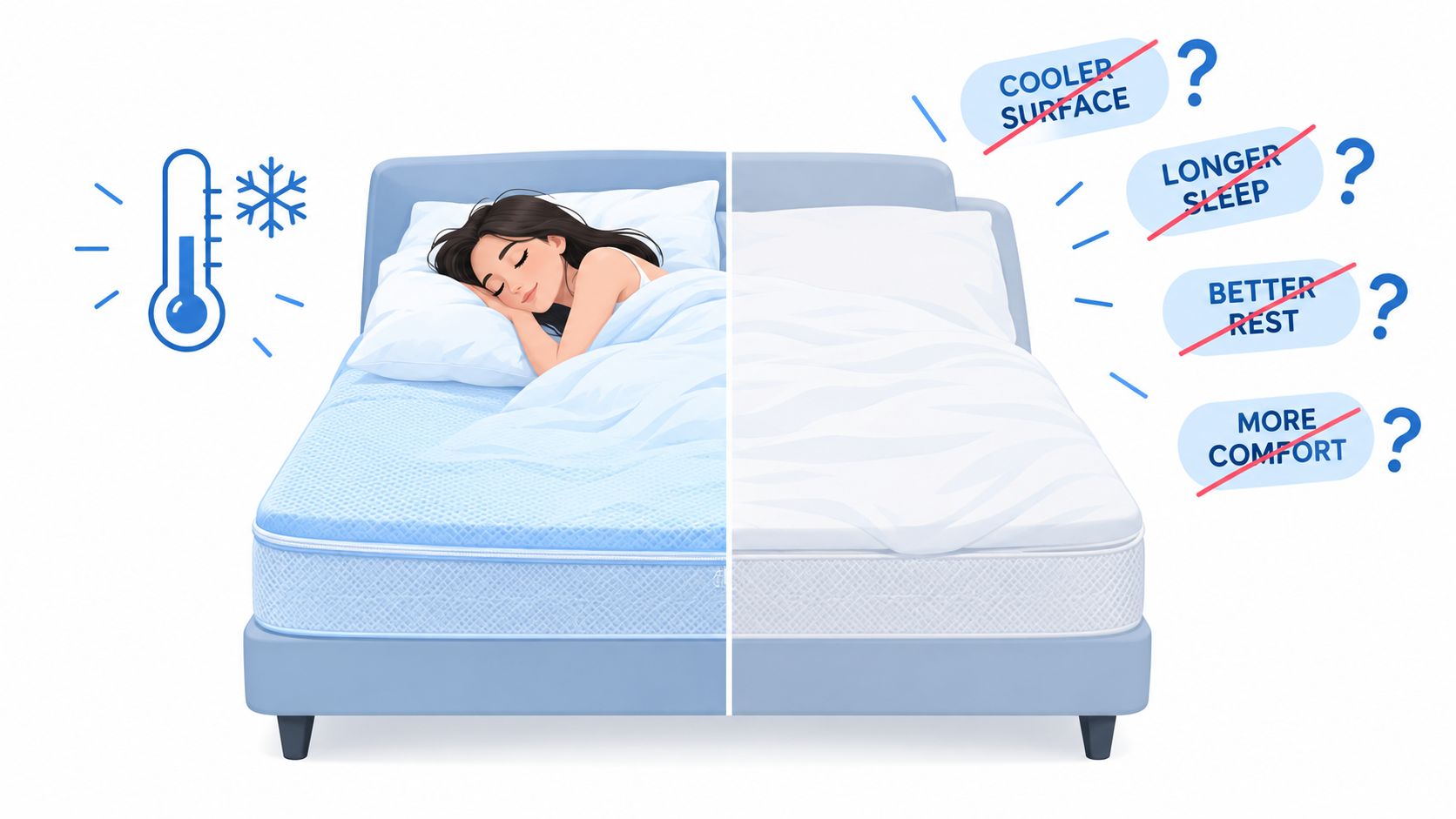
A cooler-feeling surface can improve comfort without reliably making someone sleep longer or changing sleep stages. Thermal comfort depends on heat leaving the body and perspiration evaporating into the surrounding air. A light wind shirt lets air move; a plastic rain jacket blocks water but can feel stuffy. A tightly woven or waterproof mattress layer can create a similar tradeoff if it lacks a path for water vapor.
Feeling cool isn't the same as sleeping better
A 2025 systematic review and meta-analysis found that cooling bedding could affect thermal comfort or short-term body temperature, but didn't consistently improve sleep duration, efficiency, sleep-onset latency, or sleep stages (review of cooling bedding and sleep outcomes). A separate 2025 field study reported better perceived sleep quality, comfort, and hot-flash or night-sweat symptoms, while objective sleep measurements didn't improve.
That distinction matters. A surface that feels pleasant may still be a worthwhile comfort choice, but it shouldn't be treated as proof of a health benefit or guaranteed change in sleep. Quilting, the membrane, and the foam or hybrid mattress underneath all influence how the bed feels.
Match the cover to the real need
Before choosing, the shopper should decide which job comes first: comfort, sweat management, allergy barriers, bed-bug visibility, or mattress preservation. A product may address more than one, but added containment or waterproofing can affect airflow and surface feel.
In Lincoln County's changing temperatures, a several-night home test can be more informative than a cool-touch claim. Keep the sheets and room conditions consistent while evaluating whether the cover feels comfortable. For other ways to manage warmth in bed, see these ideas for sleeping cooler at night.
Fabrics and Membranes That Stay Breathable
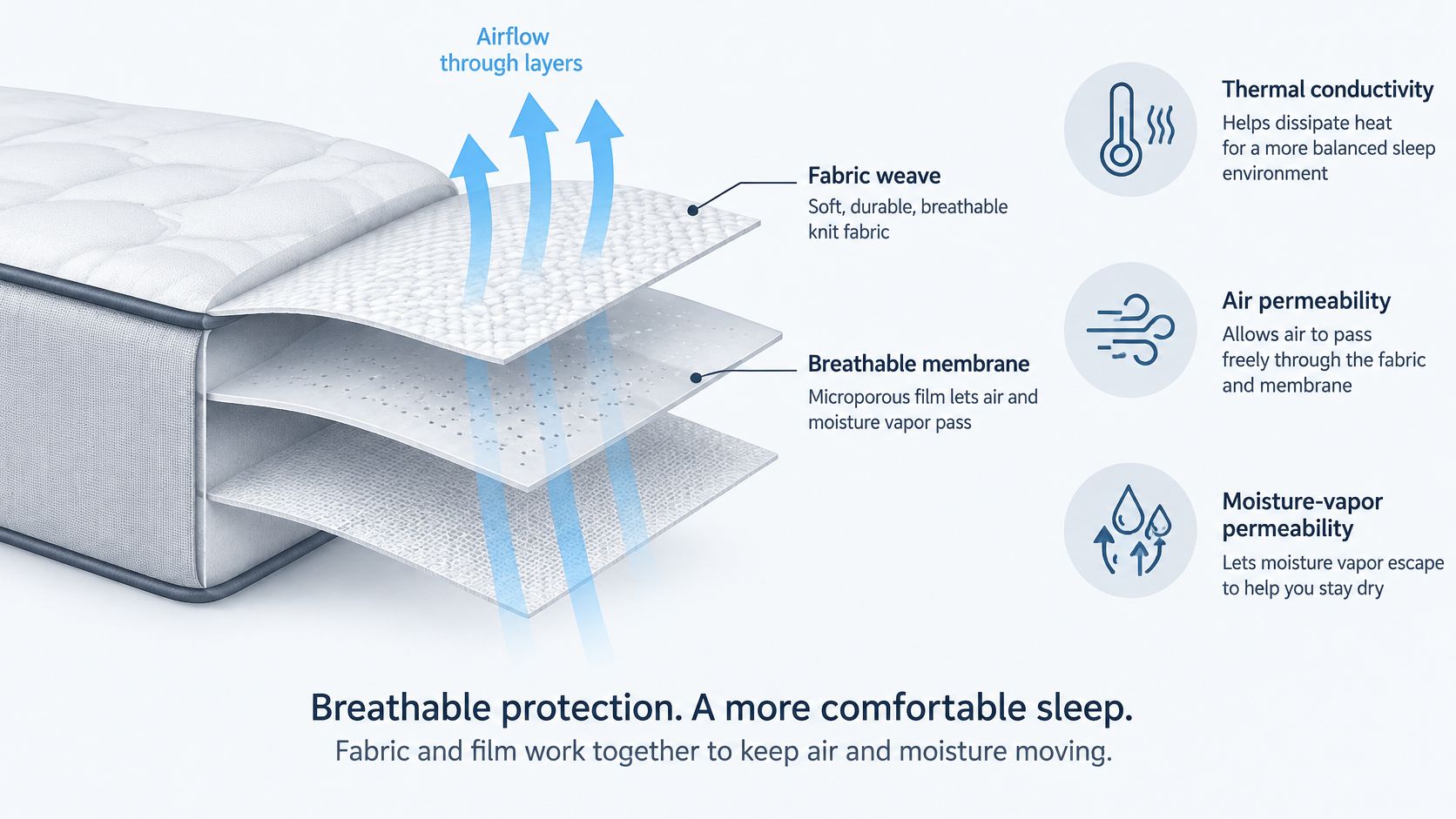
When you're choosing an encasement, the fiber name alone won't tell you how warm it will feel. Heat can move through fabric, air can pass through it, and moisture vapor can escape at different rates. Dense, thick layers can slow heat and moisture transfer, while more air-permeable fabric gives heat an easier path out.
Look past the fiber name
In research on multilayer bedding textiles, Tencel had a reported thermal resistance of 0.0037 m²·°C/W, compared with 0.0084 m²·°C/W for polyester. The reported water-vapor transmission rate for Tencel was 1,069.21 g/24 h·m² (multilayer bedding textile findings). These results describe the tested materials, not every finished encasement. Use them to understand what the measurements describe, rather than to predict exactly how a particular cover will feel.
Research on mattress-ticking fabrics also found differences in breathability, liquid absorption, and transfer among materials. Lyocell, viscose, and viscose-linen showed stronger moisture-management characteristics, while viscose-linen moved liquid faster in both tested directions (ticking fabric moisture-management research). A cool touch is a surface sensation; moisture management describes how a material handles liquid. Neither measurement by itself proves that you'll sleep longer or better.
Three checks for the label or product details
Ask for published vapor measurements, then check how the cover is built. A lightweight face fabric, low-bulk membrane, and ventilated sides may leave heat and vapor a clearer route away from your body. Waterproofing can protect the mattress, but it doesn't automatically mean the cover breathes well.
- Vapor data: Look for water-vapor transmission or resistance measurements, not just a cooling-fiber claim.
- Layer construction: Check whether the face fabric and membrane are lightweight rather than thick and dense.
- The whole bed: A dense protector placed over a breathable encasement may restrict airflow.
If you don't need a full wrap, a cooling mattress pad is another option. The practical choice is between more surface airflow and all-around containment. A cool-feeling cover may improve comfort, but it can't guarantee measurable sleep improvement.
Allergen Spill and Bed Bug Protection
In a Ruidoso cabin or a Lincoln County home, an encasement has two separate jobs: it can limit contact with allergens inside the mattress, and a suitable design can help contain bed bugs. Neither job is the same as making the sleep surface feel cool. A cool-touch fabric changes how the surface feels; it does not by itself show that sleep has improved or that the cover blocks allergens or pests.
The National Institute of Environmental Health Sciences lists mattresses, bedding, upholstered furniture, carpets, and curtains as places dust mites may live. It recommends dust-proof or allergen-impermeable covers for mattresses and pillows (NIEHS dust-mite guidance). An encasement is one layer of an allergy-control routine, not medical treatment.
CDC-hosted clinical guidance identifies mattresses, box springs, and pillows as sources of mites and mite allergens. In an intervention across 14 U.S. states, 60.3% of households receiving education used mattress encasements, compared with 30.3% in the comparison group, a 30.0 percentage-point difference. The reported adjusted odds ratio was 2.4, with a 95% confidence interval of 1.2–4.8 (CDC clinical guidance). These results describe encasement use after education, not proof that a cover alone treats allergies.
Separate protection jobs
Pair an allergen barrier with regular hot-water washing, lower indoor humidity, and routine cleaning. Dry mountain air does not remove dust and allergens from a home. These bedroom dust- and allergen-control habits can complement a cover.
- Allergen barrier: Choose a cover designed to enclose the mattress and limit exposure to allergens inside it.
- Liquid protection: Waterproofing can guard against spills, though a membrane may affect airflow. It does not automatically provide allergen or pest protection.
- Bed-bug barrier: Cooling claims alone tell you nothing about pest containment. A technical summary gives a maximum fabric pore size of 0.015 mm, or 15 microns, for effective exclusion, and notes that the zipper seal matters too (bed-bug encasement design details).
New Mexico State University explains that mattress and box-spring encasements can make bed bugs easier to spot on the protected surface and help assess whether treatment worked (New Mexico State University bed-bug guidance). They do not replace room inspection, careful cleaning, or professional treatment, and cannot contain bugs hiding elsewhere.
How to Choose Fit and Protection Level
A sealed encasement and a fitted protector solve different problems. Enclosing all six sides supports containment, while a top-only layer can leave more of the mattress sides exposed to airflow. Choose according to the protection you need and how much added coverage you're comfortable with.
Start with the mattress's construction, size, and depth. Memory-foam, hybrid, and innerspring beds can differ in profile and surface behavior, so check the actual mattress rather than relying only on an online size label. A thick hybrid, for example, may need extra depth to let the zipper close without strain.
Check that the zipper track and end stop close fully. The fabric should lie flat, not pull so tightly that the seal gaps or the surface feels altered. Before buying, review membrane noise, care instructions, and warranty compatibility for your mattress.
Compare the layers by their main job
| Option | Best job | Airflow tradeoff | Care check |
|---|---|---|---|
| Zipper-sealed encasement | All-side containment and coverage | A membrane or dense fabric may restrict vapor movement | Verify depth, zipper closure, and wash instructions |
| Fitted protector | Top-surface spill protection | Often less coverage around the sides | Check waterproof layer and fit |
| Washable comfort layer | A removable, washable surface | Adds another layer between sleeper and mattress | Confirm laundering requirements |
| Sheet system | Surface comfort and moisture handling | Doesn't enclose or seal the mattress | Follow fabric care directions |
Don't mistake sheet results for encasement results
A 2025 study of hot sleepers using treated cotton sheets reported that heat-related sleep difficulty fell from 82.5% to 39.7%, while reported sleep duration rose by about 26 minutes (2025 hot-sleeper sheet study). These findings describe sheets, not mattress encasements. They show why cool-touch comfort and measurable sleep changes are separate questions, and they do not establish that an encasement will produce the same results.
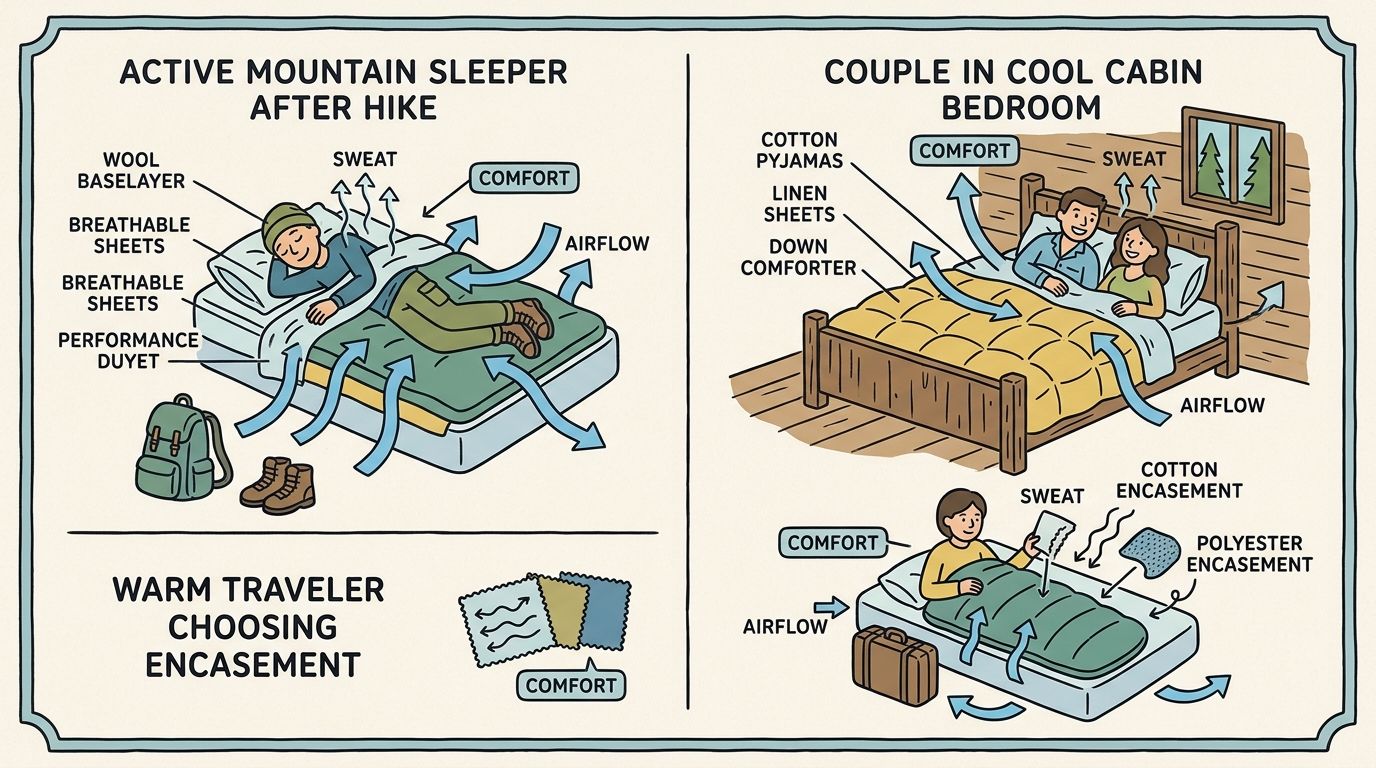
For a couple, a sealed cover may suit a containment need, while a breathable construction may feel more comfortable to a partner who overheats. A cabin owner may prefer full enclosure for the added coverage, while accepting that denser materials can reduce airflow. Match the choice to the bed's fit, the protection required, and the surface feel you want.
Setups for Ruidoso Cabins and Couples
An active mountain sleeper who returns from hiking and sweats overnight may do best by prioritizing vapor flow and pairing the encasement with moisture-wicking sheets. Adding a second dense protector over a breathable cover can impede the very moisture path the sleeper is trying to preserve. Fiber research offers a useful benchmark, not a finished-product promise: reported moisture-buffering capacity was approximately 9.9 kJ/m² for wool, 6.9 kJ/m² for cotton, and 0.6 kJ/m² for polyester (sleepwear and bedding moisture-buffering review).
When sleepers need different things
One partner might want a barrier for allergy reasons, while the other wakes feeling overheated. A breathable, properly sealed cover can be a middle ground, while a plastic-like film may feel too warm. Body type and sleep position also affect pressure and surface comfort, so the encasement should be tested on the actual mattress rather than judged by the fabric alone.
For a side sleeper on memory foam, pressure relief and the mattress's contouring may shape the feel more than a cool-touch finish. Someone considering a hybrid may also notice how the comfort layers and coil support affect airflow and spinal alignment. Cooling gel technology in a mattress can influence surface feel, but it doesn't guarantee that a separate encasement will stay cool.
For a frequently used cabin
A Sudderth-area rental or another Lincoln County cabin may need a cover that makes inspection simpler between guests. New Mexico State University notes that encasements can help make bed bugs more visible when they leave the mattress and help evaluate treatment, but they don't replace inspection or professional care. Fit, zipper closure, and washability matter alongside comfort.
For more ideas on setting up a guest bed, explore these cabin bed ideas. A shopper balancing body type, sleep position, budget, and protection needs can start by deciding which tradeoff is acceptable: more containment, easier washing, waterproofing, or more airflow.
Install Care and Your Next Sleep Step
A correctly fitted encasement gives you a fairer test of its comfort. If it bunches beneath the sheets or sits under a restrictive protector, you may be reacting to the setup rather than the fabric. Measure mattress depth, fit the cover evenly, and smooth out wrinkles before making up the bed. Close the zipper fully, checking the track and end stop.
Follow the care label when washing, and avoid high heat if it could damage the membrane. Keep the encasement's breathable surface from being covered by a dense, non-breathable protector. Then use the same sheets and similar bedroom conditions for several nights. A cool-touch feel is a personal impression, while a measurable change in sleep is a separate question, so consistent conditions make comparison more useful.
An encasement doesn't replace cleaning or rotating your mattress when the manufacturer recommends it. A typical mattress lifespan is 7 to 10 years, though care and the mattress's condition affect how long it lasts. These mattress maintenance and cleaning practices can help you care for a clean, comfortable sleep setup.
If you're unsure about depth, fit, or warranty details, a local visit can help you check the match in person. Full-Service Delivery with Professional Setup, a Low Price Promise, and a Comfort Promise can also ease concerns about choosing a bed-and-cover combination.
Visit Mattress Pro by Miller Waldrop at 2801 Sudderth Drive, Suite F, in Ruidoso, Monday through Saturday, to compare premium and budget-friendly sleep systems. The Sleep Pros can help match a mattress and encasement to your room, sleep style, and protection needs, with Full-Service Delivery and Professional Setup available. Browse Mattress Pro by Miller Waldrop or stop by to find a setup that makes mornings feel better.