

7 Zero Gravity Position Benefits for Better Sleep in 2026


You wake up with a stiff lower back, a sour taste in your throat, or heavy legs after a long day on your feet in Ruidoso or up the canyon in Alto. Many of these discomforts trace back to how your body rests on a flat surface all night. A zero gravity position changes the angle of your spine, legs, and upper body, and that change can bring real relief when the mattress under you holds the new shape.
Flat sleep asks muscles to brace against gravity for hours. A gentle lift lets the hips open, the knees bend, and the torso rest at a calmer angle. That is the practical core of zero gravity position benefits, and it is not a miracle preset. It is a supported posture you tune to your body, your symptoms, and the dry mountain nights of Lincoln County.
The mattress still does most of the work. A Tempur-Pedic memory foam layer, a Sealy hybrid, a Stearns & Foster innerspring, or a Sherwood build will not bend or cradle the same way on an adjustable base. Here are seven benefits worth understanding before you decide whether this position fits your sleep.
1. Spinal Decompression and Lower Back Relief
Say you spent the day on Sudderth Drive, then drove home with a tight lumbar area that already feels loaded. Sitting stacks pressure on the lower discs. Lying flat helps, but a flat back with straight legs can still leave the pelvis tilted and the low back working.
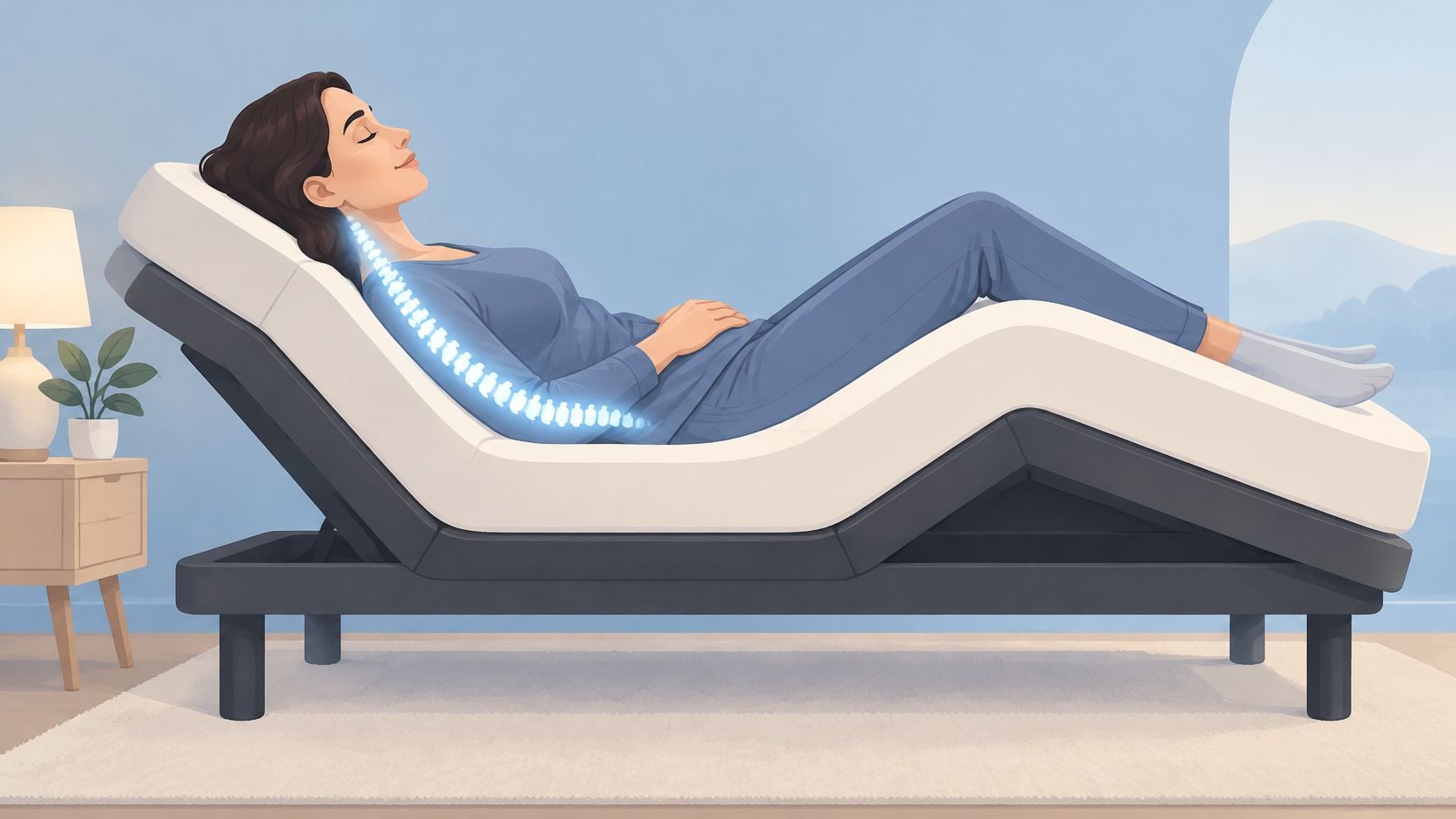
The zero gravity position raises the knees and reclines the upper body so pressure shifts away from the lower spine. During the Skylab era in the 1970s, NASA's Spinoff summary describes how astronauts settled into a neutral body posture with partially flexed hips and knees, a gently curved spine, and supported limbs. Reclining in that posture can reduce strain from gravity. It does not prove the position treats a medical condition, and it does not help every person the same way.
What the angle is actually asking your spine to do
NASA-derived ergonomic measurements put a representative relaxed trunk-to-thigh angle at about 128°, with real variation from person to person, according to a NASA human-factors report. Treat that figure as a reference, not a remote setting you must hit. Start with modest head and knee elevation, then adjust until the lumbar area feels supported without forcing the pelvis into a deep tuck.
Your mattress has to finish the job the base starts. A responsive memory foam comfort layer fills the small of the back as the deck bends. A hybrid with a supportive coil unit keeps the midsection from hammocking while the comfort layer still yields at the shoulders. In Ruidoso's dry air, an all-foam bed can feel warmer if the cover traps heat, so a breathable hybrid cover is often the calmer choice for an active sleeper who already runs warm.
Practical rule: Change the preset by a small step across several nights. A big jump on night one usually creates a new ache instead of removing the old one.
- Start gentle: Use the lowest comfortable head and knee lift, then add height only if the low back still feels compressed.
- Add a knee pillow: If the foot section does not rise enough, a slim pillow under the knees keeps the same hip opening.
- Get pain checked: Pain that stays sharp, or pain that travels down a leg, needs a clinician, not another angle.
2. Improved Circulation and Reduced Leg Swelling
You finish a shift on your feet, or a long hike above town, and your ankles look puffier than they did at breakfast. Raising the lower legs so the feet sit about level with the heart lets gravity help fluid move back toward the core. That is a comfort strategy for mild end-of-day heaviness, not a treatment for vascular disease.
The effect stays modest, so it works best beside daytime walking, not instead of it. A mattress that lets the calves sink will erase the lift you just set on the base. You want a surface with enough push at the lower third that the heels and calves stay up where you placed them.
Where “legs up” stops being a free benefit
A USA Today health report notes that hours with the hips and knees bent can stiffen the hip, calf, and hamstring muscles, and that long immobility can raise concern about circulation and deep-vein thrombosis in susceptible people. Having the legs raised is not the same thing as better circulation for everyone. The useful question is which lift, for which symptom, and for how long.
A moderate lift you can hold without tightness beats a steep “weightless” pose you abandon at 2 a.m.
For a couple sharing a cabin bed, one sleeper may want calves high after a trail day while the other wants nearly flat. A split setup, or separate saved presets, keeps that from becoming a nightly argument. On a single base, agree on the lower of the two comfortable settings.
- Match foot height to the heart: A huge knee bend that leaves the ankles below the chest does little for swelling.
- Move before you recline: A short walk and a glass of water support venous return better than elevation alone.
- Protect the edge: A firm enough perimeter, common on a Sealy or Stearns & Foster hybrid, keeps legs from sinking off the lift.
- Call a clinician for new swelling: One-sided swelling, warmth, or unexplained pain is a medical visit, not a preset.
3. Acid Reflux and Heartburn Relief
Nighttime heartburn is often a geometry problem. When you lie flat, stomach contents can move upward more easily. Raising the whole upper body uses gravity to keep acid lower in the esophagus while you sleep.
A 2021 systematic review, summarized in BMC Primary Care, looked at randomized evidence on head-of-bed elevation. In one crossover trial, 39 participants were analyzed after six weeks. A meaningful symptom improvement, defined as at least a 10% improvement, occurred in 27 people (69%) with elevation, compared with 13 people (33%) in the control group. The risk ratio was 2.1 (95% confidence interval 1.2 to 3.6). The average symptom-score change favored elevation by 1.3 points (95% confidence interval 0.6 to 2.0).

Why a wedge of elevation is not the same as a deep recline
The same review includes a small crossover trial of 15 people with gastroesophageal reflux disease. A 10-inch wedge cut the share of sleep time with esophageal pH below 4 from 21% flat to 15% when raised. That supports a raised torso. It does not mean every zero gravity angle works the same, and it does not replace care for symptoms that keep returning.
A thick pillow stacked under the head often kinks the neck and can make reflux feel worse. The base should lift the torso as a unit, with a contour pillow only filling the space behind the neck. Consistent elevation across the week tends to tell you more than one heroic night.
- Leave a gap after dinner: Skip large meals within three hours of lying down.
- Lift the chest, not the chin: Raise the head section gradually and keep the neck neutral.
- Write the angle down: A simple sleep diary shows which preset cuts the sour taste and which one only looks impressive on the remote.
If burning, regurgitation, or trouble swallowing continues, talk with a clinician. An adjustable base is a comfort tool for some nighttime reflux, not a diagnosis.
4. Snoring and Airway Support
Your partner usually hears the change before you do. Flat on your back, gravity can pull soft tissue in the throat backward and narrow the airway. A modest upper-body incline can leave that passage a little more open for some mild snorers.
A peer-reviewed study of adults with predominantly mild-to-moderate obstructive sleep apnea tested a 7.5-degree head-of-bed elevation made with a 15-centimeter support under the head-of-bed legs. The paper, available through PubMed Central, reported that the elevation reduced sleep-apnea severity by 31.8% on average without disrupting sleep quality. That is a mild incline, not a steep lounge-chair pose. It is a comfort strategy for some sleepers with mild nighttime breathing trouble. It does not replace a sleep study or prescribed CPAP.

What the mattress adds when the airway is the issue
The base sets the incline. The mattress decides whether your jaw and neck stay neutral on that incline. A mattress that is too soft under the shoulders lets the head drop back. One that is too tall and firm can shove the chin toward the chest once the head section rises. Side-sleep pressure and snoring often travel together, which is why a guide to easing snoring with the right mattress belongs in the same shopping trip as the base.
Lincoln County air is dry, and a dry nose makes mouth breathing, and snoring, more likely. A cool-mist humidifier on the nightstand pairs well with a breathable cover. Memory foam with a cooling gel layer can still sleep hot if the room is closed up, so crack a window on cool mountain nights or choose a hybrid with more airflow.
- Add height slowly: Test a small incline first. More lift is not automatically a clearer airway.
- Clear the nose: Saline and humidity help when the air feels thin and dry.
- Don't self-treat apnea: Gasping, witnessed pauses, or exhaustion every morning belong with a sleep physician.
5. Pressure Point Relief for Shoulders and Hips
Side sleepers in a flat bed often wake with a hot spot at the shoulder or the outer hip. Those two points carry a large share of body weight on a narrow contact patch. A zero gravity-style recline spreads load across the upper back, the back of the thighs, and the calves, so the shoulder and hip do less of the holding.
WIRED's account of zero gravity sleep describes a setup modeled on NASA's neutral posture, with the upper body and legs raised so the head and knees sit above the heart. A commonly described arrangement uses roughly a 40-degree upper-body recline with the knees slightly raised. The same account warns that too much head elevation can strain the neck or interfere with breathing. Your comfortable angle depends on your build, your sleep position, and your symptoms.
Matching the comfort layer to the sore spot
Pressure relief fails when the mattress cannot conform at the bend. Memory foam excels at hugging a shoulder so the joint sinks just enough for the neck to stay level. A hybrid comfort layer does similar contouring on top of coils that stop the hip from dropping too far. That balance matters for spinal alignment as much as for the sore spot itself.
A side sleeper who also wants a knee lift should read a shoulder-pain sleep position guide before locking in a preset. The V of a full zero gravity pose tends to roll people toward the back. If you sleep on your side, use a gentler foot lift and a pillow in front of the top knee so the hip stays stacked.
- Plan for warm nights: Cooling gel or a breathable cover matters in a closed cabin, even when outside air is cool.
- Check the base rating: Confirm the mattress is approved for an adjustable foundation before you buy. A very thick coil unit can fight the hinge.
- Support the top leg: A side pillow keeps the upper knee from twisting the lower back.
6. Easier Mobility and Getting Out of Bed
Getting out of bed is its own workout when the surface is low, soft, and flat. Older adults, and anyone easing back after surgery or a strain, often spend the first minute of the day hauling the torso upright with the arms and the low back. A raised head section shortens that job. You are already partway to sitting before your feet hit the floor.
This is a mechanical convenience. It is not a medical device and it is not a recovery plan. Consumer write-ups often treat the full zero gravity posture as a treatment for pain, breathing, and sleep quality. A review of the position's limits points out that large clinical trials of the complete posture for conditions such as obstructive sleep apnea or chronic pain are lacking. Reduced loading can feel better. Feeling better is not the same as a proven treatment. People with persistent snoring, witnessed pauses, or daytime sleepiness still need a clinical evaluation.
A safer path from recline to standing
The sequence matters more than the brand name on the remote. Lower the foot section first so the legs are not trapped in a bend. Raise the head until sitting feels natural. Then swing both legs off together. Jerking straight up from a deep knee bend is how a helpful preset turns into a stiff hip.
Mattress Pro by Miller Waldrop offers standard delivery and white glove delivery, and the personalized setup service positions the mattress for the sleeper's own preferences. That visit is the moment to test sit-to-stand on the actual edge, not on a showroom guess. A set of morning mobility tips pairs well with that fitting if mornings are the hardest part of the day.
- Ask about the edge: A reinforced perimeter makes the sit-and-stand moment steadier than a soft all-foam border.
- Try every preset in the showroom: A control you cannot read at night will not get used.
- Keep the remote close: A simple, labeled handset beats a menu you have to hunt through half asleep.
7. Relaxation and Restful Sleep Onset in Ruidoso
The first job of the position, for many people, is not therapy. It is permission to stop bracing. Lights down, a podcast on, knees slightly up, and the body finally has somewhere to rest that is not a couch that dumps the legs.
A clinical study in the Journal of Medical Internet Research compared flat sleep with an adjustable bed at a 12-degree upper-body incline. The researchers called 12 degrees enough to raise the head while staying comfortable for sleep, and they noted that a mild incline is generally more tolerable than larger angles. Prior laboratory work cited there found head-of-bed incline could reduce obstructive sleep apnea severity without disrupting normal sleep architecture. For winding down, that milder number is a smarter starting point than the steepest preset on the remote.
Mountain air changes the setup around the angle
Ruidoso evenings cool off fast, and Lincoln County air stays dry. A mattress that feels plush in a humid climate can feel stiffer, and nasal passages drier, at this elevation in spirit if not in a lab. You live with that air every night, and a local fitting accounts for it in a way a bed-in-a-box checklist does not. Sherwood and Sealy hybrids with breathable covers often feel less sealed-in on a cool night. A Tempur-Pedic foam layer still makes sense when pressure relief is the priority, especially with a cover that moves heat away from the torso.
Build a short wind-down that matches the preset, using ideas like the three things to skip before bed. The angle will not override a late meal, a bright screen, or an inconsistent bedtime.
- Humidify the room: A small humidifier offsets dry nighttime air so you are not waking with a scratchy throat.
- Dim the hour before: Lower the lights and set the screens aside for 30 minutes once the recline is saved.
- Keep the clock steady: A consistent bedtime does more for sleep onset than chasing a new angle every night.
If the hips feel tight by morning, flatten the knee section a few degrees rather than abandoning the head lift that helped you fall asleep. Many sleepers use the recline to drift off, then ease toward a gentler angle when they wake later.
Zero Gravity Benefits at a Glance
| Benefit | Best For | Ideal Mattress Layer | Main Caution |
|---|---|---|---|
| Spinal decompression and lower back relief | Back sleepers with stiffness or lower back strain | Medium-firm supportive hybrid or responsive memory foam | Not a substitute for medical care; soft mattresses may sag |
| Improved circulation and reduced leg swelling | People with mild swelling after standing | Firm-enough support to maintain leg elevation | Excessive knee bending may restrict blood flow |
| Acid reflux and heartburn relief | Sleepers with nighttime reflux | Cooling gel memory foam or responsive latex | Persistent reflux needs medical evaluation |
| Snoring and airway support | People with mild snoring | Flexible hybrid or memory foam | Does not treat sleep apnea |
| Pressure point relief for shoulders and hips | Side sleepers with shoulder or hip discomfort | Contouring memory foam or comfort-layer hybrid | Thick memory foam may trap heat |
| Easier mobility and getting out of bed | Older adults and people recovering from injury or surgery | Firm-edge mattress support | Softer edges may sag when sitting |
| Relaxation and restful sleep onset in Ruidoso | People seeking a calming wind-down routine | Breathable layers for cool, dry nights | Benefits vary and are less studied |
Choosing Your Angle With Confidence
The right zero gravity setup depends on your body, your symptoms, and the bedroom you sleep in. A back sleeper with lumbar stiffness may want a supported knee bend on a hybrid. A side sleeper with a sore shoulder may need less knee lift and more contour from memory foam. A reflux sleeper needs a steady torso incline more than a dramatic leg raise. A cabin owner furnishing two different guests needs presets that are easy to reset, not a single pose sold as universal.
Mattress Pro by Miller Waldrop is a local, family-owned sleep shop with a 70-year Miller Waldrop legacy, focused on sleep rather than a one-size delivery box. The TEMPUR-Ergo Extend Smart Base includes a Zero Gravity Preset that raises the head and feet to take pressure off the back while you sleep. It is one option among Tempur-Pedic, Sealy, Stearns & Foster, and Sherwood systems a Sleep Pro can compare in person. The Comfort Promise is there so the fear of picking the wrong bed does not freeze the decision. The Low Price Promise keeps the conversation honest on price. Full-service delivery with professional setup positions the mattress for optimal comfort once it is in your room, whether that room is in town or up toward Alto.
Customers who want help choosing can connect with a Sleep Pro, and the Sleep Knowledge blog is there for buying guides between visits. None of that replaces medical care for apnea, vascular disease, or pain that radiates or worsens. Use the lowest angle that solves the symptom you came in with, and change it when your body asks.
Ready to transform your sleep? Visit our Sleep Pros at the Mattress Pro showroom located at 2801 Sudderth Drive, Suite F, in Ruidoso. From luxury brands to budget-friendly solutions, we're here to help you wake up loving your mornings. Browse our collection online or stop by Monday through Saturday.
Mattress Pro by Miller Waldrop fits adjustable bases and mattresses to the way you sleep, including zero gravity presets for back pressure, reflux-friendly elevation, and easier mornings. A Sleep Pro will walk the angle with you, then back it with the Comfort Promise and full-service setup. Visit Mattress Pro by Miller Waldrop at 2801 Sudderth Drive, Suite F, in Ruidoso, Monday through Saturday, and test the position on the mattress you are considering.