

Best Mattress for Plus Size Side Sleepers Guide

A familiar morning in Ruidoso starts with a stiff shoulder, a sore hip, and the feeling that the mattress has worked against the body all night. Side sleeping concentrates pressure at the shoulder, hip, and knee, while a higher-weight body can sink farther into comfort layers before reaching the supportive core. The result is often a bed that feels comfortable for a few minutes in the showroom but allows the pelvis to drop and the spine to twist during sleep.
The best mattress for plus size side sleepers isn't automatically the softest or firmest model. It needs pressure-relieving comfort layers, a supportive interior, a stable perimeter, and construction that can handle repeated compression. The following comparison gives a practical starting point before a sleeper visits a showroom or studies a mattress specification sheet.
| Mattress construction | Pressure relief | Support and durability | Cooling performance |
|---|---|---|---|
| Memory foam | Excellent contouring at the shoulder and hip | Can allow deep sinkage when the foam lacks sufficient density | Often warmer, although gel layers and breathable covers may help |
| Innerspring | Limited contouring unless paired with substantial comfort layers | Strong responsiveness, but coil design and padding determine long-term support | Usually breathable because air moves through the coil unit |
| Latex | Buoyant pressure relief with less of a trapped feeling | Resilient, durable, and resistant to deep impressions | Generally breathable and temperature-neutral |
| Reinforced hybrid | Strong balance of cushioning and structural support | Supportive coils, dense foams, and reinforced edges suit higher loads | Often the strongest all-around choice when paired with breathable materials |
Why Plus-Size Side Sleepers Need a Specialized Sleep Surface
You can lie down on a showroom mattress in Ruidoso and feel comfortable within minutes, then wake with a compressed shoulder, aching hip, or stiff lower back. For plus-size side sleepers, the problem usually has two parts: the surface presses too firmly against the shoulder and hip, while the deeper support lets the pelvis sink too far.
Side sleepers place their main pressure points at the shoulders, hips, and knees. The Sleep Foundation pressure-relief methodology notes that lighter side sleepers often fit Medium Soft to Medium surfaces, while side sleepers over 230 pounds generally need Medium Firm support to limit sinkage and help preserve spinal alignment.
Why softness alone fails
A very soft mattress feels inviting at first. Under a heavier body, the hips can keep sinking after the shoulder and legs have settled. The spine then curves into a hammock shape, and the sleeper may wake with pressure through the pelvis or lower back.
A mattress that is too firm creates concentrated pressure at the shoulder and hip. Numbness, soreness, and repeated position changes follow. Side sleepers need cushioning at the contact points, followed by a supportive transition that stops the torso before it drops too far.
Practical rule: The right bed cushions the shoulder and hip, then stops the torso from sinking farther.
A useful pressure benchmark in mattress testing is around 14 PSI or less for side sleepers, as described in Mattress Clarity's pressure-testing methodology. That figure does not guarantee comfort for every body, but it shows why concentrated force matters when the shoulder and hip carry much of the load.
What a successful test feels like
The shoulder should settle without feeling trapped. The waist and pelvis should feel held up rather than suspended in a depression, and rolling should remain manageable.
A mattress that is too soft produces a deep, enveloping feel with weak pushback beneath the hips. One that is too firm reveals itself through shoulder pressure, numbness, or the urge to brace your body. Review this mattress thickness guide before comparing construction details, but judge the actual surface in person.
For Ruidoso sleepers, a physical test carries more value than a generic firmness chart. High-altitude mountain conditions make breathable materials and durable edge support practical priorities, while body weight determines how quickly the perimeter and comfort layers face repeated compression. Reinforced hybrids deserve a close test because their coil support, cushioning, and edge structure must work together.
Your height, shoulder width, hip shape, pillow, and sleeping position all change the result. Lie in your normal position long enough to assess the entire body, not just the firmness label.
Critical Mattress Specs for Heavier Body Types
A firmness label cannot show how a mattress will hold your body over time. For heavier side sleepers, inspect the profile, support core, comfort layers, and perimeter before judging the surface feel. In a Ruidoso showroom, a reinforced hybrid should earn attention through its construction, not through a generic firmness chart.
Start with the mattress profile
Guidance for higher-weight sleepers recommends at least a 13-inch mattress, with 14 inches or more for sleepers over 400 pounds. The National Council on Aging mattress guide connects mattress height with a practical engineering point: a taller profile leaves room for meaningful cushioning, transition support, and a stronger base between your body and the foundation.
Height alone does not prevent sagging. A thick mattress made with weak, low-density materials can still develop impressions. Look for a profile that gives the shoulder and hip enough cushioning while keeping the pelvis from pressing through to the support core.
Examine the support materials
High-density foams resist compression more effectively than less substantial foams. Reinforced coil systems add pushback, airflow, and responsiveness. Latex can provide buoyant support without the slow, sinking sensation found in some foam constructions.
Review these specifications before you lie down:
- Comfort-layer construction: Choose enough cushioning to protect the shoulder and hip without forming a deep cavity.
- Transition support: This layer spreads pressure between softer comfort materials and the firmer core.
- Core structure: Reinforced coils or resilient latex provide stronger resistance beneath the pelvis.
- Perimeter reinforcement: Strong edges preserve usable surface area and make sitting down or standing up easier.
- Base compatibility: The foundation and frame must support the complete sleep system. Review this bed frame guide for heavy couples before pairing a mattress with a new base.
Coil gauge means little without the surrounding design. Coil count, zoning, foam density, edge construction, and foundation quality all affect how the bed responds. Pressure-testing methods also examine how force moves through the surface and support layers, as described in Mattress Clarity's pressure-testing methodology.
Treat edge support as a daily-use feature
A weak perimeter reduces the mattress's usable area. You may shift toward the center to avoid an unstable edge, and couples can lose sleeping space along both sides. Strong reinforcement also makes it easier to sit on the bed, put on shoes, and stand up.
A reinforced hybrid is a practical starting point for many heavier sleepers because its coil base, cushioning, and edge structure can share the load. Standard mattresses often support about 300 pounds per side, while plus-size or HD designs may support approximately 450 to 500 or more pounds. Capacity varies by model, so check the mattress, foundation, and frame separately.
Ruidoso's high-altitude mountain climate makes durable edge support and breathable construction practical priorities. Repeated compression matters more than a showroom label, especially around the perimeter and beneath the hips. Higher-weight sleepers may experience useful mattress life of about 5 to 7 years, rather than the usual 7 to 10 years, when construction is not reinforced. A warranty cannot restore comfort after premature sagging, so inspect the materials before you buy.
Comparing Mattress Materials for Maximum Support and Cooling
Each mattress material solves a different problem. Traditional memory foam excels at contouring, innersprings provide responsiveness, latex offers buoyancy, and hybrids combine several responses in one sleep surface.
Ruidoso and Alto sleepers also need to consider temperature. Dry mountain air can feel cool in the evening, but a sleeper can still overheat inside dense foam, thick bedding, or a highly conforming comfort layer. Breathable covers, open coil systems, latex, and cooling gel technology can help manage heat, although no mattress can control the entire bedroom environment.
Memory foam
Memory foam spreads weight across a broader area and can reduce sharp pressure at the shoulder and hip. That contouring can feel especially comfortable for side sleepers who dislike the pushback of a firm surface.
The concern is depth and recovery. A higher-weight sleeper may compress the foam farther, making movement harder and allowing the pelvis to settle too far into the bed if the transition layers aren't strong. Dense foam can also retain more heat than a coil-based design. Memory foam remains a reasonable choice when the sleeper prefers close contouring, but the support core and foam quality deserve careful inspection.
Innerspring
An innerspring mattress allows air to circulate through its coil unit and usually feels easier to move on. Its responsiveness can benefit sleepers who dislike being enveloped by foam.
Traditional innersprings may not provide enough contouring at the shoulder and hip for a plus-size side sleeper. Without substantial comfort layers, the coils can create pressure points instead of relieving them. Innersprings work better for this sleep profile when paired with a well-designed surface that cushions the contact areas.
Latex
Latex provides a springy, buoyant feel. It can relieve pressure without allowing the body to sink as much as it might in softer foam. That combination may suit a sleeper who wants support and easier movement in the same bed.
Latex also tends to breathe well and recover quickly after compression. Its feel is distinct, though, and some sleepers prefer the slower contour of foam. A showroom test should determine whether the surface provides enough shoulder accommodation without making the hips feel unsupported.
Reinforced hybrid
A reinforced hybrid usually offers the strongest balance for plus-size side sleepers. Coils provide deep structural resistance and perimeter stability, while foam or latex comfort layers cushion the shoulder and hip.
The RTINGS side-sleeper mattress guidance similarly points heavier side sleepers toward Medium to Medium-Firm hybrids rather than very soft beds. The reason is mechanical, not merely subjective. The upper layers need to compress at pressure points, but the support system must stop the pelvis before spinal alignment breaks down.
| Material type | Best fit | Main concern |
|---|---|---|
| Memory foam | Sleepers who want close contouring and strong motion absorption | Heat and deep sinkage if the support core is inadequate |
| Innerspring | Sleepers who prioritize airflow and easy movement | Shoulder and hip pressure without enough comfort material |
| Latex | Sleepers who prefer buoyancy and resilience | A distinctive springy feel that isn't ideal for everyone |
| Reinforced hybrid | Plus-size side sleepers seeking pressure relief and durable support | Higher construction complexity makes in-store testing valuable |
A detailed breakdown of these constructions is available in this memory foam, hybrid, and innerspring comparison. For many local shoppers, the most promising starting point is a reinforced hybrid with breathable materials and a strong perimeter.
How to Test Mattresses In-Store Like a Sleep Pro
Online shopping can identify promising specifications, but it can't reveal whether a sleeper's shoulder feels compressed after several minutes. An in-store test turns the decision into a physical comparison instead of a guess.
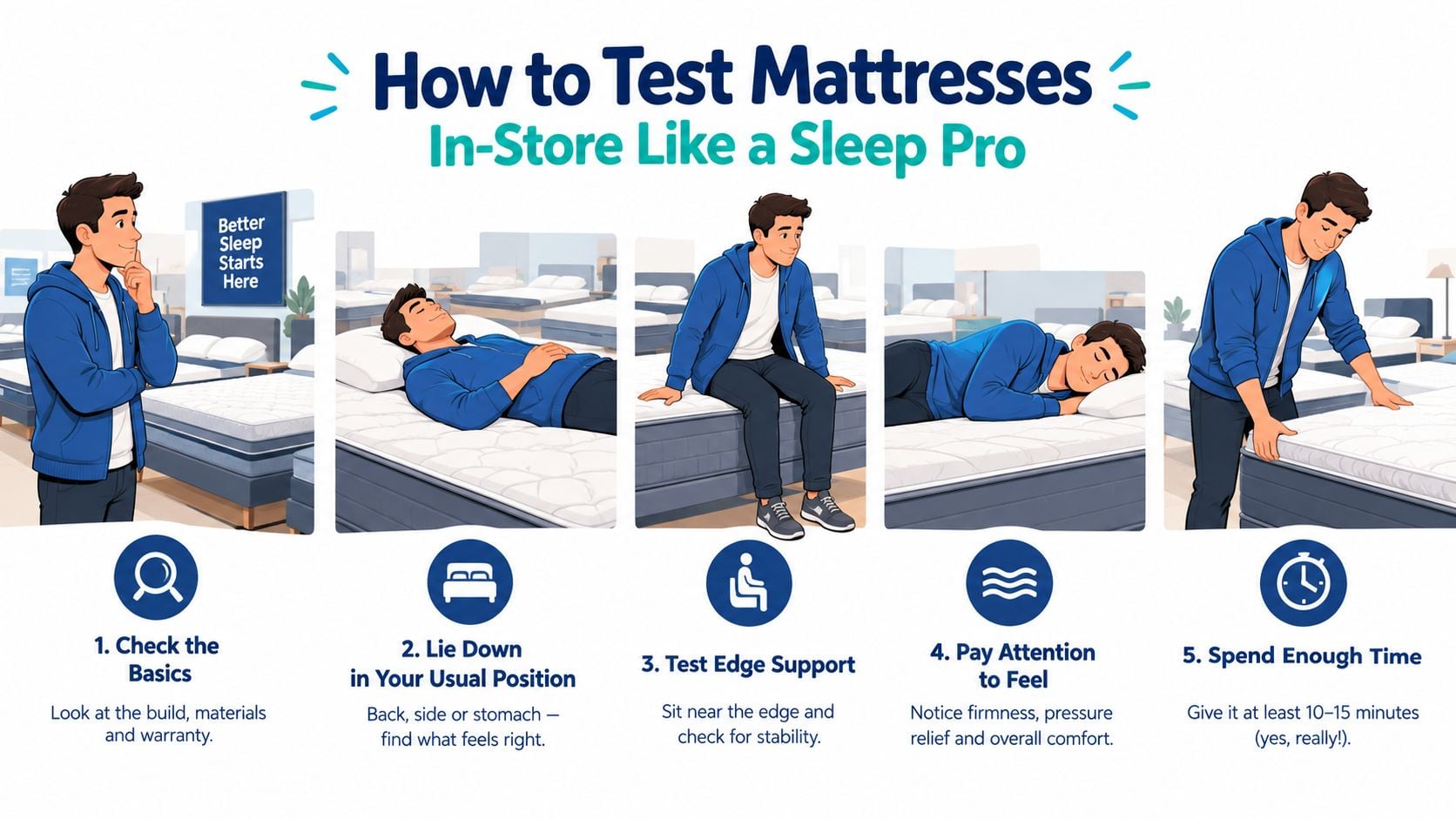
Five practical testing steps
- Begin in the primary position. A side sleeper should lie on the side with a pillow close to the normal height. The shoulder, hip, waist, and knees should be checked for pressure and support.
- Stay long enough to notice changes. Spending at least 15 minutes in the primary position gives the comfort layers time to respond. A quick sit can hide pressure that appears after the body settles.
- Check the edge while sitting. Sit near the usual entry point. The edge should feel stable rather than collapsing under the body.
- Test the edge while lying down. Move near the perimeter in the normal sleep position. A good edge should preserve confidence without forcing the sleeper toward the center.
- Add movement and partner testing. Roll from side to back, sit up, and return to the side. When two people share the bed, one partner should move while the other remains still.
The mattress selection guide can help organize the questions before a visit. A Sleep Pro should also compare Tempur-Pedic, Sealy, Stearns & Foster, and Sherwood models by construction and feel, not by brand reputation alone.
What the body should report
A side sleeper shouldn't feel a sharp ridge under the shoulder or a hollow beneath the waist. The hips should settle enough for comfort but shouldn't feel lower than the chest and legs. Rolling should require effort, but not a struggle against deep foam.
Ruidoso shoppers can make the test more realistic by bringing the pillow style used at home and wearing ordinary sleepwear. The dry mountain climate also makes cooling worth testing. A breathable cover may feel pleasant on the showroom floor, but the complete bedding setup still affects overnight temperature.
Solving Complex Sleep Challenges for Couples and Back Pain
A shared mattress must support two different bodies without forcing either sleeper into an uncomfortable compromise. Weight, sleep position, movement, and pressure sensitivity can differ substantially between partners.
Different bodies need different support responses
A side sleeper may need more shoulder cushioning, while a back or stomach sleeper may need stronger midsection control. One uniform surface can work when both partners accept the same feel, but a split-king arrangement or dual-firmness design may be more practical when preferences are far apart.
The couple should test the bed together. One partner can lie still while the other changes position, sits near the edge, and gets out of bed. The test should include both partners on the perimeter because edge behavior can change when the load is distributed across the full surface.
A useful couple's test: Comfort matters on each side, but stability matters across the entire sleep surface.
Motion isolation also deserves a physical test. Dense foam can absorb movement, while a well-designed hybrid can balance motion control with easier movement. The right choice depends on whether the couple values a quieter surface, a more buoyant feel, or both.
Lower back pain needs alignment, not just firmness
A side sleeper with lower back pain shouldn't automatically choose the firmest mattress available. The body needs enough cushioning at the shoulder and hip to maintain a relatively neutral line, while the transition layers and support core prevent the pelvis from dropping.
Targeted lumbar zoning can help when the support zones align with the sleeper's body. Transitional foam can bridge the difference between the deeper shoulder area and the heavier hip area. Neither feature guarantees relief, so the mattress should be tested in the actual side-sleeping position.
A painful mattress can make the sleeper brace the muscles throughout the night. A supportive mattress should feel steady without creating pressure, and a healthcare professional should be consulted when pain is persistent, severe, or associated with other symptoms.
The Miller Waldrop Difference and Local Sleep Solutions
A mattress purchase involves more than selecting a comfort level. It includes delivery, setup, warranty questions, frame compatibility, and the confidence that the chosen bed can be reconsidered if the fit isn't right.
Miller Waldrop brings a 70-year family legacy to Ruidoso and Lincoln County. Its local Sleep Pros understand the practical concerns of mountain homes, including access routes, cabin bedrooms, changing temperatures, and the need for a sleep system that works beyond the first night.
Local guidance reduces the guesswork
A bed-in-a-box website can show specifications and ship a package. It can't physically observe shoulder pressure, pelvic sinkage, edge instability, or the way two partners move on the same surface. In-store guidance lets a sleeper compare construction instead of relying on a generic firmness chart.
The Comfort Promise addresses the fear of picking the wrong bed. That reassurance matters for plus-size side sleepers because body weight can change how quickly a comfort layer softens and how the body settles. The right local policy gives the shopper a practical path if the initial choice doesn't deliver the expected comfort.
Service continues beyond the sale
The Low Price Promise helps budget-conscious shoppers compare value locally, while flexible financing can make a complete sleep system more manageable. The service should include more than a mattress placed at the door.
Full-Service Delivery with Professional Setup handles the heavy lifting and places the mattress correctly in the home. Professional setup is especially valuable when the mattress is tall, substantial, or destined for a cabin, upper-level bedroom, or tight hallway near Sudderth Drive. Local support also makes warranty questions and foundation concerns easier to discuss.
Mattress Pro by Miller Waldrop, located in Ruidoso, provides a showroom setting for evaluating sleep systems from Tempur-Pedic, Sealy, Stearns & Foster, and Sherwood. A local Sleep Pro can match body type, sleeping position, comfort preference, and budget without reducing the decision to firmness alone.
Common Questions About Plus-Size Mattress Care and Warranties
What foundation should support a heavier sleeper?
A plus-size sleeper needs a foundation or adjustable base rated for the complete sleep system. The mattress rating does not automatically cover the frame, slats, center support, or legs.
Before delivery, confirm:
- Foundation capacity: Check the manufacturer's current specifications.
- Frame construction: Verify center support, slat spacing, and floor-contact legs.
- Adjustable-base compatibility: Match the exact mattress model and size.
- Warranty requirements: Keep approved foundation details with the purchase documents.
The mattress warranties guide explains why approved support matters. An unsuitable base can change comfort and complicate a warranty claim. In Ruidoso's high-altitude mountain climate, proper support also helps protect the sleep system through seasonal changes.
Should a reinforced hybrid be rotated?
Rotate a reinforced hybrid only when the manufacturer permits it. Follow the care instructions for that specific design instead of applying a universal schedule. Rotation can distribute wear, but it cannot correct an unsuitable foundation or a comfort layer that has already softened.
Do not flip the mattress unless it was built for two-sided use. A topper, protector, and fitted sheets should match the mattress profile without compressing the edges.
What weight limits apply to premium mattress brands?
Capacity varies by model, size, foundation, adjustable base, and frame. Do not assume one limit applies across an entire mattress line.
Ask the store or manufacturer for written capacity confirmation for the exact model and size before purchase. The calculation should include the sleeper or sleepers, mattress, bedding, pets, foundation, adjustable base, and frame. Request separate guidance for split configurations or a shared bed.
Mattress Pro by Miller Waldrop offers local Sleep Pro guidance, the Comfort Promise, the Low Price Promise, and Full-Service Delivery with Professional Setup for Ruidoso and Lincoln County sleepers. Visit Mattress Pro by Miller Waldrop at 2801 Sudderth Drive, Suite F, in Ruidoso to test reinforced hybrids, pressure-relieving comfort layers, and stable edges in person.