

Consumer Reports Best Mattress for Couples


You are not shopping because a mattress looks worn. You are shopping because one of you rolls over at 2 a.m., the other wakes up, and neither of you feels rested by morning. One side feels too soft, the other wants more support, and every online list promises a winner without explaining why it should work for two different bodies.
That gap is exactly why couples search for Consumer Reports best mattress for couples guidance. The useful question is not which bed wins a headline. The useful question is how a shared bed handles motion isolation, support, firmness, and durability when two people test it every night.
Why Couples Need a Different Mattress Standard
A solo mattress has one job: keep one spine aligned in one position. A shared mattress has to do that twice, on the same surface, while one of you rolls over, gets up early, or reads with the light on.
That is the flaw in most Consumer Reports best mattress for couples lists. They name winners. They rarely tell you how to translate the testing into a floor model you can try in ten minutes. Consumer Reports ratings combine lab performance with owner satisfaction surveys, and that matters because a bed can feel plush under your palm and still broadcast every partner shift after midnight.
Two Sleepers Change the Math
You bring different weights, heights, and preferred positions to the same queen or king. A side sleeper needs pressure relief at the shoulder and hip so the spine stays aligned. A back or stomach sleeper usually needs a firmer, flatter surface so the hips do not sink. If one of you is a 130-pound side sleeper and the other is a 220-pound stomach sleeper, “medium” means two different things.
Size is part of the equation. Usable width decides whether either of you gets pushed toward a weak edge, and edge support decides whether that outer third feels stable or like a ramp. Couples who feel crowded should start with a practical guide to mattress sizes and room fit before debating foam versus coils. More space does not fix motion transfer. Too little space makes every movement harder to avoid.
The Four Filters That Matter Most
Use these filters in order when you compare any ranking to a floor model:
- Stability: Does movement stay on one side, or does it ripple to the other pillow?
- Support: Does each spine stay aligned in your real sleep positions, not just flat on your backs?
- Firmness fit: Can one firmness serve both bodies, or is one partner compromising?
- Durability: Will that feel hold up under two sleepers, night after night?
A couples mattress is not the softest bed in the store. It is the bed where neither partner trades support for quiet sleep.
In Ruidoso and across Lincoln County, add a fifth local filter: temperature. Dry mountain air and cool nights can hide heat buildup during a quick daytime lie-down, especially in Alto cabins and second homes where bedroom temperatures swing. Judge cooling and edge support with the same seriousness as firmness.
At Mattress Pro by Miller Waldrop, the Sleep Pro fitting starts before the brand name: how you sleep, who moves more, what wakes you now, and which side each of you claims. The right shortlist follows from those answers, not from a headline.
How Consumer Reports Tests Mattresses for Couples
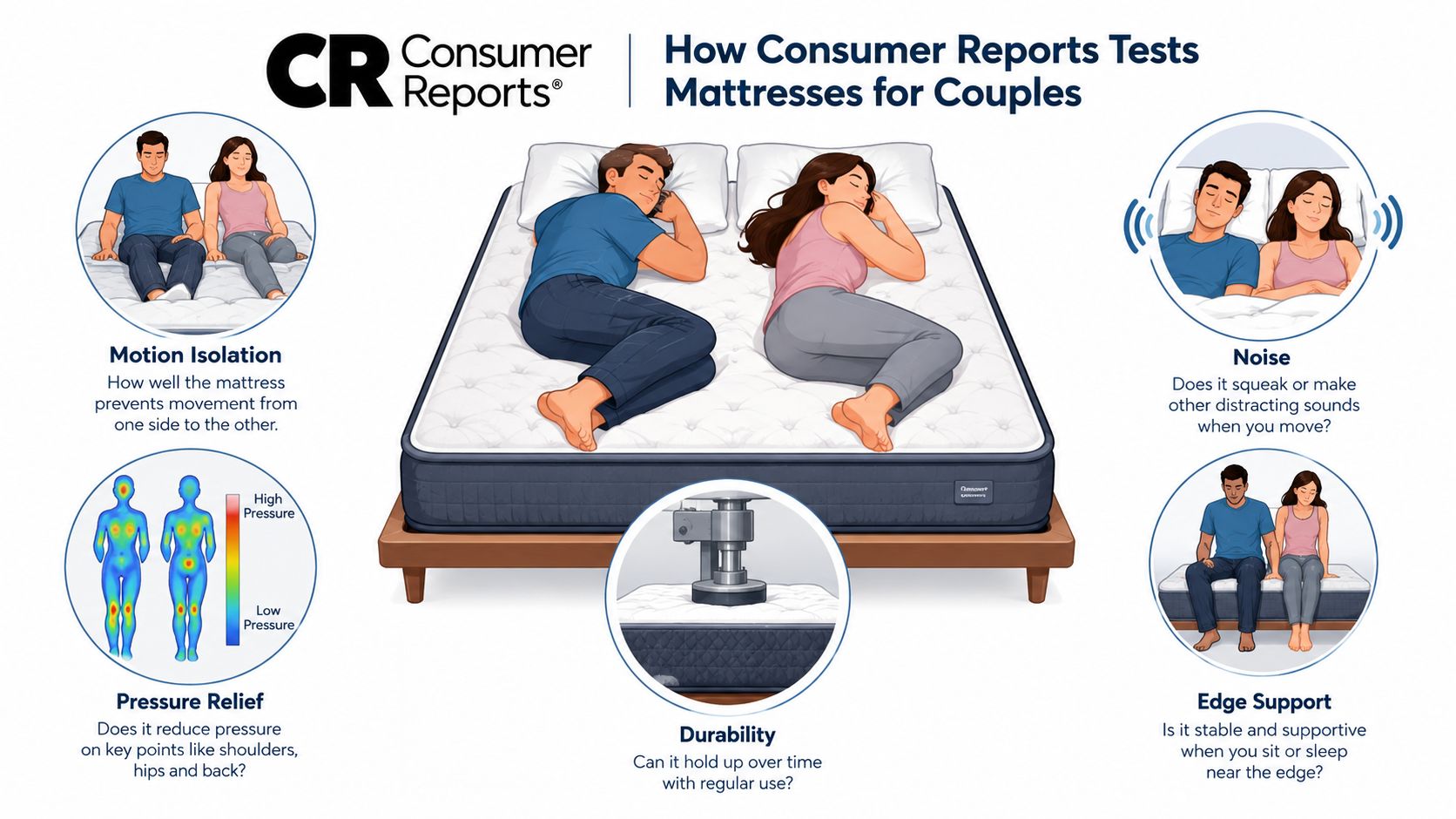
A score means nothing until you know what produced it. Consumer Reports tests queen-size mattresses in an outside laboratory overseen by its staff, a lab with more than 25 years of mattress-testing experience. The same protocol page shows firmness, support, stability, and durability scored as separate measurements rather than folded into one vague comfort grade.
What the Stability Test Simulates
For two sleepers, stability is the number to chase. Consumer Reports describes foam models generally outperforming traditional innersprings at keeping one sleeper's movement from reaching the other, and notes that individually wrapped coils typically isolate motion better than interconnected coils. Its lab method drops a heavy weight and measures vibration at the impact point and across the rest of the surface.
Translate that test the moment you step onto a showroom floor. If a mattress cannot contain a controlled weight drop, it will not contain your partner's 3 a.m. roll. Read up on what strong motion isolation looks like in mattress construction before you visit, then verify the claim by lying down together and taking turns shifting position.
Firmness and Durability Are Measured, Not Guessed
Consumer Reports measures firmness on a new mattress and again after durability testing. That second reading is the one couples skip. Two bodies compress foams and coils faster than one, so a bed that starts medium-firm can drift toward hammock territory within a few years when the materials are weak.
The durability protocol is punishing on purpose. Consumer Reports' own published testing history also records blind rest tests run with 54 staff members back in 2010, pairing instrumented measurement with human comfort judgment. Instruments tell you whether a surface survived. People tell you whether it still feels secure when you change positions. You need both answers before trusting a ranking.
Practical rule: trust a couples recommendation more when stability and durability scores are strong together. A quiet bed that sags early is still the wrong bed.
Do not read a score as a personal verdict. Read it as evidence that a construction survived partner-like impact and long-term wear. Your job in Ruidoso is to confirm that the surviving construction also fits your shoulders, hips, and temperature needs. That confirmation happens at Mattress Pro by Miller Waldrop, where a Sleep Pro will walk you through the same impact-and-feel check on the floor models you are deciding between.
Comparing Mattress Types for Two Sleepers
Construction drives couples performance more than a label like plush or luxury. Memory foam, hybrid, traditional innerspring, and latex each solve one problem well and create a trade-off somewhere else. Your job is to pick the trade-off you can live with.
Sleep Foundation methodology notes that all-foam mattresses with memory-foam comfort systems consistently rank highly for motion isolation, while hybrids with pocketed coils and substantial comfort layers generally isolate movement better than conventional innersprings with thin comfort sections, in its motion isolation testing methodology. That finding matches what Sleep Pros see during couple tests on Sudderth Drive. Foam absorbs, interconnected coils broadcast.
Mattress Type Performance for Couples
| Construction | Motion Transfer | Edge Support | Cooling | Firmness Flexibility | Durability |
|---|---|---|---|---|---|
| Memory foam | Very low | Moderate, varies by base foam | Moderate, better with cooling gel | Good for similar preferences | Good when foams are dense |
| Hybrid | Low with pocketed coils | Stronger, especially reinforced edges | Better airflow through coils | Strong across body types | Strong when coils and foams are quality |
| Traditional innerspring | Higher with interconnected coils | Often firm at perimeter | Airy and cooler feeling | Limited for mismatched couples | Variable by coil and padding quality |
| Latex | Low to moderate, more responsive | Moderate to strong | Naturally breathable feel | Good, but bouncier feel divides couples | Very resilient |
How to Read the Trade-Offs
Memory foam contours closely, spreads pressure across shoulders and hips, and keeps spinal alignment steady for many side sleepers. The cost is responsiveness. Strong absorption can make repositioning feel slower, which bothers combination sleepers and anyone with mobility limits.
Hybrids from lines like Sealy and Stearns & Foster pair pocketed coils with foam comfort layers. You get easier movement, better perimeter use, and more airflow than most all-foam beds. Motion isolation depends heavily on how thick and absorptive the comfort layers are, so you still need a partner test rather than trusting the word hybrid.
Traditional innerspring models feel familiar and bouncy, and they can sleep cooler. For light sleepers, that bounce is usually the problem, not the benefit. If you want a fuller breakdown before comparing floor models, review innerspring versus memory foam construction differences and bring your questions to the fitting.
Latex deserves consideration when you want contour without a stuck feeling. It responds faster than memory foam and holds its shape well. Some couples love that buoyant feel, while others find it transmits just enough movement to notice.
On firmness, do not chase extremes. A peer-reviewed study of people replacing older bedding found medium-firm bedding reduced reported back pain by approximately 48% and improved sleep quality by about 52%. That does not make medium-firm automatic for you, but it explains why Sleep Pros usually start mismatched couples there and adjust.
The clear recommendation is simple. Most couples should start with foam or a foam-forward hybrid, then move toward latex or innerspring only if responsiveness or cooling matters more than stillness. Softness is the wrong first question. Absorption is the right one.
Your 60-Second Showroom Motion Test
Most couples lie down, smile, and choose too fast. You need a routine you can repeat on every candidate, in the same order, so your impressions stay comparable. This test takes about a minute per bed once you know the steps, plus a short heat check on your finalists.
Wear normal clothes, use the pillow style you sleep on, and test in your real positions. If one partner cannot attend, a Sleep Pro can play the moving partner. Solo impressions are useful, but they cannot replace a two-person disturbance test.
Step One Test Partner Movement
- Partner shifts: One person lies still with eyes closed while the other rolls from back to side, sits up, and gets out of bed.
- Score the transfer: Rate what reaches the still partner as none, mild, or disruptive, and say it out loud so you remember it.
- Switch roles: Repeat with the lighter or more sensitive sleeper as the still partner, because that person sets the pass mark.
Do not accept mild on every bed without asking why. Mild transfer on a hybrid might come from a thin comfort layer. Mild transfer on foam might disappear once you use your own pillows and bedding at home.
Step Two Test the Edge
Sit on the perimeter as if putting on socks. The surface should stay stable enough that you do not slide forward. Then lie near the edge in your sleep position and roll slightly toward the side.
- Usable surface: You should feel supported close to the edge, not tipped outward.
- Getting up: You should be able to plant your hands and stand without the side collapsing.
- Partner space: Strong edges matter more on a queen, where every inch counts for couples.
Excellent motion isolation does not guarantee a stable perimeter. Test both, every time.
Step Three Check Heat and Ease of Movement
Lie still on your finalist for two full minutes. Notice whether heat builds under your back or hips, especially if you already sleep warm in Ruidoso's dry mountain climate. Then roll side to side and judge whether the surface helps you move or holds you in place.
Combination sleepers should weight ease of movement heavily. A bed that absorbs every ripple can still frustrate you if changing positions feels like work. Note heat, effort, and pressure at the shoulder before you move to the next model.
Even a careful test cannot predict night twenty at home. That is why the Comfort Promise exists, as protection against the fear of picking the wrong bed. You test in the showroom, and the promise gives you a path forward if the feel proves wrong after real sleep.
Bring your scores to the Sleep Pro rather than trying to remember five beds. None, mild, or disruptive, plus edge and heat notes, will narrow a wall of options to two serious finalists quickly. That is how a consultative fitting should work.
When Couples Need a Split or Adjustable Bed
Some couples do not need a better compromise. They need separate control. If one of you wants firm and flat while the other wants plush and raised, a single shared surface forces one person to lose every night.
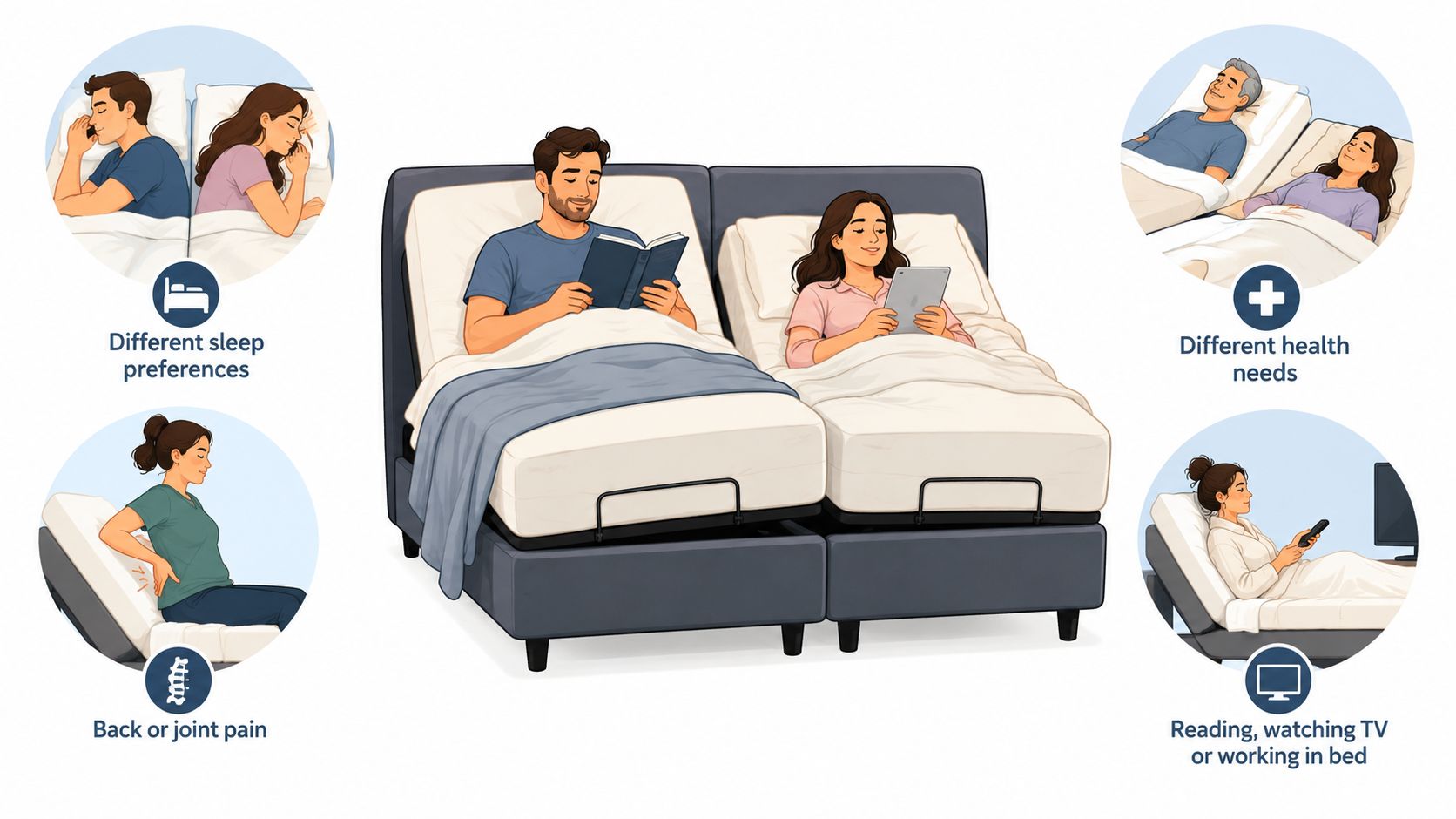
A split configuration lets each side use a different firmness or elevation. An adjustable base under one shared mattress still helps when you agree on the mattress but want head or foot elevation for reading, reflux comfort, or getting in and out more easily. Couples considering that route should review how adding an adjustable base changes a sleep setup before assuming a new mattress alone will solve positioning.
What the Adjustable Base Evidence Supports
A 2025 field study published in SLEEP found adjustable-base users reported 15% better perceived sleep quality, 18% greater morning refreshment, and 28% less back pain. A related multi-feature base report in that same research summary described larger perceived gains. Those are meaningful comfort signals, not medical proof.
Hold the line on that nuance. The studies were short and pre-post rather than randomized clinical trials, and objective sleep measures did not improve. An adjustable base is a comfort-management tool, not treatment for chronic pain.
A Clear Decision Rule for Couples
Choose a standard shared mattress when your firmness preferences are close, your schedules align, and the showroom motion test scores none or mild. In that case, a quality Tempur-Pedic foam model or a supportive hybrid will usually serve you better than paying for separation you do not need. Simpler is better when compromise costs neither partner real sleep.
Move to split or adjustable when any of these apply:
- Firmness gap: One partner consistently chooses firm while the other chooses plush on every test bed.
- Position gap: One partner needs elevation to get comfortable while the other sleeps flat.
- Mobility gap: One partner needs an easier exit height or lift assistance from the base.
- Disturbance gap: Adjustment noise or elevation changes would wake the other partner unless sides operate independently.
Test the base the way you test the mattress. Raise and lower each side while your partner lies still, listen for motor noise, and check whether vibration crosses the middle. Sherwood and Tempur-Pedic lineups at local showrooms include adjustable-friendly options worth trying side by side.
Do not buy split technology to fix a heat problem or a blanket fight. It solves firmness and positioning differences. Naming the actual problem first keeps you from buying the most complex answer to a simple issue.
Beyond the Mattress, Diagnosing Sleep Conflicts
A top-rated couples mattress can still lose to a hot bedroom, a stolen blanket, or a 5 a.m. alarm. Before you replace a bed that passes motion and support tests, diagnose whether the mattress is the source of the conflict. Many couples spend on construction when bedding or schedule is the culprit.
Recent coverage of couples sleep notes that research focuses more on the broader sleep environment, including temperature, noise, light, and routines, than on mattress rankings alone, in a University of the Sunshine Coast review of the Scandinavian sleep method. That same coverage cautions that separate bedding has not been directly tested in controlled research. Treat it as a practical experiment, not a proven cure.
Three Questions to Answer Before You Spend
First, where does the heat come from? A sleeper can run warm because of metabolism, medication, or room temperature, while a mattress can trap heat because dense foam limits airflow. If you wake hot on hotel beds and guest beds too, bedroom climate and bedding layers deserve attention before a new mattress does.
Second, what wakes the other person? Track a week. Is it rolling, cover pulling, getting up, snoring, or a phone alarm? Couples who suspect snoring is part of the pattern can review mattress and positioning tips that may help alleviate snoring while remembering that persistent snoring deserves medical advice.
Third, how far apart are your schedules? If one partner reads late and the other rises early, separate blankets, a dimmer lamp routine, or a split base may help more than switching foam brands. Dual-zone firmness does not automatically solve light, noise, or temperature conflict.
Low-Cost Tests for Lincoln County Homes
- Separate top blankets: Try two lighter blankets for several nights and note whether cover movement wakes either partner.
- Bedroom climate check: Adjust nighttime temperature and bedding layers for mountain day-night swings before blaming foam.
- Cover-change test: Have one partner change covers while the other rests, and judge whether bedding, not the mattress, transmits the disturbance.
Mattress choice is only one part of couple compatibility. Bedding configuration and sleep environment may deliver bigger gains than swapping one well-rated mattress for another.
For vacation cabins and occasional-use bedrooms, weigh humidity, layered bedding, and infrequent occupancy. A guest couples bed needs easy care, stable edges, and a broadly comfortable medium feel more than personalized technology. Your primary bedroom deserves the opposite priority, precise fit for the two people who use it nightly.
Run the diagnostic first, then shop. If motion still scores disruptive after bedding and climate fixes, you have clean evidence that construction is the problem. That evidence makes your showroom test faster and your purchase more confident.
Putting It All Together With Your Local Sleep Pro
A couple walks into the showroom with a notebook. One page lists wake-up times, the other has motion scores from three weeks of testing at home. Twenty minutes later they are down to two mattresses. That is what a consultative fitting does with the standard, the test, and the diagnostic you have already built.
How a Consultative Fitting Narrows the Field
A Sleep Pro starts with sleep position, body type, pain points, temperature, and who wakes whom. From there, the shortlist usually maps cleanly to four priority brands. Each serves a different couples profile, and none should be chosen by name alone.
- Tempur-Pedic: Dense pressure-relieving foam for couples who rank motion isolation and contour first.
- Sealy: Reliable hybrid support for couples who want coil responsiveness with foam comfort.
- Stearns & Foster: Premium craftsmanship and reinforced comfort for couples who want a more substantial, traditional feel.
- Sherwood: Boutique comfort options for couples who want distinctive feels worth testing in person.
You then run the same partner-shift, edge, and heat checks on each finalist. The Sleep Pro watches spinal alignment from the side, something neither partner can judge well while lying down. That outside view catches hip sink and shoulder pressure that a mirror cannot.
Mattress Pro by Miller Waldrop is one local option for that process in Ruidoso, with Sleep Pros who match couples by body type, sleep position, and budget. The store is backed by a 70-year Miller Waldrop legacy as a family-owned local business, with a focus on sleep rather than general furniture. Neighbors in Alto and across Lincoln County get the same consultative approach, not a call center script.
The Promises That Remove the Risk
Three protections matter after you choose. The Comfort Promise addresses the fear of picking the wrong bed if real nights at home disagree with the showroom. The Low Price Promise gives you cost confidence locally, and flexible financing can spread a premium couples bed into a manageable monthly plan.
Full-Service Delivery with Professional Setup handles the rest, including placement in primary homes, cabins, and vacation rentals around Ruidoso. That matters with split bases and heavy hybrids, where correct setup affects feel and function. You should not have to wrestle a king hybrid up a mountain driveway to get good sleep.
Bring your notes, your partner, and your honest wake-up complaints. Test together, score every bed the same way, and let the evidence pick the finalist. That process beats any headline ranking, including a Consumer Reports best mattress for couples list read in isolation.
Ready to transform your sleep? Visit the Sleep Pros at the Mattress Pro showroom located at 2801 Sudderth Drive, Suite F, in Ruidoso, where couples can test Tempur-Pedic, Sealy, Stearns & Foster, and Sherwood side by side with the Comfort Promise, Low Price Promise, and Full-Service Delivery behind the choice. Browse the collection through Mattress Pro by Miller Waldrop or stop by Monday through Saturday to run the partner motion test together and wake up loving your mornings.