

Best Mattress for Motion Isolation: A Ruidoso Guide

A lot of couples in Ruidoso know this feeling. One person rolls over, gets up early for work, or shifts after a long day on the mountain, and the whole bed seems to ripple. The other person wakes up frustrated, even though nobody meant to disturb anybody.
That problem usually isn't about being a “light sleeper.” It's often about motion transfer, which means the mattress is passing movement from one side to the other instead of absorbing it. The best mattress for motion isolation can change that experience in a very practical way. Less shaking, fewer wake-ups, and a more settled night.
For families across Lincoln County, that choice can feel harder than it should. Online descriptions all sound similar, and a bed-in-a-box page can't tell someone how a mattress will feel when a partner gets in and out of bed at 2 AM. That's why local guidance matters, especially from a business with the Miller Waldrop legacy behind it, built on more than 70 years of helping neighbors sleep better.
Table of Contents
- Tired of Your Partner's Tossing and Turning
- What Is Motion Isolation and Why It Matters
- Comparing Mattress Materials for Motion Transfer
- How to Test a Mattress for Motion Isolation
- Your Ruidoso Sleepers Buying Checklist
- Caring For Your Low Motion Transfer Mattress
- Frequently Asked Questions About Motion Isolation
Tired of Your Partner's Tossing and Turning
It usually starts small. A shoulder turn. A leg adjustment. A quiet trip out of bed before sunrise. But on the wrong mattress, that small movement feels much bigger than it should.

For many couples in Ruidoso and Alto, that repeated disruption becomes the reason sleep never feels fully restorative. One partner says the bed feels fine. The other says every movement travels across the surface like a wave. Both can be right. The issue is often construction, not comfort alone.
That's why motion isolation matters so much. A mattress built to absorb movement keeps one sleeper's motions from becoming the other sleeper's problem. For couples with different schedules, pet owners, and anyone who wakes easily, it can make the bedroom feel calmer almost immediately.
A mattress can feel soft, supportive, and still perform poorly for motion control if the materials keep sending movement across the bed.
Couples who are also balancing different comfort needs may want a broader look at mattresses for couples with different preferences. Motion isolation is a big piece of the puzzle, but it works best when it's matched with the right support and feel.
The local part matters, too. Sleepers in Lincoln County often come in dealing with back tension, pressure points, or overheating in dry mountain air. The right motion-isolating mattress has to do more than stop shake. It also has to support spinal alignment, cushion the body well, and fit the way real people sleep night after night.
What Is Motion Isolation and Why It Matters
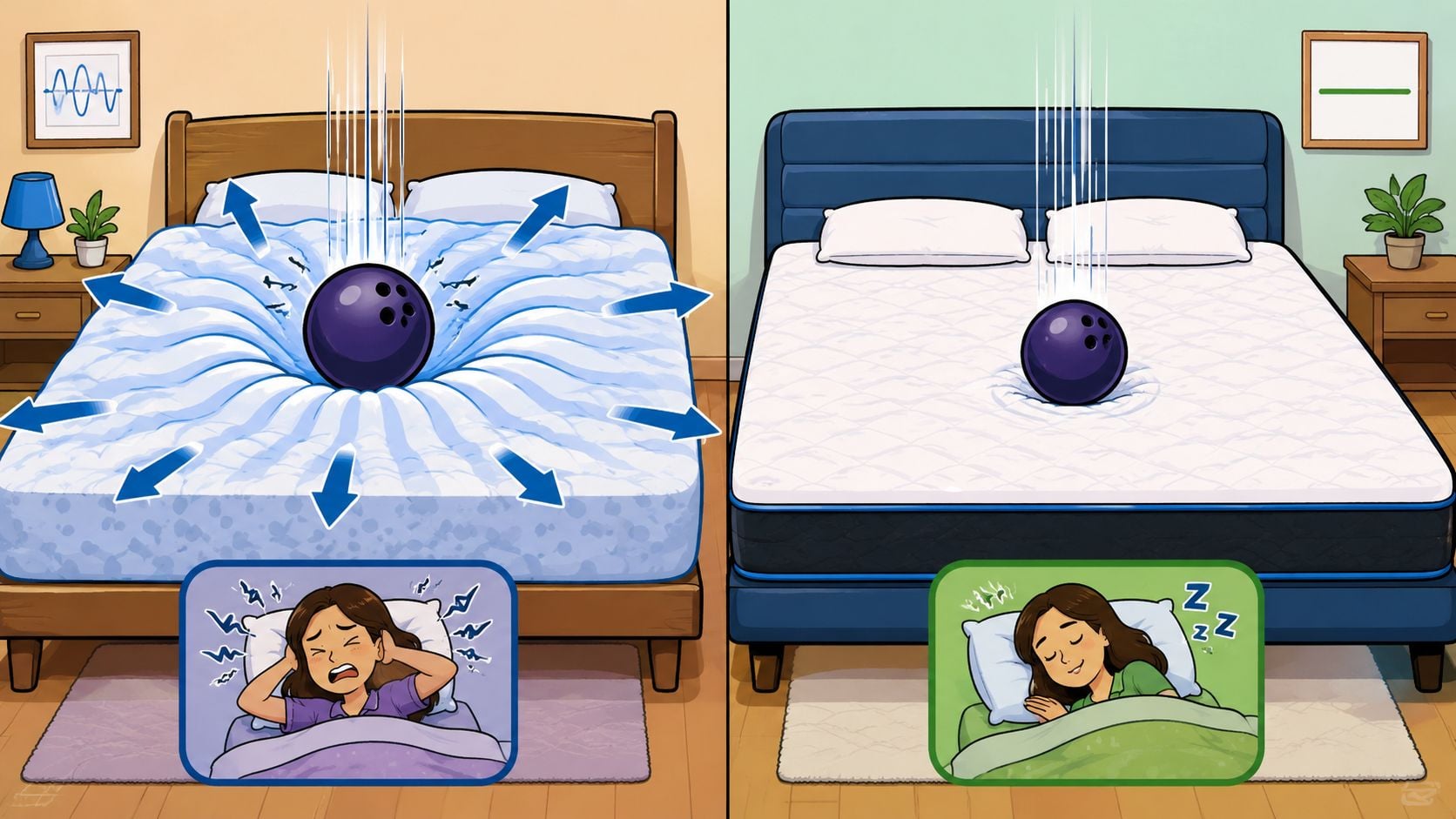
Motion isolation is a mattress's ability to absorb movement in one area so it doesn't spread across the surface. In plain language, when one person moves, the other person shouldn't feel much of it.
What motion isolation actually means
A simple way to think about it is this. A bouncy surface spreads force. A dense, contouring surface absorbs it closer to where it happens.
That's why memory foam is one of the most popular and effective materials for motion isolation because its dense, contouring structure absorbs movement before it can travel across the bed, making it ideal for couples and light sleepers. Readers who want a closer look at that material can explore what a memory foam mattress is.
When people first hear “motion isolation,” they sometimes assume it only matters if a partner tosses and turns dramatically. That's not the full picture. Smaller movements matter too. Shifting a pillow, changing sleep position, or sitting on the edge of the bed can all trigger motion on a less stable mattress.
Why disturbed sleep adds up
Interrupted sleep isn't always obvious in the moment. Some sleepers don't fully wake up, but their bodies still react to the disturbance. Over time, that can leave them feeling less rested in the morning.
This is especially important for:
- Couples with different schedules who don't go to bed or wake up at the same time
- Light sleepers who notice every movement
- Pet owners whose dog or cat jumps on and off the bed
- Older adults who may be more sensitive to shifts in the mattress surface
Practical rule: If one sleeper regularly says, “I felt you get up,” the mattress is probably transferring too much motion.
The best mattress for motion isolation doesn't just reduce annoyance. It helps create a steadier sleep surface, which is often what people were missing all along.
Comparing Mattress Materials for Motion Transfer
Material choice does most of the work here. The surface feel matters, but the inside construction decides whether movement gets absorbed, delayed, or sent straight across the bed.
Memory foam and why it leads
For raw motion control, memory foam usually sets the standard. Its viscoelastic structure compresses where pressure is applied and then returns more slowly than spring-based materials. That slower response helps keep movement local instead of launching it outward.
A study showed that memory foam mattresses demonstrated an 87% higher motion isolation rate than traditional innerspring models, and hybrids that combined individually wrapped coils with a memory foam top layer reduced motion transfer by an additional 45%, according to the verified study data provided for this topic.
That result lines up with what many shoppers feel in person. A quality foam build tends to mute movement rather than echo it. That's one reason Tempur-Pedic remains a priority brand in this category for shoppers focused on partner disturbance and pressure relief.
Some sleepers worry that all-foam beds will feel too slow or too warm. That's a fair concern. Better designs address that with improved support layers and cooling features, which matters in Ruidoso's dry mountain climate where temperature comfort can affect how much a person shifts through the night.
Hybrid mattresses and the support balance
A well-built hybrid can be an excellent compromise for people who want support, easier mobility, and strong motion control. The key is individually wrapped coils, sometimes called pocketed coils.
Each coil responds more independently than an old connected spring unit. That limits the wave effect that travels across the bed. It also gives hybrids a more lifted, supportive feel than many all-foam models.
Shoppers comparing feel differences may also find it helpful to review latex mattress vs memory foam.
Here's the important nuance. Not every hybrid isolates motion equally well. A thin comfort layer on top of coils usually won't do enough. The coil system may reduce some movement, but the comfort materials still need enough depth and density to absorb the leftover energy.
Traditional innerspring and why movement spreads
Traditional innerspring beds usually perform worst for motion isolation. Their connected coil systems tend to distribute force through the structure, which is why one person's movement can shake the opposite side.
These mattresses can still appeal to sleepers who like a familiar, buoyant feel. But if partner disturbance is the main problem, a basic spring build is rarely the smartest place to start.
That's also why shoppers often feel confused after trying mattresses quickly. A spring bed can feel supportive for a few minutes in the showroom, yet still do a poor job controlling motion once two people spend a full night on it.
Latex and other specialty feels
Latex can reduce some movement, but it usually feels more responsive and buoyant than memory foam. Some sleepers love that easier repositioning. Others notice more surface feedback than they want.
Adjustable air systems can also perform well for motion isolation, especially when each side can be tuned separately and paired with quality foam layers. For couples with very different firmness needs, that category can be worth trying in person.
Below is a simple comparison that many shoppers find useful.
| Mattress Type | Motion Isolation Rating | Feel | Best For |
|---|---|---|---|
| Memory foam | Excellent | Close-contouring, stable | Couples, light sleepers, strong pressure relief needs |
| Hybrid with pocketed coils and substantial foam | Very good to excellent | Balanced, supportive, easier to move on | Couples who want motion control without an all-foam feel |
| Latex | Good | Responsive, buoyant | Sleepers who want some motion control with more bounce |
| Traditional innerspring | Fair to poor | Bouncy, connected | Shoppers who prioritize classic spring feel over isolation |
The strongest hybrid options aren't “just coils plus foam.” They depend on the right coil design and enough comfort material on top to absorb what the springs don't.
For shoppers in Lincoln County furnishing a primary bedroom, guest room, or cabin, that difference matters. The best mattress for motion isolation isn't the softest model. It's the one whose materials stop movement at the source.
How to Test a Mattress for Motion Isolation
Reading specs helps. Testing in person tells the truth faster.
The simplest tests to do in person
A few showroom checks can reveal motion transfer within seconds:
Have one person roll normally
The second person should lie still and notice whether the movement travels across the bed.Try the get-in and get-out test
This matters for couples with different work schedules. A strong mattress won't jolt the resting partner every time the other person stands up.Press down on one side
A gentle push with a hand or forearm can show whether the surface sends a ripple outward.Use the glass test
Set a glass of water on one side and create light movement on the other. The less the water reacts, the better the mattress is controlling motion.
Hybrid mattresses with individually wrapped coils are a top choice for isolating movement because they confine motion to specific coils. That design works especially well for partners who toss and turn and still want sturdy support.
What to notice beyond the bounce
The first mistake many shoppers make is focusing only on whether the bed feels plush. Plush doesn't always mean stable. Sometimes a very cushy surface can still allow a lot of movement underneath.
It helps to pay attention to three things at once:
- Surface calm when the other sleeper moves
- Ease of repositioning if one sleeper changes positions often
- Edge stability when someone sits or gets up
A practical next step is to review this guide on how to choose a mattress, then use that checklist during an in-store test. That approach tends to be much more reliable than choosing from photos and marketing phrases alone.
Your Ruidoso Sleepers Buying Checklist
A mattress purchase gets easier when the decision starts with the sleeper instead of the label on the tag. That matters in Ruidoso, where sleep needs vary widely between active adults, retirees, cabin owners, and couples with very different routines.
Start with the sleeper, not the label
Use this checklist before narrowing the options:
Identify the main problem
If the main complaint is waking each other up, motion isolation should be near the top of the list. If the complaint is pain, temperature, or sagging, those issues need equal weight.Match feel to mobility
Some people want deep contouring. Others don't like feeling “held” by the bed. That difference often decides whether memory foam or a hybrid will feel better long term.Consider your local sleep environment
Ruidoso's dry mountain air can make temperature regulation more noticeable. Sleepers who run warm may want cooling-focused materials or a hybrid that balances airflow with good motion control.Think about who uses the bed
A full-time primary bedroom has different demands than a guest room or vacation rental in Lincoln County. Durability, support consistency, and ease of use all matter.
A mattress that stops motion but strains the shoulders, hips, or low back still isn't the right fit.
For shoppers who want a starting framework, this mattress buying guide can help narrow the field before testing in person.
Use the Miller Waldrop safety net
Local shopping alters the experience. The Miller Waldrop approach removes some of the risk that makes mattress shopping stressful in the first place.
The Comfort Promise addresses the fear of choosing wrong. The Low Price Promise gives budget-conscious shoppers more confidence. Full-Service Delivery with Professional Setup also matters more than many people expect, especially for larger homes, mountain access roads, upstairs rooms, and households replacing older sets.
One option many shoppers ask about is Mattress Pro by Miller Waldrop, which offers access to major brands such as Tempur-Pedic, Sealy, Stearns & Foster, and Sherwood in a local showroom setting where couples can test motion transfer side by side.
The flagship example in this category is straightforward. The Tempur-Pedic TEMPUR-Adapt was identified in 2026 testing as the Best Overall Motion Isolation Mattress, with a 4.6/5 overall score for motion damping and pressure relief in the verified data provided for this topic. For shoppers who want a proven place to begin, that makes it a logical model to test early.
A strong buying process often looks like this:
First test memory foam
That gives a clear benchmark for what low motion transfer feels like.Then test a premium hybrid
Compare whether the added lift and mobility feel better without giving up too much stability.Check edge behavior
One partner getting in and out of bed is a common source of disturbance.Ask about setup and protection
A good mattress performs best on the right foundation and with proper care.
For many households, the best mattress for motion isolation is the one that calms the bed down without creating new problems in comfort, heat, or support. That's exactly why trying the bed locally matters more than reading about it online.
Caring For Your Low Motion Transfer Mattress
Once a mattress is doing its job well, regular care helps it keep doing that job.
Protect the comfort layers
A waterproof mattress protector is one of the simplest ways to preserve the foam and fabric near the surface. Spills, body oils, and everyday moisture can wear down the materials that help absorb movement.
That's especially important for motion-isolating designs because the comfort layers often do much of the damping work. If those layers break down early, the bed can feel less stable over time.
Light vacuuming also helps, especially in Ruidoso where dry air and dust can build up more easily than people expect.
Keep wear even over time
Most modern one-sided mattresses benefit from periodic rotation. Turning the mattress end to end helps spread out wear so the comfort layers stay more even.
A simple routine works well:
- Rotate on a regular schedule to reduce concentrated body impressions
- Use the right foundation so the core stays properly supported
- Check for uneven settling before it becomes a bigger comfort issue
Good motion isolation depends on stable materials. Once the top layers wear unevenly, sleepers often notice more disturbance even if the mattress still looks fine.
If a household invests in a quality Tempur-Pedic, Sealy, Stearns & Foster, or Sherwood model, basic care goes a long way toward protecting both comfort and performance.
Frequently Asked Questions About Motion Isolation
Is memory foam always better than a hybrid
Usually for pure motion control, yes. But the answer depends on construction. The efficacy of motion isolation is primarily determined by decoupling the comfort layer from the support core. Individually wrapped coils or high-density foam cores prevent motion transfer, but the comfort layer must be sufficiently thick (≥2.5 inches) to absorb residual energy effectively, according to the verified data provided for this topic.
That's why some hybrids perform very well and others don't. If the comfort layer is too thin, the coils can't do all the work by themselves.
Can a mattress topper help
Sometimes, yes. A topper can reduce some motion on an older mattress, especially if the current bed is too bouncy. But it usually won't fully fix a mattress with a highly reactive support system underneath.
A topper works best as a temporary step, not as a substitute for a mattress that's specifically built for motion isolation.
Does the bed frame matter
Yes. Even a good mattress can feel less stable on the wrong base. A supportive, quiet foundation helps the mattress perform the way it was designed to perform.
If the frame shifts, squeaks, or flexes too much, sleepers may blame the mattress when the support system is really part of the problem.
What should couples prioritize first
Couples usually do best when they rank their needs in this order: motion isolation, support, pressure relief, and temperature comfort. Those priorities can shift a little based on body type and sleep position, but a mattress has to keep both people settled before anything else matters.
For couples in Ruidoso, Alto, and the rest of Lincoln County, that often means testing memory foam first, then comparing it to hybrids with pocketed coils and thicker comfort layers.
Ready to transform your sleep? Visit the Sleep Pros at Mattress Pro by Miller Waldrop. The showroom is located at 2801 Sudderth Drive, Suite F, in Ruidoso. From luxury brands to budget-friendly solutions, the team helps shoppers compare options, understand the Comfort Promise, use the Low Price Promise, and arrange Full-Service Delivery with Professional Setup so they can wake up loving their mornings. Browse the collection online or stop by Monday through Saturday.