

Best Back Pain Relief Products: A Ruidoso Guide


A lot of people in Ruidoso go to bed tired, hopeful, and already bracing for the morning. They wake up stiff through the lower back, shift to the edge of the bed, and wait a moment before standing because the first few steps hurt. Then the search begins. Endless product lists, mixed opinions, and too many promises from companies that never meet the person who'll sleep on the bed.
That confusion is real. Back pain makes every purchase feel high stakes, especially when a mattress, pillow, or adjustable base can change how the body feels all day. Neighbors in Lincoln County don't need more noise. They need clear guidance from people who understand how sleep products work and how mountain living, active routines, and Ruidoso's dry air shape comfort needs at night.
For families in Alto, along Sudderth Drive, and across the area, local help still matters. Miller Waldrop has served this region for 70 years, and that legacy means something simple. People can walk in, lie down, ask questions, and get matched to a sleep system built around the body they have, the pain they feel, and the budget they need to respect.
Table of Contents
- The Foundation of Relief Your Mattress
- Decoding Mattress Types for Back Pain
- Beyond the Mattress Essential Support Products
- How to Choose Your Perfect Sleep System
- The Miller Waldrop Difference Why Shopping Local Matters
- Your Next Steps to Pain-Free Mornings
The Foundation of Relief Your Mattress
When back pain is part of the picture, the mattress usually does the heavy lifting. Heat packs, pillows, and other support products can help, but the body still spends hours on one surface every night. If that surface bends the spine out of shape or creates pressure at the hips and shoulders, the muscles stay tense instead of recovering.
A simple way to think about it is a house foundation. If the base shifts, everything above it has to compensate. Sleep works the same way.
Why spinal alignment matters
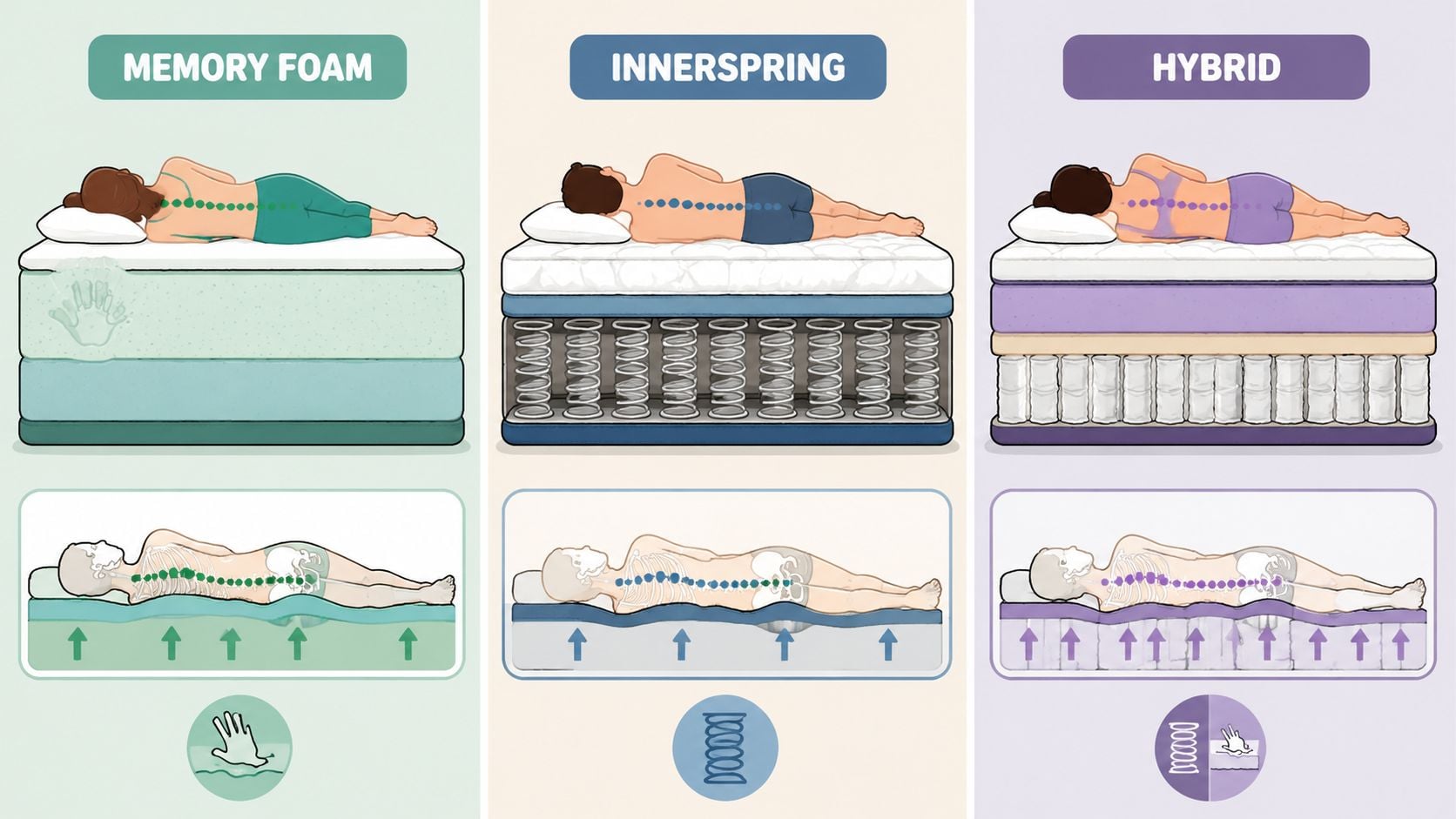
A healthy sleep surface helps the spine rest in a more natural line. That doesn't always mean hard. It means the mattress supports the heavier parts of the body, especially the hips and torso, without letting them sink too far.
If the bed sags in the middle, the lower back often takes the hit. If it's too firm and flat for the sleeper's shape, the body may twist or tense to find relief. Either way, the muscles work when they should be off duty.
Practical rule: The right mattress should let the body settle in without letting the midsection drop lower than the rest of the spine.
Pressure relief changes the whole night
Pressure relief matters because pain rarely stays in one neat spot. A mattress that pushes too hard against the shoulders, hips, or ribs can trigger tossing and turning. That constant repositioning interrupts rest and often leaves the back feeling worse by sunrise.
Mattress materials are key. Foams can spread body weight differently than coils, and hybrids can combine support with cushioning. For shoppers who want a deeper explanation of how firmness, support, and materials work together, this mattress buying guide for local shoppers is a useful next read.
A mattress isn't just a comfort item. For many people, it's one of the most important back pain relief products in the home because it affects posture for hours at a time.
Decoding Mattress Types for Back Pain
Shoppers often hear broad advice like “get something firm” or “try foam.” That's too simple. The better question is how each mattress type supports the spine, eases pressure, and handles body heat through the night.
Different builds solve different problems. That's why trying beds in person matters so much in a place like Ruidoso, where some sleepers want contouring comfort and others need easier movement and a cooler feel.
Memory foam for contouring support
Memory foam is built to respond to body weight and shape. For sleepers with sore pressure points, that contouring effect can be a big advantage because it helps distribute weight more evenly across the surface.
Tempur-Pedic is often the category people ask about first, and for good reason. This style of bed tends to suit people who want close body-conforming support and less sharp pressure at the shoulders and hips. Some models also use cooling materials, which can help sleepers who run warm even in Ruidoso's cooler nights and dry mountain air.
This category often fits:
- Side sleepers: They usually need more give around the shoulders and hips.
- People with pressure point pain: Foam can soften those concentrated load areas.
- Couples bothered by motion: Foam tends to absorb movement well.
Hybrid beds for balance
A hybrid combines coils with foam or similar comfort layers. That gives the bed two jobs. The coil system supports the body from below, while the upper layers cushion the joints and reduce sharp pressure.
Sealy and Stearns & Foster hybrids are strong options for shoppers who don't want the deep hug of all-foam but still need better pressure relief than a basic innerspring usually provides. They often work well for people with back pain because they balance support, responsiveness, and easier repositioning.
A sleeper who says, “foam feels too stuck, but the old spring bed hurts my hips,” often ends up most comfortable on a hybrid.
Hybrids commonly suit:
- Back sleepers: They often need support under the lower back without an overly rigid feel.
- Combination sleepers: They move more and usually prefer a surface that responds faster.
- Hot sleepers: More airflow through the coil system can help with temperature control.
A helpful local reference for comparing mattress constructions is this guide to mattress types and feel.
Innerspring support with a familiar feel
An innerspring mattress uses coils as the main support system and usually has a thinner comfort layer on top. Sherwood models often appeal to shoppers who want a more traditional sleeping surface with a bit more lift and less sink.
This type can feel easier to get in and out of, which matters for some adults with morning stiffness. It also gives a familiar, buoyant sensation that some people prefer.
That said, innersprings are usually less pressure-relieving than memory foam or hybrids. For back pain, they tend to work best when the sleeper wants a firmer, more classic feel and doesn't need heavy contouring around the shoulders or hips.
Beyond the Mattress Essential Support Products
The mattress is the base layer of relief, but it isn't the whole system. Plenty of people buy a new bed and still wake up sore because the pillow is wrong, the base is flat when the body wants elevation, or the mattress surface needs a small comfort adjustment.
That's where support products earn their place. They don't replace the mattress. They refine it.
Pillows keep the top of the spine honest
Many people think of back pain as a lower-body issue, but neck angle affects the whole spinal chain. If the pillow is too tall, the head tilts up. If it's too flat, the head drops back or to the side. Either problem can create tension through the neck, shoulders, and upper back.
A good pillow should match sleeping position:
- Side sleepers: Usually need more loft to fill the space between shoulder and head.
- Back sleepers: Usually do better with moderate loft that supports the neck without pushing the chin forward.
- Stomach sleepers: Often need a very low profile, though this position can be harder on the back overall.
Toppers can fine tune the feel
A topper can help when the mattress support is decent but the surface feel is wrong. For example, a mattress may still hold the spine well but feel too firm at the shoulders. In that case, a topper may add comfort without changing the entire bed.
This works best as a fine-tuning tool, not as a cure for a worn-out mattress. If the bed has visible sagging or uneven support, a topper usually masks the problem instead of solving it.
One practical option for shoppers exploring premium pressure-relieving materials is to review Tempur-Pedic sleep solutions and support layers.
A topper can soften the surface. It can't rebuild support that the mattress has already lost.
Adjustable bases help lower back pressure
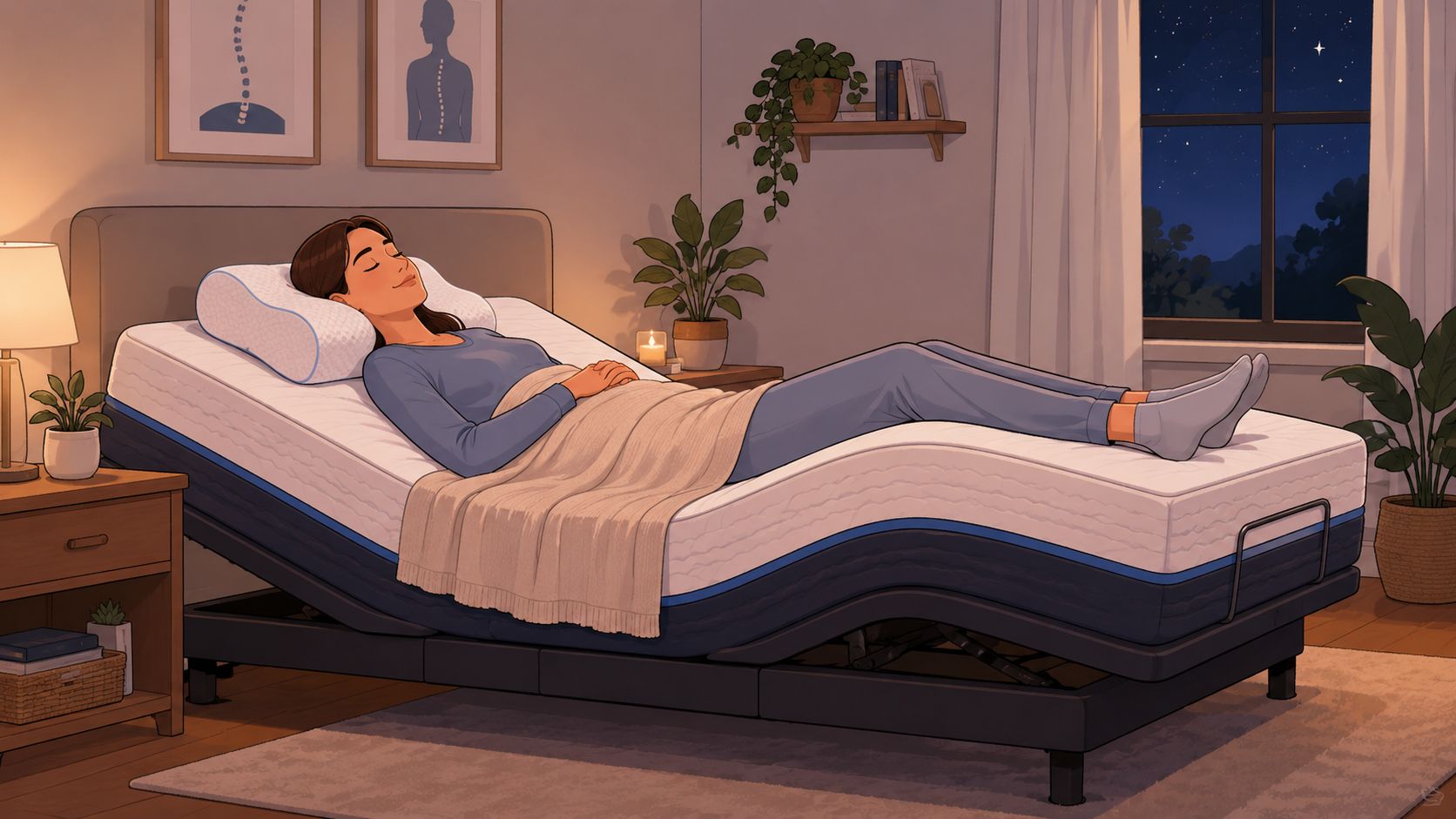
An adjustable base changes the body's position, and that can matter a lot for lower back comfort. Slightly elevating the head and legs can reduce strain through the lumbar area and make it easier for some sleepers to relax into the bed.
This is one of the most overlooked categories among the best back pain relief products tied to sleep. People often focus only on the mattress feel, but body position can be just as important.
Outside the bedroom, some people also use short-term relief tools during the day. Customer satisfaction data found that TENS units and cold/heat therapy packs had a median customer rating of 4.5 out of 5, with an interquartile range of 4.3 to 4.6, while hand and arm massagers scored lower and more inconsistently. That same analysis estimated annual costs at $50 to $260 for TENS units, $20 to $75 for heat therapy, and $15 to $40 for cold therapy, while topical patches were estimated at $120 to $720 annually because they need frequent refills (customer ratings and annual cost ranges for back pain relief devices). Those can help during the day, but sleep posture still depends on the bed, pillow, and base working together.
How to Choose Your Perfect Sleep System
Most shoppers don't need more choices. They need a cleaner way to narrow them down. The two most useful filters are sleep position and where the pain shows up most.
That combination usually points toward the right comfort level faster than buzzwords do. It also makes an in-store fitting much more productive.
For side sleepers with lower back pain
Side sleepers usually need enough cushioning at the shoulders and hips to prevent twisting. If those areas don't sink in at all, the waist may stay unsupported and the spine can angle awkwardly overnight.
A medium to medium-firm hybrid or a pressure-relieving memory foam model often makes sense here. The goal isn't softness for its own sake. The goal is to let the curves of the body settle while keeping the torso supported.
Useful checkpoints:
- Shoulders: They shouldn't feel jammed upward.
- Hips: They should settle slightly without dipping too far.
- Waist: It shouldn't feel like there's a gap with no support.
For back sleepers with upper back pain
Back sleepers usually do best on a surface that keeps the pelvis steady and supports the natural curve of the lower back. If the bed is too plush through the middle, the upper back and shoulders may tense in response. If it's too hard, the shoulder blades can feel pressed into the surface.
A supportive hybrid or a slightly firmer contouring foam bed can work well. The pillow matters just as much here. Too much loft can push the head forward and load the upper back all night.
The right setup lets the rib cage, hips, and head rest in a calm, neutral line instead of forcing the muscles to brace.
For combination sleepers who can't get comfortable
Combination sleepers need a bed that can do more than one thing well. It should cushion enough for side sleeping but respond fast enough for turning and repositioning.
That's why many of these shoppers prefer hybrids. The coil support helps with movement, while the comfort layers still reduce pressure. A comparison tool like this mattress comparison resource for different sleep needs can help narrow the field before a showroom visit.
For these sleepers, the full system often matters more than one feature:
- Mattress: Responsive, supportive, not overly rigid
- Pillow: Loft that matches the most common position
- Base: Optional elevation if lower back stiffness shows up most in the morning
The Miller Waldrop Difference Why Shopping Local Matters
You wake up in Ruidoso with that same familiar ache, shuffle to the kitchen, and wonder if buying another mattress online will help or leave you stuck with one more expensive mistake. Back pain makes that choice harder because comfort on a screen is still just a guess.
A mattress for back pain has to do more than sound supportive in a product description. It has to hold your body in a steady, neutral position after your muscles relax, your hips settle, and a few real minutes pass. That is hard to judge from photos, reviews, or a short lie-down without guidance.
In a local showroom on Sudderth Drive, shoppers can slow the process down. They can test how different models feel under the shoulders, waist, and hips, then talk with someone who knows what those pressure points usually mean. That kind of in-person fitting is the part national retailers cannot copy well.
Why in person testing beats guesswork
Bodies often need a little time to tell the truth. A bed that feels plush in the first minute can let the midsection drop once the body settles. A firmer model can feel stiff at first, then prove calmer and more balanced after a few minutes because it keeps the spine from bowing out of line.
That is where local guidance helps people in Lincoln County make a better call. Couples can compare how a mattress handles two body types. Active adults can notice whether their lower back relaxes or stays guarded. Cabin owners setting up guest rooms can choose something broadly supportive instead of relying on a star rating from strangers.
A shopping trip in town often turns into a full errand day, so this guide to antique stores in Ruidoso near Sudderth Drive can help if you want to map out nearby stops while you are out.
Promises that reduce the risk
Pain makes people cautious, and for good reason. Nobody wants to pay for a mattress, sleep on it a few nights, and realize it was the wrong fit.
The Comfort Promise lowers that pressure. It gives local shoppers a clear path if the mattress feels different at home than it did in the store. The Low Price Promise also matters for households trying to solve back pain without overspending. Full-Service Delivery with Professional Setup matters for another reason. It spares you the lifting, twisting, and hauling that can flare up an already irritated back.
Mattress Pro by Miller Waldrop offers this kind of guided, local fitting. For shoppers in Ruidoso, Alto, and across Lincoln County, that means real conversation, real testing, and real follow-through. Online retail can ship a box. Local sleep pros can help you match the whole sleep system to the way your body rests.
Your Next Steps to Pain-Free Mornings
Back pain at night usually isn't about one magic product. It's about getting the foundation right, then building around it. A supportive mattress helps with alignment. The right pillow keeps the upper spine from drifting out of position. An adjustable base or topper can refine comfort when the body needs more than a flat surface can offer.
That's why the smartest approach is local and hands-on. People in Ruidoso, Alto, and the rest of Lincoln County can test different feels, notice how their body responds, and use the Comfort Promise to reduce the fear of making the wrong choice. Bed-in-a-box shopping can't replace that.
For people also thinking about short-term pain relief outside the bedroom, it helps to know the evidence is mixed. For acute low back pain, NSAIDs are the only over-the-counter treatment class with strong evidence for short-term relief, and ibuprofen is identified as a strong option for fast relief, while acetaminophen alone wasn't found useful for back pain in the same way. That report also noted that combining different NSAIDs raises the risk of adverse events (evidence summary on acute low back pain treatments and NSAIDs). For sleep, though, the focus still comes back to the bed that supports the body for hours every night.
Ready to transform your sleep? Visit our Sleep Pros at the Mattress Pro by Miller Waldrop showroom located at 2801 Sudderth Drive, Suite F, in Ruidoso. From luxury brands to budget-friendly solutions, we're here to help you wake up loving your mornings. Browse our collection online or stop by Monday through Saturday.