

Relieve Neck Pain: Your Ideal Pillow for Neck Support


A lot of people in Ruidoso go to bed tired, sleep through the night, then wake up feeling like they somehow injured their neck in their sleep. The head turns slowly. The shoulders feel tight. By breakfast, the whole morning already feels off.
That kind of wake-up isn't something people should just accept. A pillow for neck support can make a real difference when it matches the body, the sleep position, and the mattress underneath it. Around Lincoln County, where active days in the mountains often lead to sore muscles at night, that support matters more than generally understood.
Table of Contents
- Waking Up to Neck Pain Is Not Normal
- Understanding the Science of Neck Support
- Match Your Pillow to Your Sleep Position
- Choosing Your Ideal Pillow Material
- The Miller Waldrop Difference Try Before You Trust
- Pillow Care and When It Is Time for a Replacement
Waking Up to Neck Pain Is Not Normal
A familiar pattern shows up again and again. Someone falls asleep on a pillow that felt fine when they first bought it. Months later, that same pillow has gone flat in one spot, bunched up in another, and started letting the head tip too high or drop too low. The body rests, but the neck never really does.
That's often why morning pain feels confusing. Nothing dramatic happened overnight. The problem is usually small, repeated strain. When the neck stays out of line for hours, the muscles tighten and hold that tension into the morning. Readers who've also wondered about low back tension may recognize the same pattern in this guide on why morning back pain keeps happening.
In Ruidoso and across Lincoln County, a lot of sleepers endure this problem for too long. They try flipping the pillow, stacking another one on top, or sleeping in a recliner for a night or two. Those tricks might get someone through the weekend, but they don't solve the underlying issue.
Neighborly truth: A pillow isn't just a cushion for the head. It's part of the sleep system that holds the neck in place for hours at a time.
That's why a pillow for neck support should be chosen with the same care people give a mattress. The right pillow helps the neck stay relaxed instead of asking the muscles to work all night. For a local family business with a 70-year Miller Waldrop legacy and deep roots in Ruidoso, sleep support has never been about pushing products. It's about helping neighbors wake up without pain and without guesswork.
Understanding the Science of Neck Support
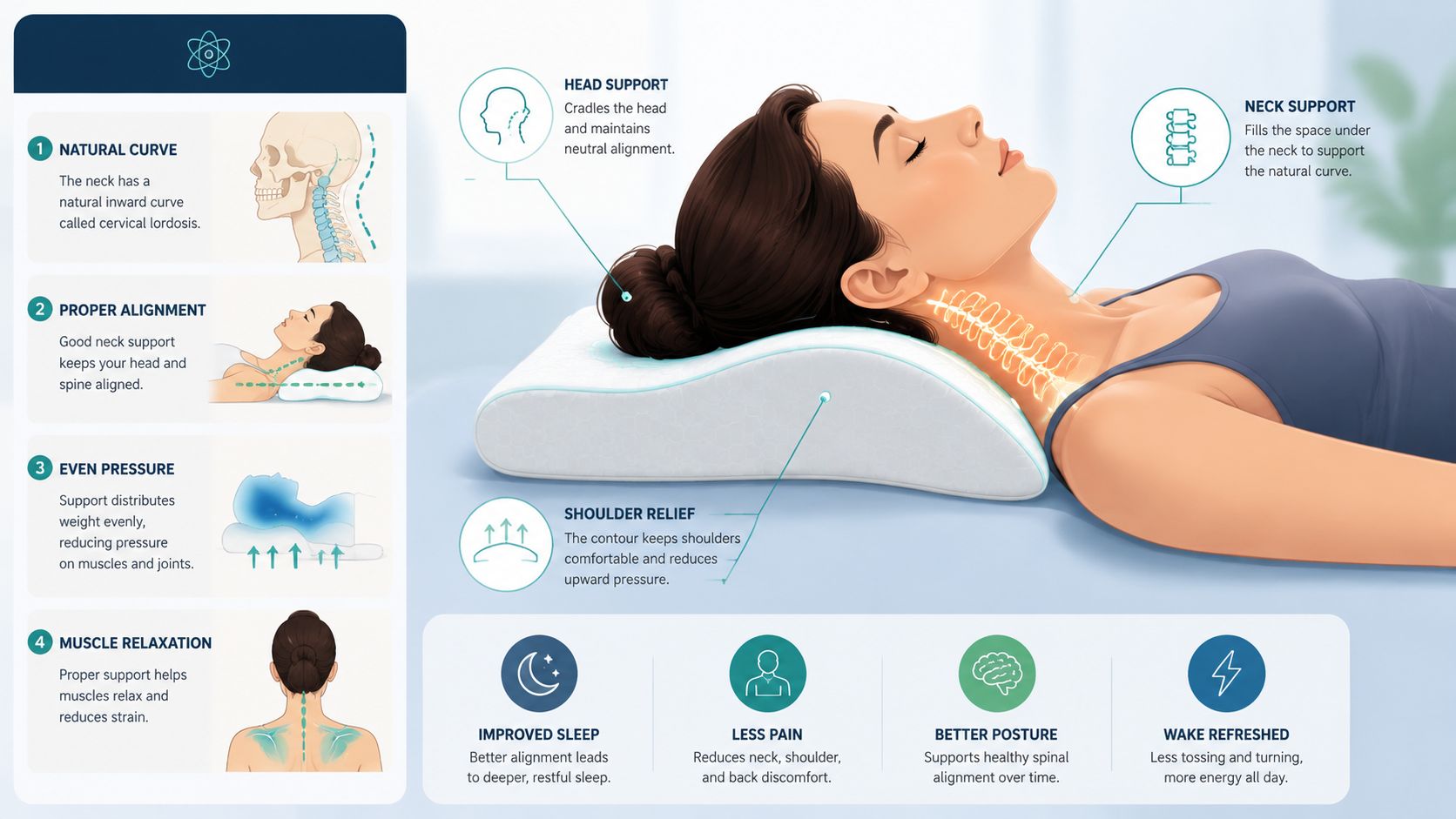
The neck does its best work when it stays in a neutral alignment. A simple way to think about that is a garden hose. When the hose runs straight, water moves freely. When it bends sharply, pressure builds at the kink. The neck reacts in a similar way when the head is pushed too far up, down, or sideways during sleep.
Neutral alignment matters more than softness
Many shoppers focus on whether a pillow feels soft. Support matters more. The neck has a natural curve, and the pillow needs to hold that curve gently instead of flattening it out.
Research notes that the optimal pillow height must maintain the physiological curvature of the cervical spine, and experts recommend a pillow between 3 and 5 inches thick for most side and back sleepers to reduce the stress that causes neck pain, according to this clinical review of pillow height and cervical alignment.
A pillow can feel cozy for five minutes in a store and still be wrong for seven or eight hours of sleep. That's where so many people get tripped up.
Sleep position changes the job of the pillow
Back sleepers need the pillow to support the neck curve without pushing the chin toward the chest. Side sleepers need the pillow to fill the space between the ear and the shoulder. Stomach sleepers need very little height, because too much lift twists the neck and arches the spine out of position.
Readers who want a broader look at this can review how spinal alignment works during sleep. The key idea is simple. The pillow has one job. It should keep the head in line with the rest of the spine.
A useful rule is to stop judging a pillow by hand feel alone. Instead, the test is whether the neck looks level and relaxed when the body is fully lying down.
- Too high: The head tilts upward or sideways, and the neck muscles stay tense.
- Too low: The head drops back or leans down toward the mattress.
- Just right: The nose, chin, and breastbone stay in a comfortable line with no visible strain.
Match Your Pillow to Your Sleep Position
The best pillow for neck support depends heavily on how a person sleeps. That's why one pillow can feel wonderful to one sleeper and miserable to another.
Moderate evidence shows that pillows that support spinal alignment often use a contoured design, with higher edges for side sleepers and a lower, flatter center for back sleepers, plus a central height of 7 to 11 cm to help unload pressure, according to this review of pillow design and sleep-related neck pain.
Side sleepers
Side sleeping creates the biggest gap to fill. The shoulder keeps the body raised, so the pillow must support the head all the way across that space.
For many side sleepers, especially active adults in Alto and Ruidoso, the right choice is a higher loft pillow with a firmer feel. A softer pillow may collapse under the head and let the neck bend downward toward the mattress.
Good signs for side sleepers include:
- Level head position: The head doesn't dip toward the bed or tilt upward.
- Steady edge support: The pillow keeps its shape instead of flattening fast.
- Shoulder clearance: The shoulder stays on the mattress, not jammed up onto the pillow.
Back sleepers
Back sleepers usually need less height than side sleepers. The goal is to support the neck's natural curve while letting the back of the head rest without being shoved too far forward.
A medium loft and medium firmness often work well here. Contoured pillows can help because the lower center cradles the head while the raised area supports the neck.
The right back-sleeper pillow should feel like it's holding the neck up, not propping the whole head forward.
Stomach sleepers
Direct answer. Stomach sleepers usually need the lowest loft and the softest feel, and many people with neck pain do better if they move away from stomach sleeping altogether.
This position is tough on the neck because the head stays turned to one side for long stretches. If someone won't give up stomach sleeping, the pillow should stay thin enough to avoid extra twisting and arching.
Combination sleepers
Combination sleepers need a pillow that can adapt. That often means choosing a shape that supports both back and side positions, without being so tall that it becomes a problem during position changes.
A practical test is to lie down and roll naturally from back to side. If the sleeper has to tug, fold, or punch the pillow into place, it's probably not the right fit.
| Sleep Position | Recommended Loft (Height) | Recommended Firmness |
|---|---|---|
| Side sleeper | Higher loft | Firmer |
| Back sleeper | Medium loft | Medium |
| Stomach sleeper | Low loft, often 3 inches or less | Softer |
| Combination sleeper | Medium to adjustable loft | Medium to medium-firm |
A useful way to think about it is this:
- Match the gap: More shoulder space usually means more loft.
- Match the movement: More position changes usually call for more adaptability.
- Match the body: Broader frames often need more support than smaller frames.
Choosing Your Ideal Pillow Material
Shape tells the pillow what to do. Material determines how it does it.
That's where feel, temperature, and pressure relief start to matter. In a place like Ruidoso, where dry mountain air can make some sleepers prefer a cooler surface feel, material choice can affect comfort as much as support.

A clinical study found that 64.3% of participants experienced significant neck pain reduction with a proper support pillow, and the researchers recommended pillows with firm cervical support as part of treatment, as reported in this study of neck support pillows and pain reduction.
Memory foam and contouring support
Memory foam is popular for a reason. It conforms closely to the head and neck, spreads pressure more evenly, and helps maintain a consistent shape through the night.
That's a strong fit for shoppers comparing Tempur-Pedic options, especially those who want deeper contouring and pressure-point relief. It can also pair well with modern mattress materials that are designed for body-conforming support. Readers comparing sleep surface feel can learn more from this guide on latex mattress vs memory foam.
Benefits of memory foam often include:
- Close contouring: Helpful when the neck needs a defined cradle.
- Steady support: Less shifting once the head settles in.
- Pressure relief: Useful for sleepers who wake up with tension at the neck and shoulders.
Latex and responsive lift
Latex feels different. It has more spring and pushback than memory foam. Instead of slowly molding around the body, it responds faster when the sleeper moves.
That can suit combination sleepers who don't want to feel “stuck” in one position. It also tends to feel a little livelier under the head, which some shoppers prefer.
Plush fills and softer feels
Traditional plush fills can feel inviting at first touch. The challenge is keeping enough support through the whole night. Softer fills may work for stomach sleepers or people who want a very gentle feel, but they often need careful testing because they can compress more easily.
Sealy, Stearns & Foster, Sherwood, and Tempur-Pedic all speak to different comfort preferences across the sleep category, and the right answer usually comes down to whether the material keeps its shape under the specific sleeper's body.
Practical rule: Choose material based on how it behaves after hours of use, not just how it feels in the first minute.
The Miller Waldrop Difference Try Before You Trust
Buying a pillow online can look simple. The hard part comes later, when the pillow arrives and the sleeper still can't tell whether the neck is aligned.
That's where in-person testing helps. A pillow for neck support should be evaluated while the shopper is lying down in the position they use at home, on a mattress that feels close to their own. Mattress Pro by Miller Waldrop offers that hands-on process in Ruidoso, along with the Comfort Promise, Low Price Promise, and Full-Service Delivery with Professional Setup across the larger sleep purchase experience.

How to test a pillow in person
A better fitting process usually looks like this:
- Lie down fully: Sitting up won't show true alignment.
- Use your actual sleep position: Side, back, or a natural combination.
- Check the neck line: The head should look level and relaxed.
- Notice pressure points: The neck shouldn't feel jammed, strained, or unsupported.
That kind of trial removes a lot of uncertainty. For shoppers worried about making the wrong choice, the Comfort Promise at Mattress Pro by Miller Waldrop helps address that fear in a practical way.
Why the right fit matters long term
Short-term comfort is one thing. Ongoing support is another. A 12-month study on an ergonomic cervical pillow found that sustained use led to significant reductions in neck pain intensity, disability, and sleep disruption, according to this 12-month cervical pillow outcomes study.
That matters because a pillow decision isn't just about tonight. It affects how the neck is supported over months of real sleep, real movement, and real recovery.
In a local showroom on Sudderth Drive, a shopper can feel the difference between too much loft, too little loft, and proper support. A website can list features. It can't watch the sleeper's posture and say, “That one keeps the head level.”
Pillow Care and When It Is Time for a Replacement
When should a pillow be replaced
Direct answer. A pillow should be replaced every 1 to 2 years if it has lost shape, gone lumpy, or stopped supporting the neck well.
That's not wasteful. It's maintenance. A pillow works every night, and over time the fill breaks down, the loft changes, and the support that once felt right starts drifting away. If a sleeper wakes up better in a guest room than at home, the pillow deserves a hard look.
The category keeps growing, too. The global neck pillow market is projected to reach $8.81 billion by 2036, and memory foam holds 41% market share because of its pressure-relieving cervical support, according to this market and pillow-shape review in The Open Public Health Journal. That growth reflects how many shoppers are looking for better support, not just softer bedding.
Simple care that protects support
In Ruidoso's dry, sometimes dusty mountain air, pillow care matters for both hygiene and performance.
A few habits help:
- Use a protector: This adds a barrier against oils, dust, and everyday wear.
- Follow the care label: Some materials can be washed, while others need spot care only.
- Check for shape loss: If the center stays compressed or the edges collapse, support is fading.
- Reassess with the mattress: A pillow can feel different after a mattress change. This article on signs it's time to replace a mattress can help sleepers look at the full setup.
A good pillow isn't just about comfort at bedtime. It protects the investment in restful sleep and more comfortable mornings in Alto, Ruidoso, and throughout Lincoln County.
Ready to transform your sleep? Visit our Sleep Pros at the Mattress Pro by Miller Waldrop showroom located at 2801 Sudderth Drive, Suite F, in Ruidoso. From luxury brands to budget-friendly solutions, we're here to help you wake up loving your mornings. Browse our collection online or stop by Monday through Saturday.