

Why Do I Wake Up with Back Pain Every Morning: Why Morning


You get out of bed, take those first few steps, and your back complains before your day has even started. If you've been asking why do i wake up with back pain every morning, you're not overreacting, and you're not alone.
Around Ruidoso, Alto, and across Lincoln County, we hear this concern often. Many people assume morning back pain is just part of getting older. In many cases, it's more mechanical than that. What happens overnight, how your body is supported, and how well you sleep can all affect how your back feels when the alarm goes off.
As a family business with a long history in this community, we've learned that people feel better when they understand the why first. Once you know what your spine, muscles, and mattress are doing through the night, the next steps become much clearer.
Table of Contents
- The Hidden Culprits Behind Your Morning Back Pain
- Is Your Mattress Secretly Sabotaging Your Sleep?
- A Sleep Pro's Guide to Choosing the Right Mattress
- Simple Stretches and Habits for a Pain-Free Morning
- Recognizing Red Flags When to See a Clinician
- Find Your Solution on Sudderth Drive Your Local Path to Better Sleep
The Hidden Culprits Behind Your Morning Back Pain
That stiff, guarded feeling first thing in the morning often has a simple starting point. During sleep, you may stay relatively still for 7 to 8 hours, and that immobility can let stiffness and inflammation build up. The Cleveland Clinic's explanation of morning lower back pain notes that lying immobile for hours can make you wake with back or hip pain, especially when your sleep position leaves the spine out of alignment.
What happens while you sleep
Your back likes movement. During the day, even small shifts in posture help tissues stay loose and distribute pressure. At night, that movement slows way down.
If your spine stays in an awkward position for hours, the first few minutes out of bed can feel rough because your muscles and joints are starting the day “cold.” That's why some people feel better after a warm shower or a short walk around the house.
The most common buckets of causes
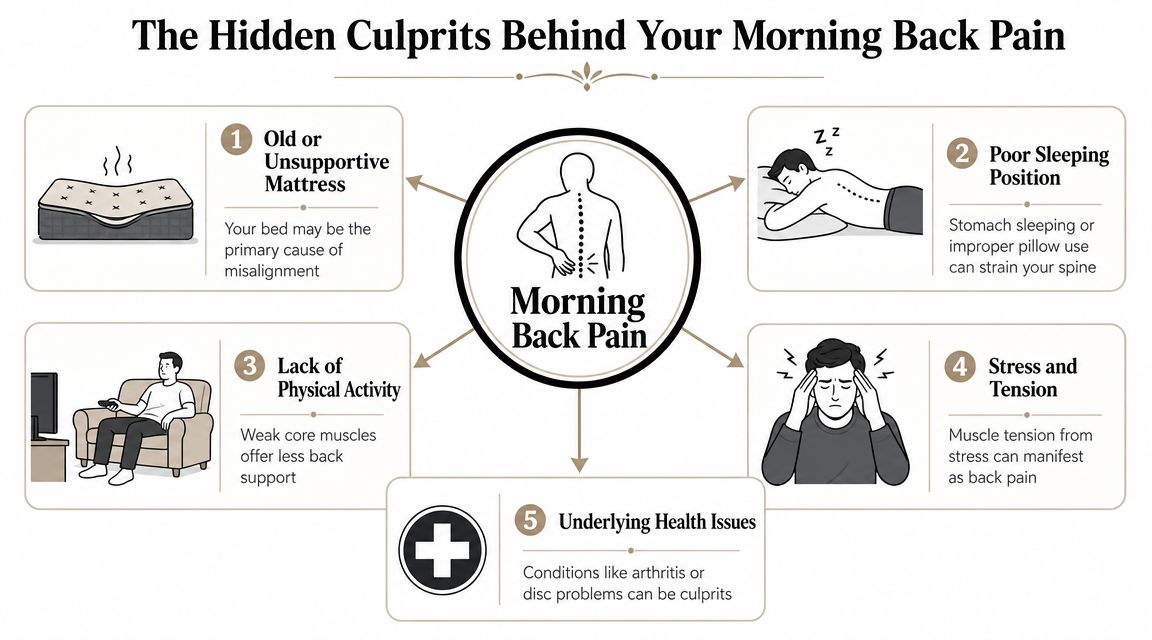
Most morning back pain falls into a few understandable categories:
- Sleep posture: Stomach sleeping, twisting at the waist, or using the wrong pillow height can leave your back working all night.
- Mattress support: If the surface no longer holds your body evenly, heavier areas can sink too far.
- Daily tension: Stress often shows up in the body as tight shoulders, clenched hips, and guarded low back muscles.
- Conditioning and activity: When your core and hips aren't supporting you well during the day, your back often notices it at night too.
- Underlying health issues: Arthritis, disc problems, and nerve irritation can also show up as morning pain.
Practical rule: If your back feels worst when you first stand up, then improves as you move around, your sleep setup may be part of the story.
A lot of readers get stuck on one question. “Is it my body, or is it my bed?” Sometimes it's both. A body that's already tense or stiff is more sensitive to poor sleep posture and weak support.
If you want to better understand positioning, our guide on how to align your spine while sleeping walks through the basics in plain language.
Is Your Mattress Secretly Sabotaging Your Sleep?
People often blame age, stress, or yesterday's yard work before they blame the mattress. But the surface under you matters because it supports your spine for a large part of every day.
A mattress doesn't have to look terrible to stop doing its job well. It can still seem comfortable at first touch and still let your body settle into an unhealthy shape overnight.
How a mattress creates strain
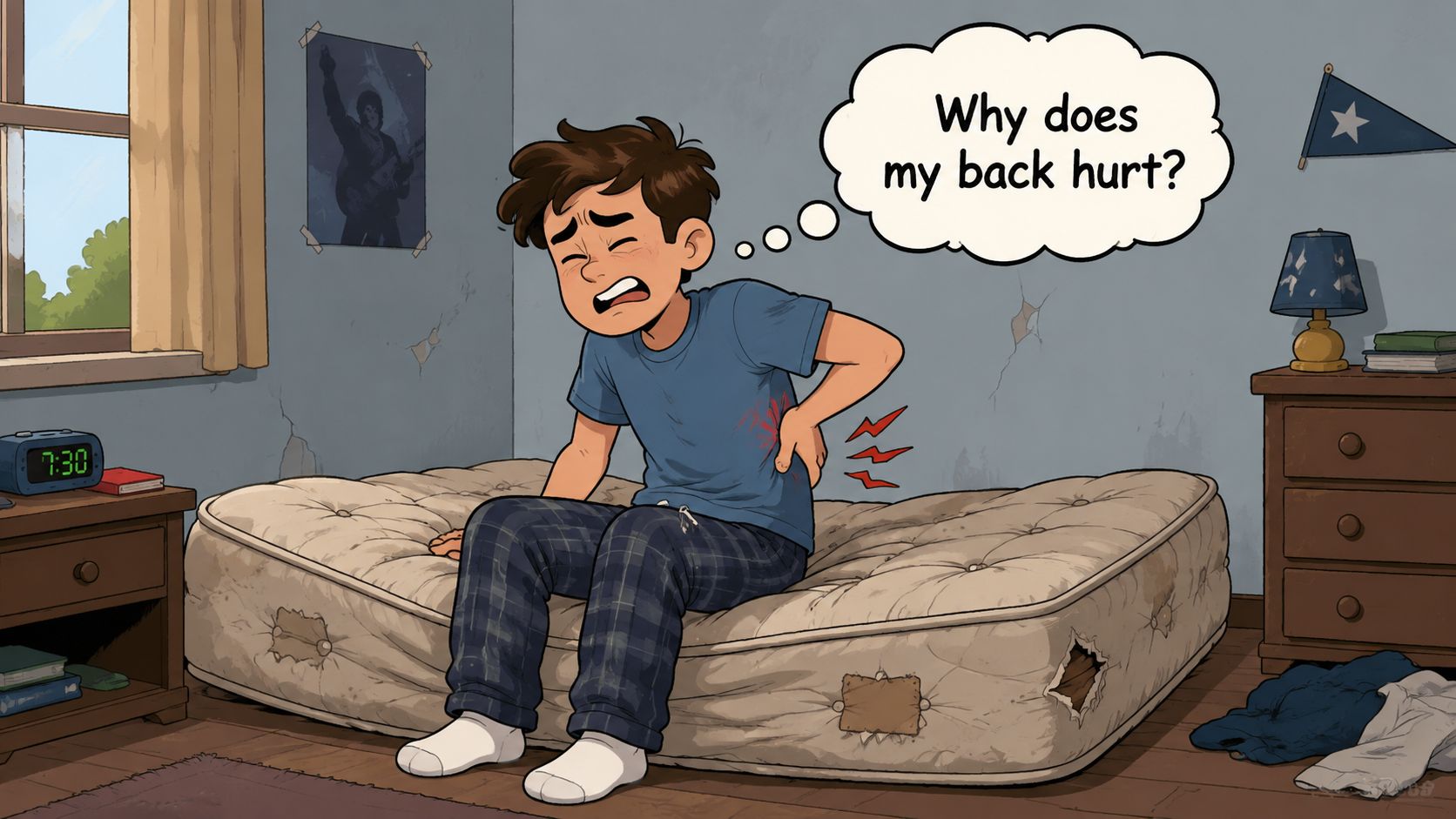
The issue isn't whether a bed is “firm” or “soft.” The issue is whether it keeps your spine in a neutral line for your body shape and sleep position. Medical News Today's review of mattress support and back pain notes a strong cause and effect link between sleep alignment and lumbar stress, and explains that a worn or cratered mattress can increase sag under heavier body areas, raising lumbar strain and morning stiffness.
That's the “hammock” problem people describe. Your hips or torso dip lower than they should, while the rest of your body tries to compensate. Your muscles stay active in small ways all night, even though you think you're resting.
Signs your bed may be part of the problem
You don't need a lab test to spot some common warning signs:
- Visible sagging: Stand at the foot of the bed and look across the surface for dips or body impressions.
- You feel better elsewhere: If you sleep better in a guest room, hotel, or even your recliner, your mattress may be telling on itself.
- You wake in one sore area repeatedly: The low back, shoulders, or hips often take the hit first.
- You roll toward the middle: That can signal uneven support.
- You keep “chasing comfort”: Extra toppers, folded blankets, or pillow stacks may be temporary workarounds.
A mattress should hold you level, not fold you into it.
That matters here in Ruidoso too. In our dry mountain air, some sleepers prefer materials that feel less heat-trapping and more pressure-relieving, especially if they toss and turn trying to get comfortable. If you're unsure how support level should feel, this guide on how to choose a mattress firmness can help you sort through the options without guessing.
A Sleep Pro's Guide to Choosing the Right Mattress
The right mattress for back pain usually isn't the hardest one in the room. It's the one that fits your body, your sleep position, and your pressure points.
That's where online one-size-fits-all advice often falls short. A side sleeper in Alto doesn't need the same feel as a back sleeper in Ruidoso, and neither one should shop as if comfort were identical from person to person.
Match the bed to the sleeper
Start with position first. That gives you a better filter than marketing words like “luxury firm” or “ultra plush.”
| Sleep Position | Recommended Firmness | Why It Works |
|---|---|---|
| Side sleeping | Medium to medium-plush | Helps shoulders and hips sink enough to reduce pressure while still supporting the waist |
| Back sleeping | Medium to medium-firm | Supports the natural curve of the spine without letting the hips drop too deeply |
| Stomach sleeping | Medium-firm and very carefully fitted | Can reduce excessive midsection sink, though many stomach sleepers do better by changing position |
| Combination sleeping | Medium or responsive hybrid feel | Makes it easier to move and stay supported in more than one position |
A couple shopping together needs one more layer of thought. If one person is a side sleeper and the other is a back sleeper, you're looking for balance. The mattress has to cushion enough for one body and stabilize enough for the other.
The goal isn't to buy a “back pain mattress.” The goal is to buy a mattress that keeps your body from fighting the bed all night.
What different mattress types do for your back
Different constructions solve different problems.
- Memory foam: Good for close contouring and pressure relief. Tempur-Pedic is often the brand people recognize here because it responds to body weight and shape in a very precise way.
- Hybrid mattresses: These combine coils with comfort layers. Sealy and Stearns & Foster hybrids can appeal to sleepers who want support, some bounce, and easier movement.
- Traditional innerspring: Some people like the flatter, more lifted feel, but the quality of the comfort layers matters.
- Value-focused foam or hybrid models: Sherwood offers options for shoppers who want support and comfort at a more approachable budget.
A personalized fitting matters more than a label on the side of the bed. That's why Mattress Pro by Miller Waldrop uses a consultative approach around sleep position, body type, and comfort preference instead of pushing one model for everyone.
If you're shopping in person, lie down the way you typically sleep. Stay there long enough to notice whether your shoulders feel jammed, your low back feels unsupported, or your hips sink too far. Those little signals matter more than a quick hand press on the edge of the mattress.
Simple Stretches and Habits for a Pain-Free Morning
A better mattress helps, but it's not the whole picture. Poor sleep itself can make pain feel louder the next day. The Sleep Foundation's guide to waking up with lower back pain explains that poor sleep can amplify pain sensitivity, and that after hours of stillness, tissues around the spine can feel less ready to move.
That's why some people still ask, “Why do I wake up with back pain every morning if my mattress seems decent?” Sometimes the answer is sleep quality, not just bed quality.
A gentle way to get moving
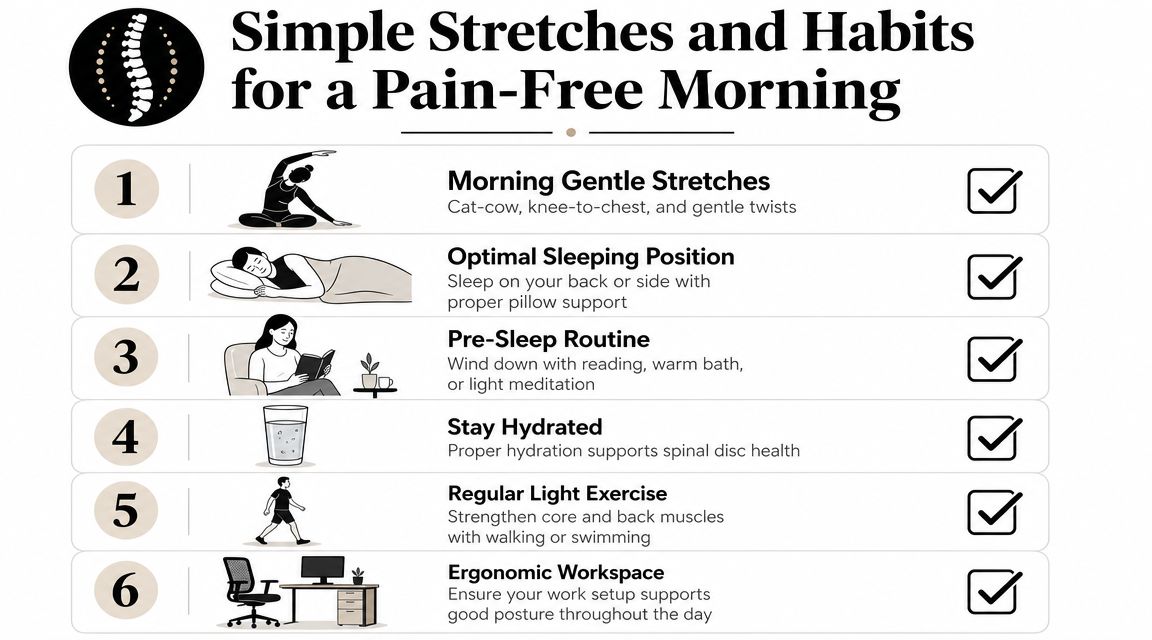
You don't need an intense routine before coffee. You need to warm the body up slowly.
Try this sequence:
- Knee-to-chest, one side at a time: Pull gently, breathe, and don't force it.
- Small trunk rotations: Let both knees rock side to side if that feels comfortable.
- Cat-cow beside the bed or on a mat: Move slowly, not dramatically.
- Short walk through the house: A few minutes of easy movement can help your tissues loosen.
If heat helps, a warm shower or heating pad can make those first movements easier.
Habits that help overnight recovery
The evening matters too. A restless night can leave your body tense by morning.
- Settle your nervous system: Read, stretch lightly, or take a warm bath instead of jumping from screen time straight into bed.
- Support your sleep position: Side sleepers often benefit from a pillow between the knees. Back sleepers may prefer support under the knees.
- Watch repeated wakeups: If you toss, turn, or wake often, your body may not be getting the restorative sleep it needs.
- Stay active during the day: Gentle walking and regular movement help many people feel less stiff at wake-up.
Better mornings often start with a calmer evening.
If you want to connect movement and rest in a practical way, our article on the connection between exercise and sleep quality is a helpful next read.
Recognizing Red Flags When to See a Clinician
Most morning back pain isn't something you should panic about. But it also shouldn't be automatically brushed off as “just age.”
What morning stiffness usually looks like
Typical mechanical stiffness often has a pattern. You wake sore, move around a bit, and things gradually ease. The pain may feel concentrated in the low back, especially after a night in one position.
That pattern is different from pain that stays intense, spreads, or interferes with basic movement well into the day.
Signs you shouldn't ignore
Consider medical evaluation if your pain does any of the following:
- Lasts beyond the first hour: Ongoing pain that doesn't settle with gentle movement can point to more than simple sleep stiffness.
- Radiates down the leg: Pain moving into the buttock, thigh, or below the knee can suggest nerve involvement.
- Comes with numbness or weakness: Those symptoms deserve prompt attention.
- Follows an injury: A fall, twist, or lifting event changes the picture.
- Limits normal function: If getting dressed, walking, or standing becomes difficult, don't wait it out.
A clinician or physical therapist can help sort out whether the issue is a disc, arthritis, nerve irritation, or something else. A mattress can improve support, but it can't diagnose a medical condition.
Find Your Solution on Sudderth Drive Your Local Path to Better Sleep
Buying a mattress online can make everything sound easy. Pick a firmness. Click a button. Hope for the best. But back pain usually doesn't come from a simple problem, so it rarely responds to a simple guess.
That's why local fitting still matters in a place like Ruidoso. People here aren't all sleeping the same way, living the same routines, or dealing with the same aches. Some are active hikers. Some are furnishing cabins. Some are couples with different comfort needs. Some just want to stop dreading that first step out of bed.

Why local fitting still matters
A personalized conversation can uncover things a product quiz won't:
- The way you sleep: Not how you wish you slept, but the position you return to all night.
- Where you hurt: Low back, hips, shoulders, and neck each suggest different pressure and support needs.
- How your partner sleeps: Shared beds need shared planning.
- What feel you prefer: Some people relax into contouring foam. Others want a more buoyant hybrid surface.
At our showroom on Sudderth Drive, that kind of in-person fitting helps remove guesswork. You can compare Tempur-Pedic, Sealy, Stearns & Foster, and Sherwood models side by side instead of trying to translate internet descriptions into real comfort.
A simpler way to shop with less risk
The fear is understandable. You don't want to spend money on the wrong bed and wake up with the same pain next week.
That's where a few practical protections help. The Comfort Promise reduces the fear of choosing wrong. The Low Price Promise helps you shop with confidence. Full-Service Delivery with Professional Setup means you don't have to wrestle a mattress into place yourself.
For many families in Lincoln County, that local support is the difference between buying a bed and finding a sleep solution. If you'd like to ask questions or plan a visit, you can contact our team here.
Ready to transform your sleep? Visit our Sleep Pros at the Mattress Pro by Miller Waldrop showroom located at 2801 Sudderth Drive, Suite F, in Ruidoso. From luxury brands to budget-friendly solutions, we're here to help you wake up loving your mornings. Browse our collection online or stop by Monday through Saturday.