

Best Mattress for Combination Sleepers: A Ruidoso Guide

You roll onto your side to ease your shoulder. Ten minutes later, you’re on your back trying to settle your lower back down. Before morning, you’ve ended up on your stomach with the blankets twisted around your legs. If that sounds familiar, you’re not picky. You’re likely sleeping on a mattress that doesn’t keep up with the way your body moves.
I’ve helped a lot of neighbors in Ruidoso, Alto, and across Lincoln County sort through this exact problem. Combination sleepers often think they need to “just get used to” tossing and turning. Usually, they don’t. They need a mattress that gives pressure relief in one position, support in another, and enough bounce to move without a wrestling match.
That’s why the best mattress for combination sleepers usually isn’t the softest bed in the showroom or the firmest one online. It’s the one that works with your body through the whole night, especially in our mountain community where recovery, temperature control, and good rest matter.
Table of Contents
- Are You a Combination Sleeper?
- The Unique Needs of a Combination Sleeper
- Decoding Mattress Features for Better Sleep
- Your Local Checklist for Choosing a Mattress
- The Feel Test In-Store and at Home
- Your Partner in Restful Sleep for 70 Years
Are You a Combination Sleeper?
If you start the night in one position and wake up in another, you’re probably a combination sleeper. That includes back-to-side sleepers, side-to-stomach sleepers, and people who seem to rotate through every position before sunrise.
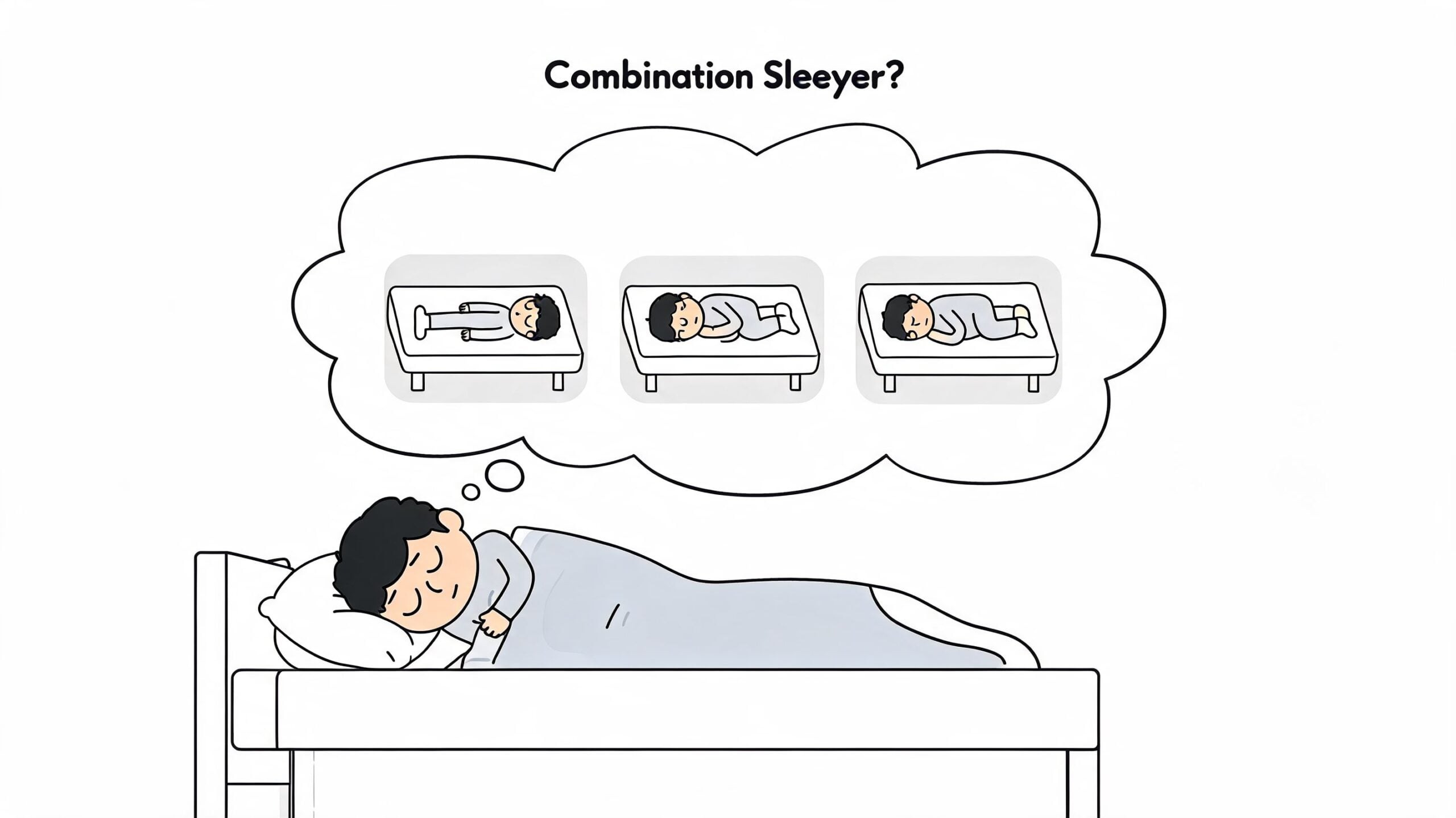
A lot of folks assume moving around means they’re “bad sleepers.” I usually tell them something different. Your body may be trying to find support that your mattress isn’t giving you.
The nightly pattern many people miss
You might notice a few signs:
- You fall asleep fine, then keep waking up. The first position feels okay, but the next one doesn’t.
- Your shoulder gets sore on your side. That often points to not enough cushioning.
- Your lower back feels tight on your back or stomach. That can mean too much sink through the middle.
- You feel stuck when you try to roll. Foam can feel comfortable at first, then resist movement.
That last point frustrates people the most. You’re tired, half asleep, and every turn takes effort.
Sometimes tossing and turning isn’t restlessness. It’s problem-solving. Your body keeps searching for a surface that feels right.
If you’re unsure where your sleep style fits, this guide on choosing the right mattress for your sleeping style can help you narrow it down.
In Ruidoso, I hear this from active adults, couples, and vacation homeowners alike. They want one bed that handles everything. That’s a fair goal. You’re not asking too much. You’re asking your mattress to do its job.
The Unique Needs of a Combination Sleeper
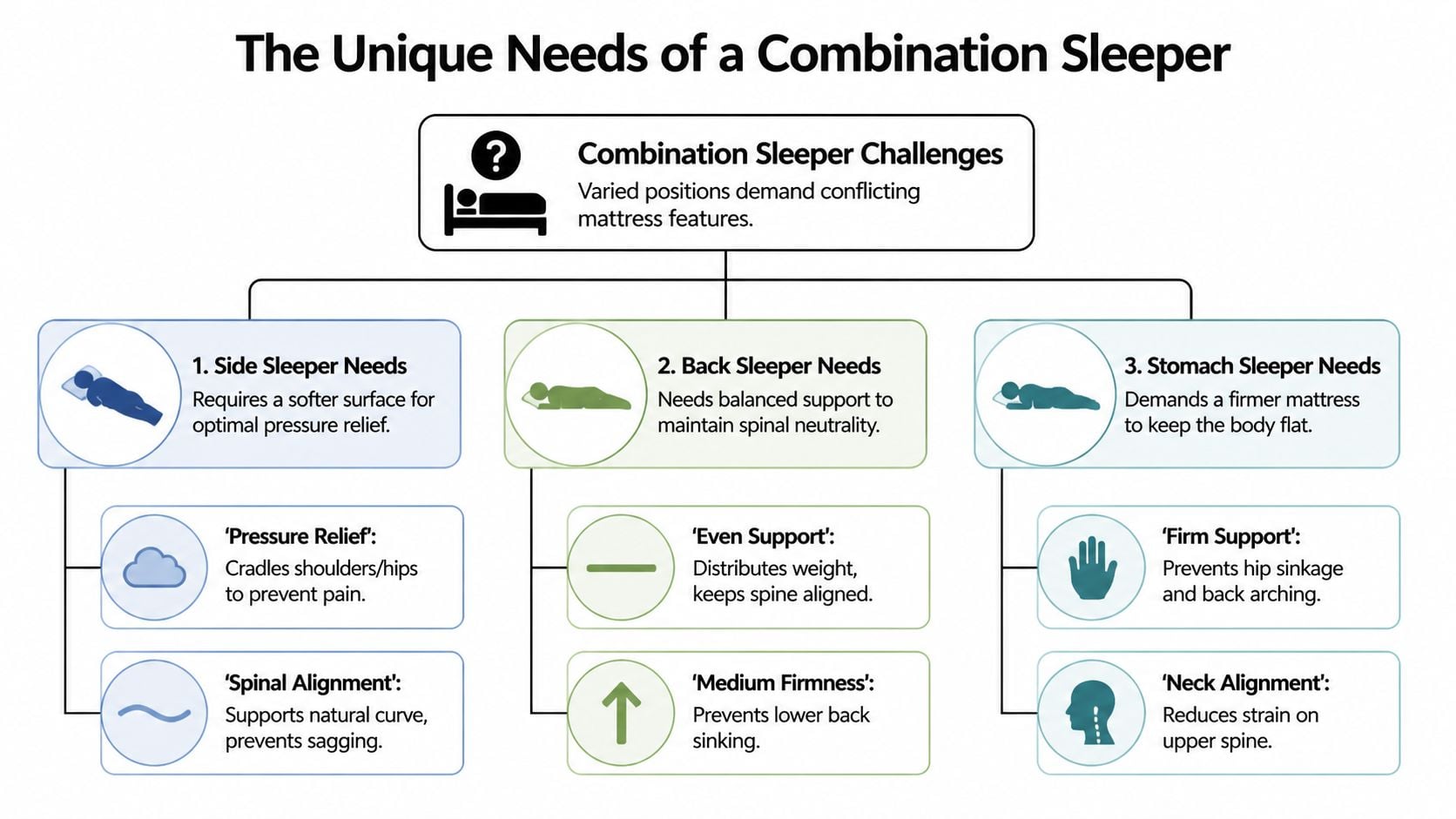
Combination sleepers are hard to fit because each sleep position asks for something different. What feels great on your side can feel wrong on your stomach. What supports your back can feel too stiff at your shoulder.
Why one position changes everything
Side sleeping usually needs more cushion at the shoulder and hip. Back sleeping needs steadier support so the spine stays in a neutral line. Stomach sleeping generally needs a flatter, firmer feel so the hips don’t dip too far.
That’s why one-note mattresses often miss the mark for mixed-position sleepers.
- Too soft: You may get pressure relief, but changing positions gets harder.
- Too firm: You may feel supported on your back, but your shoulder can take the hit on your side.
- Too slow to respond: You can feel trapped when you roll.
If you’re working on posture and pain reduction, this article on how to align your spine while sleeping explains why that middle-ground support matters.
Why hybrids solve the conflict better
The reason hybrid mattresses come up so often is simple. They combine two different jobs in one build. Coils provide push-back, lift, and easier movement. Comfort layers on top help cushion pressure points.
A 2026 consensus summary on combination sleepers identifies hybrid models as the top choice, and notes that zoned support hybrids reduced tossing and turning by 23% compared to traditional memory foam, which matters because 55% of Americans report poor sleep due to position shifts.
That lines up with what many shoppers feel in person. A hybrid can support your back, cushion your side, and still let you roll without fighting the surface.
Practical rule: If you move a lot in your sleep, look for a mattress that cushions without swallowing you.
For many people in Lincoln County, the sweet spot is versatility, not perfection in one single position. A mattress doesn’t need to feel specialized for only side sleeping or only back sleeping. It needs to stay comfortable as your body changes its mind through the night.
Decoding Mattress Features for Better Sleep
When you shop for the best mattress for combination sleepers, three features deserve most of your attention. Not marketing names. Not fancy fabric stories. Start with firmness, responsiveness, and support with pressure relief.
Firmness first
Most brands use a 1 to 10 firmness scale, and medium-firm, around 6 to 7, tends to work well for combination sleepers in the verified data. That feel usually gives enough cushion for side sleeping and enough push-back for back or stomach time.
If you go much softer, movement can get harder. If you go much firmer, your shoulder and hip may complain.
A good first question is not “What’s the softest bed?” It’s “What firmness helps me stay comfortable in more than one position?” This guide on how to choose a mattress firmness can help you think through that.
Responsiveness matters more than most shoppers think
Responsiveness is how quickly a mattress adjusts when you move. Combination sleepers notice this right away, even if they don’t know the term.
If a mattress is responsive, you roll and it rolls with you. If it isn’t, you feel drag.
Sleepopolis testing on mattresses for combination sleepers notes that top performers consistently reach responsiveness scores of 4.5/5 and pressure relief scores of 4 to 5/5 across positions, which is why those models tend to feel easier to move around on without giving up comfort.
Here’s a simple comparison:
| Feature | Hybrid Mattress | Memory Foam Mattress | Innerspring Mattress |
|---|---|---|---|
| Ease of movement | Usually easier to reposition on | Can feel slower and more contouring | Usually easy to move on |
| Pressure relief | Balanced cushioning and support | Often strong pressure relief | Usually lighter contouring |
| Spinal support feel | Supportive with some comfort layering | Depends heavily on foam density | More lifted, on-top feel |
| Best fit for combo sleepers | Often the most versatile choice | Better for people who want deeper hug | Better for people who want bounce |
Support and pressure relief must work together
People often mix these two up. Support holds your body in alignment. Pressure relief cushions the heavier contact points like shoulders, hips, and ribs.
You need both.
Tempur-Pedic hybrids are a good example of how those two ideas can work together. Sealy and Stearns & Foster also offer coil-based designs that many mixed-position sleepers like because they feel supportive without feeling rigid. Sherwood can be worth a look too if you want a simpler feel with balanced comfort.
One practical option some local shoppers compare in person is Mattress Pro by Miller Waldrop, where different hybrid and foam builds can be tested side by side instead of guessed at from a box description.
If your mattress feels comfortable only when you lie perfectly still, it probably isn’t the right fit for a combination sleeper.
Your Local Checklist for Choosing a Mattress
A mattress that works in a downtown apartment somewhere else might not be the right fit for life in Ruidoso or Alto. Local lifestyle matters. So does the way you use the room, the climate, and whether the bed is for your home, a guest room, or a cabin rental.

What matters in mountain homes and cabins
Active sleepers often come in with sore hips, tight backs, or tired shoulders after long days outdoors. In those cases, zoned support can make more sense than a flat, uniform feel because it gives different parts of the body different levels of push-back.
Climate matters too. Our dry mountain air and temperature swings can make some mattresses feel warmer or less comfortable over the course of a night. Breathable covers, coil airflow, and cooling materials aren’t just nice extras for many local homes.
A broad online list can’t see whether you sleep hot in a sun-facing bedroom, whether your cabin gets chilly at night, or whether you spend weekends hiking and want a surface that helps you recover.
What couples should check before buying
Couples usually need to think beyond comfort in one sleeping position. The mattress has to work when one person turns, gets up earlier, or uses more of the bed.
A Mattress Clarity review of combination sleeper mattresses notes that hybrids with reinforced edge support improve full-surface usability, and cites the Helix Midnight Luxe at 4.8/5 for edge support, with 25% better mobility and stability metrics than all-foam competitors in the referenced lab comparison.
That matters in real life because edge support changes how secure the whole bed feels. It affects whether you can spread out, sit comfortably near the side, or sleep close to the perimeter without that sliding-off feeling.
A quick local checklist helps:
- For active sleepers: Look for zoned support and easy movement.
- For couples: Check motion isolation and edge stability together.
- For hot sleepers: Favor breathable builds and cooling materials.
- For guest or rental spaces: Choose a versatile feel that suits a wider range of people.
The Feel Test In-Store and at Home
Online reviews can narrow the field, but they can’t tell you what your shoulder, hip, and lower back will think after ten minutes on a mattress. That’s why the feel test matters.
How to test a mattress in the showroom
Don’t just sit on the side and call it good. Lie down in the positions you use. Stay there long enough for your body to settle.
Try this in order:
- Start in your usual sleep position. Give it a few quiet minutes.
- Roll to your second-most common position. Notice whether the mattress helps or resists.
- Pay attention to your midsection. If your hips sink too much, your back may tell you later.
- Check your shoulder and hip. If you feel pressure quickly, that won’t improve at 2 a.m.
- Move near the edge. Couples should always test this.
A Sleep Advisor review of combination sleeper mattresses notes that the feel of responsiveness is tied directly to construction, and that dual-coil systems can deliver 30 to 40% higher bounce than foam hybrids, which is something you can often feel during an in-store test.
Roll from your back to your side without using your arms much. If the mattress makes that easy, you’re learning something useful.
Why your home trial still matters
A showroom tells you first impressions. Your home tells you the truth.
Your pillow, your room temperature, your sheets, and your body after a full day all affect how a mattress feels. That’s why many shoppers worry about making the wrong choice, especially if they’ve already bought one mattress that didn’t work out.
A Comfort Promise makes a difference. It lowers the pressure of having to get the choice perfect in a few minutes under store lights. You can test whether the mattress still feels right after real nights of turning, settling, and waking up in your own bedroom on Sudderth Drive, in Alto, or anywhere else in Lincoln County.
Your Partner in Restful Sleep for 70 Years
The right mattress for a combination sleeper usually needs a balanced feel, easy movement, and enough pressure relief to keep joints calm without letting the spine drift out of line. Hybrid builds often check those boxes well. The hard part isn’t learning that. The hard part is choosing the version that fits your body, your room, and your budget.
That’s where local guidance matters more than a national ranking list.
What lasting sleep help looks like
For more than 70 years, Miller Waldrop has served this community as a family business, and that history matters because sleep shopping is personal. You’re not buying a gadget. You’re trying to solve a nightly problem that affects how you feel the next day.
The brands many combination sleepers ask about most often are Tempur-Pedic, Sealy, Stearns & Foster, and Sherwood. Each brings a different feel. Some lean more pressure-relieving, some more buoyant, some more traditional. The useful part isn’t memorizing brand slogans. It’s feeling those differences in person with someone who listens.
You can learn more about that local history on the Miller Waldrop about us page.
A good Sleep Pro doesn’t push you toward one mattress. They help you rule out the wrong ones faster.
A local approach that lowers the risk
In my experience, people rest easier when the buying process feels clear. That means asking how you sleep, whether you share the bed, whether you wake with shoulder or back pain, and whether your bedroom runs warm or cool.
It also means reducing the risks that make mattress shopping stressful:
- Comfort Promise: You’re not stuck worrying that one quick test decided everything.
- Low Price Promise: You can focus on fit, not on whether you overpaid.
- Full-Service Delivery with Professional Setup: You don’t have to wrestle a heavy mattress through the house or set it up alone.
That kind of support matters in a mountain town. It matters if you’re furnishing your home, setting up a guest room, or replacing the bed in a vacation property. And it matters if you’re tired of waking up sore and wondering if that’s just part of getting older.
The best mattress for combination sleepers should help you move easily, stay supported, and wake up feeling more settled than when you went to bed. That answer is part sleep science, part personal fit, and part having a trusted local team who knows the difference.
Ready to transform your sleep? Visit our Sleep Pros at the Mattress Pro showroom located at 2801 Sudderth Drive, Suite F, in Ruidoso. From luxury brands to budget-friendly solutions, we’re here to help you wake up loving your mornings. Browse the collection at Mattress Pro by Miller Waldrop or stop by Monday through Saturday.