

Best Mattress for Restless Sleepers: A Ruidoso Guide

You know the feeling. You finally get into bed, shift to your favorite side, pull the covers up, and hope tonight will be different. Then the cycle starts. You turn because your shoulder aches. You wake because your partner moved. You flip the pillow looking for the cool side. At some point, you check the clock and realize you're wide awake again.
For a lot of people in Ruidoso, Alto, and across Lincoln County, restless sleep isn't one big dramatic problem. It's a chain of small disturbances that keep stacking up through the night. By morning, you don't feel sick. You just feel worn out, stiff, and frustrated.
As Sleep Pros from a family business with a 70-year legacy in this community, we've seen this pattern for generations. The good news is that restless sleep often becomes easier to manage when you stop treating it like a mystery and start matching your mattress to the way your body sleeps.
Table of Contents
- That 3 AM Wake-Up Call You Never Asked For
- Why You Are Tossing and Turning All Night
- The Key Mattress Features for Peaceful Sleep
- Choosing Your Material Foam vs Hybrid for Restless Sleepers
- How to Match Firmness to Your Sleep Position
- The Miller Waldrop Difference A Local Promise for Total Peace of Mind
- Your Action Plan for More Restful Nights
That 3 AM Wake-Up Call You Never Asked For
Some nights, restless sleep feels almost childish in the worst way. You get tangled up, your mind gets louder, and the bed that looked comfortable at bedtime suddenly feels like the wrong place to be.

Maybe your hips start talking back the moment you settle in. Maybe your spouse rolls over and your side of the bed seems to react to it. Maybe you fall asleep fine, then wake up again and again without knowing exactly why. That's what makes this so draining. It isn't always one obvious issue.
We've talked with neighbors who assumed they had to live with this because they were "just light sleepers." Often, that wasn't the whole story. Their mattress was too firm at the shoulders, too bouncy for couples, too warm for dry mountain nights, or too soft to support easy movement.
Restless sleep usually isn't random. Your body is responding to pressure, motion, heat, or lack of support.
If you also deal with longer stretches of wakefulness, it helps to understand how sleep disruption can build over time. Our guide on what causes insomnia and what you can do to help walks through those patterns in plain language.
The best mattress for restless sleepers doesn't just feel nice for five minutes. It reduces the little interruptions that keep pushing you back into wakefulness.
Why You Are Tossing and Turning All Night
Individuals don't toss and turn because they're doing something wrong. They do it because their body is trying to solve a comfort problem while they're half asleep.
Four common reasons sleep keeps getting interrupted
Pressure points are one of the biggest culprits. If your shoulder, hip, or lower back takes on too much force, your body responds by shifting away from it. That may happen over and over all night.
Partner movement matters more than many couples realize. A mattress with poor motion control can turn one person's position change into a shared event.
Heat buildup is another common trigger. Even in our mountain climate, bedrooms can get stuffy, and some mattresses hold onto body heat. When you sleep warm, you tend to wake more easily and move more often.
Wrong firmness can create all three problems at once. Too soft, and you sink in and struggle to reposition. Too firm, and your joints push back.
A hidden issue many sleepers miss
For some people, the problem includes Restless Legs Syndrome, or RLS. According to Sleep Advisor's review of mattresses for Restless Legs Syndrome, RLS affects an estimated 7% to 10% of the U.S. population, and mattresses that reduce motion transfer and improve pressure relief can help reduce tossing and turning associated with it.
That doesn't mean a mattress cures a medical condition. It means the right surface can stop adding extra irritation to an already restless night.
Practical rule: If you wake up in a different position than you fell asleep in and feel sore in the same spots most mornings, your mattress may be creating the problem your body keeps trying to fix.
A lot of shoppers get confused here because they think "support" and "softness" are opposites. They aren't. A mattress can feel cushioned on top and still hold your spine in a steadier position underneath. That's where mattress design starts to matter.
The Key Mattress Features for Peaceful Sleep
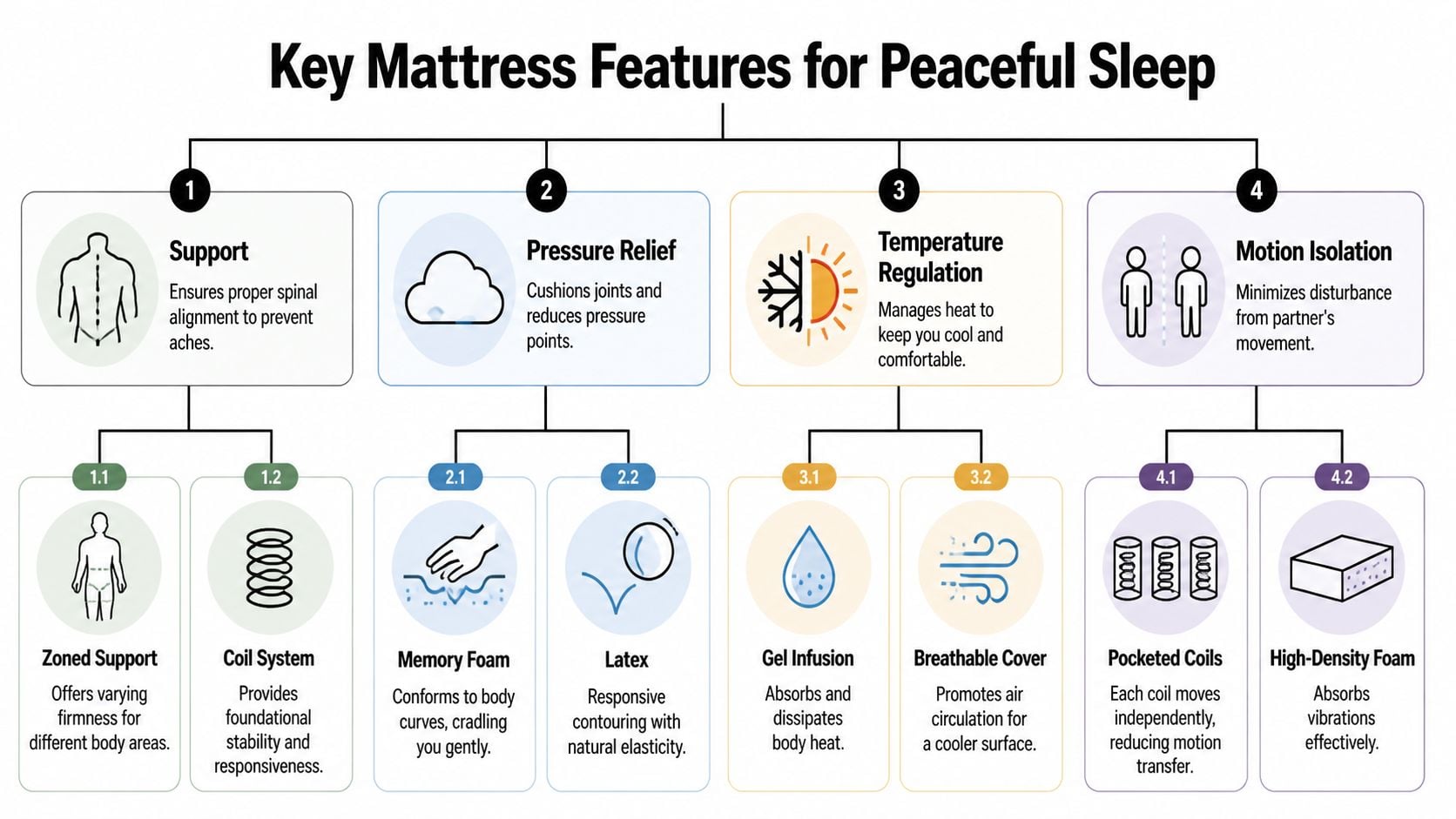
A mattress for restless sleep should do four jobs well. It should absorb unwanted movement, cushion pressure points, manage heat, and stay stable when you move near the edge.
If your bedroom already runs warm or your bedding traps heat, improving the full sleep setup can help. This guide on creating a sleep sanctuary with lighting, temperature, mattress, and bedding explains how those pieces work together.
Motion isolation keeps small movements small
Motion isolation means one part of the mattress can respond without shaking the whole bed. This matters for couples, pet owners, and light sleepers.
Memory foam usually does this very well because it absorbs movement instead of bouncing it across the surface. Pocketed coils can help too, because each coil responds more independently than older connected spring systems.
If you wake up every time your partner gets up earlier than you, this feature isn't optional. It's one of the clearest paths to less interrupted sleep.
Pressure relief reduces the need to reposition
Pressure relief is what keeps your shoulders, hips, and lower back from taking too much force in one spot. Higher-quality foam and better hybrid construction stand out in this area.
In 2026 Consumer Reports lab tests of mattresses, high-density memory foam and hybrid mattresses provided 21% superior pressure relief compared to standard foams. The same source notes that pressure point buildup affects 55% of people with back pain.
That matters because tossing and turning is often your body's attempt to escape pressure. Better pressure relief can mean fewer forced position changes.
Temperature regulation matters more than people think
Many restless sleepers blame themselves for waking up hot. Often, the mattress is part of it.
Foams with gel or copper infusions, breathable covers, and coil systems that allow more airflow can help the surface feel less stuffy. In dry mountain air, you might think cooling doesn't matter as much as it does in humid climates. But if your body stores heat under heavy bedding or in a mattress that hugs too tightly, you'll still feel it.
Look for comfort layers that contour without trapping you. That's especially helpful if you're sensitive to heat and also need pressure relief.
Edge support creates a steadier sleep surface
Good edge support helps the mattress feel consistent across more of the bed. That matters if you sleep near the side, sit on the edge to get up, or share your mattress with a partner.
A weak perimeter can make the whole bed feel less stable. Some sleepers react to that instability by tensing up or shifting away from the side during the night.
The best mattress for restless sleepers isn't about one magic material. It's about how several features work together so your body has fewer reasons to keep waking itself up.
Brands like Tempur-Pedic, Sealy, Stearns & Foster, and Sherwood all approach these features differently. The right fit depends on whether your main complaint is pressure, partner disturbance, heat, or difficulty changing positions.
Choosing Your Material Foam vs Hybrid for Restless Sleepers
For most restless sleepers, the decision usually comes down to memory foam or hybrid. Both can work well. They just solve the problem in different ways.
When memory foam makes the most sense
Memory foam is strongest when your biggest issue is motion transfer or sharp pressure at the shoulders and hips. It molds more closely to the body and tends to absorb movement instead of pushing it outward.
That's why many couples gravitate toward Tempur-Pedic. If one partner is a light sleeper and the other changes position often, foam can create a calmer surface.
Some sleepers do get confused by the term "supportive foam." They assume foam means sinking. Better foam doesn't just let you drop. It contours, then resists more firmly so your body isn't left hanging in the wrong places.
When a hybrid is the better fit
A hybrid combines foam comfort layers with a coil support core. For restless sleepers, that often means a more balanced feel. You get contouring at the top, but also easier movement and a steadier pushback from the coils.
According to NCOA's guide to the best mattresses for Restless Legs Syndrome, hybrid mattresses feature zoned pocketed coil cores and high-density foam layers, achieving a pressure relief index up to 30% lower than all-foam beds in compression tests. The same guide says this design allows restless sleepers to transition positions with 50% less effort.
That second point matters if you hate the feeling of being "stuck" in bed.
For a deeper look at construction, our article on what a hybrid mattress is breaks down how coils and foam work together.
Foam vs. Hybrid for Restless Sleepers
| Feature | Memory Foam (e.g., Tempur-Pedic) | Hybrid (e.g., Sealy, Stearns & Foster) |
|---|---|---|
| Motion control | Excellent for absorbing partner movement | Very good, especially with pocketed coils |
| Pressure relief feel | Deep contouring, close body hug | Balanced contouring with more lift |
| Ease of movement | Can feel slower to respond | Usually easier to change positions |
| Cooling potential | Depends heavily on foam design and cover | Often stronger airflow through coil core |
| Best for | Couples, pressure-sensitive sleepers, people who want a quieter surface | Combination sleepers, people who want support plus easier repositioning |
If you wake because of your partner, lean toward foam. If you wake because you're struggling to move comfortably, test a hybrid first.
Neither material is automatically better. The best mattress for restless sleepers is the one that addresses your actual pattern of wake-ups.
How to Match Firmness to Your Sleep Position
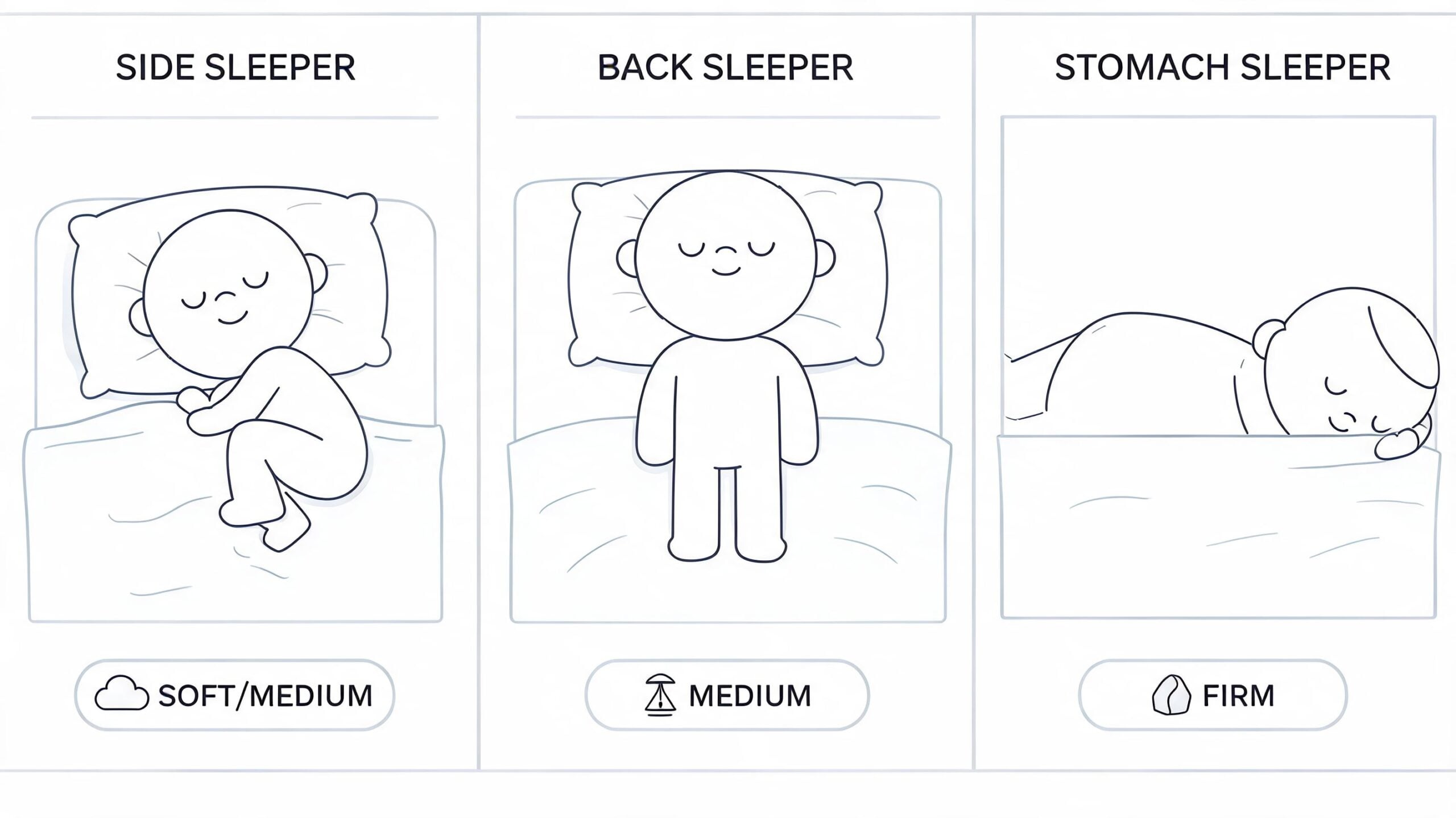
The short answer is simple. Your mattress firmness should match the way your body makes contact with the bed most often. If the firmness is off, even a high-quality mattress can feel restless.
If you're not sure how firmness terms translate into real comfort, this guide on how to choose a mattress firmness can help you sort out what soft, medium, and firm usually feel like in real life.
Side sleepers need cushioning first
Side sleeping puts more pressure on the shoulder and hip than other positions. If the mattress is too firm, those joints take the hit and you keep rolling to escape it.
A side sleeper usually does best with enough surface give to let the shoulder and hip settle in a bit while the waist still feels supported. If you wake with numb arms or sore hips, that's a sign to pay attention to.
Many restless side sleepers think they need "more support" when what they really need is better pressure relief.
Back sleepers need balanced support
Back sleepers usually need a flatter, more even feel. Too soft, and the hips can sink lower than the chest. Too firm, and the lower back may not feel comfortably supported.
The goal is neutral alignment. Your body shouldn't feel like it's bowing inward or being pushed upward awkwardly.
A good test in the showroom is to lie on your back and notice whether your lower back feels lightly supported instead of forced flat.
Stomach sleepers usually need a firmer feel
Stomach sleeping tends to work best on a firmer, more supportive surface because the midsection carries so much weight. If it sinks too far, your lower back can arch.
That arch often leads to subtle, repeated adjustments through the night. You may not remember them, but your body does.
What if you change positions all night
Combination sleepers need a middle ground. You want enough cushioning for your side, enough support for your back, and enough responsiveness that changing positions doesn't feel like work.
A helpful in-store routine is this:
- Start in your usual position: Spend a few minutes exactly the way you fall asleep at home.
- Roll naturally: Don't "test" the bed stiffly. Change positions the way you normally would at night.
- Check your pressure spots: Notice your shoulders, hips, and lower back first.
- Pay attention to effort: If turning takes work, the mattress may be too soft, too slow, or just the wrong build.
That kind of fitting is where local guidance helps. A trained Sleep Pro can often spot a mismatch before you live with it for months.
The Miller Waldrop Difference A Local Promise for Total Peace of Mind
Buying a mattress online can look easy until you're the one trying to decide from photos, marketing claims, and a firmness scale that means something different from brand to brand.

Why trying beds in person still matters
A restless sleeper needs more than a quick bounce test. You need to feel whether your shoulder settles correctly, whether the edge feels stable, whether motion carries across the bed, and whether changing positions feels smooth or awkward.
That's hard to judge on a website. It's easier when you can lie on Tempur-Pedic, Sealy, Stearns & Foster, and Sherwood models side by side and compare what your body says.
For neighbors in Ruidoso, Alto, and the wider Lincoln County area, the in-store experience also reflects local life. Mountain living changes the way people think about recovery, comfort, and temperature. A bed that feels fine in a generic review may not feel right in your actual room, with your bedding, your sleep habits, and your climate.
Why local service lowers the risk
The biggest fear in mattress shopping isn't price alone. It's making the wrong choice and being stuck with it.
That's why the Comfort Promise matters so much. It gives you a safety net if your new mattress isn't the right fit after real nights of sleep. You can learn more about that protection in the Comfort Promise details.
There are other advantages too:
- Personal fitting: A Sleep Pro can help match you to the right feel based on body type, sleep position, and what keeps waking you up.
- Low Price Promise: You don't have to choose between local care and strong value.
- Full-Service Delivery with Professional Setup: That means less hassle and a cleaner transition from old bed to new.
- Community trust: A family business with a 70-year history has to stand behind what it recommends.
A mattress is easier to choose when someone can watch how you lie down, how you turn, and where your body loses support.
That's the difference between buying a product and getting a sleep solution.
Your Action Plan for More Restful Nights
If you're tired of guessing, keep it simple. Focus on the problems you feel at night, then choose a mattress that answers those problems directly.
Your mattress shopping checklist
Bring this checklist with you when you shop:
- Notice what wakes you: Is it heat, pressure, partner movement, or trouble changing position?
- Test in your real sleep posture: Don't just sit on the edge. Lie down the way you sleep at home.
- Stay on the mattress long enough: Restless sleepers need a few minutes to feel shoulder, hip, and lower back response.
- Roll from side to side: If turning feels difficult, try a more responsive build.
- Test with your partner if possible: Motion isolation is easier to judge together.
- Ask about delivery and setup: A smooth setup process makes the transition easier.
- Look for a comfort guarantee: Fear of choosing wrong keeps many people from upgrading too long.
Simple habits that support deeper sleep
A mattress does a lot, but it doesn't do everything. Your routine still matters.
Try these habits alongside your mattress search:
- Keep a steady sleep and wake time. Your body rests better when the timing is predictable.
- Cool the room before bed. Even small changes can help if you tend to sleep warm.
- Use bedding that matches the season. Heavy layers can undo the benefits of a cooler mattress.
- Stretch gently if your legs or back feel tight. Light movement before bed can help your body settle.
- Pay attention to patterns, not one bad night. Look for what repeats.
If you live in Ruidoso or nearby and your sleep hasn't felt restorative in a while, don't assume you just have to tolerate it. The best mattress for restless sleepers often comes down to good pressure relief, better motion control, the right firmness, and guidance from someone who can help you feel the difference in person.
Ready to transform your sleep? Visit our Sleep Pros at Mattress Pro by Miller Waldrop showroom located at 2801 Sudderth Drive, Suite F, in Ruidoso. From luxury brands to budget-friendly solutions, we’re here to help you wake up loving your mornings. Browse our collection online or stop by Monday through Saturday.