

Best Firm Mattress for Stomach Sleepers: No More Back Pain

A lot of stomach sleepers know the routine. They go to bed feeling fine, sleep through the night, then wake up with that dull pull across the lower back and wonder what went wrong.
The problem usually isn't that stomach sleeping is “wrong” for everyone. The problem is that this position asks more from a mattress than people realize. When the bed doesn't hold the middle of the body up evenly, the hips dip, the lower back arches, and the morning starts with stiffness instead of relief.
That's why the search for the best firm mattress for stomach sleepers can feel frustrating. One guide says “firm.” Another says “medium-firm.” A shopper tests one mattress for two minutes, another for five, and both somehow feel “supportive” in the showroom. Then the true test happens at home.
In Ruidoso, Alto, and across Lincoln County, that confusion shows up in the store every week. Many shoppers arrive after trying to solve the issue alone, often after sleeping on a mattress that feels comfortable at first but stops giving the body the support it needs by morning. A local family business with a 70-year legacy, Miller Waldrop has spent decades helping neighbors sort through that confusion with a more practical question: not just “Is it firm?” but “Is it firm enough for this body and this sleep position?”
Table of Contents
- Introduction Waking Up on the Wrong Side of Firm
- Why Your Spine Demands a Firm Mattress
- How to Choose the Right Firmness for Your Body Type
- Decoding Mattress Materials for Stomach Sleepers
- Essential Accessories for Perfect Alignment
- The Local Advantage Why Buying in Ruidoso Matters
- Your Next Steps to Restful Sleep
Introduction Waking Up on the Wrong Side of Firm
A stomach sleeper often describes the same scene in slightly different words. The bed felt soft enough to be cozy, maybe even luxurious at first. But by sunrise, the lower back felt tight, the hips felt heavy, and rolling out of bed took a moment longer than it should.
That pattern confuses people because the mattress doesn't always feel “bad.” It may feel plush, smooth, and inviting. The issue is what happens after several hours, when the midsection settles too far and the body stays there all night.
That's one reason firm support matters so much for this sleep position. A stomach sleeper puts more demand on the center of the mattress than many people expect, especially through the abdomen and hips. If the bed gives way there, the spine pays the price.
A mattress can feel soft and pleasant for ten minutes, then feel punishing after eight hours. Stomach sleepers often learn that lesson the hard way.
Many generic guides often stop too soon. They say “buy firm” and leave the shopper to sort out the rest. But firmness isn't one-size-fits-all. A lighter sleeper and a heavier sleeper can lie on the same mattress and have completely different alignment.
For a shopper walking into a showroom on Sudderth Drive, that's good news. It means the problem is usually solvable. The goal isn't to chase the hardest bed in the room. The goal is to find the level of support that keeps the body flatter, steadier, and less stressed through the night.
Why Your Spine Demands a Firm Mattress
Stomach sleeping puts the middle of the body in a tough spot. The hips and abdomen press into the mattress first, so the bed needs enough pushback there to keep the spine from sagging.
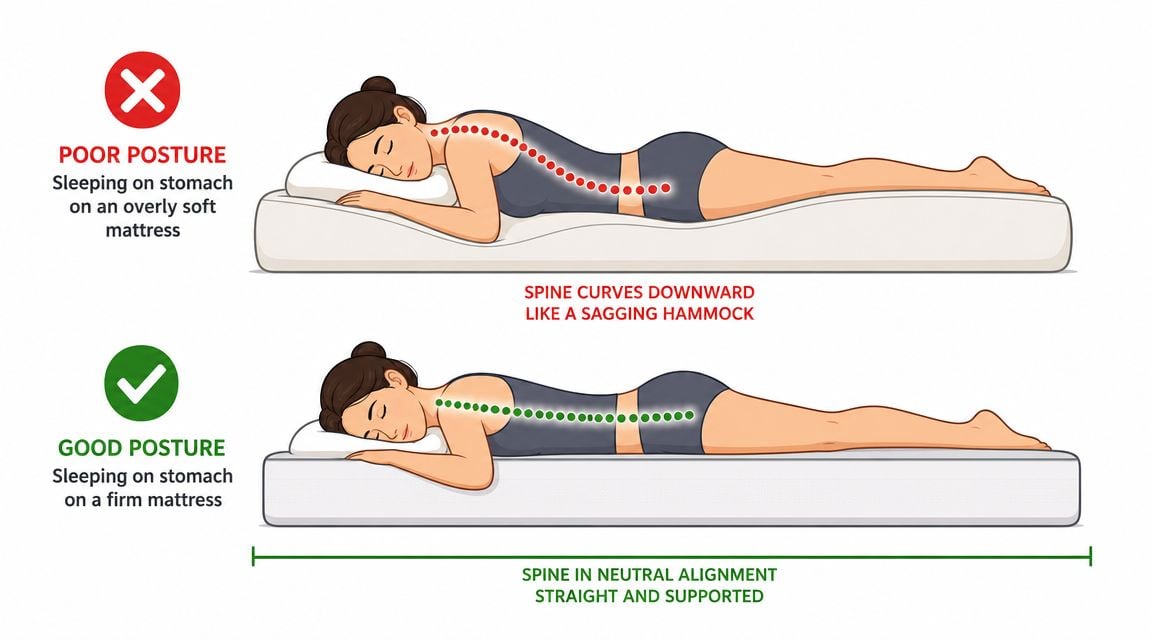
Why softness backfires for stomach sleepers
A soft mattress works like a hammock under a stomach sleeper. The heavier middle drops lower while the chest and legs stay higher. Over several hours, that bend can leave the lower back feeling tight and overworked by morning.
The simplest way to picture it is a straight board laid across two chairs. If the center bows, all the strain collects in the middle. Your lower back ends up handling that same kind of strain when the pelvis sinks too far below the rest of the body.
Sleep experts often point to the same risk for stomach sleepers. Too much sink under the midsection can pull the spine out of a more neutral position and increase stress on the lumbar area, as explained in this stomach sleeper mattress guide.
That is why a mattress can feel pleasant at bedtime and still cause trouble by sunrise.
What firm support is doing
Firm support creates resistance under the hips and abdomen so the body stays flatter. For stomach sleepers, that matters more than a plush surface feel. The goal is not hardness for its own sake. The goal is steadiness.
A good firm mattress lets you rest more on the surface than deep inside it. That shallower cradle often helps keep the pelvis from dipping and the lower back from arching. The American Academy of Sleep Medicine also notes that mattress choice can affect sleep quality and pain symptoms, which helps explain why support feels so different from one bed to another over a full night of sleep, according to its sleep health guidance on mattresses and sleep surfaces.
Here is the part many shoppers miss. "Firm" is not one fixed setting for every stomach sleeper. A lighter person may stay level on a medium-firm bed because they do not sink as much. A heavier person often needs a firmer build to get that same flat, supported posture. The right feel depends on how much of the comfort layer your body compresses.
For readers trying to connect mattress support with morning soreness, this guide on why you wake up with back pain every morning can help explain the bigger alignment picture.
Practical rule: If your hips settle lower than your chest, your lower back is doing extra work all night.
How to Choose the Right Firmness for Your Body Type
Most mattress advice tends to be too vague. “Firm” sounds simple, but one person's firm is another person's too soft. Body weight changes how much a sleeper compresses the comfort layers and support core.
A simple weight based guide
The right firmness depends on body weight. Lighter stomach sleepers might find a medium-firm 6.5 out of 10 mattress supportive enough, while heavier stomach sleepers often need a firm mattress because a softer surface lets the midsection dip too much, as noted in this Sleepopolis stomach sleeper guide.
Here's a practical framework shoppers can use.
| Body Weight | Recommended Firmness (1-10 Scale) | Why It Works |
|---|---|---|
| Lighter build | 6.5 | A lighter body doesn't sink as deeply, so medium-firm support can still keep the midsection level while offering a bit more surface comfort. |
| Average build | 7 to 8 | This range usually gives enough pushback under the hips while still allowing a little cushioning at the chest and knees. |
| Heavier build | 8 to 9 | A heavier body compresses more of the mattress, so firmer support helps stop the abdomen and pelvis from dropping too far. |
A lighter sleeper on an ultra-firm mattress may feel too much pressure at the ribs or chest. A heavier sleeper on a softer model may feel comfortable at first, then wake up with a strained lower back because the support wasn't strong enough.
Body shape matters too
Weight is only part of the picture. Body shape also changes mattress fit.
A sleeper with broader shoulders and narrower hips may need a little more surface cushioning than a sleeper who carries more weight through the abdomen and hips. Someone with a pronounced midsection usually needs stronger center support, because that's where the mattress sees the highest load.
That's why two people with similar body weight can still prefer different feels. One may do well on a flatter, firmer surface. The other may need a touch more contouring on top without losing support underneath.
A couple can run into this issue fast. One partner may be lighter and happy on medium-firm. The other may need a sturdier feel to avoid hip sink. In that situation, a mattress with a firmer support system and carefully chosen comfort layers often gives the best middle ground.
Shoppers who want a clearer feel for how these choices work can use this guide on how to choose a mattress firmness to narrow the range before testing beds in person.
Decoding Mattress Materials for Stomach Sleepers
Firmness tells part of the story. Construction tells the rest. Two mattresses can both feel “firm” in a showroom and still perform very differently overnight.
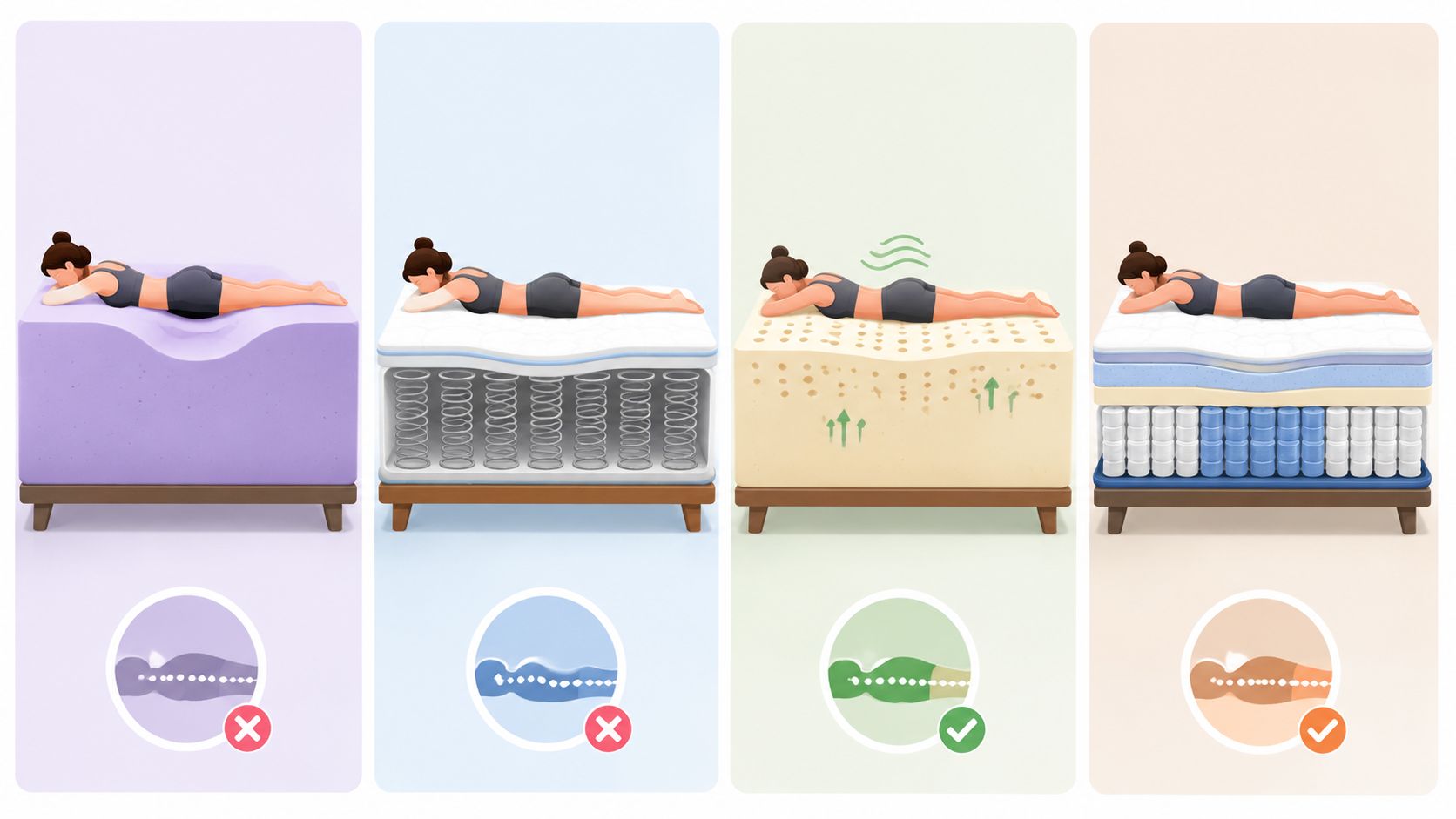
Memory foam and all foam builds
Memory foam can work for stomach sleepers, but only when the build is supportive enough. The common fear is deep sink, and that fear is reasonable. If the foam is too plush or too slow to push back, the midsection can settle farther than it should.
A firmer all-foam model can solve that problem by using denser comfort layers and a stronger support core. That setup can help a sleeper feel cushioned at the surface without losing the flatter posture the lower back needs.
Often, premium foam designs excel. A firmer Tempur-Pedic model, for example, can appeal to someone who wants pressure relief without a loose, sagging feel. In dry mountain air like Ruidoso's, some shoppers also pay closer attention to heat retention and cover feel, since temperature can affect comfort even when support is right.
Innerspring latex and hybrid choices
Innerspring mattresses offer a more traditional, lifted feel. They usually feel easier to move on and often provide a flatter surface. For some stomach sleepers, that straightforward support feels immediately better than a slow-moving foam bed.
Latex feels different again. It's resilient and buoyant, which means it pushes back quickly instead of letting the sleeper sink significantly. That can be a strong match for stomach sleepers who want support with a little spring rather than a body-hugging sensation.
Many shoppers end up landing on hybrids, especially when they need both structure and a bit of comfort at the surface. Firm hybrids and latex hybrids are often top-rated for stomach sleepers because they combine higher coil resistance or resilient latex in the center third of the bed, producing stronger support under the hips. This kind of zoned support is a key feature to watch for, according to this Sleep Advisor stomach sleeper guide.
Zoned support means the mattress doesn't treat every part of the body the same. It gives the torso more resistance where stomach sleepers need it most.
A good hybrid can be especially useful for shoppers comparing brands like Sealy, Stearns & Foster, and Sherwood, where coil design, center reinforcement, and top-layer firmness can vary in meaningful ways. For people who want to understand that category better, this explanation of what a hybrid mattress is helps translate the jargon into plain English.
A practical way to think about materials is this:
- Firm memory foam suits sleepers who want more contour and motion absorption, as long as the foam doesn't allow deep midsection sink.
- Innerspring suits those who want a flatter, more lifted, easier-to-move-on surface.
- Latex works well for sleepers who like responsive support and a buoyant feel.
- Hybrid often gives the widest comfort range because it blends strong support with controlled cushioning.
Mattress Pro by Miller Waldrop offers in-person comparison of different hybrid and foam builds, which can help a stomach sleeper feel how support changes from one construction to the next without relying on online guesswork.
Essential Accessories for Perfect Alignment
A mattress does most of the heavy lifting, but it isn't the whole sleep system. A stomach sleeper can pick the right bed and still wake up sore if the pillow or foundation works against it.
The pillow can help or hurt
For stomach sleepers, pillow height matters more than many people expect. A thick pillow can crank the head upward and to the side, which adds neck strain on top of whatever the lower back is already dealing with.
That's why many stomach sleepers do better with a very thin pillow or, in some cases, no pillow under the head at all. The goal is simple. Keep the neck from bending farther than it has to.
Some sleepers also place a thin pillow under the hips or lower abdomen. That won't fix a poor mattress, but it can sometimes reduce the amount of arch in the lower back.
A firm mattress under the torso and a low pillow under the head usually work better together than a firm mattress and a lofty pillow.
Don't ignore the foundation
The base under the mattress matters too. A strong mattress placed on a weak or sagging foundation can still dip where support is needed most.
That's especially important with heavier firm mattresses, including many hybrids. If the base flexes too much in the middle, the sleeper may blame the mattress when the actual issue is underneath it.
A complete alignment check should include three questions:
- Is the pillow too high? Neck strain often starts there.
- Is the mattress holding the hips level? That's the core issue for stomach sleepers.
- Is the foundation stable? If it sags, the mattress can't perform the way it should.
For shoppers trying to fine-tune the full setup, this guide on how to align the spine while sleeping offers a useful next step.
The Local Advantage Why Buying in Ruidoso Matters
A stomach sleeper can order a "firm" mattress online, sleep on it for one night, and still wake up wondering why the lower back feels tighter instead of better. That happens because a firmness label is only a shortcut. It cannot show how the bed will hold up under a lighter frame, a broader torso, or more weight through the hips.

Why in person testing changes the decision
For stomach sleepers, local shopping gives something a product page cannot. Real feedback from the body.
A mattress works a lot like a pair of boots. Two pairs may both be labeled the same size, but one fits your foot and stride better. Firm mattresses work the same way. Two beds can both sound "firm," yet one may keep a lighter sleeper floating on top while another may let a heavier sleeper sink too far through the middle.
That body weight and build piece gets missed in many mattress guides. It matters a great deal for stomach sleepers. A person with a lighter build may feel best on the lower end of firm because the surface still needs a little give at the chest and knees. A heavier sleeper often needs a sturdier feel and stronger coil or foam support to keep the hips from dipping. Lying down in person helps you sort that out in minutes.
In a showroom, a shopper can compare a premium foam feel against a supportive hybrid or a more traditional innerspring build. That side by side testing makes the differences easier to feel than any online description. The goal is not to find the hardest mattress in the room. The goal is to find the one that keeps the body level for your shape.
What local service adds after the sale
The local advantage continues after the mattress is chosen.
In a mountain community like Ruidoso, convenience means more than fast checkout. It means fewer surprises, fewer returns, and a better chance of getting the setup right the first time. A store on Sudderth Drive serving Ruidoso, Alto, and Lincoln County can talk through body type, sleep position, bedroom setup, and access to the home before delivery day arrives.
That matters because mattress problems do not always show up on the sales floor. Sometimes the issue appears once the bed is in the room, on the foundation, with your usual pillow and bedding. A family-owned business that has served local shoppers for years tends to treat that purchase like a neighbor's back pain problem, not just another order number.
Shoppers often appreciate three forms of support here:
- Comfort Promise gives more peace of mind if the first feel is not quite right.
- Low Price Promise helps keep the purchase focused on value, not pressure.
- Full-Service Delivery with Professional Setup saves buyers from wrestling a heavy mattress through the house and helps the bed get set up correctly.
For shoppers who want to choose carefully without forcing the budget, buy now, pay later mattress financing options can make it easier to bring home the right support for their body type and build.
Your Next Steps to Restful Sleep
The best firm mattress for stomach sleepers usually starts with one simple truth. This sleep position needs stronger support through the middle of the bed.
The broader mattress market has largely converged on the view that stomach sleepers need 7 out of 10 firmness or higher to help prevent spinal strain, according to this Mattress Firm overview of firm mattresses for stomach sleepers. That doesn't mean every stomach sleeper should buy the hardest bed available. It means softness is rarely the safe choice when the goal is alignment.
A practical plan for choosing well
A stomach sleeper can make the decision much simpler by following a short checklist:
- Start with support first. Look for a mattress that keeps the hips from dropping below the rest of the body.
- Match firmness to body weight. Lighter sleepers may do well on the lower end of firm, while heavier sleepers often need a sturdier feel.
- Choose construction carefully. Firm foam, latex, innerspring, and hybrid models all feel different, even when the firmness label sounds similar.
- Check the full setup. Pillow height and foundation support can make a good mattress feel bad.
- Test in a real sleep position. A stomach sleeper needs to lie flat long enough to feel whether the lower back relaxes or tightens.
A better night's sleep usually doesn't come from guessing harder. It comes from narrowing the choices, listening to what the body is saying, and using real support instead of showroom softness as the standard.
Ready to transform sleep? Visit the Sleep Pros at Mattress Pro by Miller Waldrop at 2801 Sudderth Drive, Suite F, in Ruidoso. From Tempur-Pedic, Sealy, Stearns & Foster, and Sherwood to budget-friendly solutions, the team is there to help shoppers wake up loving their mornings. Browse the collection online or stop by Monday through Saturday.