

Ashley Furniture Memory Foam Mattress: Buy Local in Ruidoso

You're probably here because Ashley is a familiar name, and you want a straight answer before you spend money. Maybe you're outfitting a cabin in Alto, replacing an aging guest bed in Ruidoso, or trying to find a comfortable mattress without jumping straight into luxury pricing.
That's a normal place to start. Around Lincoln County, a lot of shoppers recognize Ashley from furniture first, then notice the mattress line second. The problem is that a brand name alone doesn't tell you how a mattress will feel after a month, how it handles back pressure, or whether it makes sense for nightly sleep versus occasional use.
At our family's stores, we've spent generations helping neighbors sort through that exact confusion. A mattress isn't just foam and fabric. It's pressure relief, alignment, temperature control, motion transfer, and long-term wear. If you understand those pieces, you can make a smarter call on any ashley furniture memory foam mattress you're considering.
Table of Contents
- Your Guide to Better Sleep in Ruidoso
- Deconstructing the Ashley Memory Foam Mattress
- Understanding Cooling Features and Gel Technology
- Ashley Memory Foam vs Hybrid and Innerspring Mattresses
- The Truth About Durability Longevity and Value
- Addressing Health Concerns Like Fiberglass
- The Miller Waldrop Advantage How to Buy with Confidence
- Find Your Perfect Night's Sleep in Ruidoso
Your Guide to Better Sleep in Ruidoso
A lot of mattress shopping starts the same way. You wake up stiff, your guests mention the spare bed feels tired, or you realize the cabin needs a simple update before family comes into town. Ashley often shows up early in that search because it's recognizable and usually positioned as an approachable option.
In Ruidoso, that decision has a local twist. Mountain living changes how people shop for sleep. Some buyers need a mattress for a primary home. Others need something practical for a vacation place in Alto. Some want relief after hiking, skiing, or long workdays on their feet.
That's why the right question usually isn't, “Is Ashley good or bad?” The better question is, “What kind of sleeper are you, and what job does this mattress need to do?”
Practical rule: A guest room mattress and a nightly-use mattress don't have to meet the same standard.
When you shop online, you usually get brand claims, a few photos, and a box on your porch. What you don't get is a real conversation about shoulder pressure, lumbar support, or whether your sleep position matches the mattress design.
A local sleep conversation helps you avoid that guesswork. If you want a few simple habits that improve rest before you even buy a new bed, our guide on how to improve sleep quality is a useful starting point.
Why local context matters
Ruidoso and the surrounding parts of Lincoln County have a mix of full-time homes, rental properties, and cabins. That matters because mattress value depends on use.
- For a guest room: A budget-friendly foam bed may be enough if it's only used occasionally.
- For a couple: Motion control becomes more important because one partner's movement can interrupt the other.
- For active sleepers: Pressure relief matters more when hips, shoulders, or lower backs already feel worn out at bedtime.
The more clearly you define the use, the easier it gets to judge whether an ashley furniture memory foam mattress is a smart buy or just a familiar name.
Deconstructing the Ashley Memory Foam Mattress
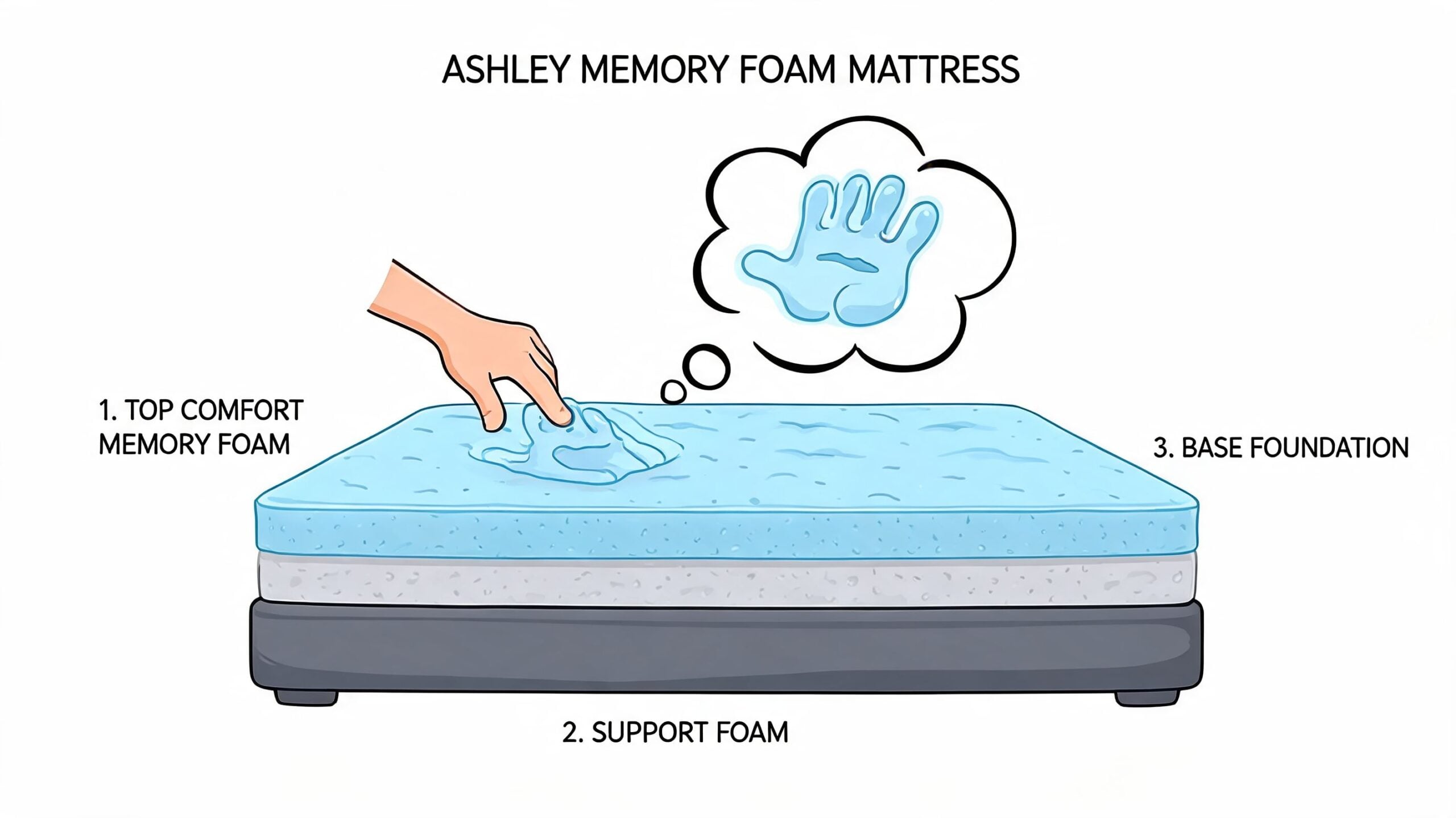
Memory foam gets talked about like it's mysterious, but the basic idea is simple. When you press into it, it compresses where your body is heavier and fills in around the curves that need support. Think of pressing your hand into bread dough. The surface gives under pressure, then supports the shape you created.
That contouring effect is why many people like foam after a long day outdoors or after sleeping on an older spring mattress that pushes back too sharply at the shoulders and hips.
What memory foam actually does
A foam mattress has two main jobs. The top layer handles comfort and pressure relief. The deeper layers handle support and alignment.
If the top is too firm, your shoulder and hip can feel jammed. If the lower support layers are too soft, your spine can drift out of line and you may wake up sore.
That's where construction matters more than the brand label.
How the Ashley foam stack works
Ashley's higher-end memory foam models typically use a 2 to 3 inch layer of medium-density memory foam over a 7 to 10 inch base of firm support foam, a build meant to balance contouring and spinal alignment for side and back sleepers, according to the Peak by Ashley mattress construction details.
In plain language, here's what that means for you:
- Top comfort foam: This is the part you feel first. It cushions shoulders, hips, and curves.
- Firm base foam: This keeps you from sinking too far and helps maintain a flatter sleeping posture.
- Thicker profile feel: A taller all-foam bed often feels more substantial than a thin entry-level foam mattress.
Side sleepers often notice the benefit first because they place more concentrated pressure on the shoulder and hip. Back sleepers tend to notice whether the mattress lets the lower back settle naturally without collapsing.
If you've never liked the “stuck” feeling of old-school foam, construction details matter more than the word memory foam itself.
That's one reason mattress history is helpful. Materials have changed a lot over time, and you can see that progression in this overview of the story of mattresses from straw mats to memory foam.
Understanding Cooling Features and Gel Technology
One of the biggest reasons people hesitate on memory foam is heat. They've either owned an older foam mattress that slept warm, or they've heard enough stories to be cautious.
That concern is fair. Foam hugs the body more closely than many spring beds do. More surface contact can mean more trapped warmth, especially if you already sleep hot or use heavier bedding during cool Ruidoso nights.
Why foam can sleep warm
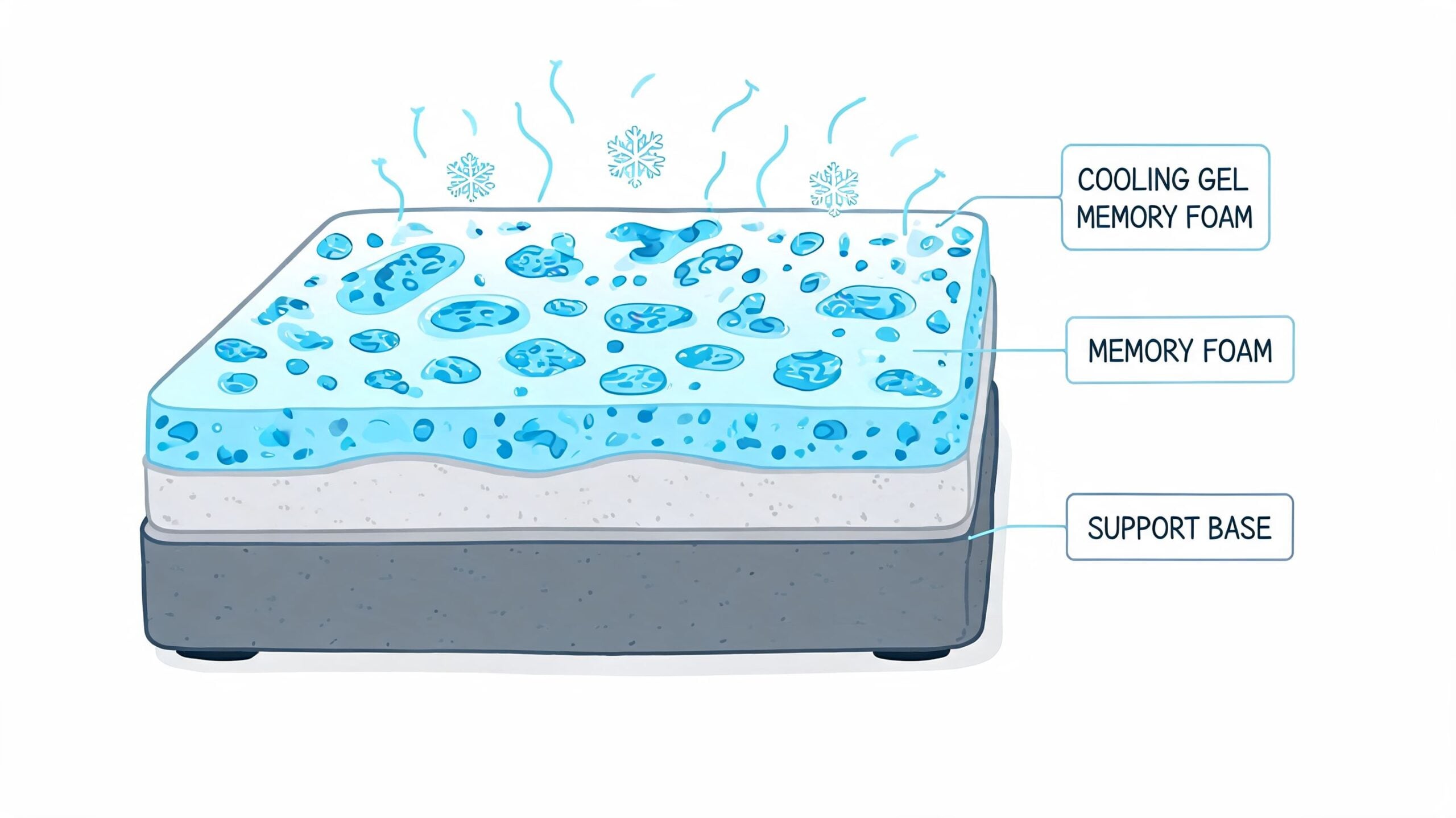
Traditional memory foam responds to body heat and pressure. That's part of what gives it that contouring, slow-molding feel. The downside is that dense foam can hold onto warmth if the design doesn't include some kind of cooling strategy.
In mountain homes, people sometimes assume cool outdoor air solves that problem. It doesn't always. Once you're under blankets, your body still creates a warm pocket at the sleep surface.
How Ashley tries to cool the surface
Ashley uses ComfortSense™ Gel Memory Foam, which uses gel phase-change particles to absorb and dissipate localized heat. In reported performance details, that can reduce mattress surface temperature by roughly 1 to 2.5 °C compared with non-gel memory foam, as described in the Ashley Sleep Gruve review at NapLab.
That doesn't mean a gel foam mattress feels cold. It usually means it feels less stuffy and less likely to build heat right where your body rests.
Consider this practical perspective:
- Gel particles help buffer heat: They work a bit like small heat absorbers near the surface.
- Open structure helps airflow: Faster heat release usually depends on how the foam is built, not just on the word “gel.”
- Your bedding still matters: Thick protectors, flannel sheets, and heavy comforters can overpower mattress cooling.
For some sleepers, that level of cooling is enough. For very hot sleepers, premium cooling systems from brands such as Tempur-Pedic can still feel more advanced. If you want to adjust the temperature feel of your current bed first, a product like a Tempur-Adapt cooling topper can also change the surface experience without replacing the whole mattress.
Cooling features help most when the mattress, pillow, protector, and room setup all work together.
Ashley Memory Foam vs Hybrid and Innerspring Mattresses
Most shoppers don't choose between one mattress and another. They choose between mattress types. That's where confusion usually starts, because a memory foam bed can feel completely different from a hybrid or a traditional innerspring even at a similar price.
The simplest way to compare them is by motion control, bounce, edge stability, and airflow.
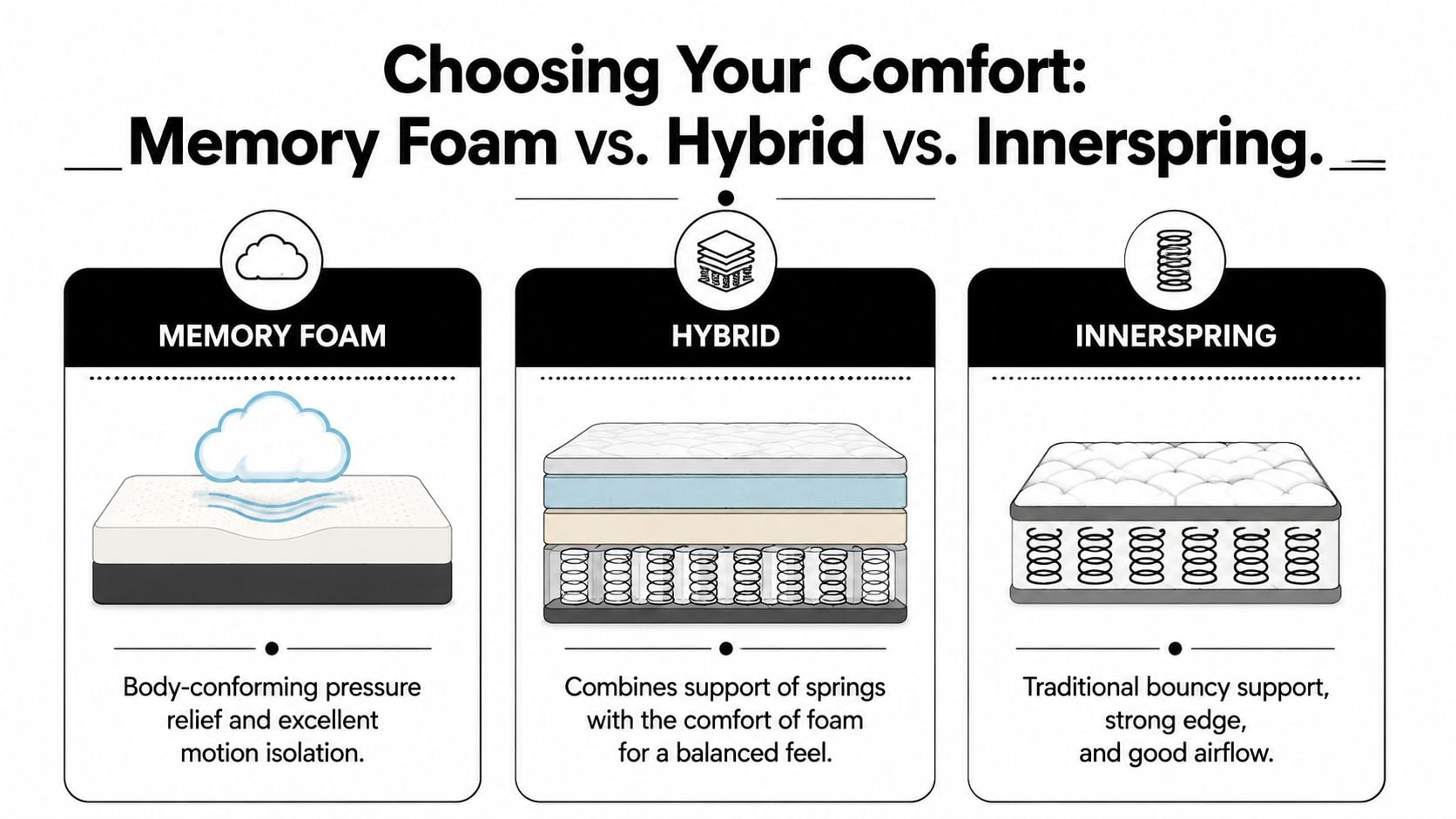
Memory foam compared with innerspring
An ashley furniture memory foam mattress usually feels quieter and more body-conforming than a basic innerspring. That's especially noticeable if you share the bed.
In comprehensive testing, a model like the Ashley Sleep Gruve showed “extremely low motion transfer”, which is a major advantage for couples, according to this independent Ashley Gruve test review on YouTube.
An innerspring usually gives you:
- More bounce
- A more lifted-on-top feel
- Better airflow from open coil space
- More noticeable partner movement
If you grew up on a traditional spring mattress, an innerspring may feel familiar. If you're tired of feeling your partner roll over, foam often feels calmer.
Memory foam compared with hybrid
A hybrid combines foam comfort layers with a coil support core. That creates a middle-ground feel.
Compared with all-foam, a hybrid often gives you:
- Stronger edge support
- More pushback when you move
- Better ease getting in and out of bed
- A little more airflow through the coil section
Memory foam usually wins on motion isolation. Hybrid often wins on edge strength and responsiveness.
If you want a clearer explanation of that mixed construction, this guide on what a hybrid mattress is breaks it down in simple terms.
Where latex fits in
Latex isn't the same as memory foam, even though shoppers sometimes group them together. Latex usually feels springier, quicker, and less sinky.
People who dislike the hugged feeling of memory foam sometimes prefer latex because it contours more gently and rebounds faster. It can be a useful alternative if you want pressure relief without as much body-cradling.
| Feature | Memory Foam | Innerspring | Hybrid |
|---|---|---|---|
| Motion transfer | Very low on many models | Usually higher | Moderate to low |
| Bounce | Low | High | Moderate |
| Edge support | Fair to good | Often good | Often stronger than foam |
| Pressure relief | Strong | More limited | Strong |
| Feel | Deep contour | Traditional and buoyant | Balanced |
Couples often notice motion isolation first. Older adults often notice edge support first.
That's why testing matters. In a showroom, you can move from a foam bed to a Sealy hybrid to a traditional spring model and feel the difference in seconds.
The Truth About Durability Longevity and Value
If you only compare sticker price, Ashley can look appealing. That's why so many shoppers stop there. But mattress value isn't just about what you spend today. It's also about how long the support stays usable.
At this stage, mattress shopping gets less fun and more important.
Why foam density matters
Foam density, usually measured in PCF or pounds per cubic foot, is one of the clearest indicators of how a foam layer may hold up over time. A major issue with many budget memory foam mattresses, including some Ashley models, is that the foam density often isn't publicly disclosed.
Industry benchmarks summarized in this Ashley mattress durability discussion note that lower-density foams can lose 40 to 60% of their support in 2 to 4 years, while high-density foams at 3.5+ PCF can last 8 to 10+ years.
That doesn't mean every budget mattress fails quickly. It means your ability to predict long-term performance is weaker when the key material spec is missing.
When Ashley can still make sense
Honesty matters more than brand loyalty.
Ashley may fit well if you need:
- A guest room solution: Occasional use puts less wear on the foam.
- A cabin mattress in Alto: A bed used on weekends has a different job than one used every night.
- A tighter upfront budget: Lower entry pricing can solve an immediate need.
A premium mattress often makes more sense if you need a primary bed for nightly use, especially if you already deal with back, neck, or pressure-point issues. That's where disclosed materials become more valuable because they reduce uncertainty.
For a practical replacement timeline, our article on how long a mattress should last helps you match expected lifespan to real use.
Addressing Health Concerns Like Fiberglass
A lot of shoppers now ask about fiberglass before they ask about firmness. That shift makes sense. People have heard stories about fire-barrier materials escaping a mattress cover and creating a mess that's hard to clean up.
The question isn't paranoid. It's reasonable.
What shoppers worry about
Ashley says its current collections are made without fiberglass. That's important and worth knowing. At the same time, shoppers are paying closer attention to this topic than they used to.
According to Ashley-related consumer concern data summarized in the brand discussion, Google Trends showed a 40% spike in related fiberglass searches in 2025, which reflects how much attention this issue now gets among buyers looking for reassurance through independent proof, as noted on the Ashley Sleep collection page.
For families in Ruidoso with allergies or respiratory sensitivities, that concern can feel even more personal because dry mountain air already makes some people more aware of dust and irritation.
Why third-party proof matters
A brand statement is helpful. A third-party certification is stronger because it gives you outside verification.
When shoppers ask me about material safety, I encourage them to think in layers:
- What does the brand say?
- What does independent certification confirm?
- Can the retailer explain the fire barrier and materials clearly?
If a mattress claim matters to your health, ask for proof you can verify, not just wording on a tag or product page.
That doesn't automatically rule Ashley out. It means health-conscious shoppers should ask more questions before buying, especially when they're comparing it with premium brands that provide more visible documentation.
The Miller Waldrop Advantage How to Buy with Confidence
Most mattress regret happens for one reason. People buy before they understand how the bed will feel after more than two minutes of sitting on the edge.
A good buying process fixes that. It slows you down just enough to notice pressure, support, motion, and ease of movement.
How to test a mattress the right way
If you're shopping in person, don't just perch on the side and call it done. Use a simple routine.
- Lie down in your real sleep position: Side sleepers should stay on their side. Back sleepers should stay on their back.
- Give it a few minutes: Foam can change feel after your body settles.
- Roll and reposition: This tells you whether the surface feels sticky, easy, firm, or unstable.
- Test the edge: Sit and lie near the side if getting in and out of bed matters to you.
- Bring your partner if possible: Motion transfer and comfort are hard to judge alone.
A consultative showroom process helps with that. At Mattress Pro by Miller Waldrop, shoppers can compare memory foam, hybrid, and premium models side by side instead of guessing from a thumbnail photo.
What local buying changes
Buying local changes the risk in a few practical ways.
First, you can feel the difference between an entry foam mattress and a more premium option like Tempur-Pedic, Sealy, Stearns & Foster, or Sherwood before you commit. That matters because many people don't know what they prefer until they try a few constructions in sequence.
Second, service matters after the sale too. The Comfort Promise reduces the fear of picking the wrong feel. The Low Price Promise helps budget-minded shoppers compare with more confidence. Full-Service Delivery with Professional Setup means you don't have to wrestle a compressed box through the door and hope it works out.
A mattress test isn't about finding the softest bed. It's about finding the bed your body stays aligned on.
That's especially helpful in Ruidoso, Alto, and across Lincoln County, where homes, cabins, stairs, and delivery access can all complicate what looked simple online.
Find Your Perfect Night's Sleep in Ruidoso
An ashley furniture memory foam mattress can be a sensible choice. It may fit a guest room, a cabin, or a budget-conscious purchase where short-term comfort matters most. The key is understanding the trade-offs, especially in feel, motion control, cooling, and long-term predictability.
If you need a primary mattress for nightly sleep, it helps to compare Ashley against more transparent and higher-performance options before making a final call. That's how you avoid buying on name recognition alone.
For families in Ruidoso, the best mattress decision usually comes from matching the bed to the sleeper, the home, and the way the mattress will be used. That's true whether you're shopping for a spare bedroom or your own everyday sleep.
Ready to transform your sleep? Visit our Sleep Pros at the Mattress Pro showroom located at 2801 Sudderth Drive, Suite F, in Ruidoso. From luxury brands to budget-friendly solutions, we're here to help you wake up loving your mornings. Browse our collection online or stop by Monday through Saturday.