

Why Does My Mattress Move When I Sleep and How to Fix It

Waking up to find the mattress several inches out of place is frustrating enough. Feeling every turn, rise, or late-night trip to the bathroom from a partner can make the whole bed seem unstable. For sleepers in Ruidoso, a moving mattress may point to the foundation, the mattress materials, or both.
The answer to why does my mattress move when I sleep starts with identifying which kind of movement is happening. A mattress can slide physically across its base, or it can stay in place while motion travels through the comfort layers. Those problems look similar at bedtime, but they need different solutions.
Diagnosing Your Mattress Movement Problem
A couple in a Ruidoso cabin may wake up to find the mattress shifted toward one side of the frame. Another couple may find the mattress perfectly centered but still feel every time a partner changes position. The first problem is mattress sliding. The second is motion transfer.
Sliding and motion transfer are different
Mattress sliding happens underneath the mattress. The sleep surface moves across the foundation because the base doesn't contain it, the frame doesn't fit correctly, or the materials create too little friction. A smooth mattress cover on a slick foundation can make this problem worse.
Motion transfer happens inside the mattress. When one sleeper moves, energy travels through the materials and reaches the other side instead of being absorbed close to the original movement. Guidance from the Sleep Foundation's motion isolation methodology distinguishes this measurable movement from simple shifting across a frame.
A quick morning check can help:
- The mattress is visibly crooked: The foundation, frame fit, rails, or surface friction deserve attention.
- The mattress stays centered but the partner feels movement: The construction may lack sufficient motion isolation.
- The frame wobbles when someone sits down: The support system may be contributing to the sensation.
- Movement feels strongest near the edge: Edge support or perimeter stability may be inadequate.
Practical rule: A strap may restrain a sliding mattress, but it can't stop movement traveling through the mattress core.
Ruidoso's dry mountain air also makes comfort and surface feel worth considering. Different covers, pads, and foundation fabrics can feel more or less slippery in a dry environment, so a local sleep consultation can reveal whether the issue is a friction problem or a mattress-construction problem before money is spent on the wrong fix.
Why Your Mattress Slides Across the Foundation
A mattress slides when the forces acting across its surface overcome the grip between the mattress and foundation. Sleepers create those forces by turning, sitting on the edge, getting in and out of bed, and shifting weight during the night. If the base doesn't provide containment, the mattress gradually moves.
The foundation may not fit the mattress
A mismatched frame size leaves room for the mattress to travel. A frame that's slightly larger than the mattress may allow side-to-side movement, while a base that's too small can leave portions unsupported. Missing guard rails and absent end stops remove the physical barriers that keep the mattress centered.
Widely spaced slats can create another concern. Slats may support the mattress unevenly, especially when they don't match the mattress manufacturer's requirements. A closer look at mattress slats and support can help determine whether the base is contributing to shifting or sagging.
Friction and weight distribution matter
A low-friction foundation cover gives the mattress less resistance. Smooth mattress covers, particularly on some compressed or boxed designs, may glide across a slick platform or older spring base. The problem becomes more noticeable when two sleepers move independently because their weight doesn't remain centered in one place.
The foundation should be assessed for:
- Correct dimensions: The mattress and frame should be designed to work together.
- Side containment: Rails or a recessed platform can help prevent lateral travel.
- Even support: The base should not tilt, dip, or rock beneath the mattress.
- Stable hardware: Loose rails, feet, or connections can create shifting and wobble.
- Appropriate surface material: The contact layer should provide dependable friction without damaging the mattress.
Why quick fixes often disappoint
A non-slip pad may reduce movement for a while, but it won't correct a frame that's too large or a base with missing structural support. Retainer straps may hold one area in place while the mattress continues to flex or shift elsewhere. Repeatedly pushing the mattress back each morning treats the visible symptom rather than the cause.
A mattress that slides in a vacation rental or cabin may need the same careful diagnosis as one in a primary bedroom. The surrounding setting changes, but the mechanical issue remains a mismatch between the sleep surface and its foundation.
Understanding Motion Transfer and Sleep Disruption
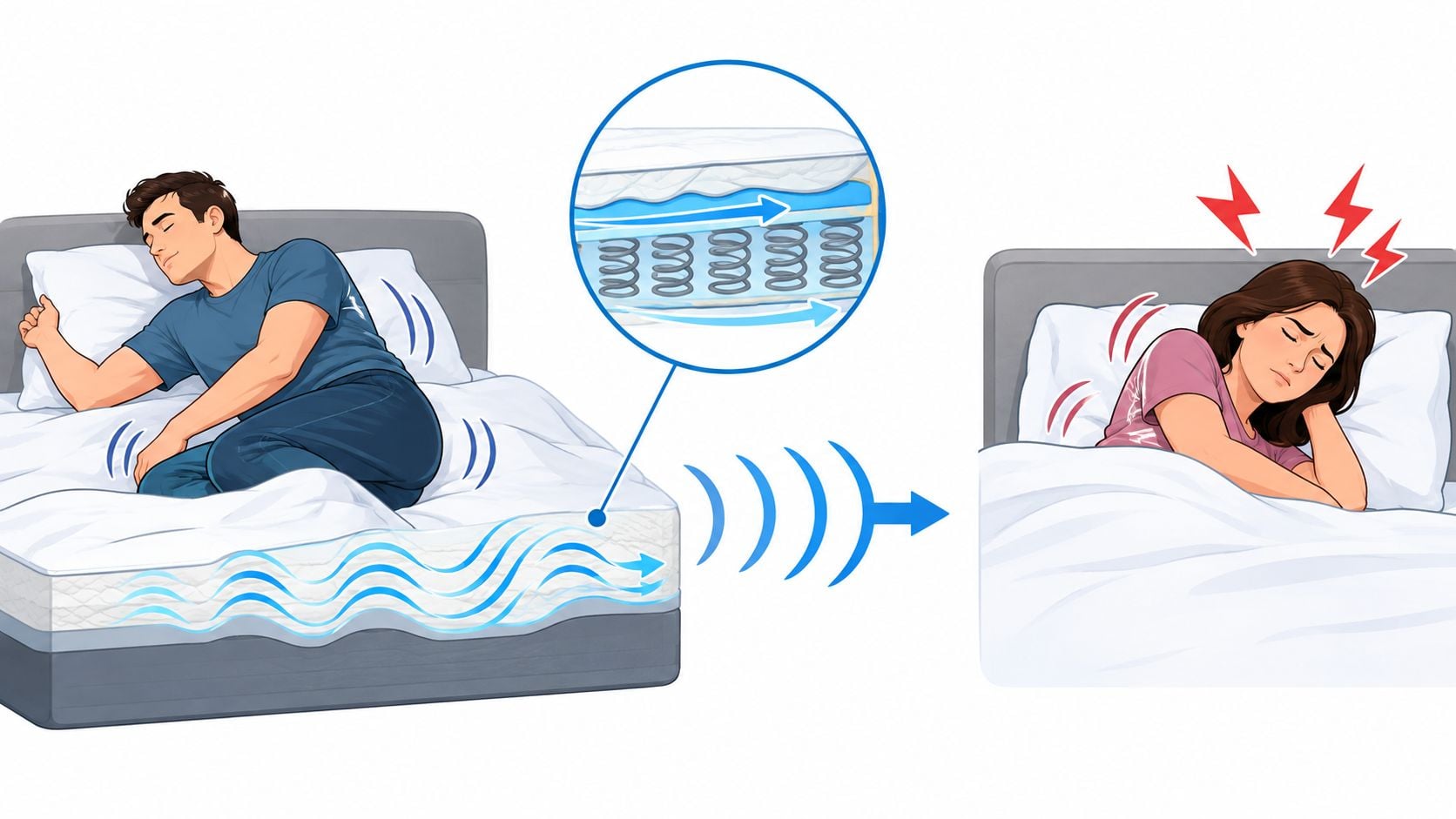
A mattress doesn't have to move across the frame to disturb sleep. When one sleeper turns, the mattress deforms beneath that body. If the materials don't dampen the deformation, kinetic energy travels laterally through the bed and reaches the other sleeper.
The mattress core determines how movement travels
Connected or interlinked coils respond as a more unified structure, so movement can spread across a larger portion of the sleep surface. Foam generally absorbs more of that energy, while individually pocketed coils can localize movement because each coil responds more independently. This construction difference is why memory foam and spring mattresses handle movement differently.
High-density memory foam can cushion pressure points and limit bounce, although its contouring feel may make position changes slower for some sleepers. A hybrid design with pocketed coils can combine responsive support with localized motion control. Cooling gel technology may be included in some foam comfort layers to manage heat, but it doesn't automatically guarantee perfect motion isolation.
Movement can affect sleep continuity
A controlled study indexed by PubMed on mattress motion transfer found that transferred movement was associated with more Stage 1 sleep and less Stage 3/4 sleep. The effect was stronger on mattresses that transferred more motion, which supports the idea that the issue involves insufficient damping, not only a mattress feeling bouncy.
The RTI mattress research measured an average of 54 minutes of movement during each 8-hour sleep period on the least-motion bed and 69 minutes on the most-motion bed, as reported in the RTI mattress study. Each step away from the least-motion bed added about 2.2 minutes of movement per night, while sleep-time differences were about 5 minutes and sleep-efficiency differences were about 1% across the tested mattresses.
Movement that feels minor while awake can become repeated sleep disruption for a light sleeper.
Other sleepers can amplify the problem
Couples often notice motion transfer when one person rises earlier, changes position frequently, or sleeps close to the center of the bed. Pets can create similar disturbances because their movement loads a small area and then sends energy outward. A sturdy perimeter can also improve stability near the edge, as explained in the Sleep Foundation guidance on edge support.
More practical ways to evaluate and reduce this issue are available in the guide to reducing motion transfer in bed.
Practical Fixes to Stop Mattress Shifting
The right fix depends on the diagnosis. A sliding mattress needs better friction or containment at the base. A mattress with excessive motion transfer needs improved damping through its comfort layers or a different construction. Treating one as the other can waste time and money.
For a mattress that slides
Short-term measures can help when the frame is structurally sound:
- Non-slip mattress pad: Adds friction between the mattress and foundation and may help with mild shifting.
- Hook-and-loop strips: Can restrain movement, but the materials must be appropriate for the mattress and foundation.
- Retainer straps: Useful when the frame already fits correctly but the surface remains unusually slick.
- Repositioning and inspection: Center the mattress, tighten loose hardware, and look for uneven support before adding accessories.
These approaches won't solve an oversized frame, missing rails, or a foundation that rocks. A recessed foundation or a properly fitted platform offers a more durable form of containment.
For motion transfer through the mattress
A high-quality memory foam topper may soften surface movement and reduce the sensation of bounce. It can't repair a failing mattress core, deep sagging, or a structure that transfers energy through the entire bed. A topper also changes the pressure-relief and temperature feel, so the result should be tested carefully.
Couples who need stronger stability should compare the whole sleep system, including the mattress, foundation, frame, and edge support. Guidance on choosing a bed frame for heavier couples can help focus the conversation on structural compatibility rather than a single accessory.
A sensible decision order
- Watch the bed during normal use. If the mattress visibly travels, inspect the foundation first.
- Test the frame. Sit near each edge and observe rocking, flexing, or loose connections.
- Check the mattress response. Have one sleeper change position while the other remains still.
- Match the fix to the result. Use friction or containment for sliding, and consider damping or replacement for motion transfer.
- Ask for an in-person evaluation. A Sleep Pro can compare materials and support instead of relying on a guess.
When It Is Time to Replace Your Mattress
A mattress may be ready for replacement when it no longer supports the body evenly, allows sleepers to roll into a sag, or transfers movement that the comfort layers once contained. Straps and toppers can't restore a collapsed core or worn edge structure.
Warning signs deserve attention
Deep body impressions can change spinal alignment and make one sleeper roll toward the other. Sagging edges can make sitting down feel unstable and can reduce usable space across the bed. A complete loss of motion isolation suggests that the materials may no longer be controlling movement effectively.
| Warning Sign | What It Means for Your Sleep |
|---|---|
| Deep body impressions | The surface may no longer distribute pressure evenly or support the spine consistently. |
| Sagging edges | Edge stability has declined, which can make getting in and out of bed less secure. |
| Persistent shifting with a sound foundation | The mattress cover or internal structure may be contributing to instability. |
| Loss of motion isolation | Partner movement may travel farther across the sleep surface. |
| Repeated discomfort in familiar positions | The comfort layers may no longer match the sleeper's pressure-relief needs. |
A broader guide to how long a mattress should last can help place visible wear in context, but condition matters more than a calendar. Sleepers should consider how the mattress feels now, whether the foundation is compatible, and whether the body wakes refreshed or repeatedly disturbed.
Construction should match the household
Tempur-Pedic and other memory foam designs may suit sleepers who prioritize contouring, pressure-point relief, and reduced bounce. Sealy, Stearns & Foster, and Sherwood offer different support feels across their mattress collections, including constructions intended to balance responsiveness, edge stability, and partner comfort.
A hybrid can be a practical choice for sleepers who want easier movement without giving up localized support. Pocketed coils may reduce the spread of movement compared with connected coils, while reinforced perimeter support can make the sides feel more secure.
Local testing removes guesswork
The fear of choosing the wrong bed is understandable, especially when online descriptions can't show how movement feels to two people sharing a mattress. The local Comfort Promise gives shoppers a way to approach the decision with greater peace of mind. The Low Price Promise also addresses budget concerns, while professional guidance can account for sleep position, body type, temperature preferences, and the existing foundation.
Your Local Sleep Experts in Ruidoso
A stable bed is a complete system. The mattress, foundation, frame, comfort layers, and edge support all influence whether the sleep surface slides, wobbles, or transfers movement. Replacing only one part may help, but the strongest solution begins with matching every component.
A showroom test answers practical questions
At a local showroom on Sudderth Drive, couples can test whether movement from one side reaches the other. A sleeper can sit near the edge, change positions, and compare memory foam, hybrid, and responsive designs while a partner remains still. That hands-on process reveals details that product descriptions can't communicate.
The climate around Ruidoso, Alto, and Lincoln County also makes temperature and material feel important. Dry mountain air may make some sleepers comfortable with contouring foam, while others may prefer a more breathable, responsive design. A Sleep Pro can discuss cooling gel technology, pressure relief, spinal alignment, and ease of movement as one connected decision.
Service continues after the purchase
The family business behind the local showroom carries a 70-year legacy of service in the community. Its Full-Service Delivery with Professional Setup helps ensure that the new mattress and foundation are positioned correctly from the beginning, reducing the chance that a setup problem will be mistaken for a mattress defect.
A local consultation also provides a practical alternative to anonymous online shopping. The local mattress store guide offers another way to consider the value of testing, delivery, setup, and ongoing guidance in one place.
The central answer to why a mattress moves is simple: first determine whether the mattress is sliding over the foundation or transferring movement through its materials. Once the cause is clear, the right sleep system can address the problem at its source instead of masking it with another temporary fix.
Mattress Pro by Miller Waldrop helps Ruidoso sleepers compare Tempur-Pedic, Sealy, Stearns & Foster, and Sherwood mattresses, foundations, and support options for better stability and motion control. Visit Mattress Pro by Miller Waldrop at 2801 Sudderth Drive, Suite F, in Ruidoso for the Comfort Promise, Low Price Promise, and Full-Service Delivery with Professional Setup.