

How to Reduce Motion Transfer in Bed: A Complete Guide

Individually wrapped pocketed coils can reduce partner motion shock transfer by 71%, making mattress construction a primary variable for couples. The most reliable approach combines an appropriate mattress with a stable frame, supportive foundation, and bedding that doesn't pull movement across the sleep surface.
One partner turns over, gets out of bed, or settles back down. The other partner feels the ripple and wakes, even though the movement seemed minor. In a shared bed, that cycle can leave both sleepers tired, frustrated, and unsure whether the problem is firmness, the frame, or the mattress itself.
Learning how to reduce motion transfer in bed starts with the full sleep system. Mattress material matters, but so do the foundation, frame connections, bedding, body weight, sleep position, and the way each person enters and leaves the bed. For couples in Ruidoso, Alto, and across Lincoln County, local guidance can also account for cooling needs in the dry mountain air, pressure relief, and the practical realities of a shared bedroom.
Understanding Why Motion Transfer Matters
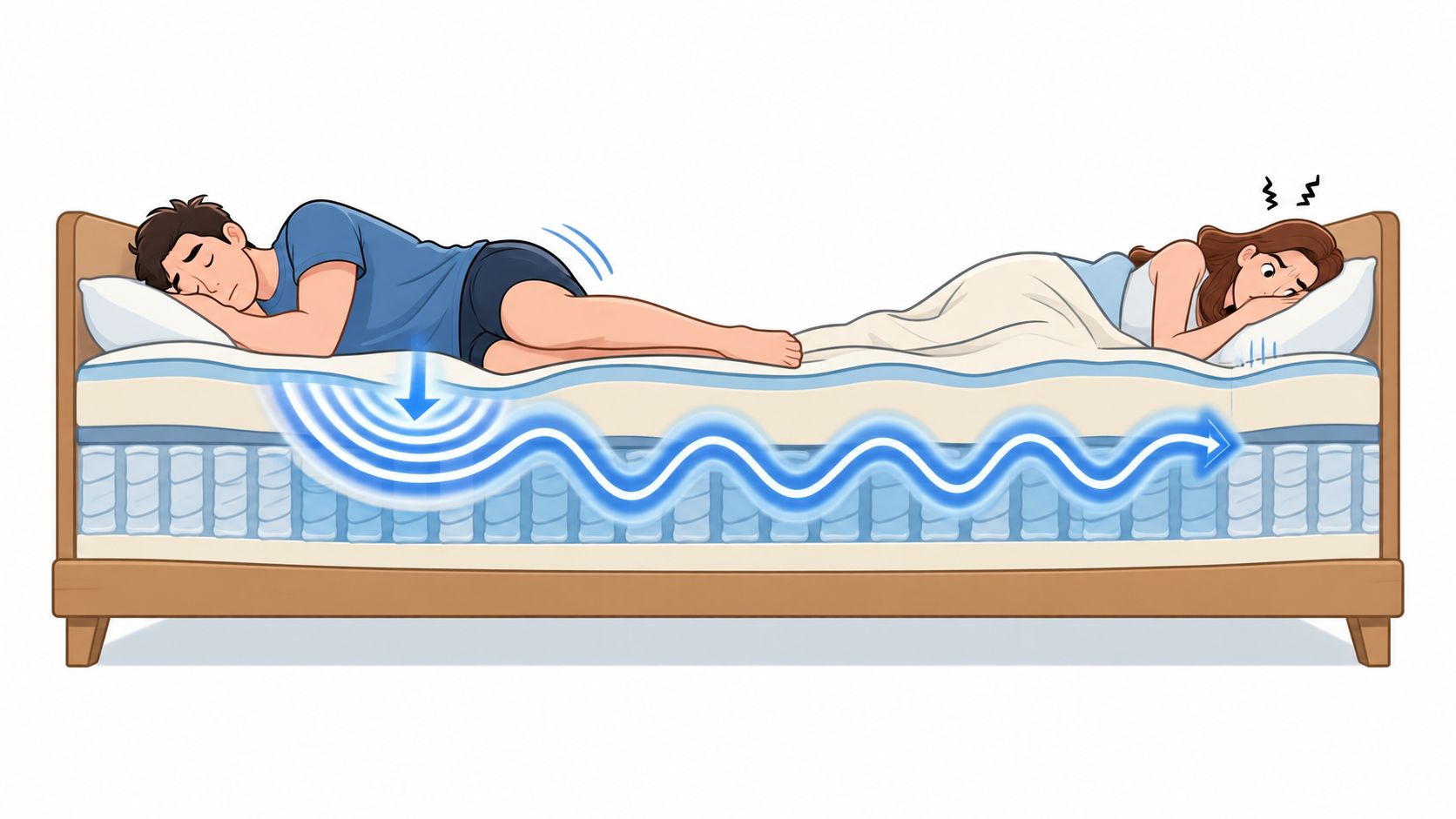
Motion transfer is the movement one sleeper feels when the other sleeper shifts position. A mattress with strong bounce spreads that force across a wider area, while an effective motion-isolating design absorbs movement closer to where it begins.
That difference matters because sleep disruption isn't limited to a full awakening. A foundational 1999 sleep study found that lateral movement from a 240-pound artificial bed partner placed on one side of a king-size mattress caused a significant increase in Stage 1 sleep and a significant decrease in Stage 3/4 sleep, even though total sleep efficiency, awakenings, and wakefulness after sleep onset didn't change significantly (Sleep Foundation's motion-isolation research overview).
Why lighter sleep still matters
Stage 3/4 sleep represents deeper restorative sleep. If mattress movement nudges a sleeper toward lighter sleep without producing a clear memory of waking, that person may still become more vulnerable to noise, temperature changes, and additional movement.
That's why motion isolation belongs in a broader conversation about sleep health, not just showroom comfort. A mattress can feel comfortable during a brief test while still allowing enough vibration to disturb a partner throughout the night.
Practical rule: If one sleeper regularly notices turning, sitting up, or getting out of bed, the mattress should be evaluated as a shared sleep surface, not as two separate comfort zones.
What couples often misdiagnose
Couples sometimes blame firmness first. A very firm surface can feel stable, but if it uses a connected spring system or rests on a flexible base, movement may still travel easily.
Other couples focus on cooling or bounce and overlook isolation. Responsive materials can make repositioning easier, but they may also send more energy across the mattress. The right choice depends on the balance between pressure relief, ease of movement, temperature, support, and disturbance control.
The useful question isn't whether a mattress feels good to one person. It's whether both sleepers can turn, rise, and settle without creating a noticeable event on the other side.
Choosing the Right Mattress for Couples
Mattress construction usually has more influence on motion isolation than the label on the showroom tag. Couples should compare the support core, comfort layers, coil design, and overall surface response before choosing based on brand reputation or firmness alone.
Memory foam
Memory foam generally performs well for motion isolation because it conforms around the body and absorbs movement at the point of impact. It can also relieve pressure around the shoulders and hips, which may help side sleepers maintain a more comfortable position instead of shifting repeatedly.
The trade-off is responsiveness. Dense foam can feel slower when a sleeper turns, and some people prefer a more buoyant surface. Cooling also deserves attention, particularly in Ruidoso's dry mountain climate. Cooling gel technology, breathable covers, and ventilation within the design can improve temperature management, but shoppers should test the actual mattress rather than assume every foam model feels the same.
Pocketed coils and hybrids
Individually fabric-wrapped pocket coils move more independently than connected wire innersprings. One cited accelerometry study involving 84 co-sleeping couples found that pocket coils reduced partner motion shock transfer by 71% compared with connected wire innersprings, while also preventing partner awakenings during position changes.
A hybrid can offer pressure relief from foam above a supportive coil core, along with more airflow and easier repositioning than some all-foam beds. The trade-off is that coils are springier, so a hybrid may transfer more motion than an all-foam mattress unless the comfort layers are thick and effective at absorbing vibration.
Construction matters more than category labels
Testing shows meaningful differences within the hybrid category. In one large test set, hybrid mattresses averaged a motion transfer score of 8.2, memory-foam hybrids averaged 8.5, and latex hybrids averaged 7.5.
Those figures aren't a reason to buy a category sight unseen. They show why shoppers should ask what sits above the coils, how thick the isolation layers are, and whether the surface calms movement quickly.
A practical shopping checklist includes:
- Support core: Prefer independently moving pocketed coils or a dense foam core over connected wire springs when partner disturbance is severe.
- Comfort layers: Look for enough foam, especially slow-moving foam, to absorb impact before it reaches the support system.
- Surface feel: Test whether one sleeper can turn without shaking the other side.
- Sleep positions: Match pressure relief and spinal alignment to each person, not just to the couple's shared preference.
- Temperature: Evaluate cooling features in person, especially if one partner sleeps warm.
For a focused buying framework, couples can review this guide to mattresses for motion isolation. Tempur-Pedic, Sealy, Stearns & Foster, and Sherwood each offer different construction approaches, so the specific model and feel still need to be tested.
Testing Your Mattress and Foundation
A mattress can't be judged properly by pressing one spot with a hand. Couples should test the assembled sleep system and recreate the movements that cause trouble at night.
Start with the glass test
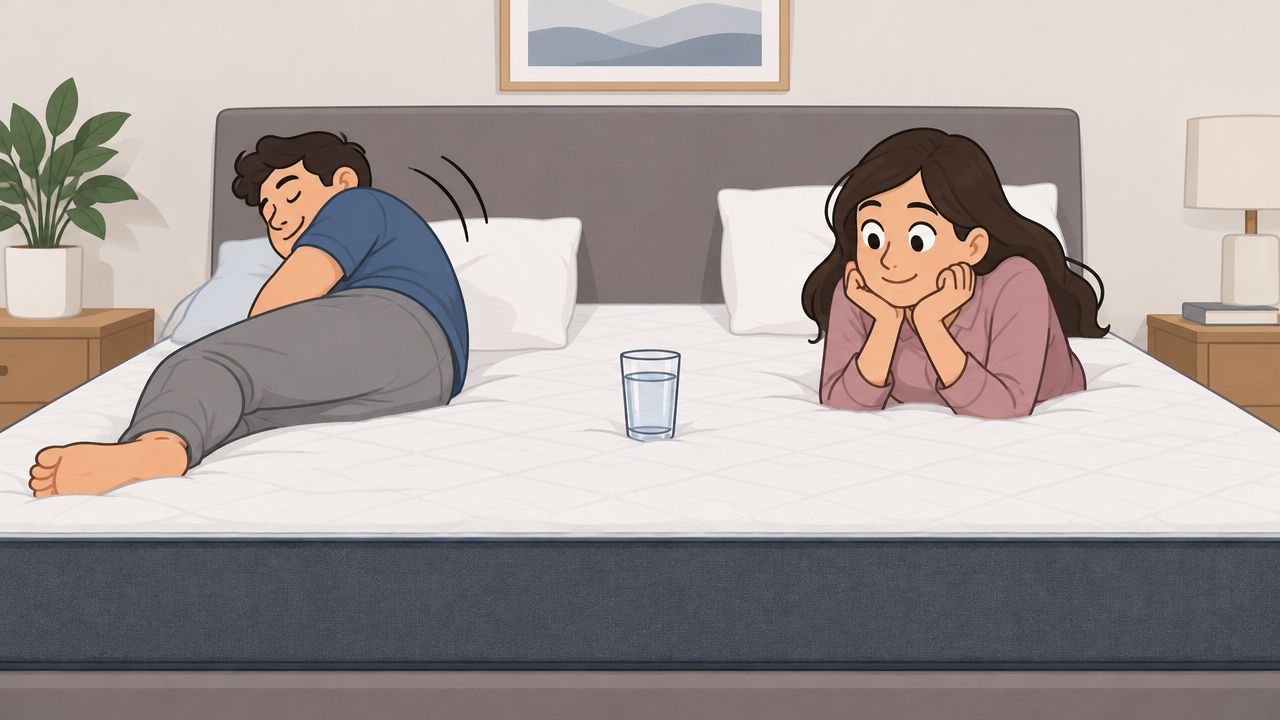
Place a filled glass on one side of the mattress. Have the other person lie down, sit, turn, and get out on the opposite side. Watch the water and the glass itself.
A stable glass doesn't prove that a mattress will solve every sleep problem, but it gives couples a repeatable way to observe vibration. A pronounced wobble suggests that movement is traveling across the surface and deserves closer investigation.
Check the frame before replacing the mattress
A loose or flexible frame can amplify movement. Before shopping for a new mattress, check the connections, center support, legs, and contact points with the floor.
Look for:
- Loose bolts or brackets: Tighten every connection and retest the bed.
- Frame sway: Push gently from the side and watch whether the frame rocks.
- Foundation flex: Notice whether the support underneath bends or rebounds when weight shifts.
- Uneven contact: Confirm that the frame sits level and doesn't rock on the floor.
A motion-isolating mattress can't fully compensate for a sleep system that moves underneath it.
Consider a solid platform
A solid wood platform can provide a stable base for a couple who wants to reduce unnecessary movement. One expert review specifically recommends a split-king setup on a solid wood platform as a strong configuration for minimizing partner disturbance.
The word “split” matters because two separate mattresses can reduce the way movement travels through the shared surface. The foundation still needs to match the mattress manufacturer's requirements. For guidance on compatible support, review the information on a memory foam mattress foundation.
Simple DIY Solutions to Reduce Movement
Replacing a mattress isn't always possible immediately. Several changes can reduce disturbance while a couple evaluates longer-term options.
Add a dense topper
A dense topper can absorb some of the force created when a sleeper sits down, turns, or gets out of bed. It won't remove a motion problem created by a worn-out support core, but it may reduce how directly movement reaches the springs underneath.
Choose the topper by feel as well as density. Memory foam can provide deeper absorption and pressure relief, while latex may feel more responsive. Couples should avoid choosing solely by thickness or label, since the result depends on the topper, the mattress beneath it, and the sleepers' body weights.
A mattress topper can be a sensible trial when the existing mattress is otherwise supportive and in good condition. More guidance is available in this memory foam mattress topper resource.
Use separate blankets
Shared bedding can pull across the surface when one person turns. Separate blankets allow each sleeper to move independently and prevent one person from tugging the other's covers.
This won't change the mattress itself, but it can remove a surprisingly common source of disturbance. It's also easy to test tonight, without changing the frame or foundation.
Consider a split-king configuration
A split king uses two separate mattresses side by side. It can be especially useful when one sleeper moves frequently, when partners have very different firmness preferences, or when a shared mattress continues to transmit movement despite other adjustments.
The gap in the center may require a suitable bridge and carefully fitted bedding. The trade-off is less of a unified surface, but the benefit can be greater independence for each sleeper.
Use a short troubleshooting order
For a practical sequence, couples can try:
- Tighten the frame and confirm that the foundation sits level.
- Test separate blankets for several nights.
- Add a dense topper if the mattress still offers sound support.
- Reassess whether the underlying mattress uses connected springs or lacks meaningful isolation.
- Test an all-foam or pocketed-coil design if movement remains disruptive.
These changes work best when couples track the actual disturbance. Note whether the problem occurs during turning, sitting, getting in, getting out, or shifting near the edge. That observation helps a Sleep Pro recommend a construction rather than simply a softer or firmer feel.
When to Seek Professional Help
Professional guidance makes sense when movement continues after the frame, foundation, and bedding have been checked. It's also useful when one partner needs strong pressure relief, the other needs easy repositioning, or both sleepers disagree about firmness and temperature.
A short showroom test can reveal obvious differences, but the right recommendation requires more than lying down for a moment. A Sleep Pro should consider:
- Body type: Weight distribution affects how each person engages the comfort layers and support core.
- Sleep position: Side sleepers often need cushioning at the shoulders and hips, while back and stomach sleepers may need a more stable alignment.
- Movement patterns: Frequent turning, rising, or edge sitting can expose weaknesses in motion control.
- Temperature preference: Foam, hybrid construction, breathable materials, and cooling gel technology create different thermal experiences.
- Budget: The most suitable sleep system still needs to fit the household's finances.
Why in-person testing helps
Partners should lie on the mattress together, not just one at a time. One person can roll, sit, and get out while the other remains in a normal sleeping position. That test reveals more than a solo comfort check.
The showroom can also help couples compare memory foam with pocketed-coil hybrids without relying on marketing language. Tempur-Pedic may appeal to sleepers who want deep contouring, while Sealy, Stearns & Foster, and Sherwood offer other combinations of support, cushioning, and responsiveness. The correct choice depends on the individual model and the couple's experience on it.
Mattress Pro by Miller Waldrop offers local mattress consultations for shoppers in Ruidoso and nearby communities, with recommendations shaped by sleep position, body type, and budget. The local sleep consultation option gives couples a way to discuss motion transfer as part of a complete sleep system.
Use a comfort promise to lower the risk
Choosing a mattress for two people carries more uncertainty than choosing one for a single sleeper. A bed can feel excellent during a brief test and still create problems after several nights of shared use.
The Comfort Promise addresses that fear of picking the wrong bed by giving shoppers a clearer path to a suitable comfort solution. A local store can also help evaluate whether the issue is the mattress, the foundation, the frame, or the bedding before recommending a complete replacement.
That local relationship matters in Ruidoso. Miller Waldrop has served the community through a 70-year family-owned legacy, with a focus on sleep rather than one-size-fits-all online transactions. Customers along Sudderth Drive and throughout Alto and Lincoln County can receive advice from people who understand local homes, mountain temperatures, delivery logistics, and the need for a sleep system that performs beyond the first night.
Know when DIY has reached its limit
A topper won't correct a sagging or overly bouncy support core. Separate blankets won't stop a connected spring system from spreading movement. Tightening a frame won't create pressure relief where the mattress no longer supports the body.
Seek professional help when:
- Movement remains obvious: The glass test still shows strong vibration after the base is stabilized.
- The mattress causes repeated repositioning: Pressure discomfort may be creating more movement than the support system can control.
- Partners need different feels: A split configuration may solve both comfort and motion concerns.
- The bed is aging or damaged: Temporary fixes may cost more time without solving the underlying issue.
- The couple feels uncertain: Testing several constructions with guidance can prevent an expensive mismatch.
The Miller Waldrop Low Price Promise, financing options, and Full-Service Delivery with Professional Setup can also simplify the transition to a new mattress system. The setup matters because even a well-chosen mattress won't perform as intended on an unstable or unsuitable base.
Mattress Pro by Miller Waldrop helps couples in Ruidoso evaluate motion isolation across complete sleep systems, from supportive foundations to Tempur-Pedic, Sealy, Stearns & Foster, and Sherwood mattresses. Visit Mattress Pro by Miller Waldrop at 2801 Sudderth Drive, Suite F, to test options with local Sleep Pros, use the Comfort Promise to reduce the risk of choosing incorrectly, and arrange Full-Service Delivery with Professional Setup.