

How to Know if Your Mattress Is Too Soft


Waking up groggy and achy in Ruidoso can be confusing when the mattress still feels wonderfully cushy at bedtime. A plush surface can feel welcoming for the first few minutes, yet allow the hips, shoulders, or midsection to sink far enough to pull the spine out of neutral overnight.
That's why learning how to know if your mattress is too soft requires more than judging comfort with a quick showroom lie-down. The useful evidence is in your alignment, ease of movement, visible sagging, sleep latency, and how restored you feel in the morning. A medium-firm mattress is the most defensible general recommendation for adults with nonspecific low-back pain or morning stiffness, but body habitus, age, sex-related anthropometry, sleep position, and thermal comfort all affect the fit, as explained in a 2026 clinical review of mattress firmness and sleep.
Why a Mattress Can Feel Fine but Still Be Too Soft
A resident on Sudderth Drive might go to bed feeling perfectly comfortable, then wake with a stiff lower back after a night of tossing. The mattress hasn't necessarily become uncomfortable at the surface. The problem may be deeper, with the support layers allowing heavier areas of the body to drop below the natural line of the spine.
Comfort and support aren't the same thing. Foam, quilting, and pocketed coils can create a soft first impression while still failing to hold the pelvis and midsection at the right height. When the hips sink lower than the shoulders, the body takes on a hammock-like posture, and that curvature can aggravate low-back pain or morning stiffness.
The delayed warning signs
A mattress that's too soft doesn't always announce the problem with immediate pain. Sleep can become less settled first. A 2025 study reported longer sleep latency on a soft mattress than on a medium mattress, while broader review evidence connects mattress firmness with sleep outcomes, as summarized in this clinical study on soft and medium mattress surfaces.
Watch for changes such as:
- Longer settling time: Falling asleep takes more effort even though the bed feels cozy.
- Repeated repositioning: The sleeper keeps shifting to find a level, supported posture.
- Morning stiffness: The body feels restricted or sore before obvious back pain develops.
- Rolling difficulty: Turning requires pushing against the mattress instead of pivoting smoothly.
- Visible impressions: The sleep surface keeps a deep body-shaped depression after rising.
Practical rule: A mattress is too soft when it feels comfortable at the surface but fails to keep the spine supported underneath.
This matters in Ruidoso's dry mountain climate, too. A contouring mattress can hold the body close, making cooling more difficult for some sleepers. If a person sleeps warmer, moves more, and wakes less restored, the bed deserves a proper alignment test rather than another pillow adjustment.
Quick Visual and Hands-On Checks You Can Do Today
A five-minute inspection can reveal whether the mattress is losing support. It won't replace a professional fitting, but it can separate a temporary comfort complaint from a genuine structural problem.
Strip the bed and inspect the surface
Remove bedding, pillows, and the protector. Look across the mattress from the foot of the bed, then from each side. A straight board or level placed across the surface gives a more objective reference than looking at the mattress while lying on it.
Use these checks:
- Measure the central impression. Consumer and expert guidance commonly flags body impressions of about 1.5 inches or more as a possible support failure. That benchmark appears in guidance on signs of excessive mattress softness.
- Look for hammocking. A U-shaped dip through the middle suggests the sleep surface is no longer distributing weight evenly.
- Inspect the seams. Persistent creasing, rippling, or a compressed border can show where materials are breaking down.
- Check the edge. Sit near the perimeter. If the body drops well below the top layer instead of remaining level, edge support may be failing.
- Press the center and hip zone. Use a flat palm, then compare the amount of give in the center with the perimeter. Excessive, uneven compression is more concerning than a uniformly cushioned feel.
For a deeper look at structural depression and support loss, use the mattress sagging guide. A photograph taken from the foot of the bed can also help. Compare the mattress with a flat board, and save the image for a later inspection rather than relying on memory.
The Lying-Down Alignment Test
The most useful test happens with the sleeper in the position used every night. A mattress can pass a hand-press check and still fail once the full body settles into it.
Side sleepers
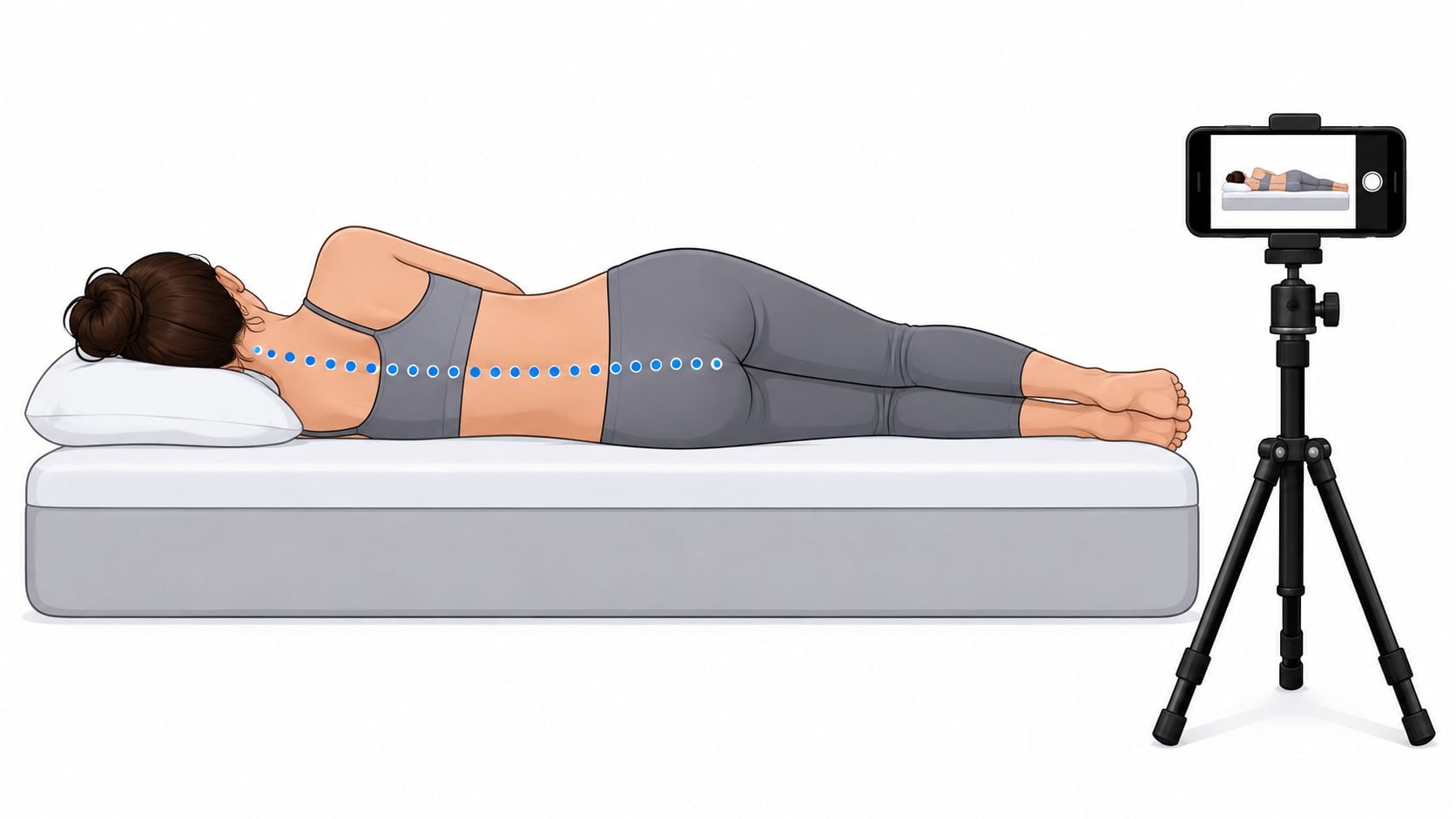
Lie on the side for at least three minutes, with the usual pillow and leg position. A partner should photograph the sleeper's profile from mattress height. The imaginary line should run from the ear through the shoulder and toward the hip without a pronounced bend.
If the shoulder and hip drop while the waist appears unsupported, the mattress is likely too soft for that body and position. The lower back may feel unsupported, and the hip may sink faster than the shoulder. The guide to aligning the spine while sleeping offers another practical reference for checking this line.
Back sleepers
Lie flat with the usual pillow. The lumbar curve should feel supported without the pelvis rolling forward into an exaggerated arch. If the knees rise or the lower body feels trapped in a hollow, the mattress may be allowing the pelvis to settle too far.
A simple self-check uses the hand-gap rule. Slide a hand beneath the lower back. A small, supported gap can be normal, but a large empty space suggests insufficient contouring, while the opposite problem, the pelvis sinking into the mattress, points toward excessive softness.
Stomach sleepers
Lie face down briefly and observe the hips. They should remain level with the torso instead of bowing downward into the mattress. A soft surface that lets the hips drop can place the lower back into extension, especially when paired with a thick pillow.
Neutral alignment should look natural, not forced. If a sleeper must brace the abdominal muscles or reposition constantly to stay level, the mattress isn't doing enough of the support work.
Test every usual position. A bed that works on the side may let the hips sink during stomach sleeping, while a bed that feels stable on the back may create shoulder pressure on the side.
What Too Soft Actually Does to Your Sleep
You may spend enough time in bed yet wake unrefreshed, restless, or stiff. A mattress can feel comfortable at bedtime while its support disrupts sleep before back pain appears. The shoulders and hips sink into the comfort layers, the pelvis rotates, and the lumbar spine loses a neutral position. Your body responds by tightening muscles, tossing, or waking briefly to move.
That hidden sleep-architecture problem can show up as longer sleep latency, meaning it takes longer to settle, followed by lighter, more interrupted sleep. The 2025 evidence cited earlier reported longer sleep latency on a soft mattress than on a medium mattress. Morning stiffness can arrive before persistent pain, so read the pattern early. For more context, see can a bad mattress cause back pain.
Why medium-firm is the useful benchmark
The firmest mattress is not automatically the right choice. A randomized, double-blind, multicenter trial found better pain and disability outcomes for people with chronic nonspecific low-back pain on a medium-firm mattress than on a firm mattress after 90 days, including pain in bed and on rising, as recorded in the PubMed trial.
A separate review of 47 studies identified medium-firm mattresses as the most defensible general recommendation for adults with nonspecific low-back pain. Very soft surfaces were less favorable, according to the long-running mattress firmness review. The useful rule is simple: choose enough support to hold alignment without creating hard pressure points.
The trial used a firmness scale from 1 to 10, with 1 as the firmest and 10 as the softest. Its firm mattress scored 2.5, while the medium mattress scored 5.6, as shown in the reported firmness scale.
If your sleep feels restless before your back hurts, treat that as a mattress warning. Bring the pattern to Miller Waldrop's in-person Comfort Promise and test a supportive alternative before guessing at firmness.
Partner Disturbance and the Stuck-Rolling Test
Static checks don't show every support problem. Movement tests reveal whether the mattress provides a stable plane or turns into a soft bowl under changing weight.
The partner-disturbance check
One sleeper lies still on the back while the other rolls, sits up, or gets out of bed. The stationary sleeper should notice how much motion travels across the surface and whether the neighboring indentation pulls at the body.
A mattress can isolate movement well and still be too soft, so motion transfer isn't a standalone verdict. The useful question is whether the sleeper feels dragged toward the partner or pushed out of alignment when the other person moves. Couples can also review guidance on mattresses designed to limit partner motion.
The stuck-rolling test
Start on the back, roll to the side, then return to the back. Repeat the movement naturally, without using the hands to push off. A passing reading feels controlled and reasonably easy, with the body pivoting across the surface.
A failing reading feels different:
- The body drops first: The sleeper sinks before the turn begins.
- The waist catches: The mattress holds the torso in a depression.
- The movement needs force: The sleeper must brace against the frame or partner.
- The body rebounds: The surface pushes back unevenly after the turn.
Lighter sleepers may notice the trapped sensation first because they stay in the comfort layers rather than reaching stable support. Heavier sleepers can sink farther and lose the pivot point entirely. The right test isn't a specific time. It's whether rolling feels natural instead of like climbing out of a soft hollow.
Practical Next Steps if Your Mattress Fails the Checks
A failed test doesn't always mean immediate replacement. The sensible response is to correct the simplest possible cause first, then move upward only if the problem remains.
Escalate in the right order
| Step | When to Use It | What It Fixes |
|---|---|---|
| Rotation or flipping | The mattress is designed for rotation or two-sided use, and wear appears concentrated | Redistributes wear and may restore a more even surface |
| Foundation inspection | The mattress looks uneven, or the base dips beneath it | Corrects support problems caused by the frame, slats, or box spring |
| Topper trial | The mattress is otherwise intact but needs a firmer surface feel | Adds a temporary layer of resistance without immediately replacing the bed |
| Targeted support | One posture or body zone causes the most trouble | A lumbar pillow or adjustable base may reduce a specific alignment issue |
| Replacement | Several checks fail, the surface hammocks, or the mattress is past seven years | Removes a worn support system that temporary adjustments can't repair |
A topper should be treated as a trial, not a cure-all. A supportive, firmer-feeling layer may reduce surface sink, but another plush layer can deepen the same problem. If the core materials have broken down, no topper can rebuild them.
Check what sits underneath
Rotate the mattress if the manufacturer permits it. If the model is two-sided, flipping may expose a less-worn support surface. Then inspect the foundation for dips, damaged slats, unsuitable spacing, or a box spring that no longer supports the mattress evenly.
Mattress Pro by Miller Waldrop can help a Ruidoso sleeper decide whether to keep the current bed, test a topper, or replace the system through an in-person consultation. The local Comfort Promise reduces the fear of choosing the wrong feel, while the Low Price Promise and Full-Service Delivery with Professional Setup address practical buying concerns.
How a Local Sleep Pro Takes the Guesswork Out
A showroom evaluation should feel like a diagnostic, not a sales pitch. Mattress Pro by Miller Waldrop's Sleep Pros can begin with a short conversation about sleeping position, body weight, partner movement, morning symptoms, and the climate of the home. In Ruidoso's dry mountain air, cooling needs matter alongside pressure relief and alignment.
The consultation then moves to the mattress itself. A sleeper can lie on matched floor samples long enough to notice whether the shoulder, hip, and lumbar area settle evenly. A side-by-side firmness comparison makes it easier to identify whether the current bed is too soft, too firm, or just worn out.
What the evaluation should answer
A useful fitting should clarify:
- Where pressure builds: Shoulders and hips need relief without letting the pelvis collapse.
- How the spine sits: A simple visual guide can reveal whether the body remains near neutral.
- How movement feels: Rolling should be controlled, not trapped or forced.
- What happens next: The recommendation should distinguish between keeping the mattress, adding a topper, correcting the foundation, or replacing the system.
That process removes the guesswork behind questions such as whether a visible depression signals normal cushioning or actual failure. It also lets a local team address delivery, professional setup, and old-mattress removal as part of the same project. Residents in Alto and across Lincoln County don't have to make a major sleep decision from a product page alone. A local sleep consultation near Ruidoso gives the body a chance to demonstrate what the mattress is doing.
Mattress Pro by Miller Waldrop helps Ruidoso sleepers test whether a soft mattress is causing poor alignment, restless movement, or unrefreshing mornings, with options from Tempur-Pedic, Sealy, Stearns & Foster, and Sherwood. Visit Mattress Pro by Miller Waldrop at 2801 Sudderth Drive, Suite F, for the Comfort Promise, Low Price Promise, and Full-Service Delivery with Professional Setup, and let the Sleep Pros help determine whether the right move is a topper, a foundation correction, or a new mattress.