

Mattress Topper Benefits for Better Sleep


A sore shoulder, a warm lower back, or repeated tossing can make a reasonably new mattress feel like the wrong bed. In Ruidoso, that discomfort can become more noticeable as dry mountain air and changing temperatures affect the bedroom environment. A mattress topper can sometimes make a meaningful difference, but only when it matches the sleeper, the mattress, and the climate.
The most useful mattress topper benefits come from treating the topper as a targeted sleep-system modification, not as a decorative bedding layer. The right surface can adjust firmness, redistribute pressure, reduce motion disturbance, or help manage heat. The wrong one can leave the spine poorly supported or hide a mattress that needs replacement.
Understanding What a Mattress Topper Actually Does
In a Ruidoso cabin, nighttime temperatures can drop quickly. A 2-inch breathable topper may soften a firm guest-room mattress without holding too much heat, while a 4-inch dense foam layer can provide deeper cushioning but may over-insulate the bed. The useful choice depends on the sleeper's body mechanics, the mattress underneath, and the room's mountain climate.
A mattress topper sits above the mattress and changes the feel of the sleep surface. It is thicker than a pad or protector, adding cushioning between the sleeper and the mattress core. Guidance commonly places toppers in the 2-to-4-inch range, as described in this expert guidance on topper thickness.
A pad or protector mainly helps guard against moisture, stains, and everyday wear. A topper creates a new comfort layer beneath that protective covering. It can soften a firm bed, add structure to a surface that feels too flat, or provide more contouring around the shoulders and hips.
The layer between the body and the mattress
A topper changes three practical parts of sleep:
- Firmness: A softer layer reduces the hard first contact of a firm mattress. A denser design can make a mattress that feels too soft more stable.
- Pressure distribution: Foam, latex, or fiber spreads body weight over a wider area rather than concentrating it at the shoulder, hip, or heel.
- Surface response: Some materials let the body settle gradually. Others respond faster as the sleeper changes position.
These differences matter in mountain homes, where dry air, cold nights, and heated bedrooms can affect how comfortable a sleep surface feels. They also matter for couples, active sleepers, and anyone with a structurally sound mattress that no longer feels right. A topper adjusts the upper layer without requiring an immediate change to the entire bed.
Why thickness changes the result
Thickness controls how much the body interacts with the topper before reaching the mattress below. A thinner layer makes a restrained adjustment. A thicker one creates more cushioning and contouring, but it can also alter support and heat retention.
Side sleepers often need enough depth for the shoulder and hip to settle. Back and stomach sleepers generally need sufficient firmness to keep the midsection from sinking too far. This memory foam mattress topper guide explains how material choice affects pressure relief and body contouring.
Practical rule: Choose a topper for one defined problem. “Too firm,” “too warm,” and “too much partner movement” require different materials and constructions.
The main mattress topper benefits are conditional. A topper can refine a mattress that still supports the body well, but it cannot repair a failed mattress core.
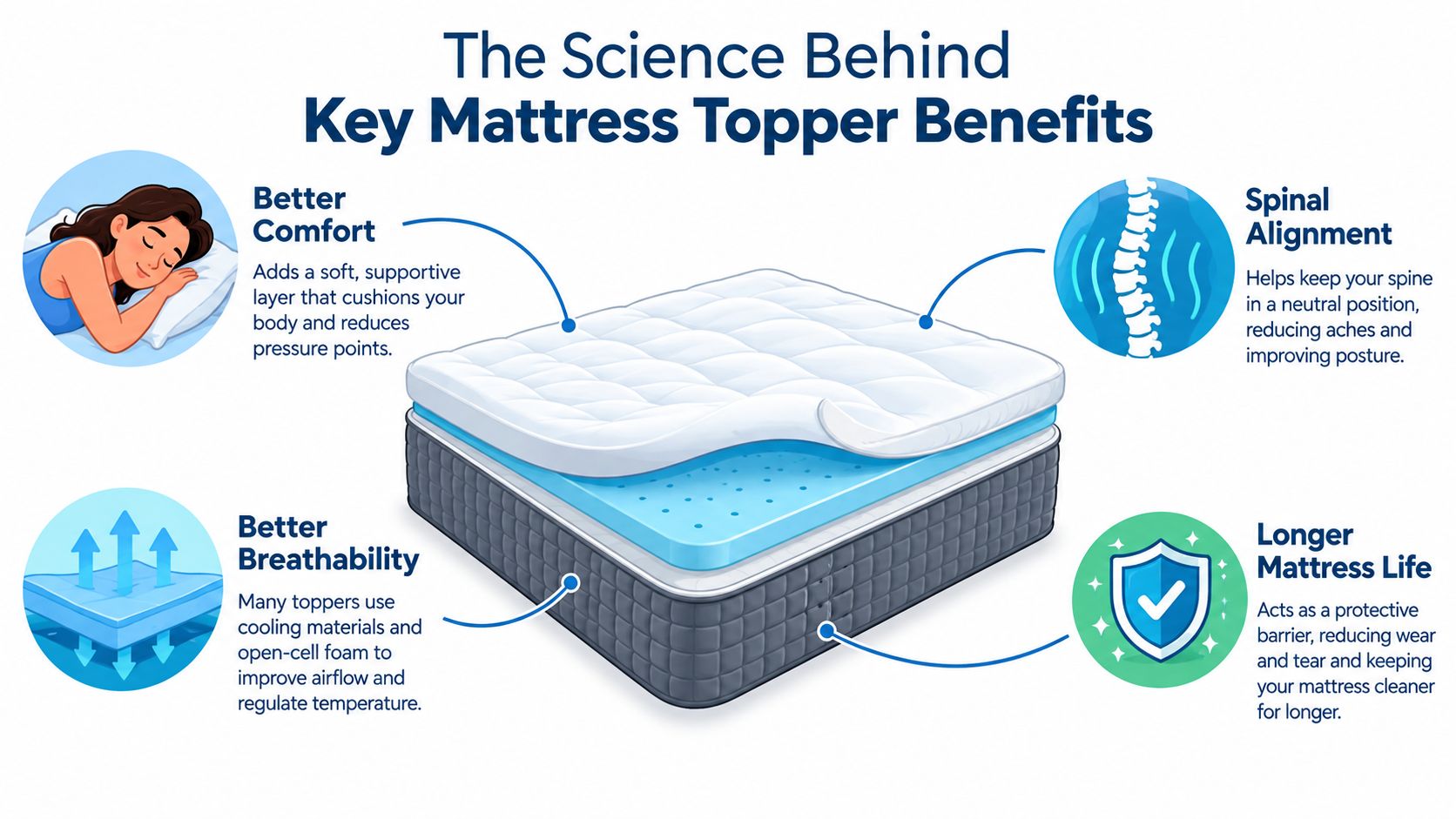
The Science Behind Key Mattress Topper Benefits
Comfort starts with what a sleeper feels, but the underlying mechanics involve pressure redistribution, support, and sleep continuity. When a surface spreads body weight more evenly, the shoulders, hips, heels, and head may experience less concentrated loading. That can be especially relevant for side sleepers and people who wake with localized soreness.
A hospital-focused study involving 27 healthy volunteers found that adding a topper solution reduced heel and head pressure by more than 30% and improved comfort on both standard and air mattresses, as reported in the quantitative study record from the University of Lancashire. The finding doesn't mean every topper will produce the same response, but it supports the mechanical reason a topper can help. The surface gives the body more opportunity to settle without forcing one area to carry excessive pressure.
Pressure relief and fewer disruptions
The SleepScore Labs analysis of nearly 700 nights of sleep found a notable change after participants added a premium mattress topper. Before using it, 25% reported comfort and 46% reported support. Afterward, 100% reported comfort and support, while nighttime awakenings fell by 12%, according to Sleep Review's report on the analysis.
These results connect subjective comfort with sleep continuity. A sleeper who experiences less pressure may shift less often to find relief. Reduced movement doesn't guarantee deeper sleep for every individual, but it explains why pressure management is one of the most practical mattress topper benefits.
For couples, surface design can also affect how movement travels across the bed. A topper may soften the transfer of a partner's position changes, though the result depends on the underlying mattress and topper construction. Guidance on reducing motion transfer in bed can help couples evaluate the whole sleep surface rather than judging the topper alone.
Support without confusing softness with alignment
Softness and support aren't opposites, but they aren't identical either. A topper may cushion a shoulder while the mattress beneath it continues to provide the main structural support. If the layer is too soft or too thick for the sleeper's position, however, the pelvis or abdomen may sink excessively.
A useful evaluation asks whether the spine remains reasonably neutral while the surface relieves pressure. Side sleepers typically need more contouring, while back and stomach sleepers often need a flatter, more responsive feel.
Protecting the mattress surface
A topper also absorbs some friction and everyday contact that would otherwise reach the mattress fabric and upper comfort layers. That may help preserve the existing surface, but a topper doesn't eliminate the need for a washable protector or regular care.
The Cochrane review cited in the Lancashire research record analyzed 8 studies involving foam mattresses and mattress toppers. One comparison reported a pressure-ulcer risk ratio of 1.59 across 4 studies and 2,247 participants, showing that surface type and pressure management are complex clinical questions rather than simple promises about comfort. The evidence supports careful material selection, not a universal claim that one topper works for everyone.
Matching Materials and Thickness to Your Sleep Style
A topper should match the way your body loads the mattress during sleep. Your position, pressure points, and ease of movement all matter. Material and thickness work as a pair. A dense layer in the wrong thickness can let the hips sink too far or make turning difficult.
Memory foam for contouring
Memory foam responds gradually to body heat and pressure. It molds around the shoulders and hips, which can ease pressure for side sleepers. Its close-fitting surface can also reduce the feeling of movement traveling across the bed.
The tradeoff is a slower, warmer feel in some designs. Cooling gel, breathable covers, and airflow-friendly construction may suit sleepers who heat up at night. The memory foam mattress pros and cons guide helps compare contouring, responsiveness, and temperature preferences.
Latex and fiber alternatives
Latex usually feels springier and responds faster than conventional memory foam. Changing positions takes less effort, and the surface feels less enveloping. That combination can suit back sleepers, combination sleepers, and anyone who dislikes sinking.
Down-alternative fiber toppers provide plush softness with a breathable feel. They can make a firm bed feel gentler, but they offer less contouring and structural guidance than foam or latex.
Thickness by sleeping position
| Sleep Position | Ideal Thickness | Recommended Material | Primary Benefit |
|---|---|---|---|
| Side sleeping | About 3 inches or more | Contouring memory foam or responsive latex | Cushioning for shoulders and hips |
| Back sleeping | A thinner option | Supportive foam or latex | Balanced comfort without excessive sinking |
| Stomach sleeping | A thinner, firmer option | Responsive foam or latex | Helps limit midsection sink |
| Combination sleeping | Moderate thickness | Responsive latex or balanced foam | Easier movement between positions |
These ranges follow consumer and expert guidance on choosing a topper, but they are starting points rather than rules. A lighter sleeper may need less cushioning, while a broader-shouldered side sleeper may need more room around the shoulder and hip.
Mountain homes add a practical selection point. In rooms with strong temperature changes, pair thicker memory foam with a breathable cover, or choose responsive latex when heat retention and easy movement are concerns.
Density, firmness, and body mechanics
Higher-density foam often feels firmer and more substantial, yet density alone cannot predict comfort. Thickness, firmness, cover design, and the mattress below shape the finished sleep surface. The guidance on cooling topper construction explains how construction can affect airflow and heat management.
Lie in your usual position and check whether your spine stays reasonably level while pressure eases. A showroom test can reveal whether the hips sink too far or the surface resists turning. Sleep Pros at Mattress Pro by Miller Waldrop can help shoppers compare a topper with established sleep systems from several mattress categories.
Adapting Your Sleep Surface for Mountain Living
Ruidoso and the surrounding Lincoln County area have a distinct sleep environment. Dry mountain air can make bedding feel comfortable at one point in the evening and overly insulating later, especially when seasonal temperatures shift or a cabin's heating and cooling control varies.
Body temperature naturally changes during sleep. A surface that traps heat can make it harder to settle, while a surface that removes heat too aggressively may feel uncomfortable. The topper becomes a small climate-control layer between the body and the mattress.
Cooling materials and conductive heat removal
Cooling toppers can promote airflow, limit heat buildup, or move heat away from the body through conductive materials. Cooling gel technology is one approach, while high-heat-capacity and high-conductivity materials use different thermal properties.
A 2026 Loughborough University study found that a cooling mattress topper improved thermal comfort in overheated bedrooms. Objective sleep data showed an average increase of 19 minutes in total sleep time and a 10-minute reduction in sleep onset latency, according to the university's bed-cooling study announcement.
A cooler sleep surface isn't only about feeling fresh at bedtime. It can influence how quickly the body settles and how long sleep continues.
Choosing for cabins and changing seasons
A hot sleeper in a heavily insulated room may prefer breathable latex or a cooling foam construction. Someone who feels chilled in winter may need a balanced material rather than the most aggressive cooling surface.
Peer-reviewed research summarized by Loughborough University found that high-rebound toppers supported a larger early-night drop in core body temperature and were associated with more deep sleep or delta power. Another heat-exposure study found that a high-heat-conductivity mattress improved total sleep time by about 21.4 minutes, increased sleep efficiency and REM duration, and reduced awakening duration at 32°C, as described in the research summary on mattress cooling.
For mountain homes, the practical lesson is simple. The topper should match the bedroom's temperature swings, the sleeper's warmth preference, and the bedding layers used above it.
Knowing When to Use a Topper Versus Replacing Your Mattress
A topper can change comfort, but it can't rebuild a mattress with failed support. Independent buyer's guides and expert reviews describe toppers as useful for changing firmness, reducing motion transfer, and relieving pressure points, while also warning that they don't cure a badly worn mattress, as explained in the Consumer Reports mattress topper buying guide.
Signs the mattress may need replacement
The mattress core deserves attention before a topper is added. Look for:
- Deep body impressions: A persistent dip can force the body into an uneven position.
- Localized lumps: Uneven areas can create pressure instead of relieving it.
- Weak edge support: A collapsing edge may signal broader structural wear.
- Ongoing discomfort: Repeated aches despite changes in pillows, position, or bedding deserve a closer assessment.
- Surface instability: A mattress that feels uneven or increasingly noisy may no longer provide a reliable foundation.
A topper may make a worn surface feel softer for a short time, but the underlying shape still influences alignment. If the body settles into a sag, adding another layer may mask the symptom without correcting the support problem.
When a topper makes sense
A topper is more appropriate when the mattress remains level and supportive but feels wrong in one specific way. A firm mattress may need more cushioning for side sleeping. A shared bed may need better motion control. A warm bedroom may call for a cooler surface.
The decision should also account for changing body needs. A mattress that once felt comfortable may no longer suit a new sleeping position, a different pain pattern, or a partner with different preferences. In those cases, a topper can serve as a measured adjustment before a complete sleep-system change.
Decision test: If the complaint concerns the surface feel, consider a topper. If the complaint concerns the mattress shape or foundation, evaluate replacement.
A local consultation can make that distinction clearer. The guide to knowing when to replace a mattress helps shoppers organize the warning signs before choosing between an add-on layer and a new mattress.
Next Steps for Better Sleep in Lincoln County
Online research can explain material differences, but a topper still needs to feel right under the body. A side sleeper may prefer the contouring of a thicker foam layer, while a combination sleeper may need the quicker response of latex. Those differences are difficult to judge from a product description alone.
A useful in-person consultation focuses on the existing mattress first. The Sleep Pros at Mattress Pro can discuss:
- Sleep position: Side, back, stomach, or combination sleeping changes the pressure and alignment requirements.
- Pain location: Shoulder, hip, heel, neck, and lower-back discomfort can point toward different surface needs.
- Temperature preference: Cooling construction may matter in a warm bedroom, while a more balanced surface may work better for a sleeper who gets cold.
- Partner movement: Couples may need a topper that limits surface disturbance without sacrificing ease of movement.
- Budget and next steps: A topper may be enough, or the mattress may need replacement.
Testing the whole sleep system
The topper shouldn't be evaluated in isolation. The mattress underneath, fitted sheet, protector, pillow height, and bedroom temperature all affect the final result. Testing a surface while maintaining a neutral spinal position gives a more useful answer than judging softness after a brief touch.
Mattress Pro by Miller Waldrop serves shoppers in Ruidoso, Alto, and across Lincoln County with options that include topper adjustments and complete sleep systems. The family-owned business carries Tempur-Pedic, Sealy, Stearns & Foster, and Sherwood, with the Comfort Promise helping reduce the fear of choosing the wrong bed. Its Low Price Promise and Full-Service Delivery with Professional Setup add practical support for shoppers who prefer local service over an impersonal shipment.
The local sleep consultation service gives residents a chance to discuss pressure relief, cooling, firmness, and replacement questions face to face. That matters for mountain homes, guest rooms, vacation cabins, and primary bedrooms where the sleep surface needs to work reliably through changing conditions.
The 70-year Miller Waldrop family legacy also means local customers can return to a familiar team when their needs change. A bed-in-a-box website can display specifications, but a neighborhood Sleep Pro can help interpret how those specifications may feel under a particular body and mattress.
Ready to adjust an overly firm, warm, or uncomfortable sleep surface? Visit Mattress Pro by Miller Waldrop at 2801 Sudderth Drive, Suite F, in Ruidoso, where local Sleep Pros can help compare mattress toppers and complete systems from trusted brands. Explore the collection online or stop by Monday through Saturday for the Comfort Promise, Low Price Promise, and Full-Service Delivery with Professional Setup.