

Pressure Relief Memory Foam Mattress: A Buyer’s Guide


A guest at a Ruidoso cabin rolls out of bed before sunrise, reaches for a coffee cup, and feels a familiar pinch in the shoulder. Another sleeper wakes with a numb hip. Someone else carries a deep ache between the shoulder blades into a day at Ski Apache. A mattress can't explain every ache, but poor pressure distribution can keep sensitive areas under stress for hours.
A pressure relief memory foam mattress addresses that problem by changing how the bed meets the body. Instead of concentrating force at the shoulders and hips, viscoelastic foam responds to body heat and pressure, then contours around those areas. The right choice still depends on sleep position, body shape, firmness, cooling needs, and whether the bed serves one sleeper or a couple.
Waking Up Sore and Why It Happens
A firm surface can feel supportive in a showroom yet create sharp contact at the shoulder when a side sleeper stays in one position. Traditional innerspring designs may concentrate force around the shoulders, hips, and heels because their surface layers don't always conform closely enough to those curves.
That pressure can trigger tossing and turning. The sleeper shifts to escape the uncomfortable spot, wakes more often, and may rise with stiffness that follows the body onto the trails around Ruidoso. Readers looking for the broader connection between mattresses and morning discomfort can also review whether a bad mattress can cause back pain.

Why pressure points matter
The body contains pressure-sensitive tissue around bony prominences. When a mattress pushes back harder than local circulation can tolerate, tissue oxygen falls and nerves can send pain signals. Sustained loading is also associated with pressure sores and circulation problems, which is why medical bedding focuses on distributing force rather than making a surface feel soft.
A mattress that relieves pressure should help the body settle without allowing the hips to collapse too far. That balance matters in a mountain home, where a bed may have been selected for a guest room, a seasonal cabin, or a quick online delivery rather than for the sleeper's actual posture.
Practical rule: Shoulder or hip soreness that appears in the same place each morning deserves a pressure-mapping conversation, not just a softer pillow.
The useful questions are straightforward:
- Where does discomfort begin? Shoulder, hip, heel, lower back, or more than one area?
- Which position creates it? Side sleeping usually loads the shoulder and hip differently from back or stomach sleeping.
- What happens after movement? Relief after rolling over can point toward concentrated surface pressure.
- Who shares the bed? A partner's posture and movement can change the right construction.
The rest of the buying decision comes down to mattress mechanics, position-specific support, cooling, and an in-person test. A showroom consultation on Sudderth Drive can reveal more than a product description because the sleeper can check whether the shoulder and hip stop pushing back.
How Pressure Relief Memory Foam Works
A mattress can feel soft at first and still leave a shoulder or hip pushing against a firm spot. The difference comes from how the material responds after your body has rested in one place.
Memory foam is a viscoelastic material that responds to heat and pressure. NASA-funded work at Ames Research Center originated the material in 1966, when researchers sought better aircraft and astronaut seating. After technology transfer, medical and mattress applications followed, with the first memory foam mattresses entering the U.S. market in 1994, as described by NASA's history of memory foam.
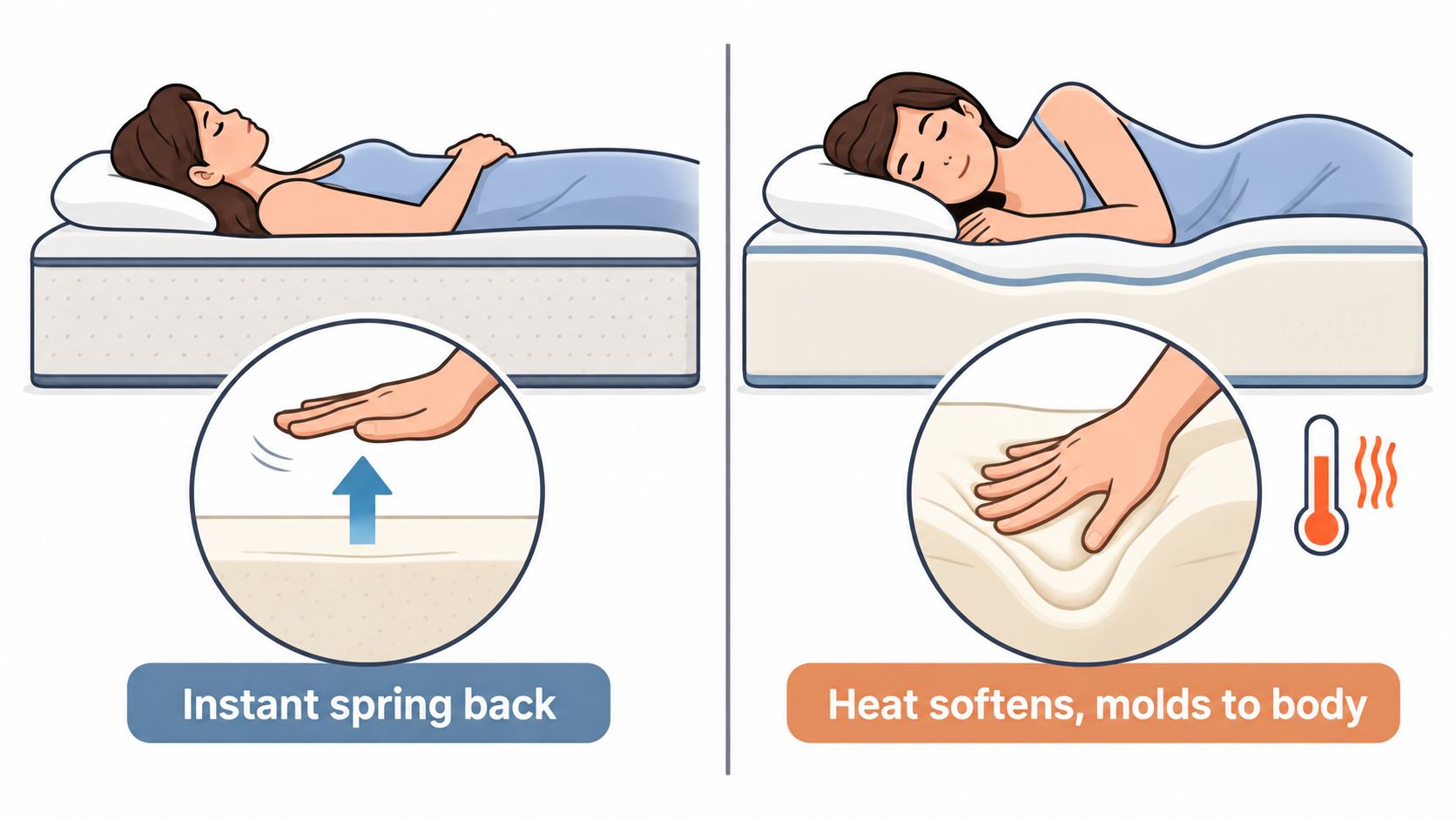
Traditional foam rebounds quickly, like a trampoline. Memory foam responds more like warm putty. Body heat and pressure soften it, allowing the foam to mold around curves. Its slower recovery helps it stay in contact with the body instead of immediately pushing the sleeper away.
The pressure-relief benchmark
Healthcare bedding discussions commonly use 32 mmHg as a practical pressure-relief benchmark. One industry publication identifies products at 32 mmHg or lower as providing pressure relief, while readings between 32 mmHg and 50 mmHg are generally described as pressure reduction. The benchmark and its clinical context appear in this pressure-relief industry publication.
A showroom shopper will not measure millimeters of mercury. Instead, lie still long enough to notice whether the shoulder settles without meeting a hard ridge, the hip feels cushioned rather than trapped, and the lower back remains supported. In a Ruidoso showroom, that check matters more than judging softness with one hand.
Density and ILD answer different questions
Density describes how much foam material occupies a given volume. Higher-density memory foam can provide greater body envelopment and more substantial deep-compression support. A Cochrane review found that denser memory foam, 40 to 60 kg/m³, may reduce incident pressure-ulcer risk compared with lower-density foam at 33 kg/m³ over 11.5 days in intensive-care patients, though that medical finding does not determine a mattress choice for every healthy sleeper. The review is summarized in this clinical evidence report.
ILD, or Indentation Load Deflection, describes the force required to compress foam. Density helps describe the material's substance and deeper support, while ILD more closely reflects the first firmness sensation. Two beds may feel similarly soft when pressed briefly, then respond differently after heat and sustained pressure build.
Give the mattress time to warm during a ten-minute lie-down. The useful result is steady comfort: fewer adjustments at the shoulder and hip, with the waist and pelvis still supported.
Side, Back, and Stomach Sleepers See Different Results
Sleep position changes the pressure map. A side sleeper may need a surface that gives more at the shoulder and hip, while a stomach sleeper may need the opposite response around the pelvis.
Position changes the buying target
Side sleepers often need a comfort layer that cushions the shoulder and hip while firmer material below limits excessive sink. Back sleepers usually need balanced contouring with enough transition support to preserve the natural lumbar curve. Stomach sleepers need careful pelvic support because excessive sink can place the lower back in an uncomfortable extension.
Density and ILD should be treated as separate specifications. Density helps describe the foam's substance and deep-support behavior. ILD helps describe how firm the material feels when a shopper first presses or lies on it.
| Sleep Position | Main Pressure Zones | Recommended Density | Recommended ILD |
|---|---|---|---|
| Side | Shoulder and hip | Deeper, slower-response comfort foam, with density selected for body size and sink needs | Softer comfort feel, with firmer transition support underneath |
| Back | Shoulder blades, sacrum, and lumbar area | Balanced comfort and transition materials | Medium to medium-firm feel that supports the lumbar curve |
| Stomach | Pelvis, ribs, knees, and chest | Support-focused comfort and core materials | Firmer, higher-ILD feel or a supportive hybrid structure |
The table offers a starting framework, not a prescription. A lighter sleeper may not need the same depth of support as a heavier sleeper, and a combination sleeper may need faster recovery than someone who remains on one side.
Couples need a shared compromise
A side sleeper and a back sleeper can experience the same mattress differently. The side sleeper may focus on shoulder cushioning, while the back sleeper notices whether the middle of the body stays level. Couples should test the bed together, including each person's usual position, rather than allowing one partner to make the decision from a seated position.
The guide to choosing a mattress for side sleepers can help organize the questions before a visit. In the showroom, a Sleep Pro can compare options from Tempur-Pedic, Sealy, Stearns & Foster, and Sherwood according to posture and pressure points.
A mattress isn't “soft” or “firm” in the abstract. It feels different under a shoulder, a hip, a pelvis, or a partner's moving body.
Memory Foam, Hybrid, and Innerspring Compared
Three broad constructions cover most mattress conversations. All-foam memory foam emphasizes contouring and motion isolation. Hybrids combine foam comfort layers with pocketed coils for airflow, bounce, and structural support. Traditional innersprings create a more responsive, flatter feel with less slow-sinking contour.
| Feature | All-Foam Memory Foam | Hybrid | Innerspring |
|---|---|---|---|
| Pressure relief | Strong contouring at shoulders and hips | Foam contouring with coil support underneath | More dependent on padding and surface design |
| Motion isolation | Usually strong | Moderate to strong, depending on the foam and coils | Often more responsive across the surface |
| Edge support | Depends on the support core and perimeter design | Often strong because of the coil structure | Commonly responsive around the perimeter |
| Cooling | Can retain more heat without airflow features | Coil channels can support ventilation | Open structure can feel airy |
| Responsiveness | Slow, cradling recovery | Balanced contour and bounce | Quick response |
| Weight | Often substantial | Often substantial | Varies by construction |
| Typical price | Varies by materials and brand | Varies by materials and brand | Varies by materials and brand |
Match the build to the sleeper
All-foam construction can suit side sleepers who want a close cradle and couples who want less partner disturbance. A hybrid can fit an active mountain sleeper who changes position or dislikes the feeling of being held in place. An innerspring may appeal to stomach sleepers or people who prefer a flatter, quicker-moving surface.
Cooling features deserve closer inspection. Shoppers can ask whether a model uses:
- Open-cell foam, intended to encourage internal airflow.
- Gel, graphite, or copper elements, designed to change how heat moves through the comfort layer.
- Pocketed coils, which create space beneath the foam.
- Zoned support, which varies support across the mattress.
- CertiPUR-US foams, when certification is part of the product specification.
The innerspring versus memory foam comparison can help clarify the basic construction tradeoffs before a showroom visit. The relevant choice isn't the category name alone. It's how the comfort layer, transition layer, support core, cover, and sleeper's posture work together.
What to Test in the Showroom Before You Buy
The showroom test should resemble real sleep as much as possible. Sitting on the edge can reveal height and edge feel, but it can't show whether a shoulder or hip receives enough cushioning overnight.
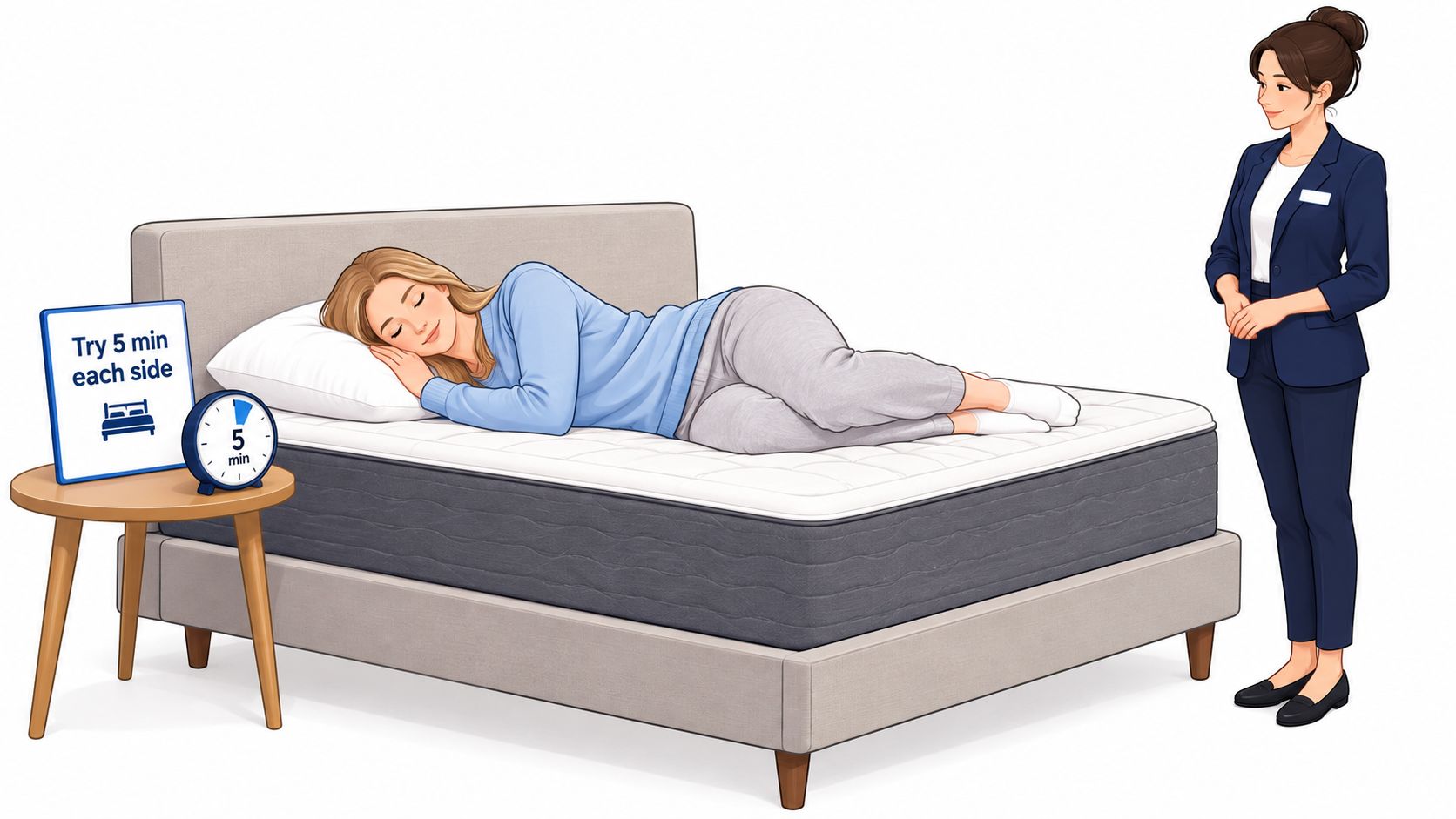
Use a position-based lie-down
Each sleeper should spend several minutes on each side in the usual sleep position. The test should continue long enough for the body to notice whether the shoulder and hip are relaxing or still searching for relief.
Look for these signals:
- Shoulder contact: The shoulder should settle without a sharp pushback or numb sensation.
- Hip comfort: The hip should feel cushioned, not jammed against a hard layer.
- Spinal alignment: A partner or Sleep Pro can check whether the body appears level from neck through pelvis.
- Lower-back support: The waist shouldn't feel unsupported, and the pelvis shouldn't sink excessively.
- Recovery speed: A combination sleeper should notice whether the foam releases the body easily after turning.
Ask for the foam density and ILD specifications for the comfort and transition layers. These details won't replace the physical test, but they help explain why two mattresses with similar showroom labels can behave differently.
Test motion and temperature
For couples, one person can shift, sit, or read while the other remains still. The goal isn't to create a laboratory result. It's to learn whether movement feels contained enough for both sleepers.
A Ruidoso bedroom also deserves a cooling conversation. Ask about the cover's moisture-wicking or phase-change properties, then test the surface with the bedding style normally used at home. Cooling depends on the mattress design, room ventilation, sheets, blankets, and each sleeper's heat output.
Before ordering, confirm:
- Comfort Promise terms, including exchange or replacement conditions.
- Warranty coverage, including what the warranty addresses.
- Delivery timing to Ruidoso, Alto, Ruidoso Downs, or Capitan.
- Full-Service Delivery, including professional setup and old-mattress removal when available.
- Financing details, so the payment arrangement is clear before purchase.
Mountain Living, Cabins, and the Comfort Promise
Ruidoso, Alto, and the wider Lincoln County area create a distinct sleep setting. Dry mountain air can leave skin feeling less hydrated, while a cooler bedroom can make memory foam feel firmer during the first moments of the night. Once the room and material warm, the foam generally responds more readily.
That matters in a cabin or vacation rental. A mattress may serve owners, weekend guests, children returning from a ski day, and visitors with very different body shapes. A durable cover and a clear replacement policy can reduce the worry that one wrong firmness choice will affect every guest.
Local conditions change the test
A mattress that feels comfortable in a warm showroom may feel slower in an unheated winter bedroom. Shoppers should ask how the model behaves in cooler conditions and allow enough time for the material to respond during testing.
Cabin owners should also consider access. Narrow staircases, curving mountain roads, and vacation-rental driveways can make a boxed delivery less convenient than professional installation. Full-Service Delivery with Professional Setup places the mattress in the room and reduces the physical work for the buyer.
The Comfort Promise reduces uncertainty
The fear of choosing the wrong bed is reasonable. A sleeper can't fully predict a mattress response from a label, a photograph, or a brief first impression.
The Comfort Promise gives shoppers a local way to address that uncertainty when the terms apply. If the bed doesn't feel right after a genuine home trial, the exchange or replacement process can provide a practical path forward. That local support is different from leaving a heavy mattress at a doorway and managing the entire setup alone.
Mattress Pro by Miller Waldrop connects showroom guidance with the Low Price Promise, financing options, and professional delivery for homes and rentals throughout the area. The important question remains whether the construction matches the sleeper, but service helps make the decision easier to manage.
When Memory Foam Runs Hot and How to Beat It
Traditional viscoelastic foam can retain heat because its dense polymer structure limits airflow. That doesn't mean every pressure-relieving memory foam mattress sleeps hot. Modern designs use different materials and structures to address the problem.
Cooling features work in different ways
Open-cell foam creates a less compact internal structure intended to support airflow. Phase-change covers can absorb and release heat as temperatures shift. Graphite, copper, and gel elements are used in some comfort layers to influence thermal conductivity and reduce the feeling of heat collecting at the skin.
A hybrid adds another route for ventilation. Its pocketed coil core leaves more open space beneath the foam, which can help air move through the mattress as the sleeper changes position.
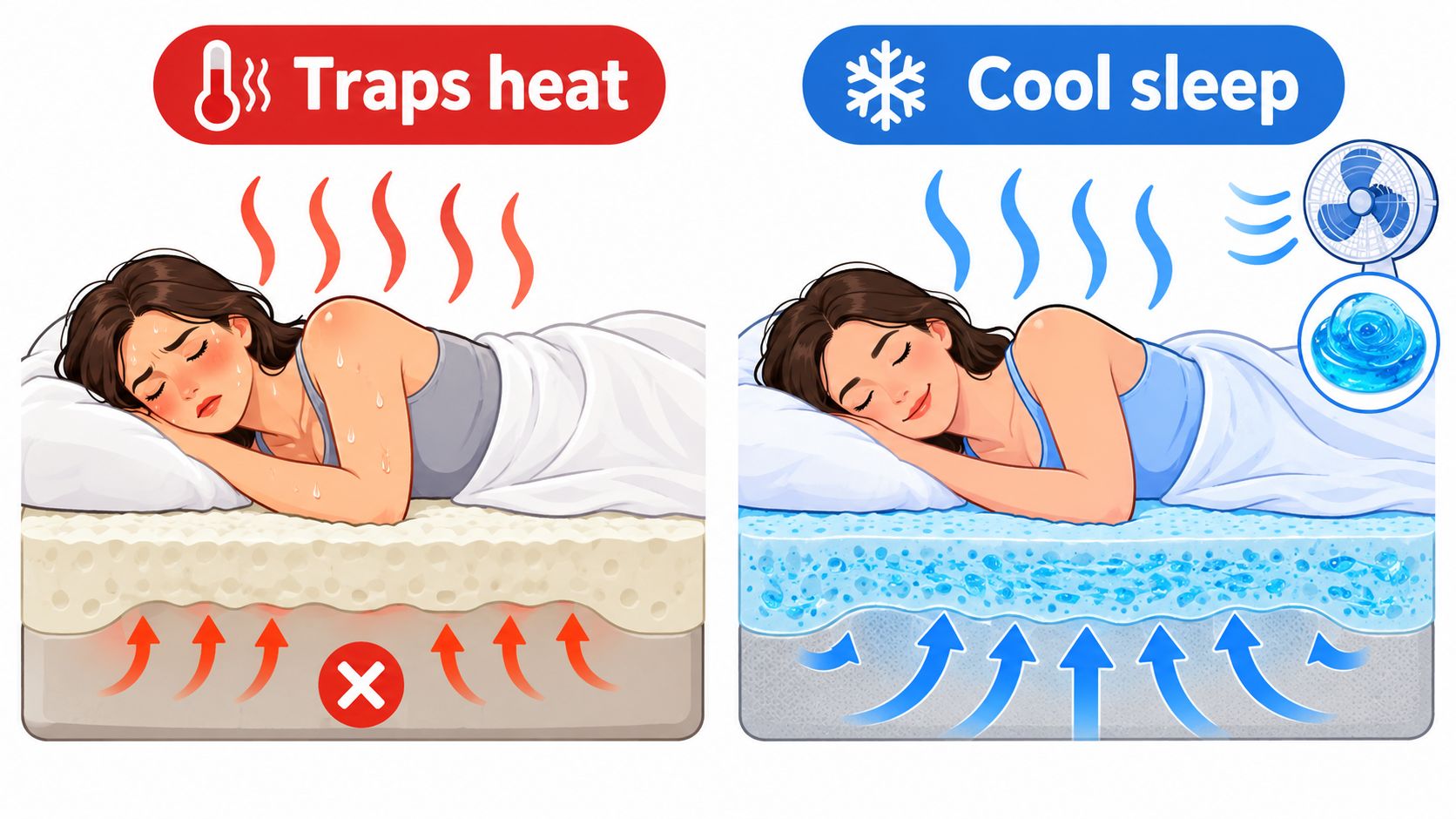
The cooling tradeoff is practical in Ruidoso. A dry mountain evening may feel cool outdoors, but a closed cabin bedroom can still become uncomfortable during summer. Couples also add body heat, blankets, and different temperature preferences to the same sleep environment.
Test the full system
The memory foam cooling guide can help shoppers identify the questions to ask. In person, the useful test includes the cover, the surface feel, the amount of sink, and the ease of changing positions.
Cooling isn't a label. It's the combined result of foam structure, cover material, airflow, bedding, room conditions, and personal heat output.
A hot sleeper shouldn't reject memory foam automatically. The better approach is to compare an all-foam model with cooling materials against a hybrid, then choose the design that preserves pressure comfort without creating a temperature problem.
Your Next Step Toward Better Sleep in Ruidoso
A useful mattress decision starts with the sleeper, not the brand name. The following checklist keeps the showroom visit focused:
- Identify the pressure points. Note whether the shoulder, hip, heel, pelvis, or lower back causes trouble.
- Confirm the dominant position. Side, back, stomach, and combination sleepers need different surface responses.
- Match support to the body. Density and ILD should be considered together, with the comfort layer cushioning and the deeper layers preventing collapse.
- Choose the thermal strategy. Compare cooling foam, specialized covers, and hybrid airflow if heat is a concern.
- Test as a couple. Check movement, edge use, and whether both sleepers can settle without compromise.
- Review the protection. Confirm the Comfort Promise, warranty, financing terms, and delivery details before signing.
Turn specifications into a real test
A Sleep Pro can help translate foam specifications into body feel. The buyer should lie on each side, roll onto the back, and briefly test the stomach position when relevant. A partner can check alignment, while the shopper pays attention to shoulder release, hip support, and the effort required to turn.
Mattress Pro by Miller Waldrop offers access to pressure-relieving models from Tempur-Pedic, Sealy, Stearns & Foster, and Sherwood, along with local consultation. The Low Price Promise applies to eligible identical models under its terms, and financing can help organize the purchase around predictable payments.
Plan for delivery, not just selection
Full-Service Delivery with Professional Setup matters in mountain homes. Professional crews can handle access challenges around cabins, staircases, and roads serving Alto and nearby Ruidoso homes. Buyers should confirm whether old-mattress haul-away and timing are included for the specific order.
The Comfort Promise remains the final safeguard against the fear of choosing wrong. A mattress should be judged by how the body sleeps at home, not only by a few minutes of showroom enthusiasm.
A pressure relief memory foam mattress should match the sleeper's position, pressure points, temperature needs, and home setting, and Mattress Pro by Miller Waldrop provides local guidance, the Comfort Promise, the Low Price Promise, and Full-Service Delivery with Professional Setup. Visit Mattress Pro by Miller Waldrop at 2801 Sudderth Drive, Suite F, in Ruidoso to test Tempur-Pedic, Sealy, Stearns & Foster, Sherwood, and other sleep solutions, then choose a mattress that supports the way mountain households sleep.