

Mattress Comfort Level: A Practical Buyer’s Guide


A couple in Ruidoso can spend months regretting a mattress that a friend recommended with complete confidence. One partner wakes with a sore shoulder, while the other sleeps comfortably. The problem usually isn't that one person chose badly. It's that mattress comfort level is personal, shaped by body weight, sleep position, pressure points, temperature sensitivity, and the way each body settles during the night.
That's why a mattress label can't make the decision by itself. The right fit balances a comfortable surface with dependable support, and it should still feel appropriate after hours of sleep, not just during a quick showroom test. Mattress Pro by Miller Waldrop brings that practical, local approach to Ruidoso, backed by a 70-year family legacy and a focus on sleep rather than a rushed sale.
Why Comfort Level Feels Different for Every Sleeper
The couple described above has already learned an important lesson. A mattress can suit one person and create pressure for another, even when both sleepers share the same room, climate, and bed size.
A lighter side sleeper may feel a mattress as firm because the body doesn't compress the comfort layers very far. A heavier back sleeper may sink more and experience that same mattress as softer. A person who sleeps hot may also judge comfort differently from someone who prefers a warmer, more enveloping feel.
The body changes the experience
Sleep position determines where the body presses into the mattress. A side sleeper loads the shoulder and hip, while a stomach sleeper places more weight through the midsection. A back sleeper needs the mattress to fill the natural curve at the lower back without allowing the hips to dip too far.
Pain and muscle tension add another layer. A shoulder that feels fine in the afternoon may become sensitive after several hours on a surface that doesn't give enough. Stress can also leave muscles tense, making a mattress feel less forgiving than it did during a relaxed afternoon test.
Practical rule: A mattress comfort level should be judged by alignment, pressure relief, and ease of movement, not by the label alone.
A 2025 study of 1,055 adults reported an average overall mattress satisfaction score of 6.9 out of 10, interpreted by the authors as “somewhat satisfied.” Comfort scored 7.1, firmness 7.0, and temperature 6.7, showing that these are separate parts of the sleep experience, not interchangeable words. The study also found higher satisfaction among adults age 75 and older than among adults age 18 to 24, while foam, hybrid, and air-filled chamber mattresses scored better than all-spring models. These findings appear in the 2025 mattress-satisfaction study.
The useful starting point for a Ruidoso shopper is personal observation. A body-type mattress guide can help organize the questions, but an in-person consultation lets a Sleep Pro connect those questions to the actual feel beneath the sleeper.
What Mattress Comfort Level Actually Means
Mattress comfort level combines three ideas that mattress labels often blur together: firmness, support, and pressure relief. Understanding the difference prevents a common mistake, choosing a bed because it feels soft for a moment without checking whether it keeps the body properly supported.
Firmness is the initial resistance
Firmness describes how much push-back the surface gives when a sleeper lies down. A softer mattress allows more immediate compression, while a firmer mattress resists the body sooner.
An easy analogy is the floor beneath a rug. The rug may add a little cushioning, but the floor determines how much the surface gives overall. Mattress firmness is similar to that first sense of resistance, although the materials inside create a far more complex response.
Support is deeper structure
Support comes from the mattress core and its ability to hold the body in a stable position. It helps keep the spine aligned as the sleeper changes position or remains still for hours.
A soft mattress can still be supportive if its deeper layers prevent excessive sinkage. A firm mattress can still feel uncomfortable if it creates pressure at the shoulder or hip. Firmness and support work together, but they aren't the same measurement.
Pressure relief cushions loaded areas
Pressure relief describes how well the upper layers distribute the body's weight. Shoulders, hips, knees, and other prominent areas can need more cushioning, particularly for side sleepers.
Think of padding on a railing. The underlying rail provides structure, while the padding makes contact more comfortable. A mattress with a balanced comfort layer can cushion those areas without allowing the entire body to collapse into the bed.
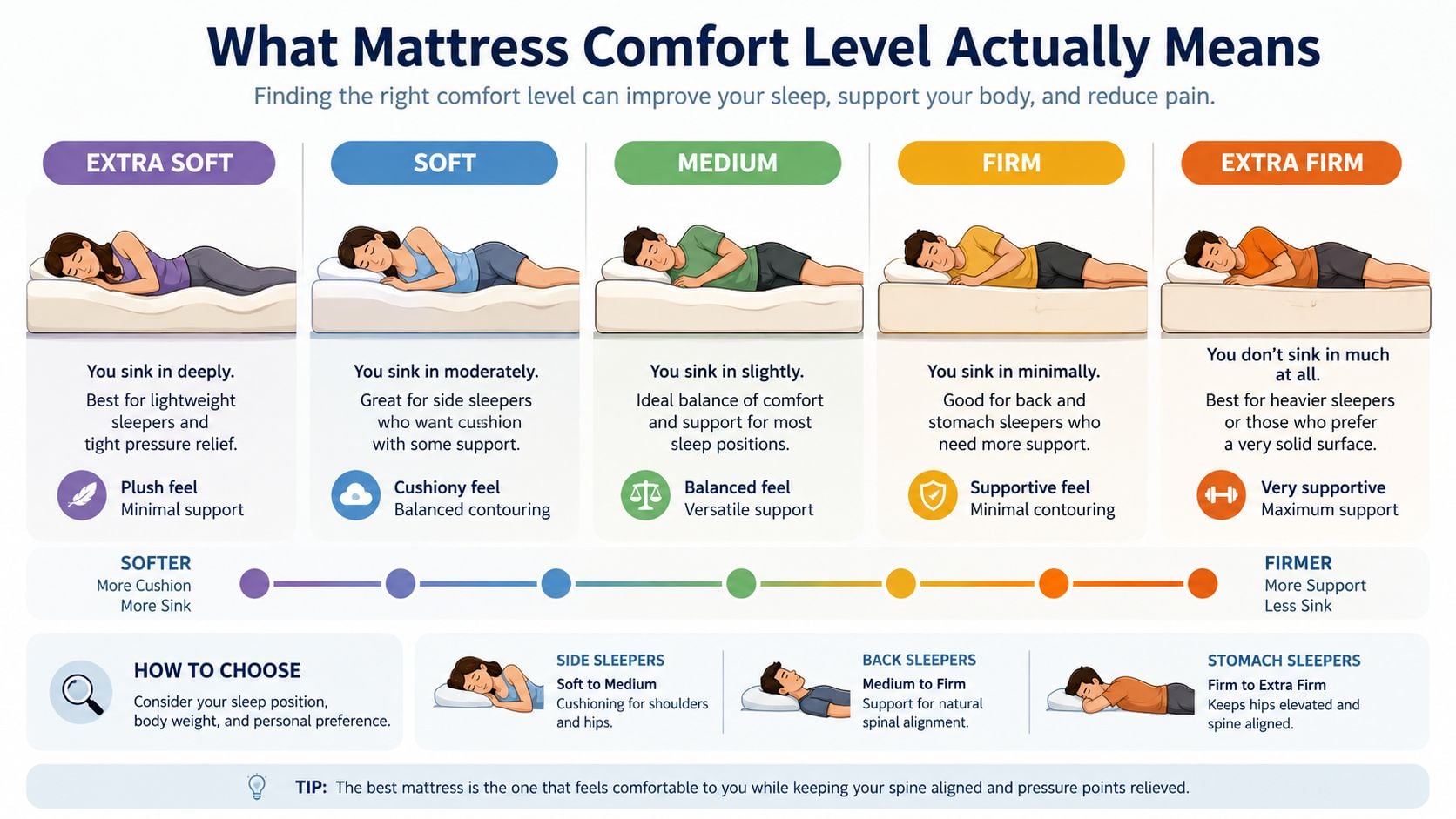
A mattress firmness selection guide helps shoppers describe the first impression, but the better question is whether the mattress provides a balanced experience. A sleeper should feel cushioned at the contact points, supported through the middle, and free to move without fighting the surface.
How Comfort Level Is Measured and Tested
Manufacturers and researchers use more than a hand press to evaluate a mattress. Interface pressure mapping uses a conformable sensor blanket between the sleeper and the mattress to show how force spreads across the body. The system can produce visual heatmaps and quantitative measurements, helping identify concentrated loading near the shoulder, hip, and other bony areas.
The method is useful because it turns body-mattress contact into information that can be compared across models and postures. The technical review of pressure-mapping systems describes how these systems assess pressure distribution in real time. Pressure mapping can reveal hotspots, but it doesn't replace the sleeper's own report of comfort.
Firmness scales create a common language
Retailers commonly describe firmness on a 1-to-10 scale, with lower numbers representing softer feels and higher numbers representing firmer feels. The scale makes comparisons easier, but it isn't a universal physical standard. A medium mattress from one manufacturer may feel different from a medium mattress made with another material design.
| Label | Firmness Score (1-10) | Typical Feel |
|---|---|---|
| Extra soft | 1-2 | Deep cushioning with substantial sink |
| Soft | 3-4 | Noticeable contouring and gentle resistance |
| Medium | 5-6 | Balanced give and support |
| Medium-firm | 6-7 | Stronger push-back with moderate cushioning |
| Firm | 7-8 | Limited sink and pronounced support |
| Extra firm | 9-10 | Very little give and a rigid surface |
Mechanical firmness testers can press a standardized disc into a mattress and record resistance. That produces a repeatable laboratory score, but a disc doesn't have a human body's shape, weight distribution, or sleep position.
Controlled sleep research reinforces that distinction. In one experiment, firmness significantly affected 9 of 11 sleep measures, with sleep time ranging from 355.6 to 360.3 minutes and sleep efficiency ranging from 79.4% to 80.4%, as reported in the actigraphy and mattress-selection research. The numbers show that firmness can affect measurable sleep outcomes, while the personal response still needs to be tested with the sleeper's own body.
How Mattress Types Translate to Feel
Construction changes the way a mattress delivers its listed comfort level. Two beds with the same firmness score can feel unlike each other because their comfort layers, support cores, airflow, edge structures, and response speeds differ.
Memory foam closely contours to the body. That contouring can spread weight around the shoulder and hip, helping reduce concentrated pressure for some side sleepers. Dense foam may respond slowly, limit easy repositioning, and hold more body heat. Cooling gel technology, breathable covers, and open-cell designs may change the thermal feel, but the exact result depends on the full construction.
Traditional innerspring mattresses use coils for a springier response. They often make movement easier and allow airflow through the coil space, while the padding above the coils determines how much cushioning the sleeper feels. A thin comfort layer may feel noticeably firmer than a generously padded version, even when both use a similar coil foundation.
Hybrids combine a coil support core with foam or latex comfort layers. They can balance contouring, bounce, and ventilation, making them a useful category for sleepers who want cushioning without a hugging feel.
Pillow-top mattresses add a visibly cushioned surface. The top can soften the first contact while the deeper support system remains relatively stable. That means a pillow-top may feel plush at first without providing the same deep contouring as memory foam.
| Mattress Type | Typical Feel | Strengths | Potential Drawbacks |
|---|---|---|---|
| Memory foam | Contouring and slower response | Pressure distribution and motion isolation | May feel warmer or harder to move on |
| Innerspring | Springy and responsive | Airflow and easy repositioning | Feel depends heavily on padding and coil design |
| Hybrid | Balanced contour and bounce | Combines foam cushioning with coil support | Construction varies widely by model |
| Pillow-top | Plush initial contact | Soft surface feel | Top comfort may not reflect deeper support |
A shopper comparing innerspring and hybrid mattress construction should lie on both rather than judging from the product tag. The important observations are whether the hips sink too far, whether the shoulders feel crowded, how quickly the surface responds, and whether a partner's movement travels across the bed.
Matching Comfort Level to Your Body and Sleep Style
Sleep position and body weight provide useful starting points, not rigid rules. The same mattress can support one sleeper well and create alignment problems for another because the body compresses the layers differently.
Side sleepers need room at the shoulder and hip
Side sleepers usually benefit from medium-soft to medium surfaces that allow the shoulder and hip to settle without creating a sharp pressure point. Lighter sleepers may need more surface cushioning because they don't compress the mattress as much. A firmer surface can feel especially unforgiving when the shoulder remains raised instead of sinking enough to keep the spine level.
The sleeper should notice whether the waist feels supported and whether the neck remains aligned with the rest of the spine. A pillow also affects this test, so the normal pillow should be used whenever possible.
Back sleepers need balance
Back sleepers generally need a middle-ground feel. The mattress should support the lumbar area without creating a hard pressure point, while the hips should remain supported rather than dropping into a deep curve.
Research summarized in the World Sleep Society abstract found that higher-body-weight sleepers had more neutral spinal alignment on firmer mattresses, while lower-body-weight sleepers were better suited to softer mattresses. The same research area found medium-firm mattresses reduced pain and improved sleep outcomes for many sleepers, although individual responses varied.
Stomach sleepers need resistance through the middle
Stomach sleepers often need a flatter, more resistant surface that limits pelvic sinkage. A bed can feel pleasant for a few minutes yet allow the hips to drop during a full night, leaving the lower back unsupported.
A simple check is to notice whether the midsection feels lower than the chest and legs. If the body forms a pronounced dip, the mattress may be too soft for that sleeper's weight and position.
Weight changes the firmness experience
A lighter sleeper tends to experience the same mattress as firmer, while a heavier sleeper compresses it more and perceives a softer response. A current body-weight guide groups lightweight sleepers around medium, average-weight sleepers around medium-firm, and heavyweight sleepers around firm, but these ranges should be treated as starting points rather than prescriptions. The body-weight testing guide explains why body mass changes the way a mattress responds.
Sleepers over 230 pounds should consider medium-firm to firm options in the 6 to 8 range, according to Sleep Foundation's body-weight methodology. Persistent pain deserves medical guidance, but a mattress trial can still reveal whether pressure or instability is contributing to morning discomfort.
Testing a Mattress in Store and at Home
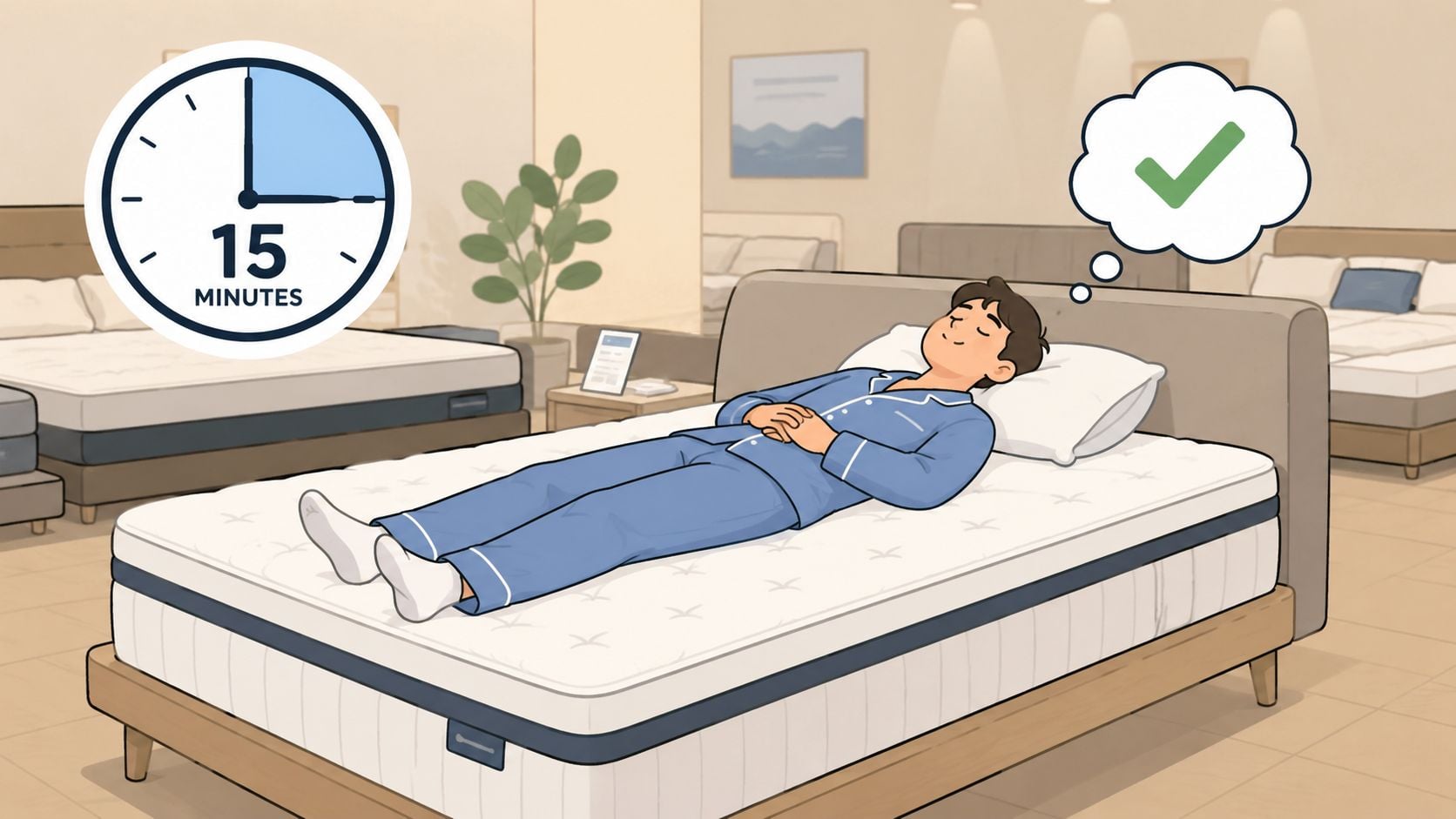
A useful mattress test moves past the first few seconds. In a showroom, remove shoes and lie in the normal sleep position for 10 to 15 minutes on each serious option. A hand press only measures the surface under a small area. A full-body test reveals whether the shoulder, hip, waist, and lower back are supported together.
A practical showroom routine
- Use the usual position: Start on the side, back, or stomach position used most often at home.
- Check pressure: Notice numbness, sharp contact, or the urge to shift away from the shoulder and hips.
- Check alignment: The spine should feel naturally supported rather than twisted or bowed.
- Test movement: Change positions without bracing against the mattress or feeling trapped by slow-response foam.
- Bring the partner into the test: Couples should lie down together and observe movement transfer and firmness preferences.
Testing several mattresses at a similar comfort level helps isolate construction differences. A medium foam bed may feel more enveloping than a medium hybrid, while a cushioned innerspring may feel easier to turn on.
The at-home trial needs consistent notes
At home, the mattress should be evaluated consistently before adding a new topper, pillow, or protector. Sleepers can record sleep quality, morning discomfort, temperature, and ease of movement in simple notes. The purpose isn't to create a laboratory study. It's to spot a pattern across normal nights.
A topper may soften a surface that feels too firm, but it won't necessarily correct a mattress that allows the hips to sink too far. Foundation support, room temperature, delivery setup, and the adjustment period can also affect early impressions. Retailer instructions should be followed carefully, including care and return requirements.
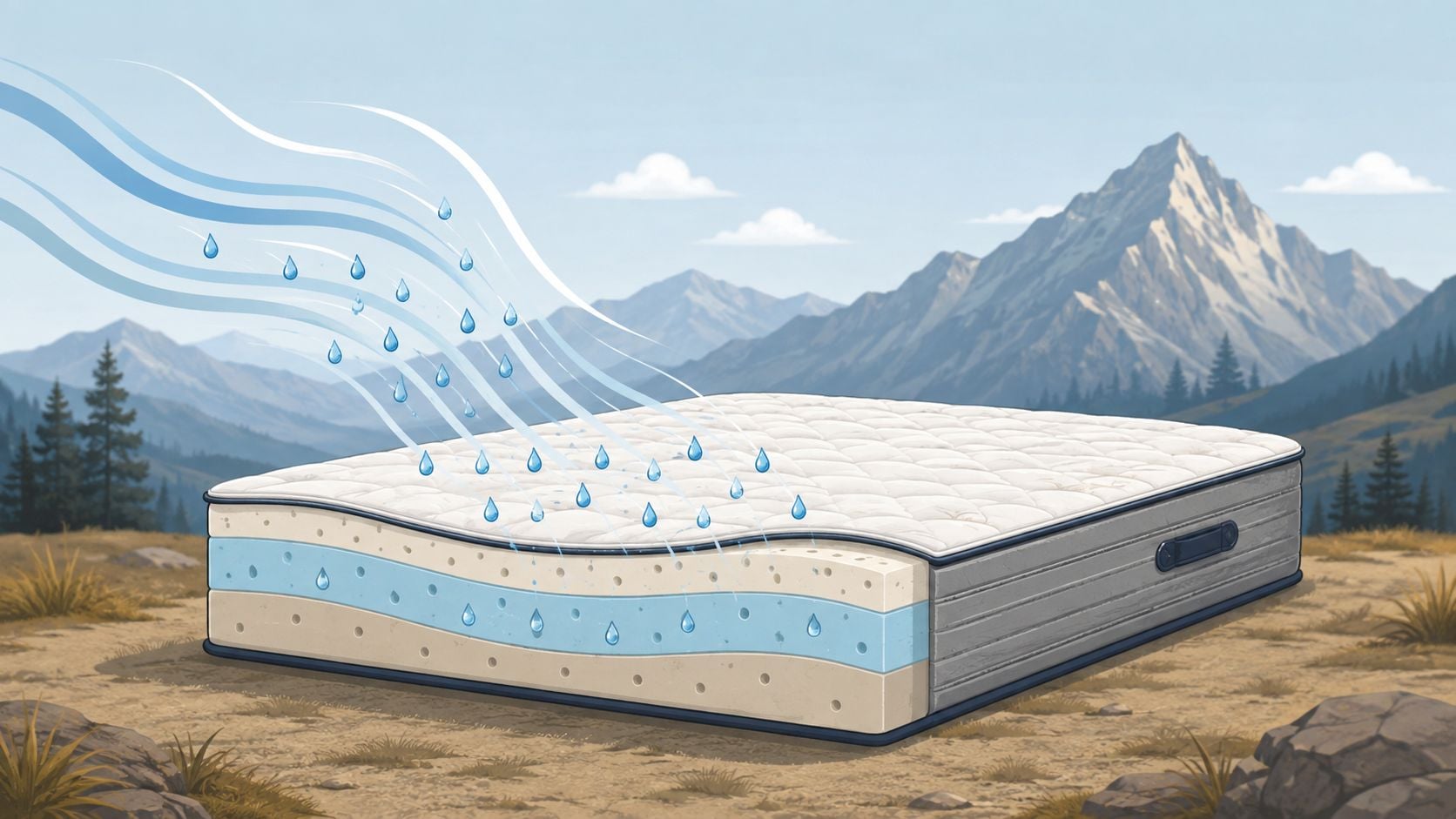
The guide to breaking in a new mattress can help set realistic expectations. The target isn't the plushest surface in the store. It's a stable combination of pressure relief, alignment, temperature comfort, and easy movement through a normal night.
Ruidoso Climate and Local Buying Considerations
Ruidoso's mountain setting makes temperature and airflow part of the mattress decision. The village sits at roughly 6,900 feet, and the dry mountain air can affect how sleepers perceive materials during the first nights at home. Lower humidity may also allow a new mattress to acclimate more readily than it would in a damp environment.
Temperature-sensitive foams can feel different as they warm under the body. A surface may seem firmer in a cool showroom and soften after body heat builds during the night. That change matters in Ruidoso, where cooler nighttime conditions can make the initial impression different from the feel at two in the morning.
Materials and setup matter locally
A Ruidoso shopper may want to compare:
- Breathable covers: These can help the surface feel less enclosed.
- Hybrid construction: Coil space may provide a more ventilated feel than dense, all-foam designs.
- Latex comfort layers: Latex tends to feel responsive rather than enveloping.
- Foundation airflow: Proper space beneath the mattress helps prevent a closed-in setup.
The right choice still depends on the sleeper. A person who sleeps cold may appreciate more cushioning, while a warm sleeper may prefer a responsive hybrid with less heat-retaining material. Alto and other Lincoln County communities can have different bedroom conditions, so the actual room where the mattress will be used deserves consideration.

Local guidance reduces guesswork because shoppers can discuss the room, the climate, and the delivery setup with people who serve the area. Mattress Pro by Miller Waldrop offers a Comfort Promise, a Low Price Promise, and Full-Service Delivery with Professional Setup, giving Ruidoso shoppers a practical path when the fear of choosing the wrong comfort level is the main obstacle.
Finding Your Comfort Level with Mattress Pro
A mattress purchase works better as a fit assessment than as a transaction. The Sleep Pros at Mattress Pro by Miller Waldrop can begin with the details that change mattress comfort level, including sleep position, body weight, shoulder or lower-back concerns, partner preferences, budget, and sensitivity to heat.
The conversation should lead to a short list rather than a showroom tour without direction. Two or three mattresses can give the sleeper meaningful contrasts, such as:
- Contouring versus responsiveness: A sleeper can compare slow-adapting foam with a quicker hybrid feel.
- Surface cushioning: Side sleepers can focus on shoulder and hip pressure.
- Deep support: Back and stomach sleepers can assess whether the hips remain stable.
- Shared comfort: Partners can test movement transfer and discuss whether different preferences require a compromise.
The Comfort Promise reduces the risk
The biggest concern for many shoppers is simple: what happens if the mattress feels wrong at home? The Comfort Promise is designed to reduce that fear by providing a defined trial period and an exchange path when the firmness doesn't fit. The exact trial length and exchange terms should be reviewed with the Sleep Pro before purchase, so the household understands the process clearly.
During the home trial, sleepers can keep brief notes, rotate through normal positions, and watch for recurring pressure or alignment issues. The no-pressure showroom test remains important because it gives the buyer a clear baseline before delivery.
Local service completes the decision
Full-Service Delivery with Professional Setup can include coordinating the mattress arrival, preparing the sleep space, and discussing available old-mattress removal. Scheduling can be arranged around the household's Ruidoso travel plans, subject to the store's current service terms.
The local sleep consultation is a practical next step. Shoppers can bring sleep notes, identify the position used most often, and ask for a comfort-level recommendation connected to a real return path. Mattress Pro also carries sleep systems from Tempur-Pedic, Sealy, Stearns & Foster, and Sherwood, allowing the consultation to focus on construction and fit rather than a single firmness label.
Visit Mattress Pro by Miller Waldrop at 2801 Sudderth Drive, Suite F, in Ruidoso to test mattress comfort levels with local Sleep Pros who can match construction to body type, sleep style, and climate. The showroom offers premium and budget-conscious options, the Low Price Promise, the Comfort Promise, and Full-Service Delivery with Professional Setup, so shoppers can make a confident decision close to home.