

Best Mattress for Back Pain Memory Foam: A 2026 Guide


You wake in Ruidoso with a stiff lower back, swing your legs toward the cold floor, and spend the first part of the morning moving carefully. If the mattress has begun sagging or feels hard in the wrong places, changing pillows or stretching may not solve the problem. The right medium-firm memory foam mattress can help balance spinal support with pressure relief, but memory foam isn't automatically the best choice for every sleeper.
The strongest recommendation is straightforward. Adults with nonspecific low back pain or morning stiffness should start by testing a medium-firm surface, not an ultra-soft or extra-firm bed. A major evidence review examined 47 studies and found medium-firm mattresses to be the most defensible general recommendation, while also noting that pressure distribution and sleep quality improved most consistently on medium-firm surfaces. The clinical review on mattresses and back pain also reported one randomized trial in which medium-firm sleepers had better outcomes than firm-mattress sleepers for pain in bed, pain on rising, and disability.
This guide connects that evidence to body type, sleeping position, heat management, and the dry mountain air around Ruidoso, Alto, and Lincoln County. It also explains why testing a bed at Mattress Pro by Miller Waldrop on Sudderth Drive can reveal more than choosing from a screen and hoping a boxed mattress works.
| Memory foam option | Main strength | Main concern | Best starting point |
|---|---|---|---|
| Traditional memory foam | Deep contouring and motion isolation | Can retain heat or feel slow to move on | Side sleepers needing pressure relief |
| Zoned or layered foam | Targeted support with varied cushioning | Feel depends heavily on layer design | Back sleepers with lumbar discomfort |
| Gel-infused foam | Pressure relief with added cooling measures | Cooling performance varies by construction | Warm sleepers who prefer foam |
| Memory foam hybrid | Foam comfort with coil responsiveness | More motion and a less enveloping feel | Combination sleepers and couples |
When Morning Back Pain Steals the Day
A worn coil mattress often announces its age through your body before it shows a visible defect. One morning, a sleeper in Ruidoso wakes with the pelvis lower than the shoulders, turns sideways to sit up, and takes a careful breath before standing. The same routine repeats because the bed feels familiar, even though familiar and supportive aren't the same thing.
Back pain can have many causes, so a mattress isn't a medical treatment. Still, an unsupportive sleep surface can leave the spine poorly positioned for hours and make pressure points more noticeable. The evidence favors a medium-firm feel for general nonspecific low back pain and morning stiffness, rather than assuming that the hardest mattress offers the most support. This guide to waking with back pain helps frame the difference between a temporary ache and a recurring sleep-related pattern.
What the right mattress should change
A suitable mattress should let the spine rest in a neutral position while keeping shoulders, hips, and the lumbar area from carrying concentrated pressure. Memory foam can do that well when the comfort layer contours without allowing the body to hammock into the bed.
A 2021 clinical report found that, after 28 days, back pain decreased by approximately 48% and sleep quality improved by 55% on the tested mattress systems. The published clinical evidence supports the practical point, mattress selection can produce measurable short-term changes in comfort and pain perception, although no mattress can explain or resolve every source of back pain.
The three decisions that matter locally
A Ruidoso shopper needs to answer three questions before choosing a foam bed:
- Does the surface keep the spine level? Medium-firm support is the sensible starting point.
- Does the foam relieve the painful areas? Side sleepers usually need more shoulder and hip accommodation than stomach sleepers.
- Can the bed manage warmth? Dry mountain air can feel cool outside while a contouring foam surface still feels warm under the body.
Testing in person also reduces the fear of choosing the wrong firmness. The Comfort Promise gives that decision a local safety net, while the Low Price Promise and full-service delivery keep the purchase grounded in practical service rather than a website checkout alone.
How Memory Foam Actually Eases a Sore Back
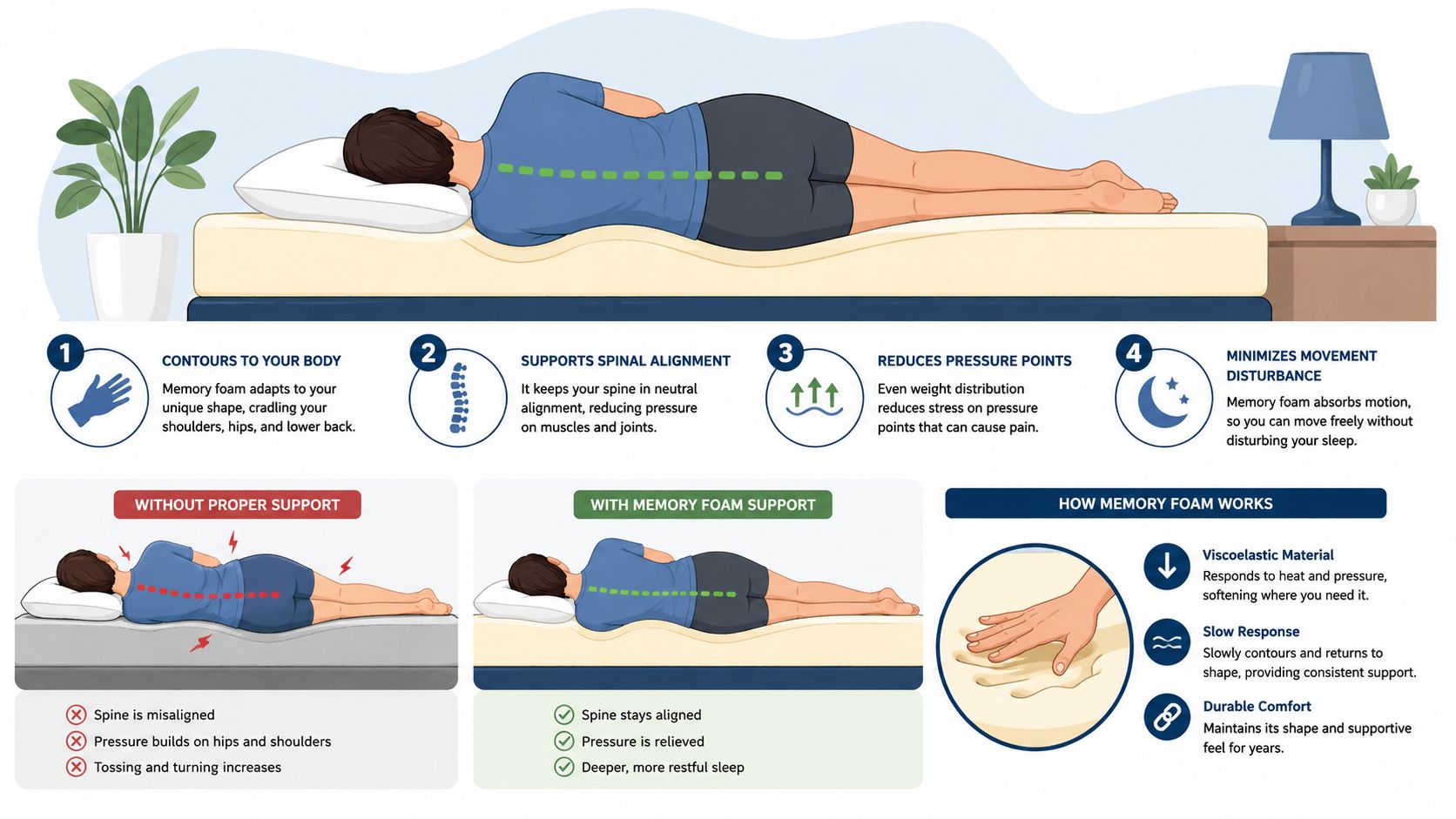
If you wake with a stiff lower back, the problem may be the way your mattress handles weight overnight. Support keeps the pelvis and rib cage from sinking out of line. Pressure relief spreads your weight across a wider area, so the shoulders, hips, and lumbar curve avoid concentrated strain.
Memory foam is viscoelastic. Body heat and pressure soften it, letting the material contour around you before it slowly moves back toward its original shape. That creates the familiar cradling feel. The support core still decides whether your spine remains aligned.
Support and pressure relief aren't interchangeable
A firm surface can stop your body from sinking while leaving empty space beneath the waist or pressing hard against the shoulder. A soft surface can feel pleasant at bedtime, then allow the pelvis to drop below the chest and pull the spine away from neutral.
Pressure relief is not just softness. It means keeping the body supported while reducing buildup around the shoulders, back, and hips. Memory foam does this by increasing the contact area between your body and the mattress, rather than forcing one joint or curve to carry the load.
For back pain, start with medium-firm memory foam. That feel usually gives the lumbar area enough resistance while allowing the shoulders and hips to settle. Your sleep position and body shape still decide how much contour you need. A heavier sleeper may need firmer underlying support, while a lighter side sleeper may need more surface give.
Why layered foam matters
A practical foam build usually includes:
- A responsive comfort layer, allowing the shoulder and hip to settle without bottoming out.
- A denser support layer, limiting excessive sinking beneath the pelvis.
- A stable foundation, keeping the mattress from flexing unevenly on its base.
A side sleeper with shoulder tenderness may prefer medium-firm foam over a firm spring surface because the foam cushions the shoulder without giving up support. A back sleeper generally needs a shallower contour. A combination sleeper needs quicker response so turning does not feel like climbing out of a hollow.
Memory foam also responds more slowly than latex or an innerspring surface. That slower reaction can reduce motion transfer, but it may briefly resist a position change. This plain-language guide to memory foam explains the material's body-contouring behavior in more detail.
Ruidoso's dry mountain air can feel cool while a contouring foam surface still holds warmth under your body. Test the mattress in the Mattress Pro showroom on Sudderth Drive, and ask for a medium-firm feel matched to your position and build.
Practical rule: A foam mattress supports your back only when its comfort layers and base work together. A soft top over a weak core can still leave the lower back unsupported.
Memory Foam Constructions Worth Comparing
Not every foam mattress produces the same result. The showroom comparison should focus on construction, not just the word “memory” on the label. Traditional foam, layered foam, cooling-infused foam, and foam-over-coil designs can all feel different beneath the same sleeper.
| Construction Type | Contour Depth | Heat Retention | Best For | Typical Lines Carried |
|---|---|---|---|---|
| Traditional single-density foam | Moderate to deep | Moderate to high | Side sleepers and couples wanting strong motion isolation | Entry Tempur-Pedic and Sealy foam models |
| Zoned or layered foam | Targeted and varied | Moderate | Back sleepers needing balanced lumbar support | Selected Sealy and Stearns & Foster constructions |
| High-density foam with gel-infused comfort layer | Moderate | Designed to manage warmth, though feel varies | Foam shoppers who sleep warm | Tempur-Pedic, Sealy, and Sherwood cooling-oriented lines |
| Memory foam over coils | Moderate, more responsive | Generally more airflow than all-foam | Combination sleepers and couples wanting easier movement | Stearns & Foster and Sherwood hybrid lines |
Traditional foam for deep pressure relief
Single-density memory foam gives the classic enveloping feel. It can suit a side sleeper whose shoulder or hip feels sore on a surface that doesn't yield enough, and it generally limits the sensation of a partner moving nearby.
The trade-off is movement speed. A sleeper who changes positions often may dislike the feeling of pushing through the foam. Traditional viscoelastic material can also retain more warmth than an open, spring-supported construction.
Layered and zoned foam for alignment
Layered beds use different foam responses across the mattress. The upper portion may cushion the shoulders, while firmer material underneath helps prevent the pelvis from sinking too far. Zoned designs apply a related idea by varying support across areas of the bed.
This approach is often a better starting point for chronic lumbar discomfort than a single soft slab. It gives the body contour where needed while keeping the middle of the mattress more stable.
Cooling foam and foam hybrids
Gel-infused comfort layers and breathable covers attempt to address the heat associated with traditional memory foam. They don't erase the basic fact that contouring foam surrounds more of the body, so warm sleepers should still test the actual bed rather than trust a feature name.
A hybrid places memory foam above coils. It provides pressure relief without the same deep sinking sensation and usually makes turning easier. This explanation of hybrid mattress construction can help shoppers decide whether coil responsiveness belongs in the final comparison.
Tempur-Pedic and Sealy may suit shoppers seeking an all-foam contour, while Stearns & Foster and Sherwood offer constructions worth testing when airflow, edge stability, or easier movement matters. The right line depends on the sleeper's posture and pressure pattern, not the brand name alone.
Matching Foam Density to Your Body and Sleep Position
Body weight changes how a sleeper engages the comfort layer. Sleep position changes where that engagement occurs. Those two variables matter more than choosing a mattress because the label says “firm” or “plush.”
Foam density and ILD ratings can provide useful technical clues, but showroom feel remains the final test. A lighter side sleeper may need more surface give to clear the shoulder, while a heavier back or stomach sleeper needs a stronger core to prevent the pelvis from dropping too far.
| Sleeper Profile | Comfort Density (PCF) | Comfort ILD | Support Core ILD | Best Feel |
|---|---|---|---|---|
| Side sleeper under 150 pounds | 3.5 or softer | 10 to 12 | Moderate | Cushioned medium-firm |
| Back or stomach sleeper over 200 pounds | 5 or higher | Above 14 | Firm | Stable medium-firm |
| Heavier back sleeper with disc concerns | Dense, durable foam | Moderate to firm | Strong support | Shallow contour |
| Petite combination sleeper | Mid-range | Middle response | Moderate | Responsive medium-firm |
Side sleepers need shoulder room
A side sleeper under 150 pounds often needs a comfort layer that gives readily around the shoulder and hip. A softer surface doesn't automatically mean poor support. If the base remains stable, the upper foam can provide needed contour without pulling the spine out of line.
For a sleeper around 180 pounds with lumbar stiffness, the safer starting point is medium-firm foam with enough shoulder accommodation to avoid a hard pressure ridge. The tester should spend time on the side, then roll onto the back before deciding.
Heavier sleepers need a dependable core
Back and stomach sleepers over 200 pounds generally need a denser support core and a firmer comfort response. A deep, slow contour can let the midsection sink too far, creating the hammock effect that causes discomfort rather than relief.
Heavier sleepers with lumbar disc issues should skip very deep contouring and test a medium-firm surface that responds more evenly. This isn't about choosing the hardest bed. It's about keeping the pelvis from becoming the lowest point.
The showroom alignment check
A simple test can expose an obvious mismatch. Lie in the usual position and slide a hand beneath the lower back. The hand should meet contact without a large open gap, while the shoulders and hips should feel supported rather than jammed upward.
Use the mattress comfort-level guide before the visit, then repeat the same test on each candidate bed. The rule is easy to remember: choose enough give for the widest pressure points, enough support to keep the waist and pelvis aligned, and no more softness than the body can control.
Why a Showroom Still Beats a Bed in a Box
A boxed mattress can offer a 120-night trial, yet a trial does not replace a proper fitting. Some online sellers require 30 nights before accepting a return, leaving the buyer to identify the problem without trained help. A showroom gives you useful answers before the mattress reaches your bedroom.
At the Mattress Pro showroom on Sudderth Drive, lie in your usual sleep position and stay there long enough to notice pressure, support, and movement. A trained sleep professional can spot a pelvis that drops, a shoulder that lacks room, or foam that makes turning difficult. You can also judge whether the bed feels secure or confining, details a product page cannot reveal.
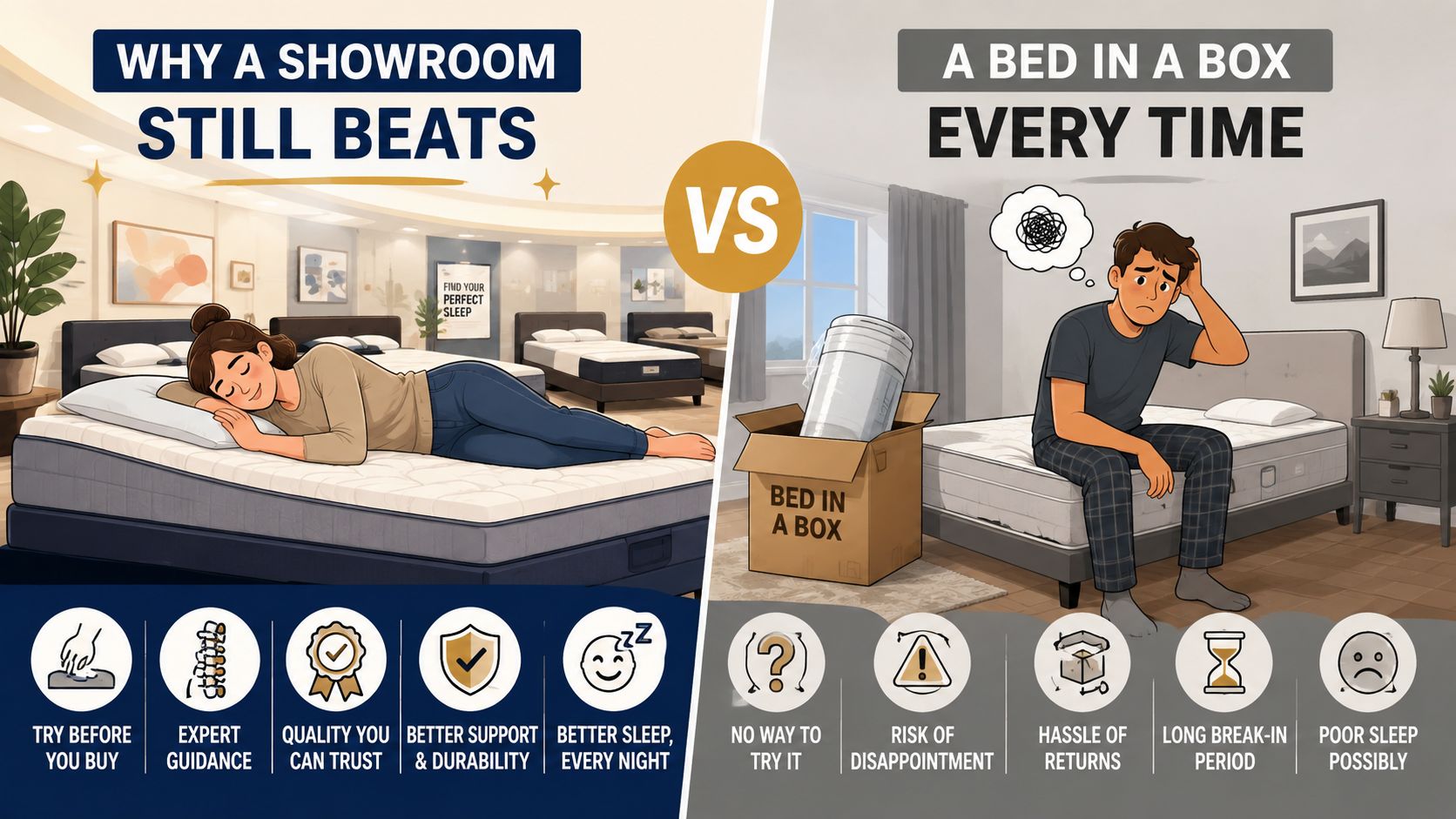
A local visit also lets you choose a local mattress store with in-person fitting instead of guessing from a screen. Bring the position that causes trouble, and test the mattress in that position first.
Ruidoso changes the cooling question
Ruidoso's dry mountain nights can feel crisp, but your body still warms the mattress. Memory foam may feel comfortable during a brief test and warmer later, because its contour surrounds more of you.
Mattress Pro by Miller Waldrop can place traditional foam, cooling-oriented foam, and hybrid surfaces side by side under the same showroom conditions. Shoppers from Alto, Capitan, and across Lincoln County can judge whether a cooling cover offsets the enveloping feel.
Use the trial window as confirmation
Choose firmness, contour depth, and movement response in person, then use the home trial to confirm that decision through ordinary nights. That is a far better process than beginning with a blind delivery and diagnosing the mismatch after weeks of discomfort.
Local buying advice: Spend a focused visit testing the position that causes pain, not merely the position that feels pleasant for a minute.
Durability, Heat, and the Honest Trade-Offs
Memory foam earns its reputation through contouring, but the same characteristic creates its main trade-offs. The material responds to heat and pressure, so it can feel therapeutic around sore joints while also feeling warmer and slower than a more elastic surface.
Recent research connects prolonged mattress use with worse low-back pain, which suggests that age-related sagging or lost support can matter as much as the original construction. The research on mattress use and low-back pain reinforces a practical buying lesson, shoppers should evaluate how a bed will hold its shape, not only how it feels on the first visit.
What changes over time
The first year should deliver the mattress's intended contour and pressure relief. By the seventh year, the comfort layer may show a visible impression, especially if the foam is less dense or the sleeper places repeated load in the same area.
The exact service life depends on construction, foundation, sleeper weight, use, and care. A denser core generally holds its support line longer than a low-density comfort stack, but even a well-built bed can soften gradually.
| Foam Type | Year 1 Contour | Year 7 Impression Depth | Heat Retention | Expected Lifespan |
|---|---|---|---|---|
| Traditional low-density foam | Noticeable contour | May show meaningful softening | Higher | Shorter than denser constructions |
| Dense all-foam design | Controlled contour | Usually better shape retention | Moderate | Longer with proper support |
| Gel-infused foam | Contouring with a cooler initial feel | Depends on foam density | Moderate, varies by cover | Construction-dependent |
| Memory foam hybrid | Moderate contour and quicker recovery | Coils help preserve responsiveness | Often easier airflow | Construction-dependent |
Three checks worth doing in the showroom
- Press the center: Hold a hand in the middle of the bed, release it, and watch how quickly the surface recovers.
- Test the corner: Fold a small corner enough to feel whether the material is springy, tacky, or slow to release.
- Ask about the cover: Breathable textiles and cooling treatments can change the experience, but the cover can't compensate for a poor support core.
For Ruidoso homes, heat management deserves the same attention as firmness. A shopper who loves deep contouring but sleeps warm may prefer a cooling foam design or a hybrid that allows more airflow.
What the Comfort Promise Covers
The Comfort Promise is designed to address the fear of choosing the wrong bed. A local process should make the decision clear before delivery and provide a defined path if the selected feel doesn't work at home.
The buyer begins with a firmness discussion and posture assessment on a showroom bed. A Sleep Pro can compare positions, note pressure areas, and record the selected comfort level before the mattress leaves the store.

What happens after the purchase
Mattress Pro by Miller Waldrop's local service model includes:
- Documented fitting: The selected firmness and comfort preference are recorded with the purchase.
- Full-Service Delivery: A professional crew brings in the mattress, sets up the foundation, and removes the old mattress.
- In-home evaluation: The buyer has a 90-night Comfort Promise window to determine whether the feel works in daily sleep.
- Comfort exchange: If the firmness misses the mark, the local team can arrange a comfort exchange under the promise terms.
The promise is meant to be explained by a real Ruidoso sleep professional, not hidden inside a call-center script. That matters when a buyer's body weight, sleeping position, or recovery needs change after the original fitting.
Know the boundaries
A local guarantee works best when its coverage is understood before signing. The stated Comfort Promise coverage includes foam indentation beyond 1.5 inches, zipper defects, and broken handles, while normal softening and stains fall outside the promise.
The available information doesn't establish average turnaround times for comfort exchanges or full defect claims, so buyers should ask for the current schedule at the time of purchase. The Low Price Promise addresses price confidence, while the Comfort Promise addresses comfort and specified product concerns. Those are separate protections, and both should appear clearly in the paperwork.
Choosing Your Best Match in Ruidoso
The best mattress for back pain memory foam shoppers usually begins with medium-firm support, then narrows through position, body weight, movement needs, and temperature preference. Specific model availability can change, so the showroom should confirm the current Tempur-Pedic, Sealy Posturepedic, Stearns & Foster, and Sherwood selection rather than relying on an old product list.
| Sleep Profile | Recommended Line | Firmness | Cooling Option | Price Band |
|---|---|---|---|---|
| 180-pound side sleeper with lumbar stiffness | Tempur-Pedic or Sealy Posturepedic foam construction | Medium-firm | Cooling-oriented cover if available | Ask showroom for current range |
| 220-pound back sleeper with disc concerns | Stearns & Foster or Sherwood supportive construction | Medium-firm to firmer response | Breathable cover or hybrid airflow | Ask showroom for current range |
| Combination sleeper with a 140-pound partner | Sherwood or Stearns & Foster memory foam hybrid | Medium-firm, responsive | Hybrid airflow or cooling cover | Ask showroom for current range |
The 180-pound side sleeper
This sleeper needs enough contour for the shoulder, but not so much that the waist collapses. A medium-firm Tempur-Pedic or Sealy Posturepedic construction is the sensible first test, with a cooling cover considered if the deep cradle feels warm during the visit.
The 220-pound back sleeper
This profile should prioritize a stable support core and a shallower contour. A Stearns & Foster or Sherwood construction with a medium-firm to firmer response can provide a more controlled feel, especially when disc concerns make deep sinking uncomfortable.
The couple with different needs
A combination sleeper paired with a lighter partner needs movement without sacrificing pressure relief. A responsive Sherwood or Stearns & Foster memory foam hybrid can be worth testing because the sleeper can turn more easily while the foam layer cushions contact points.
A boxed delivery may make sense for a second home near Alto or Capitan when convenience is the overriding concern, but it still carries the risk of choosing without a fitting. For a primary bed in Ruidoso, the local showroom visit, Comfort Promise, Low Price Promise, and Professional Setup provide a more complete buying process.
Stop by 2801 Sudderth Drive, Suite F, and lie on the calibrated beds for at least fifteen minutes in the positions used at home. The Sleep Pros can help narrow firmness and cooling choices without pressuring a buyer into a model that doesn't suit the body.
Mattress Pro by Miller Waldrop offers local mattress fitting, the Comfort Promise, the Low Price Promise, and Full-Service Delivery with Professional Setup for Ruidoso and Lincoln County sleepers. Visit Mattress Pro by Miller Waldrop to browse memory foam and hybrid options, then stop by the showroom on Sudderth Drive to test the support your back needs.