

Innerspring Mattress with Box Spring: Do You Need One?


An innerspring mattress does not automatically need a box spring. The right support depends on the specific mattress model, its manufacturer's requirements, and the foundation and bed frame beneath it. These three parts work like a connected system: a mismatch in any one can affect how the mattress is supported.
For Ruidoso homeowners and cabin owners, check the mattress specifications, measure the foundation, and inspect the frame before choosing a pairing. A firmness label or coil count alone cannot confirm compatibility. The tape measure is a practical starting point, alongside the manufacturer's support instructions and a careful look beneath the bed.
When an Innerspring Mattress Needs a Box Spring
A traditional flexible box spring is the default pairing for many innerspring mattresses, while the exact model determines whether another foundation is suitable. Some mattresses allow a rigid foundation or approved platform; others require a flexible base. Check the mattress's support instructions before choosing.
The manufacturer guidance on foundation compatibility explains why model-specific support requirements and warranty terms should guide the choice. A mattress label alone does not tell you whether the foundation and frame underneath it will work together.
Foundation Options and Compatibility With an Innerspring Mattress
| Support type | Works with innerspring? | What to verify | Typical risk |
|---|---|---|---|
| Traditional flexible box spring | Yes, a common pairing | Manufacturer-approved type and size, intact modules | Sagging when the box spring is worn |
| Rigid foundation or platform | Often, if the manufacturer lists it | Support spacing and surface flatness | Firmer feel, possible warranty conflict |
| Slatted platform bed | Sometimes | Slat gaps meet the model's maximum spacing | Gaps cause uneven support |
| Adjustable base | Only if the mattress is rated for it | Flex limits in the manufacturer documents | Coil fatigue or voided warranty |
| Bare or improvised frame | Only with an approved support surface | Flat, rigid, fully supported deck and required center support | Uneven support and faster sagging |
The name “box spring” can be misleading. Some products sold under that name are rigid foundations, and upholstery may conceal how they are built. Check the product label and construction details rather than judging by appearance.
For an older Ruidoso cabin or vacation rental, inspect the existing frame before reusing it. A replacement mattress may fit between the rails but still lack the support its manufacturer specifies. Compare the frame, foundation, and mattress requirements as one system.
Can an Innerspring Mattress Be Used Without a Foundation?
Use one without a foundation only if the manufacturer approves a platform or solid base that provides the required support. A bare floor is not automatically an approved substitute, and an open frame with wide gaps does not provide a complete support surface.
An unapproved setup may conflict with warranty terms. Adding a sheet of material or another base without checking the mattress requirements can leave the underlying support problem unresolved.
Practical rule: Check the exact mattress model's support requirements, then compare them with the foundation and frame.
The mattress support system guide can help identify the parts to check. Mattress Pro by Miller Waldrop offers personalized guidance to help customers choose a mattress and support setup.
How the Two Layers Share the Load
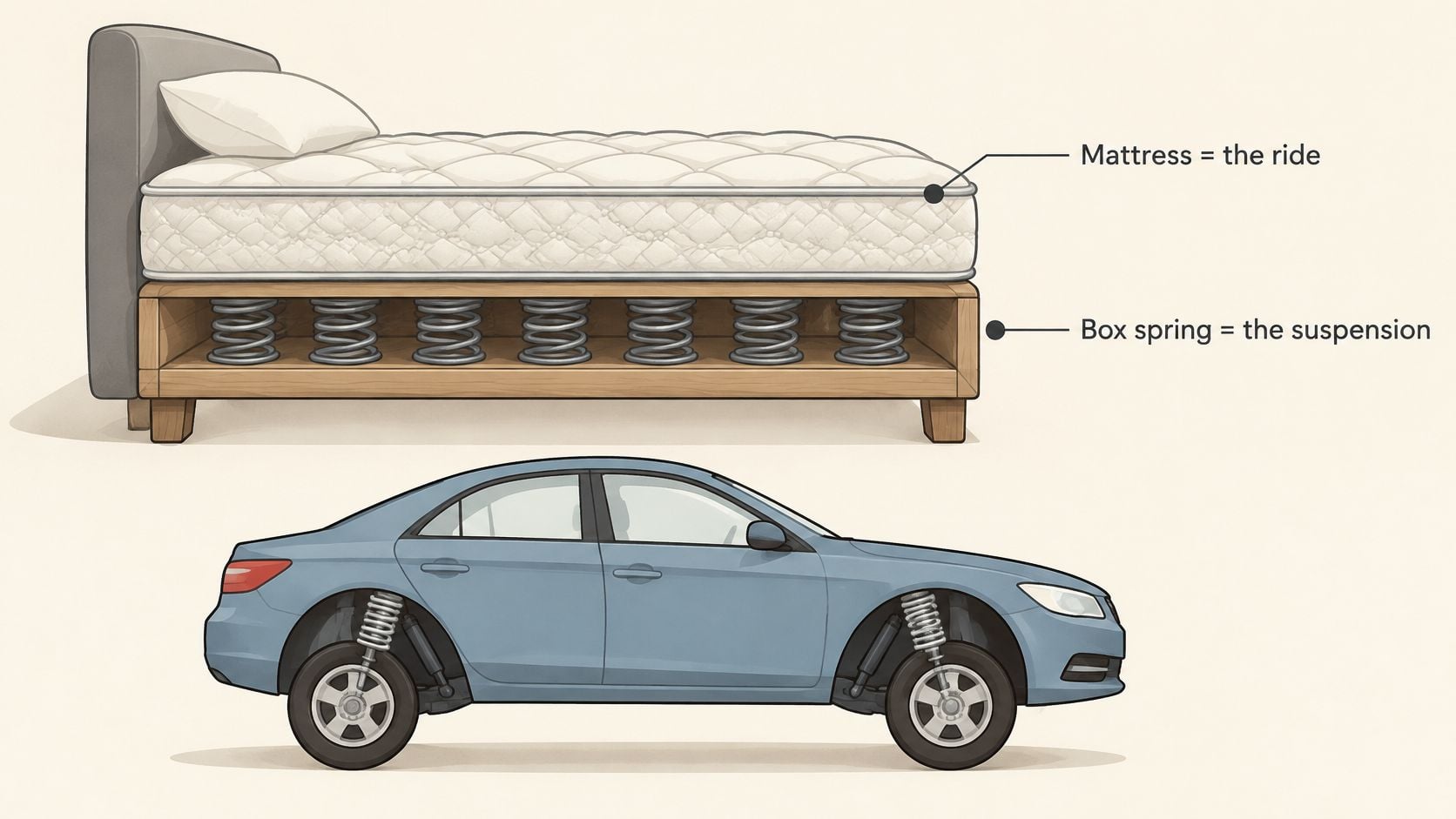
A mattress and its foundation share the work much like a car seat and suspension: the mattress meets the sleeper, while the layer beneath it supports the mattress and helps the setup feel steady. The amount of movement matters. A foundation that flexes should be suited to the mattress above it.
Different Jobs Within the Same System
The box-spring history and construction overview distinguishes the upholstered coil unit inside a mattress from the load-supporting foundation beneath it. Each layer has a specific role:
- The mattress supplies the sleep surface. Its upholstery and coils respond to the sleeper's shape and pressure.
- The foundation supports the mattress. It contributes stability, elevation and load distribution.
- The frame holds the assembly. It keeps the foundation in position and transfers the load toward the floor.
A traditional flexible box spring has a rigid perimeter or metal support structure, with internal springs or shock-absorbing modules. These components compress slightly under load, allowing a compatible mattress and foundation to respond together.
Why a Similar-Looking Base Can Feel Different
A shopper replacing an old innerspring mattress may keep the existing base. The new mattress feels comfortable in the showroom, yet at home the middle feels less stable because the old foundation yields unevenly. The support beneath the mattress has changed the feel of the whole setup.
A modern rigid foundation may have a fabric-covered exterior much like an older flexible box spring, but it responds differently under pressure. To assess compatibility, consider the mattress's weight and dimensions, its intended support pattern, and the manufacturer's specifications.
Choose the mattress, foundation and frame as a system. A base that looks right may still provide a different kind of support than the mattress is designed for. Check the product's construction description and support requirements, then compare them with the foundation and frame you plan to use. That practical check helps you judge the full pairing, rather than relying on appearance alone.
Center Support, Slats and Frame Checks
Mattress Size, Frame Needs and Center Support
| Size | Frame or foundation needs | Center support |
|---|---|---|
| Twin | Standard twin frame matched to actual mattress dimensions | Usually not required |
| Twin XL | Extra-length frame matched to the mattress | Usually not required |
| Full | Standard full frame | Check manufacturer; often recommended |
| Queen | Queen frame or foundation | Yes, must reach the floor |
| King | King foundation or approved two-piece set | Yes, must reach the floor |
| California King | California king frame | Yes, must reach the floor |
The size name is a starting point, not a substitute for measurement. The frame's usable support area, the foundation's actual dimensions and the mattress footprint all need to match.
The National Institute of Standards and Technology document on mattress foundations warns that a poorly matched foundation can reduce mattress performance and service life and may affect the complete set's fire performance. For queen and larger frames, center support should reach the floor; unsupported or flexible areas can concentrate bending forces and accelerate deformation.
A Home Inspection With a Tape Measure
A tape measure, flashlight and phone camera are enough to document most visible concerns. Removing bedding first makes the edges and support surfaces easier to inspect.
Locate the approved foundation requirements. Save the exact mattress model's support instructions, because similar-looking models may have different requirements.
Measure the frame. Record its outside dimensions and usable interior support dimensions, then compare those with the mattress and foundation rather than relying on the size label.
Inspect the center support. Confirm that required support legs contact the floor firmly, since a leg suspended above the floor isn't carrying the intended load.
Measure the clear gaps between slats. Compare the widest gap with the manufacturer's stated maximum, because unsupported spans can allow uneven deflection.
Press the foundation's corners and center. Look for broken components, loose connections or modules that remain compressed, which indicate uneven response under load.
Measure total bed height. Record the distance from the floor to the top of the mattress, because easy entry and exit matter as much as the support hidden underneath.
Check Fit, Not Just Strength
A frame can feel solid yet hold the foundation poorly. Look for a foundation resting partly off its support ledges, loose corner connections or a center leg standing on an unstable surface.
For older adults or guests with mobility concerns, test the finished height while sitting at the edge. Stable foot contact and an easy transition to standing are more useful than choosing a tall setup for appearance alone.
The mattress slats and support guide can help organize those observations before a showroom visit. Photos should show the frame without the mattress, the center supports and any damaged sections.
In Ruidoso cabins and rentals, the oldest frame component may be the first part that fails inspection. Frequent guest turnover makes a documented check especially useful before another mattress is placed on an inherited or improvised setup.
Firmness, Comfort and Sleep Position
A firmness label describes a feel, not a guarantee of good support. The right pairing depends on how the mattress, foundation and bed frame respond together when you lie down. The goal is balanced support that cushions pressure points while resisting excess midsection sinking.
A systematic review indexed by PubMed associated subjectively medium-firm mattresses with better comfort, sleep quality and spinal alignment than firmness extremes. It also found no single firmness that suits every sleeper. Use the label as a starting point, then assess your own comfort and alignment.
The Foundation Changes the Combined Feel
A flexible box spring adds an elastic layer beneath the mattress, much like a second spring in the system. A soft mattress on a highly flexible base may allow more overall sink than the same mattress on an approved rigid foundation. Flexibility can still feel comfortable; the key is whether the mattress and base together provide suitable resistance for your body and usual sleep position.
Sleep Position and the Right Foundation Pairing
| Sleeper position | What the mattress must do | Foundation to pair |
|---|---|---|
| Side sleeper | Allow shoulders and hips to settle enough to ease pressure | Approved flexible box spring with a medium-firm mattress, if alignment remains balanced |
| Back sleeper | Support the lumbar curve while limiting midsection sag | Approved firmer foundation or solid platform |
| Stomach sleeper | Resist sagging at the midsection | Approved firm, stable foundation |
| Combination sleeper | Balance conformity with resistance as positions change | Approved medium-response foundation; test the full set |
Treat these pairings as starting points, not substitutes for the mattress maker's requirements. Weight distribution and the mattress's comfort layers can change how the same foundation feels.
Pressure Relief Without Excess Sinking
Side sleepers need room for the shoulder and hip to settle while the waist remains supported. Back and stomach sleepers generally benefit from stronger resistance to excessive midsection displacement.
Memory foam conforms as its material compresses. A hybrid combines cushioning materials with coil support. In both, pressure relief comes from distributing contact comfortably, rather than merely making the surface softer.
A mattress that feels pleasant under a hand can still provide the wrong balance when the sleeper lies down.
Couples should lie down together in their usual positions and shift naturally. Check each partner's alignment separately, even if both prefer the same firmness description. At home, note whether shoulders and hips feel comfortable and whether the waist or midsection seems to sink excessively.
The mattress comfort level guide can help turn preferences into practical questions. For a meaningful comparison, test the intended mattress-and-foundation combination, since trying the mattress alone does not show how the complete pairing will feel.
How Long Innerspring and Box Spring Systems Last
Sleep Foundation's mattress lifespan guide estimates average lifespans of approximately 5.5 to 6.5 years for innerspring, 6 to 7 years for foam, 6.5 to 7.5 years for hybrids and 7.5 to 8.5 years for latex. These are category estimates, not expiration dates or guarantees for an individual mattress.
Expected Lifespan by Mattress Type
| Mattress type | Expected lifespan | Sagging resistance |
|---|---|---|
| Innerspring | 5.5 to 6.5 years | Poor to fair |
| Foam | 6 to 7 years | Not rated in the cited comparison |
| Hybrid | 6.5 to 7.5 years | Not rated in the cited comparison |
| Latex | 7.5 to 8.5 years | Not rated in the cited comparison |
The same assessment rates innerspring sagging resistance as poor to fair, while noting that innersprings generally resist premature softening and body impressions better than some foam designs. Those are different kinds of wear, so a bed can retain surface resilience yet develop an uneven overall shape.
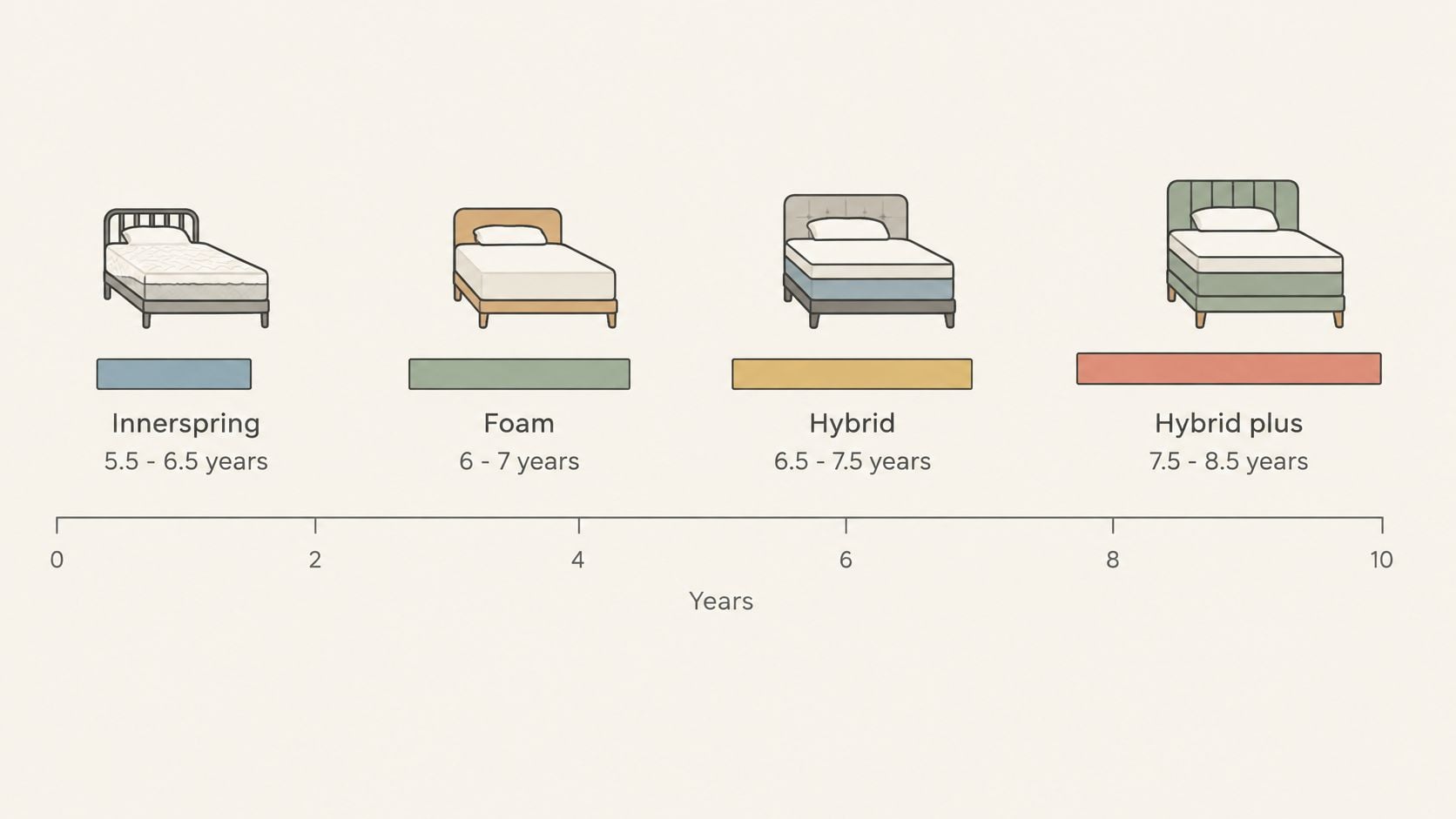
The category estimates in the table are the useful comparison, rather than any additional category labels in the illustration. They don't establish a separate replacement schedule for box springs.
When the Foundation Becomes the Weakest Layer
A newer mattress doesn't restore a worn foundation. The system can lose stability when the base underneath stops supporting it evenly.
- A dipping center suggests that part of the supporting structure isn't holding its shape.
- Creaking or shifting calls for inspection of connections and internal components.
- Cracked or loose slats leave the mattress without a dependable support surface.
- Modules that stay compressed indicate that the foundation isn't recovering normally after unloading.
Noise alone doesn't prove that replacement is necessary, but it identifies a place to investigate. A loose connection and a broken internal component require different responses.
The guide to how long a mattress should last helps place age alongside condition. Ruidoso's dry mountain air doesn't eliminate wear, and altitude alone doesn't establish a foundation's remaining life.
For seasonal cabins, the useful record is how the bed performs before and after occupancy. Guest use, moving the setup and unnoticed damage deserve attention even when the bedroom sits empty between stays.
When to Replace, Reuse or Recycle the Foundation
A foundation does not need replacing just because its mattress is being replaced. The key is whether it remains sound and compatible with the new mattress. Sleep Foundation's replacement guidance recommends replacing most mattresses about every 6 to 8 years, though lower-quality innersprings may sag sooner. Permanent dips, uneven support, new waking aches or consistently better sleep elsewhere are reasons to consider replacement sooner.
A Condition-Based Replacement Decision
- Replace both layers if both have failed or the base is incompatible. A worn mattress needs suitable support, but that does not always require buying a new foundation.
- Reuse a sound, approved foundation. Check its structure and confirm that it meets the replacement mattress model's requirements.
- Separate damaged or contaminated items. Photograph structural damage or signs of moisture, smoke or bedbugs, then disclose the condition to the removal service.
- Plan removal before delivery. Confirm access, accepted materials, recycling options and haul-away arrangements for the property.
Bedbug concerns need particular care. Do not donate a potentially contaminated foundation or place it in a standard recycling stream without the receiving service's approval and handling instructions.
For a cabin near Alto or elsewhere in Lincoln County, check driveway access, stairs, narrow turns and where the old bed will be moved. Planning an exit route helps prevent the replacement from arriving before the old setup can be safely removed.
Before pickup: Keep photographs, model labels and purchase documents together. Tell the removal service about damage rather than hiding it beneath a cover.
Disposal Is Part of the Purchase
The Mattress Recycling Council reported collecting 564,796 mattresses and box springs in 2025, up from 500,006 in 2024, according to Axiobench's industry statistics. This describes national program activity, not local availability, so confirm recycling arrangements where you live.
Use this mattress delivery and removal guide to organize questions about pickup and removal. Pickup or full-service delivery with professional assembly may be available, but confirm removal details separately rather than assuming they are included.
Mattresses come with warranties covering manufacturing defects, and each product lists its specific terms. Keep the purchase record and applicable warranty information together in case you need them later.
Confirm Your Mattress and Box Spring Pairing Before You Buy
A box spring that fits the frame may still be wrong for the mattress. Check the mattress requirements, foundation and bed frame as one system before you buy, then confirm the setup will suit your room.
A Short Pre-Purchase Path
- Bring the model requirements and measurements. Take frame dimensions, photos of the foundation and the total floor-to-mattress height. Compare them with the mattress maker's support requirements.
- Test the mattress in store. Mattress Pro by Miller Waldrop offers in-store testing and personalized guidance. A Sleep Pro can help match a mattress to your body type, sleep position and budget.
- Confirm the setup. Ask whether your existing foundation and frame are compatible with the selected mattress, and clarify delivery and assembly arrangements before purchase.
A quick home check helps: measure the frame's interior, photograph the foundation, and note any sagging or broken slats. These details make it easier to confirm that the pieces will work together, rather than choosing a box spring by appearance alone.
Local Help Beyond the Checkout
Mattress Pro by Miller Waldrop brings a 70-year family legacy to sleep health in Ruidoso and Lincoln County. Its Comfort Promise supports a comfortable sleep experience, while the Low Price Promise includes matching local competitors' prices. The store also offers a Rest Easy Guarantee; review its terms before buying.
For a final fit check, bring your measurements and mattress model details to the showroom. You can also ask how the foundation and frame should be set up for your chosen mattress.
Visit Mattress Pro by Miller Waldrop at 2801 Sudderth Drive in Ruidoso to test mattresses and get personalized guidance on your pairing.