


How to Make Memory Foam Mattress Firmer Without Buying New


You wake up in Ruidoso after another night of sinking too far into the bed. Your hips feel low, your back feels tired, and turning over takes more effort than it should. Before buying a new mattress, it helps to identify why the memory foam feels soft, because temperature, the foundation, and material fatigue can create a similar sensation for very different reasons.
The right fix might cost nothing tonight. Removing a plush topper, cooling the room, or testing the foundation can reduce sinkage without changing the mattress itself. A worn comfort layer or sagging support core, however, needs a more structural solution.
A Sleep Pro approach starts with diagnosis rather than a sales pitch. That matters in Ruidoso, where dry mountain air, cool nights, heated bedrooms, and seasonal temperature swings can change how foam responds. By the end, the reader should be able to decide whether the mattress needs a simple adjustment, a firmer surface layer, a stronger base, or a professional evaluation.
Introduction Why Your Memory Foam Feels Too Soft Right Now
A memory foam mattress can feel comfortable at bedtime and overly soft by morning. Body heat gradually makes the foam more compliant, so the surface may allow deeper contouring as the night progresses. A warm bedroom or heat-retaining bedding can make that sensation stronger.
The problem may also sit underneath the mattress. A bowed slat system, weak box spring, or uneven support can increase sinkage even when the foam itself remains in reasonable condition. That's why a mattress that feels fine on a rigid surface may feel noticeably softer on a flexible base.
Material fatigue creates a third possibility. Foam that has permanently softened or developed deep impressions won't regain its original support because the room is cooler. A guide to recognizing when a mattress is too soft can help distinguish normal contouring from problematic sagging.
A cause-first check
Before changing anything, note what happens during sleep:
- The bed feels firmer in a cool room: Temperature may be influencing the foam.
- The mattress feels better on a solid surface: The foundation may be contributing to softness.
- The same deep impression remains after the bed is empty: Material fatigue or structural damage deserves attention.
- The body feels pressured rather than supported: The mattress may be too firm in the wrong places, not too soft overall.
A quick fix can improve tonight's feel, but it won't repair fatigued foam. The useful question isn't only how to make memory foam mattress firmer. It's which part of the sleep system needs to change.
Understanding What Controls Firmness in Memory Foam
A mattress can feel soft for three different reasons: the foam is warming and yielding, the foundation is allowing extra flex, or the materials have permanently softened. Knowing which cause fits your bed prevents you from using a firming fix where structural attention is needed. For background, see this guide to what a memory foam mattress is and how its layers work.
Density is not the same as firmness
Density describes how much foam material is packed into a cubic foot. Firmness describes how strongly the foam resists indentation. They are related to performance, but they are not interchangeable. A dense foam may still feel soft, while a lower-density foam may feel firm if its indentation resistance is higher. This technical overview of memory foam density explains the distinction.
Memory foam is made across a broad density range, from under 1.5 lb/ft³ to about 8 lb/ft³, with many standard bedding foams around 3 to 4.5 lb/ft³. A 2026 research review reported that low-density comfort foams under 1.5 lb/ft³ can lose up to 58% of their load-bearing firmness by simulated year 4, while foams at 4.0+ lb/ft³ retained over 82% of initial support. These figures describe material durability, not the immediate feel of every mattress.
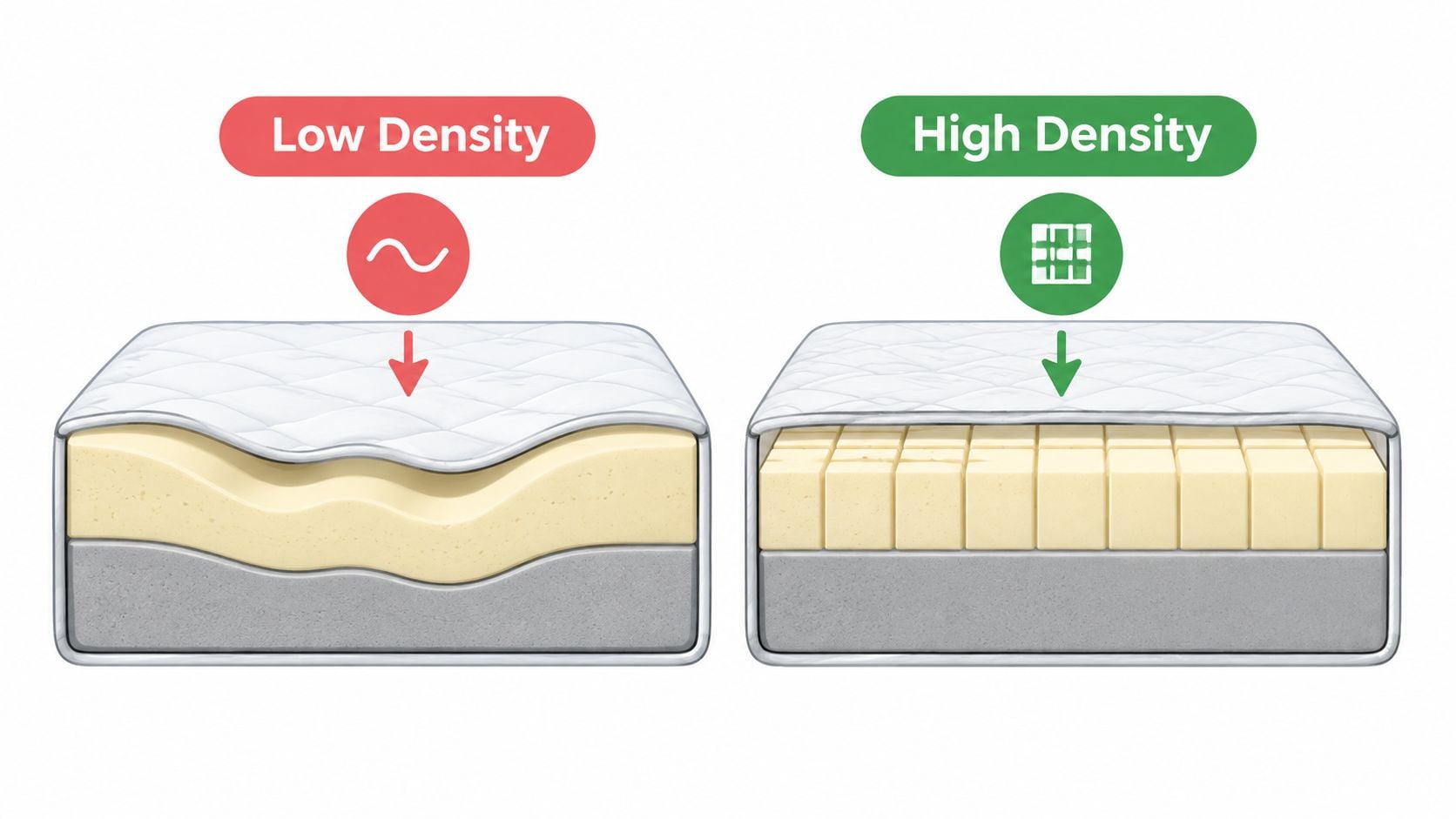
Important distinction: Density can support durability and resistance to progressive softening, but it does not automatically produce a firm surface.
Temperature changes the response
Memory foam was originally developed by NASA in the 1960s as a pressure-absorbing material before becoming a mattress material. Its viscosity-based behavior explains why room conditions matter. In cooler conditions, the foam generally feels firmer and recovers more slowly. In warmer conditions, it becomes more compliant and conforms more readily.
Modern gel-viscoelastic versions appeared in 2006 and gained popularity after major retail releases around 2011, as described in this memory foam mattress performance research. Many memory foam mattresses fall roughly between IFD 12 and IFD 16. Super-soft formulations can sit around IFD 10, while semi-rigid versions may be around IFD 12.
Support layers share the load
A firm feel usually comes from the whole layered design. The support core pushes back against body weight, while the comfort layer cushions pressure and controls how quickly you sink. Higher ILD or indentation values generally indicate greater resistance, but sleeping position and body shape still affect whether that resistance feels supportive or harsh.
A very firm surface can reduce sinkage while creating pressure at the shoulders and hips. Guidance on comfort layers and firmness supports choosing a balanced feel rather than making every layer harder. That distinction matters in a cool mountain climate, where temperature may change the foam's response from one night to the next.
Quick Ways to Make Your Mattress Feel Firmer Tonight
If your memory foam feels unusually soft tonight, start by identifying the cause. Extra warmth can make foam conform more readily, a flexible base can let the mattress bend, and a thick comfort layer can increase sinkage. Each cause needs a different adjustment. These checks work in a primary bedroom, a vacation cabin in Alto, or a guest room anywhere in Lincoln County.
Remove the plush layer
A thick, soft topper may be adding most of the sinking you notice. Remove it for one night, then sleep directly on the mattress with breathable sheets. If the surface feels more stable by morning, the topper is contributing more softness than the mattress core.
Use the same test with thick mattress pads, quilted protectors, and layered blankets. You are isolating the mattress's response, not trying to create a hard bed. Removing one layer at a time makes the result easier to interpret.
This memory foam topper guide offers further guidance on choosing or removing a surface layer.
Cool the sleep environment
A cooler bedroom can help memory foam respond with slightly more resistance. In Ruidoso, mountain air may lower the room temperature naturally, but keep the space comfortable and safe. The goal is a cooler sleep surface, not an uncomfortably cold room.
Try these adjustments:
- Ventilate before bed: Let warm air out when weather and security allow.
- Use breathable bedding: Choose lighter layers instead of thick, heat-retaining covers.
- Remove heated bedding: Heating pads and heated blankets can soften the surface response.
- Avoid direct heat: Keep hair dryers, space heaters, and other concentrated heat sources away from the foam.
Expect a modest overnight change. Cooling can reveal temperature-related softness, but it cannot restore foam that has permanently lost its shape.
Test the foundation
A rigid support surface can show whether the base is part of the problem. Check for bowed slats, uneven support, or spacing that exceeds the mattress manufacturer's requirements. Then compare the mattress on a properly rigid surface, while following all safety and warranty instructions.
A floor test can serve as a short diagnostic check. It should not become a permanent arrangement without considering ventilation, moisture, access, and manufacturer requirements. If the mattress feels firmer on the rigid surface, inspect the base before replacing the mattress.
Warranty terms matter here. Avoid drilling, modifying, or adding unapproved support materials until you know what the manufacturer allows.
Practical rule: Change one variable at a time. Otherwise, you cannot tell whether cooling, removing the topper, or correcting the base created the improvement.
Longer Term Solutions That Add Real Support
Start by identifying why the bed feels soft. Temperature-related softness responds to a cooler sleep surface, while foundation flex calls for better support underneath. A mattress with permanent impressions needs a different decision altogether.
If the mattress has only mild surface softness and no deep sagging, a firmer topper can adjust the feel without replacing the bed. A thinner layer makes a lighter change, while a thicker one creates a more noticeable shift. Review topper thickness guidance before choosing, and check that your fitted sheets can accommodate the added height.
Topper material matters too. Higher-density memory foam generally offers stronger support and durability than lower-density foam, but density alone does not determine how firm the bed will feel. Use the topper density guidance alongside your sleep position, pressure points, and the condition of the mattress below.
Compare the practical choices
| Solution | Best For | Firmness Impact | Watch Out For |
|---|---|---|---|
| Remove a plush topper | A bed softened by an added comfort layer | Immediate reduction in surface sinkage | May expose a mattress that was already too soft |
| Firmer topper | Slight softness with no deep sagging | Moderate surface change | Adds height and can affect sheets and edge feel |
| Correct the foundation | Flexing, bowed, or weak support underneath | More stable load sharing | Must meet mattress warranty requirements |
| New layered mattress | Permanent impressions or failed support | Structural change from surface to core | Requires careful firmness testing and budget planning |
A topper cannot rebuild foam that has permanently softened. It also cannot correct a damaged support core or a foundation that bends under the mattress. A consumer guide to mattress toppers explains the same practical limit: a topper changes comfort, not the mattress's underlying structure.
When replacement makes more sense
Replace the mattress when deep impressions remain after cooling and foundation checks, or when the support core no longer recovers. A new system can pair a firmer comfort layer with a stronger core and cooling features suited to your sleep position and climate.
Mattress Pro by Miller Waldrop offers sleep systems from Tempur-Pedic, Sealy, Stearns & Foster, and Sherwood. You can compare memory foam and hybrid constructions by pressure relief, spinal alignment, cooling gel technology, sleep position, and budget.
Match the base to the setting
A cabin in Alto may sit unused between visits, so ventilation and foundation condition deserve attention before you blame the mattress. In a Ruidoso bedroom, cooler bedding and dependable support can help the bed feel more consistent through changing seasons.
Use this memory foam mattress foundation guide to check whether your base suits the mattress. Full-Service Delivery with Professional Setup can also help ensure the chosen mattress and foundation are assembled correctly, reducing the chance that a support problem gets mistaken for a mattress problem.
Mistakes That Can Damage Your Mattress or Void Your Warranty
Some popular firmness hacks create more risk than relief. The safest approach is to make reversible changes first and check the manufacturer's warranty before modifying the support system.
Plywood isn't automatically a solution
A rigid board can help diagnose foundation flex, but placing plywood incorrectly may restrict ventilation, create uneven support, or conflict with warranty requirements. A properly designed foundation or bunkie board is safer when it's approved for the mattress.
Excessive heat can backfire
Heat makes memory foam more compliant, so a heated surface usually moves the bed in the softer direction. It can also expose the material to unnecessary stress. Cooling the room is the better experiment when the problem appears temperature-related.
Folding and flipping need caution
Most memory foam mattresses are designed with a specific top-to-bottom layer order. Folding, bending, or flipping a non-flippable mattress can damage the foam and alter support. Follow the care instructions instead of trying to force a different orientation.
Density still doesn't equal firmness
A dense mattress may last longer while retaining a soft comfort feel. Judge the bed by pressure relief, alignment, sinkage, and recovery rather than density alone.
Very firm isn't always healthier
A hard surface can increase pressure at the hips and shoulders and may reduce comfort for side sleepers. Medium-firm support can be a better direction for some sleepers, especially when back comfort is the concern.
Before adding boards, changing layers, or making permanent alterations, check the warranty terms and photograph any visible sagging. If the support core has failed, document the problem and contact the retailer or manufacturer rather than trying to repair it with improvised materials.
When to Stop Tweaking and Find Your Ideal Firmness Locally
Keep adjusting the current mattress when the softness changes with room temperature, disappears after removing a plush topper, or improves on a properly rigid foundation. Start looking for a different sleep system when deep impressions remain, support feels uneven, or discomfort continues after reasonable adjustments.
A simple home checklist can clarify the decision:
- Check the surface: Look for a lasting impression after the bed is empty.
- Check the base: Compare the mattress on approved rigid support.
- Check the body: Note whether the issue is pressure, sinking, or poor alignment.
- Check the pattern: Track whether the bed feels different in warm and cool conditions.
A local Sleep Pro consultation can take body type, sleep position, comfort preferences, and budget into account. Mattress Pro by Miller Waldrop serves Ruidoso, Alto, and Lincoln County with the Comfort Promise, the Low Price Promise, and Full-Service Delivery with Professional Setup, reducing the fear of choosing the wrong bed. A local sleep consultation also gives shoppers a chance to test firmness in person instead of guessing from a screen.
Mattress Pro by Miller Waldrop can help identify whether a firmer topper, stronger foundation, or new Tempur-Pedic, Sealy, Stearns & Foster, or Sherwood system fits the problem. Visit Mattress Pro by Miller Waldrop at 2801 Sudderth Drive, Suite F, in Ruidoso, Monday through Saturday, or browse online and take the next step toward waking up loving your mornings.