

Mattress Sizes in Inches: Complete 2026 Guide

You can be standing in a doorway with a tape measure in one hand, a room sketch in the other, and still feel unsure whether a Queen will clear the hall, fit the cabin bedroom, and leave enough space to walk around the bed. That moment is exactly why mattress sizes in inches matter more than the label on the tag. The inch dimensions tell the truth about fit, comfort, accessories, and delivery, which is why a calm measurement check beats guessing every time.
Why Mattress Sizes in Inches Matter More Than Names
A mattress name sounds simple. Twin, Queen, and King feel familiar, but the name alone doesn't tell you whether the bed will fit the room, the frame, or the sheets already in the linen closet. The decision starts with inches, because a mattress is only as useful as the space it occupies.
That matters even more in a mountain home, cabin, or guest room where doorways can be tight and every inch of floor space feels earned. A mattress labeled the same size can vary slightly by maker, and those small differences can decide whether a setup goes smoothly or turns into a delivery headache.
Practical rule: measure the room, then measure the path into it, then measure the mattress spec sheet. In that order, not the other way around.
For local shoppers in Ruidoso, Sudderth Drive, Alto, and Lincoln County, a local showroom helps. The right mattress isn't just a sleep decision, it's a fit decision, and a family-owned store like Mattress Pro by Miller Waldrop can talk through those inches with the kind of patience a bed-in-a-box site can't match, especially when a bedroom also has a TV stand to work around, as seen in the 60-inch TV stand guide.
The goal here is simple. By the end, the size labels should feel less like marketing names and more like a map of width, length, room clearance, and accessory fit.
The Standard Mattress Size System at a Glance
The standard U.S. mattress-size system is built on a fixed family of dimensions that shoppers compare again and again, whether they're furnishing a bedroom, guest room, or vacation rental. The core sizes are Twin 39 x 75 inches, Twin XL 39 x 80 inches, Full 54 x 75 inches, Queen 60 x 80 inches, King 76 x 80 inches, and California King 72 x 84 inches. Those baseline measurements are the starting point for nearly every buying decision in the market, and they're widely reported across neutral size guides, including the standard set summarized by HowStuffWorks.
| Standard U.S. Mattress Sizes in Inches | |||
|---|---|---|---|
| Size | Width (in) | Length (in) | Best Fit |
| Twin | 39 | 75 | Children, bunk beds, tight rooms |
| Twin XL | 39 | 80 | Taller solo sleepers, dorm-style rooms |
| Full | 54 | 75 | Solo sleepers who want more room |
| Queen | 60 | 80 | Couples, primary bedrooms, guest rooms |
| King | 76 | 80 | Couples who want extra width |
| California King | 72 | 84 | Tall sleepers, long rooms |
How the sizes relate to one another
The easiest way to read this system is by comparing what changes and what stays the same. Queen and King are both 80 inches long, so the jump is width. King adds 16 inches of width over Queen, while California King trades 4 inches of width for 4 extra inches of length compared with a standard King, which is the kind of geometry that matters for room shape and bedding fit, as noted in the standard comparisons from NCOA.
That's why the chart works best as a family tree, not a list to memorize. If a room is cramped but long, California King can make more sense than a wider King. If the room is square and shared, Queen and King solve different problems even though both sound like “upgrade” sizes.
The size label only becomes useful when the inches tell the story.
How Width and Length Translate Into Real Sleep Space
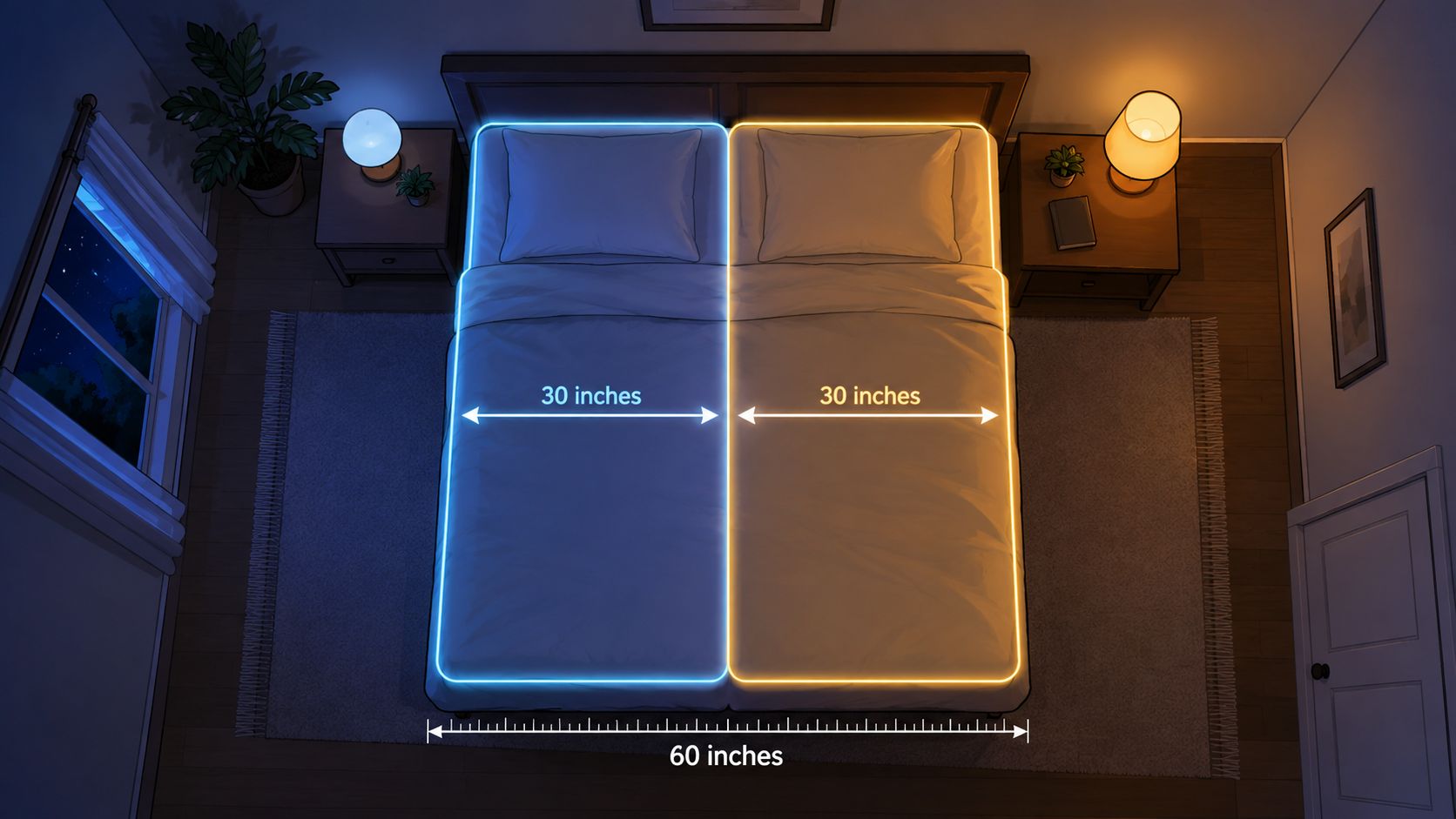
A mattress doesn't feel bigger because of the name on the tag. It feels bigger because of the inches under your body, especially when two sleepers, a pet, or a restless partner share the surface. A Queen gives 60 inches of width, which means two adults split that space into about 30 inches each. A King gives 76 inches of width, so each sleeper gets about 38 inches, which is a meaningful difference when elbows, knees, and blanket fights enter the picture.
Why the extra width changes the night
That width change is not just abstract math. The NCOA notes that a King provides 1,216 square inches of sleep surface versus 960 for a Queen, a 26.7% increase that helps explain why larger sizes dominate when room and budget allow (NCOA). More surface area means more breathing room, more room for movement, and fewer midnight nudges when one person rolls over.
A wider bed doesn't fix every sleep problem, but it often reduces the little interruptions that make a night feel broken.
Length matters just as much. Twin and Full are both 75 inches long, while Queen and King are 80 inches long. For taller sleepers, those extra inches decide whether feet drift toward the edge or stay supported through the night. In a mountain home where layers, blankets, and thick pillows already take up room, the difference between 75 and 80 inches can feel bigger than it looks on paper.
A practical rule helps here. If the bed is for two people, width usually becomes the first comfort question. If it's for one tall sleeper, length usually wins.
Specialty and RV Mattress Sizes Explained
Standard sizes cover most bedrooms, but they leave out a lot of real-world sleeping spaces. Cabins, RVs, custom frames, and adjustable bases often need dimensions that don't fit the usual six-size lineup. That's where specialty measurements matter, because the wrong length or width changes sheet fit, encasement fit, and whether the mattress even clears the space it's meant to occupy.
The dimensions that solve unusual spaces
A few nonstandard sizes show up often enough to matter:
- Full XL, 54 x 80 inches, adds length without changing width.
- Olympic Queen, 66 x 80 inches, widens the bed for a room that can handle more surface.
- Split King, 78 x 80 inches, uses two 39 x 80 inch mattresses so each side can move independently.
- Short Queen, 60 x 75 inches, trims length for RV bedrooms and slide-outs.
- RV and short-format mattresses are especially useful when cabinetry, wheel wells, or narrow sleep bays cut into the available footprint.
These aren't cosmetic changes. They alter the usable sleep area and the accessory fit around the bed. A short queen can solve the classic RV problem where a standard queen is just too long for the space, while split configurations make sense when one side of the bed needs to move differently from the other.
For buyers comparing bedroom setups against travel or cabin spaces, the details matter enough to verify before ordering. A helpful place to start is the local guide to the RV mattress queen size options, especially if a vacation rental or mountain trailer needs a bed that fits the frame instead of forcing the frame to adapt to the bed.
If a mattress size is unusual, measure the finished opening, not the label on the old mattress. That one habit prevents most accessory surprises.
Measuring Your Room, Doorway, and Bed Frame
A mattress can be the right size on paper and still fail in the hallway. That's why the smartest shoppers measure the path into the bedroom before they measure the bedroom itself. In older Ruidoso and Alto cabins, narrow doors and tight corners are common enough that a King may need a careful route, or even partial disassembly, to get to the final room.
A five-step check before delivery
- Measure the doorway opening. Record both width and height, then check the mattress against the smaller number.
- Measure hallway turns. A straight hallway is easier than a tight pivot, so corners matter.
- Check stairway or elevator openings. Even if the bedroom is roomy, the access path may not be.
- Measure the bedroom footprint. Confirm bed length, width, and the walking space you want left over.
- Measure the bed frame and headboard area. Include clearance for foundations, footboards, and anything that sits above the mattress line.
Delivery rule: whoever measures last should be the person who isn't moving the mattress.
That rule sounds simple because it is. Delivery problems usually happen when one person assumes the old bed's path will work for the new one, even though a different size, base, or headboard changes the angle. For buyers who want help with in-home handling, white-glove service can remove the guesswork, and the practical setup details are outlined in the local white-glove delivery guide.
The bedroom itself needs breathing room too. A King can feel perfect in a wide room and overwhelming in a narrow one. If the bed dominates the space, the room starts working against sleep instead of supporting it.
Choosing the Right Size for Couples, Cabins, and Rentals
The best size is the one that fits the way the room gets used. A couple in a small master bedroom usually lands on Queen 60 x 80 inches because it balances shared comfort with practical floor space. A guest room that doubles as a home office often works better with Full 54 x 75 inches, or even Twin XL 38 x 80 inches if the room is especially tight.
Matching size to the space
- Couples in a standard primary bedroom: Queen is usually the cleanest fit when the room can't comfortably hold a bigger frame.
- Tall sleepers: California King's 84-inch length gives more legroom, which matters when feet keep reaching for the edge.
- Vacation rentals in Ruidoso or Alto: Queen is often the safest expectation because guests tend to know that size well and sheets are easy to source.
- Pet households: Moving from Full to Queen can create the extra sleep surface a dog or cat tends to claim without making the bed feel cramped.
- Cabins with narrow layouts: Full or Twin XL can keep a room open while still giving guests a real bed, not a squeezed-in compromise.
The details behind those choices are available in the local size guide linked from when to choose a king or a queen mattress. That kind of room-by-room thinking matters because cabins, rentals, and mountain homes don't follow suburban bedroom rules.
A useful shortcut is this. If the room is shared, width matters first. If the sleeper is tall, length matters first. If the room serves multiple jobs, footprint matters first.
Fitted Sheets, Foundations, and Accessory Fit
A mattress can fit the room and still fail in the details. The first place that shows up is usually the fitted sheet, then the foundation, then the frame height at the headboard. If the inches are off anywhere in that chain, the bed may look finished from across the room but feel improvised up close.
Why accessories depend on inches too
Fitted-sheet pockets usually run 7 to 14 inches, while thicker pillow-top and luxury builds often need deep-pocket sheets. That matters for higher-profile beds, including models from Tempur-Pedic and Stearns & Foster, because a mattress can be comfortable and still feel messy if the corners keep slipping free.
Foundation height changes how the whole setup sits in the room. A traditional box spring adds more height than a low-profile foundation, and adjustable bases raise the sleep surface in a different way while also needing motor clearance. Split configurations and moving bases need room under the headboard brackets too, so the right answer is often decided before delivery day, not after it.
If you want a clear side-by-side explanation of the support choices, box spring vs foundation is worth reading before you buy.
If the mattress feels perfect but the sheets fight it, the total setup is wrong, not the mattress alone.
A local showroom can sort those inches before anyone brings home the wrong combination. That matters in a place like Ruidoso, where dry mountain air and cooling comfort needs often push shoppers toward more specialized sleep systems, and where cabin guest rooms, short-queen RV spaces, and mountain-home doorways all put real limits on what fits cleanly. Mattress Pro by Miller Waldrop can help in person with size, fit, and setup, then back that with the store's Comfort Promise and Full-Service Delivery with Professional Setup.
Mattress Thickness, Tolerances, and Real-World Fit
Size charts make mattresses sound exact, but finished products can land slightly under the nominal number and still be sold under the standard size label. That's why a Queen can sometimes feel a little snug inside a fitted sheet even when the label says 60 x 80. The inches on the chart are the category, not always the final finished edge.
Why height matters as much as footprint
Mattress height is often left off size charts, even though it affects headboard alignment, sheet stretch, and ceiling clearance. A taller profile can look luxurious, but it also changes how far the sleeper sits from the floor and how much room remains under a low ceiling fan. In a mountain home, that visual height can matter as much as the width.
Higher-elevation homes in Lincoln County also benefit from checking bed-frame support carefully. Dry air and a taller mattress profile can make a weak center support more obvious over time, so the frame needs to be solid before the mattress goes in. That's especially true when the build uses foam-heavy layers or a substantial hybrid construction.
Measure twice, then verify the exact finished dimensions of the specific model you're buying. After that, measure the access path again. That sequence protects against the kind of fit problem that only shows up on delivery day.
Putting It All Together With Local Help
A good mattress-size decision comes down to three questions. Will it clear the door? Will it fit the room? Will it fit the sleeper? If those answers line up, the purchase usually feels calmer and more confident.
That's where local guidance matters. In Ruidoso, the showroom at 2801 Sudderth Drive, Suite F can help shoppers compare the inch dimensions, talk through room fit, and use the Comfort Promise to take the fear out of choosing the wrong bed. The Low Price Promise keeps the budget side honest, and Full-Service Delivery with Professional Setup handles the heavy lifting that bed-in-a-box shopping leaves to the customer.
The family-owned 70-year Miller Waldrop legacy shows up in the details, not in big speeches. A local team knows the difference between a room that feels spacious on paper and one that works once the bed is inside, the lamps are back in place, and the walkway still needs to stay open.
Quick Answers to Common Mattress Sizing Questions
What if the mattress is too tall for my sheets?
Choose sheets with a deeper pocket so the corners stay secure. Height matters just as much as width and length, especially on thicker foam and hybrid models.
Does a modern foam or hybrid bed still need a box spring?
Not always. Many setups work better with a foundation or adjustable base, but the right support depends on the mattress design and the frame underneath it.
How do Twin and Twin XL fit bunk beds or loft spaces?
Twin is the shorter standard option at 75 inches, while Twin XL adds length at 80 inches without adding width. That extra length is useful when a bunk or loft needs more legroom.
Does a split-king adjustable setup feel like one bed?
It can feel like one shared sleep surface, but each side still moves independently. That makes it a strong choice when two sleepers want different positions or different lift settings.
Ready to transform your sleep? Visit our Sleep Pros at the Mattress Pro showroom located at 2801 Sudderth Drive, Suite F, in Ruidoso. From luxury brands to budget-friendly solutions, we're here to help you wake up loving your mornings. Browse our collection online at Mattress Pro by Miller Waldrop or stop by Monday through Saturday.